AI visibility is how often, and how favourably, your business shows up when someone asks ChatGPT, Google AI Overviews, Perplexity, or Gemini for a recommendation. It matters because a growing share of customers now get their answer directly from the AI tool, without ever clicking through to a website. If your business is not part of that answer, you are not in the running, and you may never know it happened.
A Simple Way to Think About It
The Library Card Catalogue vs The Librarian’s Recommendation
📇 Being in the catalogue
Your book sits on the shelf, correctly indexed, waiting for someone to walk down that specific aisle and pull it out themselves.
🗣️ Being the librarian’s answer
Someone walks up and asks the librarian directly, and she hands them your book by name before they’ve even reached the shelf.
Traditional SEO gets you correctly shelved. AI visibility gets you handed to the customer. Both still matter, and the section below explains why Malaysian SMEs need to track them separately.
Why AI Visibility Matters for Malaysian SMEs Right Now
AI-generated summaries change what happens after someone searches. Pew Research Center found that users clicked through to a website in just 8% of visits where an AI summary appeared, compared with 15% when no summary was shown. In 26% of visits with an AI summary present, the user ended the session immediately after reading it, versus 16% when there was no summary. AI summaries showed up in 18% of the searches Pew studied, and that share is only going in one direction.
Gartner has projected that traditional search engine volume could fall by 25% by 2026 as more queries get handled by AI chatbots and virtual agents instead of a list of blue links. For a Malaysian SME, that is not an abstract trend. Malaysia closed 2025 with 35.4 million internet users and 98.0% internet penetration, and separately recorded 30.7 million social media identities, roughly 85% of the population. That is an enormous, digitally fluent audience, and a growing slice of them are asking an AI assistant before they ever open Google.
A business that ranks well on Google but never gets mentioned by ChatGPT or an AI Overview is now invisible during the exact moment a buyer is narrowing down their options.
AI Visibility vs Traditional SEO: What Actually Differs
SEO and AI visibility are built on the same foundation, credible, well-structured content, but they reward slightly different signals and get measured differently. Here is the practical breakdown.
| Factor | Traditional SEO | AI Visibility |
|---|---|---|
| Success metric | Ranking position, 1 to 10 | Mentioned or not mentioned |
| Primary output | A list of links | One synthesised answer |
| Content signal | Keyword relevance | Clear structure, citations, freshness |
| Platforms to monitor | Google, Bing | ChatGPT, Perplexity, Google AI Overviews, Gemini |
| Update cycle | Monthly crawl cycles | Near real-time retrieval |
Note the overlap: a website that ranks poorly in Google rarely gets cited in an AI answer either. AI visibility sits on top of solid SEO, it does not replace it.
How to Measure Your AI Visibility: A 5-Step DIY Check
You do not need paid software to get a first read on where you stand. This takes about an hour.
1. List 10 to 15 real customer questions
Use the exact phrases a customer would type or say, not marketing language. Think “best digital marketing agency in Kuala Lumpur” or “affordable SEO services for small business Malaysia,” not your tagline.
2. Run each question through ChatGPT, Perplexity, and Google AI Overviews
Note whether your brand appears, where it appears in the answer, and how it is described.
3. Score sentiment for every mention
Mark each result positive, neutral, or negative, then check the same prompts against your three closest competitors.
4. Repeat weekly
AI answers shift often. A single check only tells you what was true at that moment, not what is typical.
5. Track citation sources
Note which pages the AI model pulls from when it does mention you, or your competitors. Those are the pages the model currently trusts, and they tell you what “earning a citation” actually looks like in your industry.
How to Improve AI Visibility in 2026
Six actions consistently move the needle for Malaysian SMEs this year.
Answer the question in the first two sentences
AI models extract direct answers. A long introduction before you get to the point just gets skipped over.
Structure content with clear headings, FAQs, and comparison tables
Machines parse organised content far more reliably than dense paragraphs. If a human has to hunt for the answer, so does the model.
Publish original data and named proof points
Generic claims rarely earn a citation. Specific numbers, named services, and real outcomes do.
Update cornerstone pages every two to three months
Freshness carries real weight in retrieval-based AI systems, more than it typically does for a standard Google crawl.
Earn third-party mentions
Guest features, press coverage, and relevant directory listings strengthen the external signals AI models use to verify who you actually are. This overlaps heavily with strong local SEO practice.
Add schema markup for Article, FAQ, and Organisation types
Structured data helps AI systems understand what your content is and who published it, which is exactly the kind of signal that separates a citation from a scrape.
How Newnormz Approaches AI Visibility for Malaysian SMEs
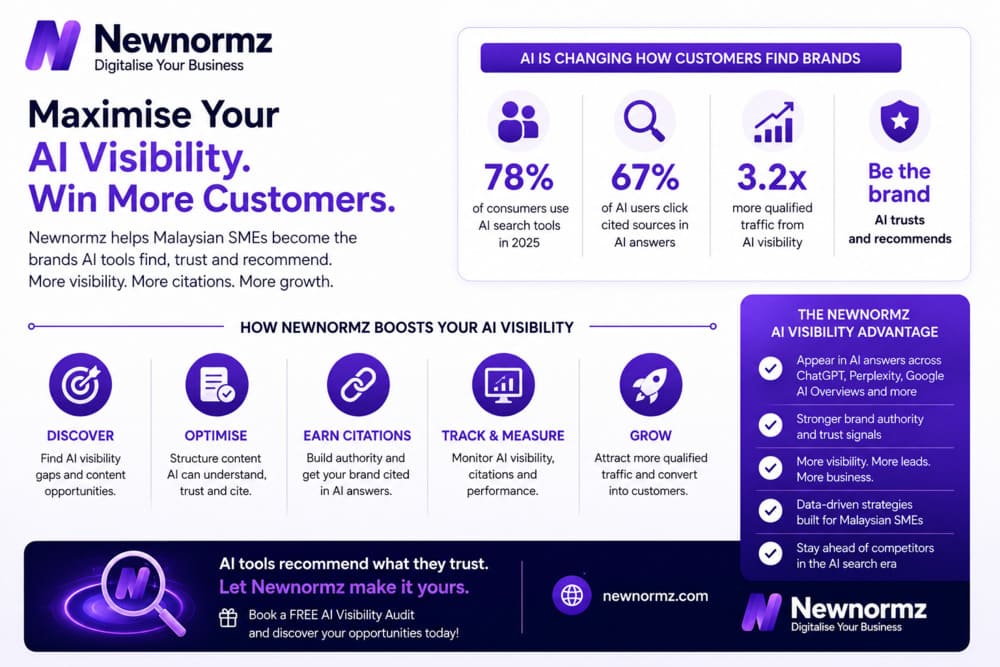
Plenty of Malaysian SMEs already run paid ads and social campaigns, yet a competitor still shows up first when a customer asks an AI tool directly. Newnormz’s free audit reviews technical SEO, content structure, schema markup, and citation visibility across ChatGPT, Perplexity, and Google AI Overviews in one pass, so you see exactly where the gap is instead of guessing.
From there, Newnormz builds clear, well-structured pages designed to be understood by both Google and AI platforms, and reports monthly on how that visibility is actually changing, not just how rankings are moving.
Wondering if ChatGPT even knows your business exists?
Find Out Where You Stand in AI Search Before Your Competitor Gets There First
Newnormz has run SEO campaigns across F&B, healthcare, ecommerce, and local services in Malaysia, backed by a performance guarantee of 70 percent of targeted keywords on Google’s first page.
30 minutes, no obligation, includes a baseline AI visibility check.
Frequently Asked Questions About AI Visibility
Why does my competitor show up in AI answers while my brand doesn’t?
Usually it comes down to citation gaps, weak content structure, missing entity signals, or pages that AI crawlers simply cannot access properly. A proper audit isolates which of these is holding you back.
Do strong Google rankings automatically get me into ChatGPT and AI Overviews?
No. Ranking well helps, but AI visibility also needs answer-ready content, schema markup, and stronger brand signals across the wider web, not just your own site.
Can a Malaysian SME check its AI visibility without paying for a tool?
Yes. Running your real customer questions through ChatGPT, Google AI Overviews, Gemini, and Perplexity, then comparing what comes back against your competitors, is a solid free starting point.
Which pages should be optimised for AI visibility first?
Start with your highest-value service or product pages and any cornerstone articles that already answer real customer questions. Those carry the most weight when an AI model is deciding what to cite.
Can AI visibility work be added on top of an existing SEO campaign?
Yes, and it should be. Technical SEO, content optimisation, schema markup, and AI citation tracking work best as one coordinated strategy rather than separate efforts pulling in different directions.

Bryan Tan is an SEO Specialist and CEO at Newnormz, helping hundreds of businesses achieve first-page rankings on Google. With a passion for driving organic growth, Bryan blends innovative strategies with hands-on experience to optimize websites for maximum visibility. Always at the forefront of the latest SEO insights and trends, he consistently adapts to the evolving digital landscape.