A working AI SEO strategy in 2026 treats Google’s classic ranking system and the AI tools sitting on top of it, AI Overviews, ChatGPT, Perplexity, Gemini, as two audiences reading the same website. The technical, content and authority foundations that built classic rankings are still required; on top of that, pages need answer-first structure, accurate schema markup and citation tracking so AI systems can lift and credit your content directly. Malaysian SMEs that only chase blue links risk losing visibility to competitors who show up inside the answer itself. The framework below breaks this into four pillars you can audit this week, not a rebrand of old keyword tactics.
A Simple Way to Think About It
The Shop With Two Doors
🚪 The One-Door Shop
A shop owner spends years polishing the main entrance. Meanwhile, a growing share of their customers never walk past it at all. They send a friend ahead to check the shelves and just take the friend’s word for it.
🔑 The Two-Door Shop
The owner who keeps both doors unlocked and clearly labelled gets found either way, by the person walking in and by the friend checking on their behalf.
The four pillars below are how you unlock that second door without ever closing the first.
What Changed: Why 2026 SEO Needs Two Audiences
Search results have started answering questions before anyone clicks through. Ahrefs’ 2026 analysis of 300,000 keywords found that pages ranking first saw an average 58% lower click-through rate once an AI Overview appeared above them. The click is no longer guaranteed just because the ranking is good.
The scale on the AI side is real too, though the numbers aren’t directly comparable to search volume. Google has reported over 5 trillion searches a year, roughly 13.7 billion a day, while OpenAI reported more than 900 million weekly ChatGPT users in 2026. These measure different kinds of activity, so treat any single ratio between them with caution. What matters for an SME owner is simpler: a meaningful slice of your buyers now get answers without visiting a website at all, and your content either earns a place in that answer or it doesn’t exist to them.
What Is an AI SEO Strategy?
An AI SEO strategy improves visibility across both Google’s standard results and AI-generated answers. It starts with the same foundations that have always mattered: crawlability, page speed, genuinely useful content and earned authority. On top of that, it adds clear answer formatting, accurate structured data, consistent entity information and tracking for when your brand gets cited inside an AI answer.
Google has confirmed that its existing SEO guidance also applies to AI Overviews and AI Mode. Generative engine optimisation (GEO) and answer engine optimisation (AEO) sit inside this wider strategy as an added layer, not a separate discipline that replaces SEO fundamentals.
Why Malaysian SMEs Cannot Afford to Wait
Malaysia had 35.4 million internet users and 98.0% penetration at the end of 2025 (DataReportal, Digital 2026 Malaysia). Google still holds roughly 93% of the Malaysian search market (Statcounter, May 2026), so the audience is large and the entry point is overwhelmingly still Google, AI answers and all.
AI Overview coverage isn’t uniform. Informational queries tend to trigger AI-generated answers more often than direct buying searches, though the rate shifts across industries, locations and time. That means priority should follow how your customers actually search, not a blanket rule:
- Retailers and F&B businesses running mostly transactional searches should weight Pillar 1 and conversion-focused pages more heavily.
- Clinics, schools and professional service firms, where buyers research before they buy, should prioritise Pillar 2, expert content and detailed FAQs.
The right mix comes from your own Malaysian search data, not a generic template applied to every account.
The Newnormz Four-Pillar AI SEO Framework
This framework came out of client audits across Malaysian retail, F&B and professional services accounts. Each pillar maps to a gap most SME websites are still carrying into 2026, and each one is something you can check this week.
| Pillar | What It Covers | Check This Week |
|---|---|---|
| 1. Technical & Structured Data Foundation | Site speed, mobile usability, clean crawlability, and schema markup such as Article, FAQPage and LocalBusiness | Run a crawl report and validate your schema with Google’s Rich Results Test |
| 2. Entity-Rich, Answer-First Content | Pages that state the core answer in the first two sentences and name specific services, locations and credentials | Rewrite the opening two sentences of your top three landing pages |
| 3. Multi-Platform Authority | Presence on Google Business Profile, LinkedIn, Reddit and industry forums that AI systems draw answers from | Claim and complete two platforms most active in your industry |
| 4. Measurement Beyond Rankings | Brand mentions inside AI Overviews and chat answers, tracked alongside Google positions 1 to 10 | Start logging which target queries trigger an AI Overview and whether you’re cited in it |
How Newnormz Applies This Framework
Newnormz audits each website against all four pillars and delivers a prioritised fix list within five business days. Our SEO team handles schema markup, answer-focused content rewrites and AI citation tracking alongside standard rank tracking, connected to the same local SEO work that has already produced measurable results for Malaysian clients, including a 700% traffic increase and 70% more ranking keywords for a healthcare client over a six-month campaign.
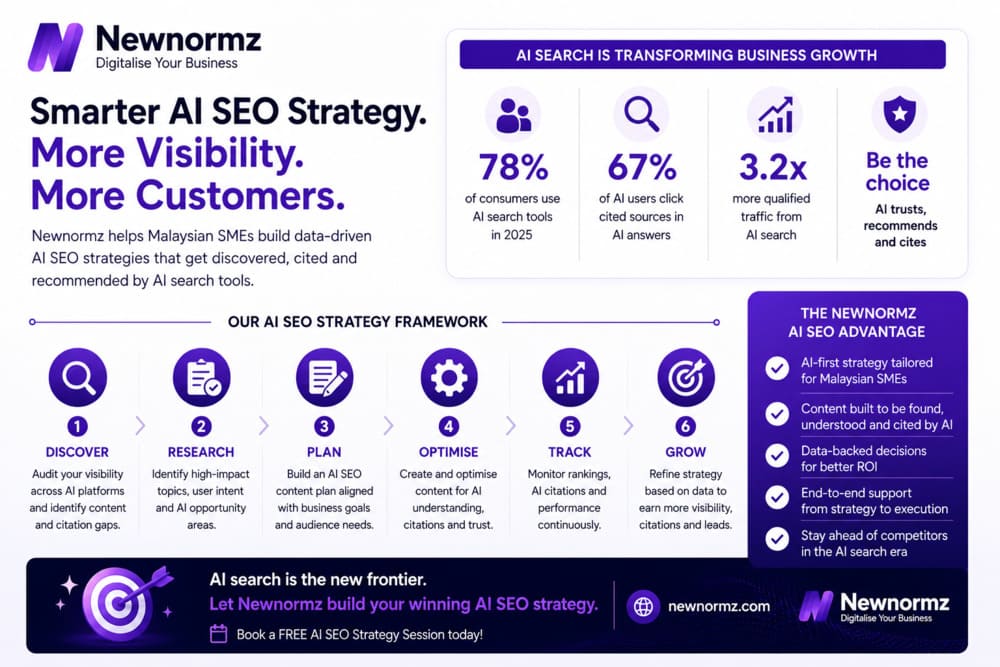
The AI layer doesn’t stand apart from that work, it sits on top of it. Fixing crawlability and schema first, then layering answer-first content and citation tracking, is what makes the pillars measurable rather than a one-off audit that gathers dust.
Build a Measurable AI SEO Strategy
Malaysian SMEs that wait for AI search to settle down risk losing visibility while competitors adapt now. A four-pillar framework gives you a structured, measurable plan built on the tactics still driving both search and AI visibility, not a guess dressed up as a trend.
Frequently Asked Questions About AI SEO Strategy
Why does my website rank on Google but stay absent from AI answers?
Ranking and citation are different signals. Newnormz checks technical SEO, content structure, entity signals and citation readiness to find the gaps a standard ranking report misses.
Which AI SEO improvements should a Malaysian SME prioritise first?
Start with crawlability and schema markup on your highest-value pages, then rewrite those pages so they answer the customer’s actual question in the first two sentences.
How soon can I expect to see progress from an AI SEO strategy?
Technical fixes and early citation changes are usually visible within the first few months. Ranking, authority and lead gains typically build over a longer campaign, similar to standard SEO timelines.
Can AI search optimisation work without traditional SEO?
No. AI visibility is built on top of strong technical SEO, useful content, internal linking and credible authority signals, not instead of them.
How do I know if my agency is actually working on AI visibility?
Ask for reporting that covers Google rankings, schema coverage, entity consistency and AI citation tracking in one place, not just a positions-1-to-10 table.
Not sure where your site stands with AI search?
Get Your Site Scored Against All Four AI SEO Pillars
Newnormz has run SEO campaigns across F&B, healthcare, ecommerce, and local services in Malaysia, backed by a performance guarantee of 70 percent of targeted keywords on Google’s first page.
30 minutes, no obligation, includes an AI visibility check.

Bryan Tan is an SEO Specialist and CEO at Newnormz, helping hundreds of businesses achieve first-page rankings on Google. With a passion for driving organic growth, Bryan blends innovative strategies with hands-on experience to optimize websites for maximum visibility. Always at the forefront of the latest SEO insights and trends, he consistently adapts to the evolving digital landscape.