You track AI citations by running the same 15 to 25 buyer questions through Google AI Overviews, ChatGPT, and Perplexity every week, then recording which brands get named as sources. Malaysian SMEs should pair this manual check with Search Console’s generative AI report and GA4’s AI referral data, since neither platform on its own shows which brand a chatbot actually names in its answer. Do this consistently and you get a real AI Share of Voice number you can track against competitors, not a guess about whether your content is working.
A Simple Way to Think About It
Two Ways to Find Out Who Got Named
😶 Flying Blind
You wait for a customer to click through to your site, but by the time they search, ChatGPT and Google’s AI Overview have already answered their question, sometimes naming a competitor instead of you.
👀 Watching the Room
You run the same questions your buyers ask through the same AI tools they use, every week, and you see exactly whose name comes up before a single customer ever visits your website.
Here is exactly how to set up that weekly check, and what to do once you can see where your brand actually stands.
What Is AI Citation Tracking?
AI citation tracking is the practice of monitoring which brands, pages, and domains get named as sources when tools like Google AI Overviews, ChatGPT, Gemini, and Perplexity answer a user’s question. Each of these systems retrieves passages from indexed content, ranks them for relevance, and decides which ones to quote or link.
Ranking on Google’s first page does not guarantee an AI Overview citation. Ahrefs found that only 38 percent of cited pages also ranked in the top 10 for that query, while the rest of the citations came almost equally from positions 11 to 100 and from pages outside the top 100 entirely. That gap matters for Malaysian SMEs: it means a smaller business can still earn AI visibility by publishing clear, well-structured, citation-ready content, even while a larger competitor holds the top organic spot.
Why Search Console and GA4 Don’t Show the Full Picture
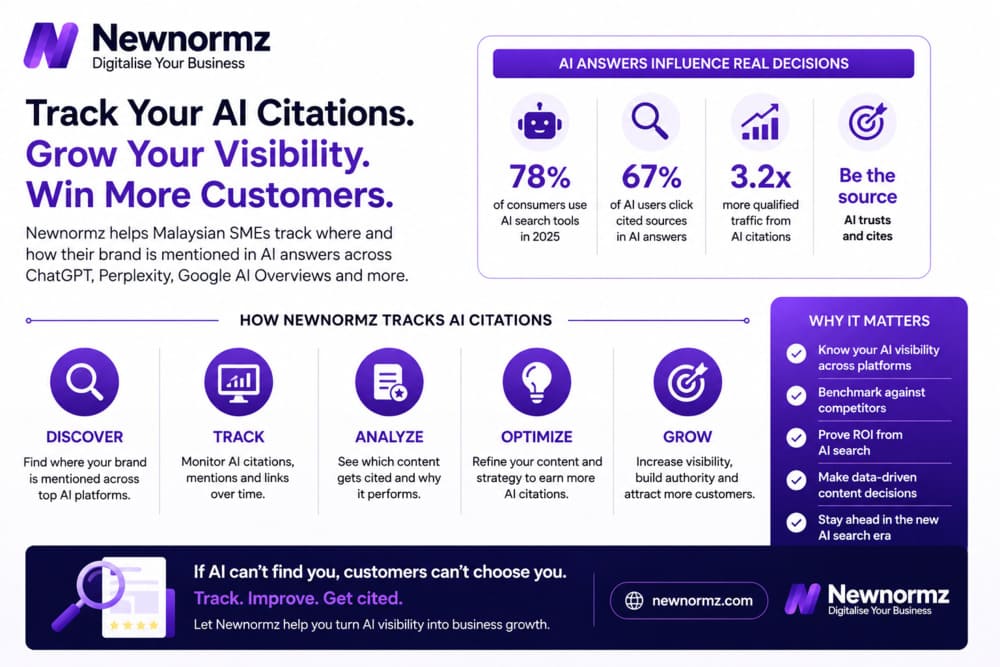
Search Console’s generative AI report shows how many AI Overview and AI Mode impressions your site received, but it does not break that down by query, by individual citation, or by click. GA4 can separate out traffic arriving from assistants such as ChatGPT and Claude, but clicks that come from Google’s own AI Overview are still grouped under regular Organic Search, so you cannot isolate them there either.
This gap is bigger than it looks. A 2026 study of 55,393 trending queries found AI Overviews appearing on 13.7 percent of searches overall, rising to 64.7 percent for question-based queries, which is exactly the kind of search a Malaysian buyer types when comparing services. If your analytics only tell you what happened after someone clicked, you are missing most of what happened before that click, including whether your brand was mentioned at all.
A 4-Step Process to Track Your AI Citations Manually
Manual tracking costs nothing but your time, and it gives you the clearest first read on your AI Share of Voice.
1. Build a list of 15 to 25 buyer questions
Pull these from the questions your sales team hears most often, from Google Search Console queries that run seven words or longer, and from the questions your competitors are already answering in their own content.
2. Search each question in incognito mode
This removes personalisation and shows what a first-time Malaysian buyer would actually see. Add &gl=my&hl=en to the search URL so the results reflect a Malaysia-based search.
3. Log every result in a spreadsheet
Record whether an AI Overview appeared, whether your brand was cited, which competitors were cited instead, and a screenshot link so you can review changes over time.
4. Calculate your AI Share of Voice weekly
Divide the number of times your brand is cited by the total number of AI Overviews triggered, then multiply by 100. A business cited in 6 out of 30 triggered overviews holds a 20 percent Share of Voice. Run the same question set through ChatGPT and Perplexity too, since each platform tends to pull from different sources.
Beyond the Spreadsheet: Where to Go When Manual Tracking Doesn’t Scale
Manual checks prove the method works, but reviewing 25 questions by hand every week gets difficult once you are also running the rest of the business. The table below lays out the realistic next steps.
| Method | Cost | Best For |
|---|---|---|
| Manual spreadsheet tracking | Free | Validating your first Share of Voice benchmark |
| Rank trackers with AI Overview filters (e.g. SEMrush, Ahrefs) | Paid subscription | SMEs already using these tools for standard SEO tracking |
| Managed AI visibility monitoring through an agency | Retainer-based | SMEs that want ongoing coverage without hiring an in-house analyst |
Talk to your marketing team about which option fits your budget and your current reporting setup before committing to a paid platform.
How to Improve Your AI Citation Rate
Tracking shows you where your brand appears today. Improving that rate requires content that search and AI systems can understand, retrieve, and quote with confidence.
Lead with a clear answer
Open each important page with a direct response to the main question it is meant to answer, before adding supporting detail.
Make the content easy to scan
Use descriptive headings, short paragraphs, and lists that a retrieval system can pull cleanly without needing to interpret dense text.
Clarify key business details
Add schema markup covering your organisation, products, services, and location so AI systems can confirm who you are and what you offer.
Publish information worth citing
Original research, verified customer results, or genuinely useful first-party insights give an AI system a reason to quote you instead of a generic competitor page.
Keep business information consistent
Match your business name, address, and service details across your website, Google Business Profile, and trusted directories. This consistency underpins strong local SEO and gives AI systems a clear, single version of who you are.
How Newnormz Helps Malaysian SMEs Track and Win AI Citations
Newnormz builds AI citation monitoring into its SEO and content strategy, so business owners get a clear view of where their brand appears across AI search rather than a guess.
As an SEO agency in Malaysia, Newnormz combines technical SEO audits, AI-focused content improvements, and schema markup into one coordinated plan. Every engagement starts with a strategy report that shows which pages are already earning citations, which pages are being overlooked, and what needs fixing first.
Frequently Asked Questions
Why does my competitor appear in AI Overviews while my brand stays absent?
Newnormz tracks priority buyer questions and identifies which competitor pages, sources, and content formats are the ones actually getting cited.
Can I track AI citations without an expensive monitoring platform?
Yes. Start with focused manual checks on your priority questions, then introduce paid tracking tools once your keyword and question set grows too large to manage by hand.
When should a Malaysian SME outsource AI citation tracking?
Once regular checks, competitor analysis, and the resulting content fixes become difficult to keep up with internally, agency support tends to make sense.
Why does a top Google ranking still fail to earn an AI citation?
Rankings alone do not secure AI visibility. Answer clarity, page structure, entity signals, and source credibility all factor into whether an AI system chooses to quote a page.
How often should AI Share of Voice be reviewed?
Priority prompts are worth checking weekly, with meaningful citation and competitor changes reported during monthly strategy reviews.
Not sure where your brand stands in AI search?
Find Out Which Brand AI Tools Are Naming Instead of Yours
Newnormz has run SEO campaigns across F&B, healthcare, ecommerce, and local services in Malaysia, backed by a performance guarantee of 70 percent of targeted keywords on Google’s first page.
30 minutes, no obligation, including a first look at your AI citation status.

Bryan Tan is an SEO Specialist and CEO at Newnormz, helping hundreds of businesses achieve first-page rankings on Google. With a passion for driving organic growth, Bryan blends innovative strategies with hands-on experience to optimize websites for maximum visibility. Always at the forefront of the latest SEO insights and trends, he consistently adapts to the evolving digital landscape.