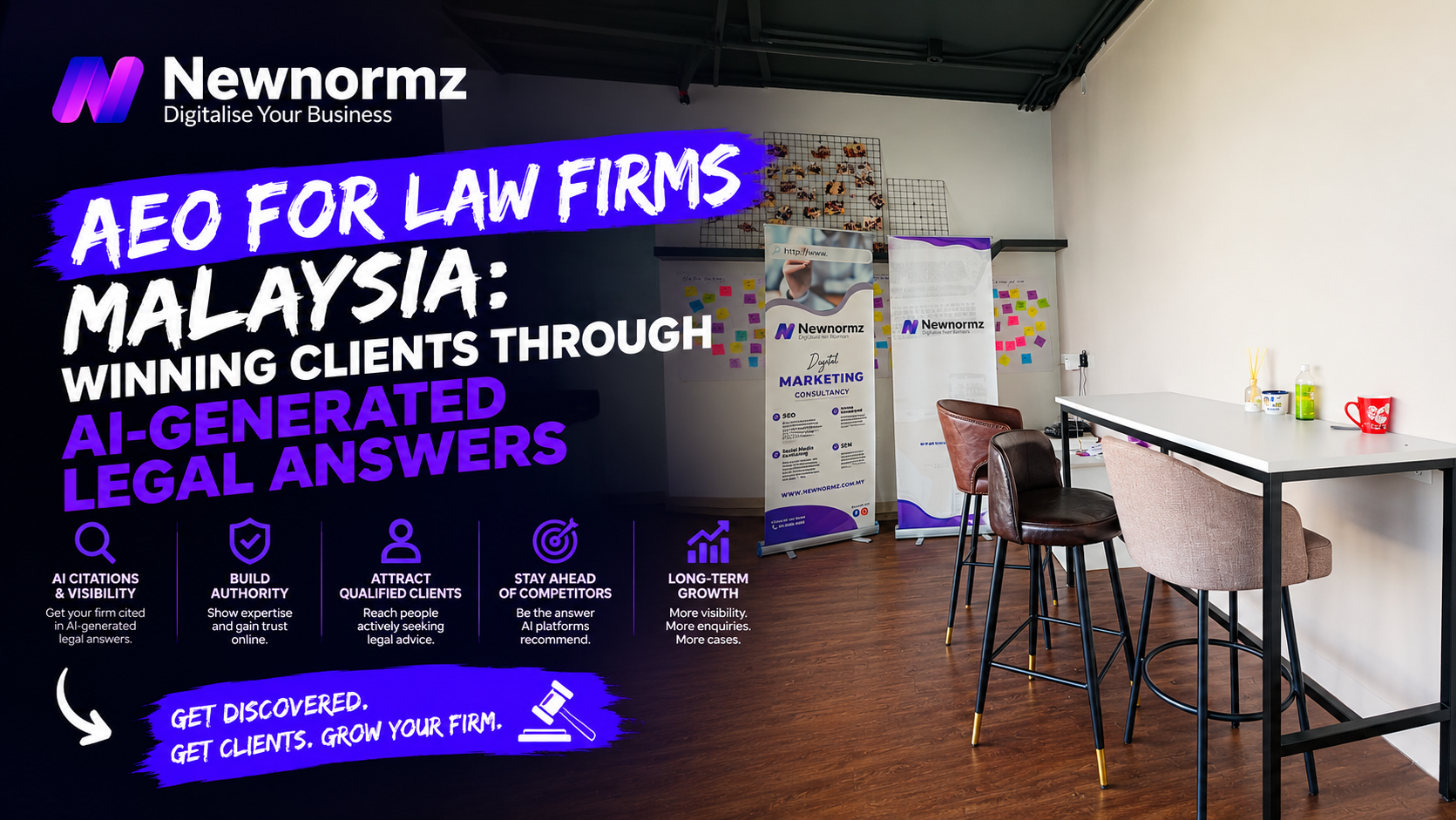
AEO (Answer Engine Optimisation) for a Malaysian law firm means writing and structuring your website so AI tools like ChatGPT, Perplexity and Google AI Overviews can pull a clear, accurate answer from it when someone describes a legal problem. More and more clients ask those tools first, before they ever compare law firm websites. No one can guarantee that an AI tool will cite your firm, just as no one can guarantee a Google ranking. What you can control is whether your pages answer real Malaysian legal questions plainly, name the actual statutes and procedures, show who wrote them, and stay current. Firms that do that well give AI tools something worth quoting. Firms whose websites read like brochures don’t.
A Simple Way to Think About It
The Question at the Networking Dinner
📄 Handing over the brochure
A business owner asks you a simple question over dinner, and you give them your firm’s brochure. They thank you politely, then turn and ask the person sitting next to you.
💬 Answering the question
You answer it in two clear sentences, then mention that you handle matters like theirs every week. Before dessert, they ask for your card.
AI tools behave a lot like that business owner. The sections below explain what they look for and how to make your firm’s website the one that actually answers.
Clients now describe their legal problem to AI before they look for a lawyer
People rarely look for a lawyer just out of curiosity. They search because a supplier hasn’t paid, a co-founder has stopped answering calls, an employee has walked out with client lists, or a contract lands on their desk with a signing deadline. That pressure changes how they search.
The old pattern was to type “corporate lawyer KL” into Google and open five tabs. The newer pattern is to type the whole situation into ChatGPT or read the AI Overview at the top of Google: “My business partner took money from the company account without approval. What can I do in Malaysia?” The person gets a summarised answer, and sometimes a firm’s name and page come with it.
That matters because of where your clients are. Malaysia had 35.4 million internet users at the end of 2025, about 98% of the population (DataReportal, Digital 2026 Malaysia), and Google holds roughly 93% of the local search market (Statcounter, May 2026). So most of your prospective clients now meet AI Overviews in their everyday searches, whether they meant to use AI or not.
Someone who explains their situation in that much detail is not just browsing. They are often only a few steps away from making contact. If your explanation is the one the AI tool quotes, your firm becomes their starting point before they have compared anyone else.
How AI tools decide whose answer to use
Here’s the honest part. None of these platforms publish a formula for which sources they cite, and they change their behaviour often. Anyone who claims they can reliably “get you into ChatGPT” is overselling. What we can see consistently is the kind of content that gets picked up, and it fits closely with what Google has rewarded for years:
- A direct answer near the top. The page states the answer in the first few lines, not after three paragraphs about the firm’s history.
- Specific to the jurisdiction. It names the Malaysian statute, court or procedure involved, so the tool can tell the answer applies to someone in Malaysia and not in the UK or Singapore.
- A named, credible author. A real lawyer with a visible profile, practice area and admission details sits behind the content.
- Current information. The page reflects the law as it stands now and shows when it was last reviewed.
- Consistent signals elsewhere. Your firm name, address, practice areas and lawyers appear the same way on your site, your Google Business Profile and the legal directories you’re listed in.
Most Malaysian law firm websites fail on the first point. Their practice area pages describe what the firm does. They don’t answer what the client actually needs to know.
What an answer-ready law firm website looks like
The gap is usually easiest to see when you put a typical firm page next to the version that AI tools and clients can actually use.
| Page element | Typical firm website | Answer-ready version |
|---|---|---|
| Practice area page | “We provide comprehensive employment law services to corporate clients.” | Opens by answering the most common questions, such as what an employer must do before dismissing someone for misconduct, with the service description after that. |
| Legal references | General wording that could apply in any country | Names the actual law, for example the Companies Act 2016 or the Employment Act 1955 as amended in 2022 |
| Lawyer profiles | A list of degrees and nothing else | Practice focus, the kinds of matters handled, admission details, and links to the articles that lawyer wrote |
| Blog | A legal update every few months that nobody revisits | Explainers for specific situations, reviewed when the law changes, each showing a “last reviewed” date |
| FAQs | Missing, or one generic page for the whole site | Short, precise Q&As on each practice area page, written about the Malaysian position |
Build pages around the questions clients actually ask
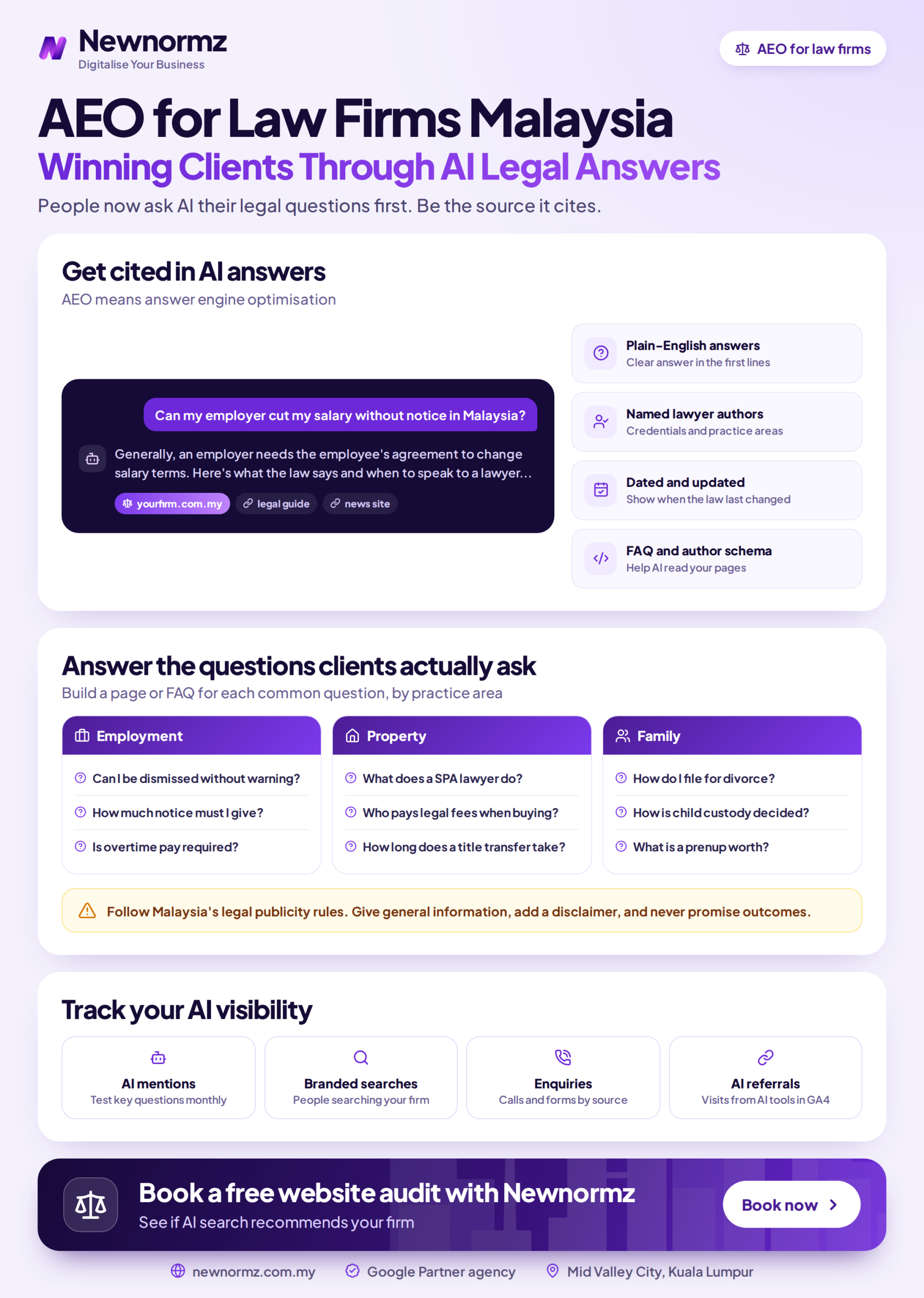
Begin with the questions your intake team hears every week, not with keyword tools. “Can I sue a client who refuses to pay?” “What should a shareholder agreement cover?” “Can I terminate an employee who keeps showing up late?” Each one deserves a clear answer of a few sentences, then the detail, the exceptions, and the point where the reader really does need a lawyer.
Don’t forget language. Many SME owners search in Bahasa Malaysia or Chinese, so phrases like “cara tuntut hutang syarikat” or questions about 股东纠纷 (shareholder disputes) are real queries. If your clients ask in those languages, at least your core practice area answers should be available in them.
Be specific about Malaysian law
An AI tool that is answering a Malaysian question needs a reason to trust a Malaysian source. Name the statute and the relevant court level, and explain the procedural steps, such as a letter of demand before a debt claim. Generic content that could be about any common law country gives it no such reason.
Make your lawyers visible as the authors
Legal content without an author is weak content. Put a named lawyer on every substantive article and link to a full profile, and make sure the same names and practice areas appear on your Google Business Profile and in the directories you’re listed in. When your firm’s details are consistent everywhere, AI tools have an easier time recognising it as one credible entity.
Use schema, but know what it does and doesn’t do
Structured data such as FAQPage, Attorney/LegalService and Person markup helps machines understand what a page is and who is behind it. Be realistic about it, though. Since 2023, Google has shown FAQ rich results only for a narrow set of authoritative government and health sites, so FAQ schema won’t give a law firm those expandable snippets in search results. It’s still worth adding as a clarity signal. It just isn’t a shortcut, and the content itself has to do the heavy lifting.
The publicity rules you have to work within
Advocates and solicitors in Malaysia operate under professional publicity rules set by the legal profession, including the Legal Profession (Publicity) Rules. Those rules affect what a firm can say about itself, which is one reason AEO suits law firms well: educational content that explains the law is a very different thing from self-promotion.
In practice, that means writing explainers, not sales copy. Avoid claims like “best” or “top-rated”, don’t make promises about outcomes, and add a clear note that the content is general information and not legal advice. Have your firm check the current rules before anything goes live. Any agency writing legal content for you should expect that review and build time for it into the schedule.
AEO sits on top of SEO. It doesn’t replace it
AI tools still draw heavily on pages that search engines have already crawled, indexed and trusted. A firm with a slow, thin or poorly indexed website won’t get cited, however well its FAQs are written. AEO is the layer that makes good content extractable. A solid SEO service is what makes that content findable to begin with.
For firms that rely on clients from one area, such as a family law practice in Petaling Jaya or a conveyancing firm in Johor Bahru, local SEO matters as much as anything here. A complete, consistent Google Business Profile and genuine reviews feed directly into the “lawyer near me” answers that AI Overviews put together.
We haven’t published a law firm case study yet, so we won’t pretend to have one. The closest parallel is another regulated sector. Our 6-month SEO campaign for Sunway Medispa in healthcare produced a 700% traffic increase, 54,000 impressions and 70% more ranking keywords. It used the same discipline: precise, compliant, expert-led content on a technically sound site.
How long it takes, and how to tell if it’s working
Restructuring your key practice area pages is usually a matter of weeks. Seeing the results takes longer, and the timing is less predictable, because it depends on how often search engines recrawl your site, how competitive your practice areas are, and how the AI platforms change their own behaviour. Treat it as a programme measured in months, not a one-off fix.
Measure what you can actually see:
- Impressions and clicks for question-style queries in Google Search Console
- Manual checks of your priority questions in ChatGPT, Perplexity and Google AI Overviews, repeated monthly
- Referral traffic from AI platforms in your analytics
- The thing that matters most: whether enquiries mention questions your content answers
Frequently asked questions
Can a boutique law firm compete with large firms in AI answers?
Often, yes. AI tools look for the clearest and most relevant answer to a specific question, not the biggest brand. A boutique employment practice with detailed, well-maintained answers on Malaysian dismissal procedure can be more useful to quote than a large firm’s generic employment page.
Does writing answers online count as giving legal advice?
Not if you frame it as general information. Explain the legal position and the usual process, say clearly that each situation is different, and add a short disclaimer. That protects your firm and still gives readers, and AI tools, a useful answer.
Which practice areas should we start with?
Start with the areas that bring in your most valuable matters and where clients ask lots of urgent questions: typically debt recovery, employment disputes, shareholder disputes, and contract review for SMEs. One well-answered practice area is worth more than ten thin ones.
Should we write in Bahasa Malaysia and Chinese too?
If your clients search in those languages, yes. Plenty of SME owners describe their problem in their first language, and far fewer law firm pages answer them in it, so there is often less competition for those queries.
Can anyone guarantee our firm will appear in ChatGPT or AI Overviews?
No. Google has said publicly that no one can guarantee a ranking position, and the AI platforms are even less transparent about how they choose sources. Anyone promising guaranteed AI citations is overselling. What you can do is give these tools the strongest possible reasons to pick your firm.
Is your firm the answer clients see, or the one they never hear about?
Find out how your law firm shows up in Google and AI search today
Newnormz has run SEO campaigns across F&B, healthcare, ecommerce, and local services in Malaysia, backed by a performance guarantee of 70 percent of targeted keywords on Google’s first page.
30 minutes, no obligation, with a check of your key practice area pages and the gaps between them and the questions clients ask.

Bryan Tan is an SEO Specialist and CEO at Newnormz, helping hundreds of businesses achieve first-page rankings on Google. With a passion for driving organic growth, Bryan blends innovative strategies with hands-on experience to optimize websites for maximum visibility. Always at the forefront of the latest SEO insights and trends, he consistently adapts to the evolving digital landscape.