Key takeaways
- ✓Social media for ecommerce works when you judge it on profit per order, work out where your sale actually closes, and let your creative do the targeting. This guide gives you 10 strategies in that order, with the maths.
- ✓Calculate your break-even ROAS before you spend anything. A platform-reported 3x ROAS can still lose money once discounts, fees and returns are counted.
- ✓Your own store, Shopee or Lazada, TikTok Shop and WhatsApp each need different tracking, campaign objectives and creative. One plan doesn’t fit all four.
- ✓On Meta and TikTok, a weekly supply of new, varied ad creative does more for results than clever audience targeting.
- ✓Blended MER (total revenue ÷ total ad spend) is the honest number when marketplace sales hide from your ad dashboards.
Social Media for Ecommerce Starts With Where Your Sale Closes
Most Malaysian online brands don’t have a reach problem. DataReportal’s Digital 2026: Malaysia report puts the country at over 35 million internet users, about 98% of the population, so your buyers are already scrolling. The problem is that the ad, the tracking and the checkout often point in different directions.
A good ecommerce social media strategy begins with one question about your own business: where does the money change hands? Usually it’s in one of four places. Your own Shopify or WooCommerce store, Shopee or Lazada, TikTok Shop, or a WhatsApp chat that ends with a bank transfer. Each one changes what you can track, which campaign objective makes sense and what the creative needs to do.
Strategies 1 and 2 apply to everyone, so do them first. Pick from the rest based on where your sales close, then use the summary table near the end to decide what to start this month.
1. Work Out Your Break-Even ROAS Before You Spend RM1
ROAS (return on ad spend) is revenue divided by ad spend. Your break-even ROAS is the point where each order’s contribution exactly pays for the ad that brought it in. You go below it, you lose money on every sale. Most brands we speak to know their ROAS but have never calculated this number.
| Example line (illustrative numbers) | Per order |
|---|---|
| Average order value (AOV) | RM120 |
| Gross margin at 55% (after product cost of RM54) | RM66 |
| Shipping, payment gateway and platform fees | RM16 |
| Contribution per order (most you can pay per sale) | RM50 |
| Break-even ROAS (RM120 ÷ RM50) | 2.4x |
Now the trap. Say Ads Manager reports RM3,000 in revenue from RM1,000 of spend: 3x ROAS, comfortably above 2.4. But every buyer used a 15% code, two of the 25 orders came back, and your store passes the pre-discount cart value to the pixel (some setups do).
| Example: same campaign | What the dashboard says | What the bank account says |
|---|---|---|
| Revenue | RM3,000 (25 × RM120) | RM2,346 (23 kept orders × RM102) |
| ROAS | 3.0x | 2.3x |
| Contribution | Not shown | RM704 (23 × RM32, minus RM32 lost on returns) |
| Result after RM1,000 ad spend | Looks profitable | A loss of RM296 |
That’s before asking how many of those 25 people would have bought anyway. Real social media ROI is profit after ad spend, not a ratio in a dashboard. Run your own numbers through our free social media ROAS calculator, then write your break-even ROAS and break-even cost per purchase at the top of every report.
Effort: one afternoon with your accountant’s margin figures.
2. Fix Pixel, Conversions API and Catalogue Data Before You Scale
Meta’s algorithm optimises for whatever events you send it. If those events are missing or wrong, you are paying it to find the wrong people. Browser-only tracking misses purchases because of ad blockers and iOS privacy settings, so pair the Meta Pixel with the Conversions API (CAPI, which sends purchase data from your server). Shopify and WooCommerce both have official or well-supported integrations for this.
In Events Manager, check three things: that Purchase fires once per order (not twice), that it passes the actual paid value after discounts, and the event match quality score for each event. Then open Commerce Manager and check your product catalogue: titles that describe the product rather than your internal SKU code, correct sale prices, and live stock status.
From our audits
One of the most common catalogue problems we find is a feed that hasn’t synced in weeks, so retargeting ads keep showing sold-out sizes and old prices. Buyers click, find nothing, and Meta learns that your ads don’t convert. Set the feed to update daily and exclude out-of-stock items with a product set filter.
Marketplace sales are the blind spot. When the sale closes on Shopee or Lazada, Meta never sees a Purchase event. Tag every link with UTM parameters so you can read the traffic in GA4 or your marketplace’s traffic source reports. Then ask your marketplace account manager whether affiliate links or collaborative ads tracking are available for your store. Even with all that, the most reliable number is blended MER: total revenue across every channel ÷ total ad spend, tracked weekly against your break-even.
Because our team runs social alongside Google Ads and SEO, we read social results next to search and WhatsApp enquiries rather than in isolation. If you want the full framework, our guide to measuring social media ROI properly covers the formulas and what to include.
Effort: medium, mostly a one-off technical job, then a monthly check.
3. Let Advantage+ Shopping Do the Targeting, and Feed It Creative
For Facebook ads for ecommerce, the old playbook of stacking interest audiences (“women 25 to 40, interested in skincare and Sephora”) has mostly stopped paying. Meta’s delivery system now finds buyers from signals in your creative and your conversion data. Broad targeting plus a varied set of ads usually beats a narrow audience with one ad.
Advantage+ Shopping campaigns are Meta’s automated campaign type for this. Meta has been renaming its Advantage+ products, so it may appear as “Advantage+ sales campaigns” in your account. Check what your Ads Manager shows. Load it with your catalogue plus 6 to 10 distinct creatives, set a purchase objective, and leave targeting broad.
One decision rule matters here. Meta’s Business Help Centre describes the learning phase as needing around 50 optimisation events in a week. If you get fewer than about 50 purchases a week, optimise for add-to-cart or initiate checkout first, or run one simple campaign rather than splitting budget across five. Splitting a small budget means no ad set ever learns anything.
The same principles apply to Instagram placements, which run inside the same campaigns. If you’d rather hand over the build and the weekly optimisation, see our Facebook ads management service.
Effort: low to set up, high to feed (see strategy 4).
4. Build a Creative Testing Rhythm, Not a Photoshoot
If creative does the targeting, creative volume is your main lever. A quarterly photoshoot gives you one look for three months. A weekly ad creative testing rhythm gives the algorithm new angles to find new buyers. Shoot on a phone, edit in CapCut, and browse the Meta Ad Library to see which formats your competitors keep running (ads that run for months are usually the ones making money).
| Angle | Format | Example hook line | Metric that decides it |
|---|---|---|---|
| Problem | 9:16 talking head, 15 to 25s | “If your tudung slips by 10am, this is why.” | Hook rate (3-second views ÷ impressions) |
| Demo | Hands-only product video | “Watch this liner survive 40 minutes in the air fryer.” | Link CTR |
| Comparison | Split screen | “RM39 vs RM129 phone stand. Here’s the difference.” | CTR and cost per add-to-cart |
| Unboxing | Phone-shot UGC | “Opening the 11.11 bundle so you know what’s inside.” | Cost per purchase |
| Founder | Founder to camera | “I started this from my kitchen in Klang because…” | Hook rate, then cost per purchase |
| Review | Customer review montage | “Our most-returned item, and what we changed.” | Cost per purchase |
A workable rhythm: launch 3 to 5 new concepts a week, give each enough spend to reach about two to three times your break-even cost per purchase, then kill, keep or iterate. Hook rate tells you whether people stopped, CTR tells you whether they cared, and cost per purchase tells you whether it pays.
Watch for creative fatigue too. When frequency (average times each person has seen the ad) keeps climbing while CTR falls and cost per purchase rises over a week, the audience is tired of it. Swap in a new hook on the same body footage before you rebuild from scratch.
Hooks That Stop the Scroll for Product Videos
- Stop + the habit: “Stop ironing your bawal every morning.” Calls out a routine the viewer recognises.
- POV + the moment: “POV: your baby finally naps in the carrier at Mid Valley.” Puts the viewer inside the use case.
- Price reveal: “Here’s everything RM89 gets you.” Works well for bundles and festive sets.
- Torture test: “Tested in KL humidity for 12 hours.” Proof before the claim.
- Myth-busting: “Nobody tells you why cheap sunscreen pills on oily skin.” Opens a loop the viewer wants closed.
Effort: high and ongoing. This is the weekly work that separates growing accounts from stalled ones.
5. Use UGC and Creators as Ads, Not Just Posts
UGC videos (content made by customers or creators on their own phones) often outperform polished studio ads on TikTok, Reels and Stories because they look like the feed around them. The mistake is paying a creator for one organic post, watching it get a few thousand views, and leaving it there.
Run the best creator content as paid ads instead. On TikTok, that’s Spark Ads, which boost the creator’s original post through your ad account. On Meta, partnership ads run from the creator’s handle with your targeting and budget. Both keep the creator’s name and comments, which reads as a recommendation rather than an advert.
Put usage rights in the brief before anyone films: how long you can run it as an ad, on which platforms, whether you get the raw files to recut, and the authorisation code or partnership permission. Ask for three different hooks on the same video. That one request triples your testing material for little extra cost. Our guide to working with influencers and creators covers how to choose who to brief.
Effort: medium. The briefing and rights admin is most of it.
Weekly creative testing, creator briefs and Spark Ads are a full-time workload, and our team can run it for you.
6. Treat TikTok Shop as a Separate Channel With Its Own Maths
TikTok Shop Malaysia closes the sale inside the app, which removes the biggest drop-off point: leaving TikTok to load a website. Sales come from three engines. Short videos with product links, live selling, and affiliate creators who earn a commission on what they sell. GMV Max, TikTok’s automated campaign type for Shop ads, may also be open to you. Check whether it’s available in your Seller Center or TikTok Ads Manager.
Don’t reuse your website ROAS target here. Commissions, transaction fees, affiliate payouts and seller-funded vouchers all come out of the same order. Take the RM120 product from strategy 1 and use these illustrative numbers (check your real fees in Seller Center): a RM12 seller voucher brings the price to RM108, then platform fees of RM16.20, a 10% affiliate commission of RM10.80 and a RM5 shipping subsidy. Contribution falls to RM22, and break-even ROAS jumps from 2.4x to about 4.9x.
The same product can be profitable on your website and lose money on TikTok Shop. Recalculate break-even for every channel.
Be honest about fit, too. TikTok Shop suits impulse-priced products that can be shown working in seconds: snacks, beauty, phone accessories, household gadgets. Considered purchases like furniture or premium baby gear tend to need more research than a live stream gives them.
Running TikTok Shop, Meta campaigns and weekly creative testing together is where most in-house teams run out of hours. That’s the gap a social media marketing agency in Malaysia should fill. Our team has run Facebook campaigns for brands such as Taiwan Excellence and TikTok campaigns for Hot & Roll.
Effort: high, especially if you add live selling.
7. Send High-Consideration Products to WhatsApp, Not the Checkout
Malaysian buyers spending a few hundred ringgit on a mattress, custom furniture, gold or a hamper order often want to ask something first. Is it in stock in grey? Can you deliver to Kuching by Friday? Click to WhatsApp ads open a chat with your WhatsApp Business number instead of a product page. For products like these, the ad’s job is to get the conversation started.
Compare the two paths with example numbers. A website campaign at RM1 per click converting 1% costs RM100 per order. A click-to-WhatsApp campaign at RM8 per chat where 1 in 5 chats buys costs RM40 per order. On a RM450 AOV, that’s a very different business. But the chat only converts if someone answers it. A chat answered in five minutes by someone who knows the product sells far better than one answered the next morning by an intern.
Track it properly: use a unique greeting message per campaign, tag chats by source in WhatsApp Business, and count orders, not conversations started.
Effort: medium for ads, high for staffing the replies.
8. Retarget by Behaviour, and Cap the Discount Habit
Retargeting means showing ads to people who have already interacted with you. Catalogue retargeting shows each person the exact products they viewed or left in the cart, which is the most efficient spend in most accounts. Split it by behaviour: product viewers in the last 7 days, cart abandoners in the last 3 days, and past buyers for complementary products.
The catch is that retargeting takes credit for sales that would have happened anyway. Someone who added to cart at midnight and was planning to pay after payday still gets counted as a retargeting conversion. Test this by excluding a group from retargeting for two weeks and comparing purchase rates.
✗ Retargeting every visitor with a 20% code
It lifts conversion rate this week and trains your customers to add to cart and wait. Within a few months, full-price sales shrink and your contribution per order is permanently lower.
✓ The fix
Lead retargeting with reviews, delivery speed and objection handling. Hold discounts for cart abandoners after day 3, keep them smaller, and keep them out of the ads people see on day 1.
Effort: low once your catalogue and events are clean.
9. Plan the 9.9 to 12.12 Run and the Festive Calendar Early
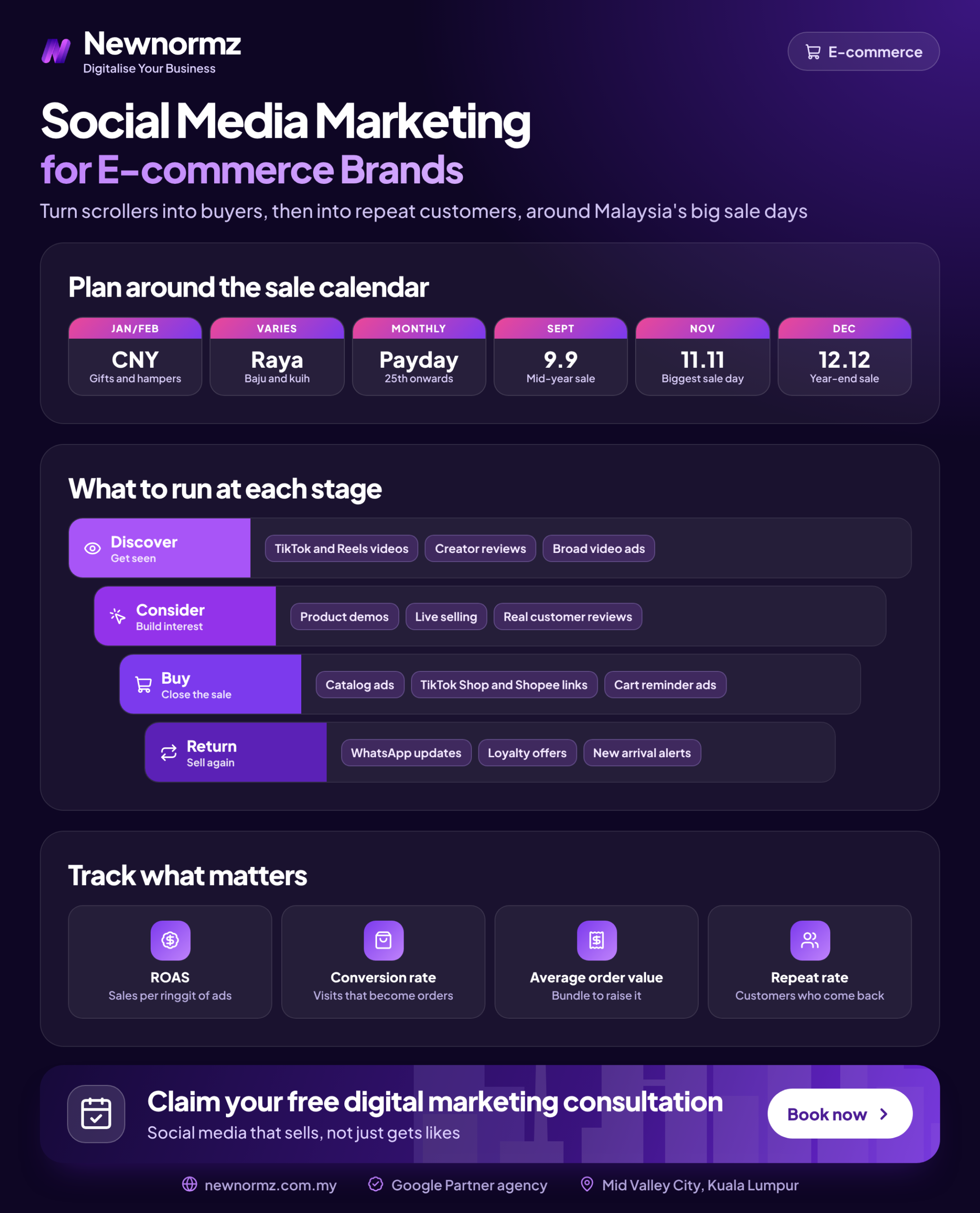
Malaysia’s calendar is packed: Ramadan and Hari Raya, Chinese New Year, Deepavali, Merdeka and Malaysia Day, plus the 9.9, 10.10, 11.11 and 12.12 sales. Competition for ad space rises around each one, so CPMs (cost per thousand impressions) climb just when you want to spend. In early 2027, Chinese New Year and the start of Ramadan fall within days of each other, so the competition for that window will be tighter than usual. Any festive sales campaign in Malaysia works best when the testing is done before the expensive days.
4 weeks out: test creative
Launch festive angles at normal budgets while CPMs are lower, and find the two or three ads with the best cost per purchase.
2 to 3 weeks out: build audiences
Run teaser content and countdown posts so you have fresh viewers and engagers to retarget on sale day.
Sale days: scale proven ads only
Raise budgets on the winners. Sale day is the most expensive time to test something new.
The week after: check blended MER
Compare total revenue against total spend across all channels, including marketplace sales, before deciding the campaign worked.
Malaysia note
Write captions per language segment in English, Bahasa Malaysia and Chinese instead of translating one ad. A Hari Raya ad translated into Chinese, or a CNY ad translated into BM, reads like an afterthought. The offer can stay the same, but the hook and the cultural cues should change.
Set aside festive budget before the year starts. Our guide to budgeting for social media in Malaysia shows how to plan spend across the calendar.
Effort: medium, but it only works if you start early.
10. Keep Organic for Proof, Not for Reach
Organic reach alone won’t grow most online stores. What organic posting gives you is proof. When someone clicks your ad and checks your profile, they look for recent posts, real comments and answered questions. An empty or abandoned feed quietly kills conversion rate.
A sustainable rhythm for most small teams is three to four posts a week across Reels or TikTok, plus replies to every comment and DM within a day. Repost customer reviews and unboxings. Answer negative comments publicly and calmly, because the next buyer is reading.
Instagram Shopping lets you tag products in posts and Reels from your catalogue, so viewers can tap through to the product. Meta has changed its shopping features several times, so check whether product tagging is available on your account in Commerce Manager. Boosted posts are fine on posts that are already doing well organically, as cheap social proof. For sales, use a proper purchase campaign. For more on the organic side, see how local Malaysian brands win on social.
Effort: low to medium, but daily.
Which Social Commerce Strategy to Start With
| Strategy | Effort | Time to impact | Best for |
|---|---|---|---|
| 1. Break-even ROAS | Low | Immediate | Every brand |
| 2. Pixel, CAPI and catalogue | Medium | 2 to 4 weeks | Every brand, before scaling |
| 3. Advantage+ Shopping | Low to set up | 2 to 4 weeks | Own store, larger catalogues |
| 4. Creative testing rhythm | High | 4 to 8 weeks | Anyone spending on Meta or TikTok |
| 5. UGC and creator ads | Medium | 3 to 6 weeks | Beauty, lifestyle, gadgets |
| 6. TikTok Shop | High | 4 to 12 weeks | Impulse-priced products |
| 7. Click-to-WhatsApp | Medium | 1 to 3 weeks | High AOV, custom or bundle orders |
| 8. Behavioural retargeting | Low | 1 to 2 weeks | Stores with steady site traffic |
| 9. Festive calendar planning | Medium | Each sale period | Gifting, fashion, F&B, marketplace sellers |
| 10. Organic for proof | Low to medium | Ongoing | Every brand running ads |
Social Media for Ecommerce: FAQs
Which social media platform is best for e-commerce in Malaysia?
The best platform is the one that matches where your sale closes and who your buyer is. In our experience, Facebook and Instagram suit own-store brands and older, family decision-makers, TikTok suits impulse products and younger buyers, and WhatsApp handles high-consideration orders. Most brands start with Meta and add TikTok Shop once their maths works.
How much should an e-commerce brand spend on Facebook and Instagram ads?
Spend enough to buy the conversions the algorithm needs to learn, and no more until results hold. For example, with a break-even cost per purchase of RM50 and a target of about 50 purchases a week, you’d need roughly RM2,500 a week. If that’s out of reach, optimise for add-to-cart first.
What is a good ROAS for an online store in Malaysia?
A good ROAS is any ROAS comfortably above your own break-even ROAS, so there’s no single market number. Divide your AOV by your contribution per order: a RM120 product with RM50 contribution breaks even at 2.4x, while the same product on TikTok Shop with vouchers and affiliate fees might need nearly 5x.
Should I sell on TikTok Shop or drive traffic to my own website?
Use TikTok Shop for impulse-priced products that demo well in seconds, and your own website for considered purchases and repeat customers. Your website gives you the customer data and margin, while TikTok Shop gives you less friction at checkout. Calculate break-even separately for each before deciding where the budget goes.
How do I track social media sales that happen on Shopee or Lazada?
You can’t track them fully in Meta, so combine UTM-tagged links, any affiliate or collaborative ads tracking your marketplace offers, and blended MER. Blended MER (total revenue ÷ total ad spend, checked weekly) shows whether social spend is lifting total sales, even when individual orders can’t be attributed.
Turn your ad spend into profitable orders, not just a good-looking ROAS
Newnormz plans, creates and runs social media and paid social for Malaysian brands, and judges every campaign on enquiries, not just views. 5.0 rating from 214+ Google reviews.
No obligation. We check your tracking, catalogue and creative.

Bryan Tan is an SEO Specialist and CEO at Newnormz, helping hundreds of businesses achieve first-page rankings on Google. With a passion for driving organic growth, Bryan blends innovative strategies with hands-on experience to optimize websites for maximum visibility. Always at the forefront of the latest SEO insights and trends, he consistently adapts to the evolving digital landscape.