Key takeaways
- ✓The short answer on PDPA social media Malaysia compliance: the Act covers the personal data your marketing collects, including names, phone numbers, emails, WhatsApp chats and lead form answers.
- ✓Most risk sits in the lead pipeline after someone taps “Submit” or “Send message”, not in your posts.
- ✓A WhatsApp enquiry is consent to a conversation, not to promotions. Ask for marketing opt-in separately, in the chat.
- ✓A lead you can’t legally message is media spend you paid for and can’t reuse for your next festive campaign.
- ✓Below are the seven mistakes we see most often when auditing social lead setups, each with a fix you can apply this week.
Your ad creative is rarely the PDPA problem. The Instant Form notice is, and so are the WhatsApp broadcast list built from enquiries, the customer list uploaded to Meta, and the ex-salesperson who still has 300 leads on a personal phone. This guide works through that pipeline the way a social media practitioner audits it.
Before you read on
This is a marketer’s view, not legal advice. Clinics, financial services and property firms in particular should confirm their setup with a lawyer who knows their sector, and check the latest guidelines from the Personal Data Protection Commissioner.
What PDPA Social Media Malaysia Compliance Actually Covers (and What It Doesn’t)
The Personal Data Protection Act 2010 (PDPA) applies to personal data processed in commercial transactions. For social media, that means the data you collect and keep: lead form answers, WhatsApp numbers and chat histories, email lists, and anything you upload to an ad platform. In practice, the Personal Data Protection Act Malaysia social media marketers answer to is mostly about how you handle data, not what you post.
A public comment or a like on your post is not where your main exposure sits. The moment you copy that commenter’s number into a spreadsheet or a broadcast list, though, you are processing their personal data. The Act’s seven principles then apply, and each one shows up somewhere in a normal social lead setup.
| PDPA principle | Where it shows up in your social lead pipeline |
|---|---|
| General | Having consent to collect and use a lead’s details for the purpose you state |
| Notice and Choice | The text on your Instant Form or first WhatsApp reply |
| Disclosure | Sharing leads with your agency, CRM, or Meta through Custom Audiences |
| Security | Open Google Sheet links, personal phones, shared logins |
| Retention | Three-year-old leads nobody has deleted |
| Data Integrity | Keeping contact details and opt-out status accurate |
| Access | A lead asking what you hold on them, or asking you to correct it |
What your ads are allowed to say (medical claims, testimonials, price claims) falls under different rules, and we cover that in a separate guide. If you are still mapping which platforms and funnels to run at all, start with planning your social media strategy and build the data flow into that plan.
The 2024 Amendment in Plain Terms for Marketers
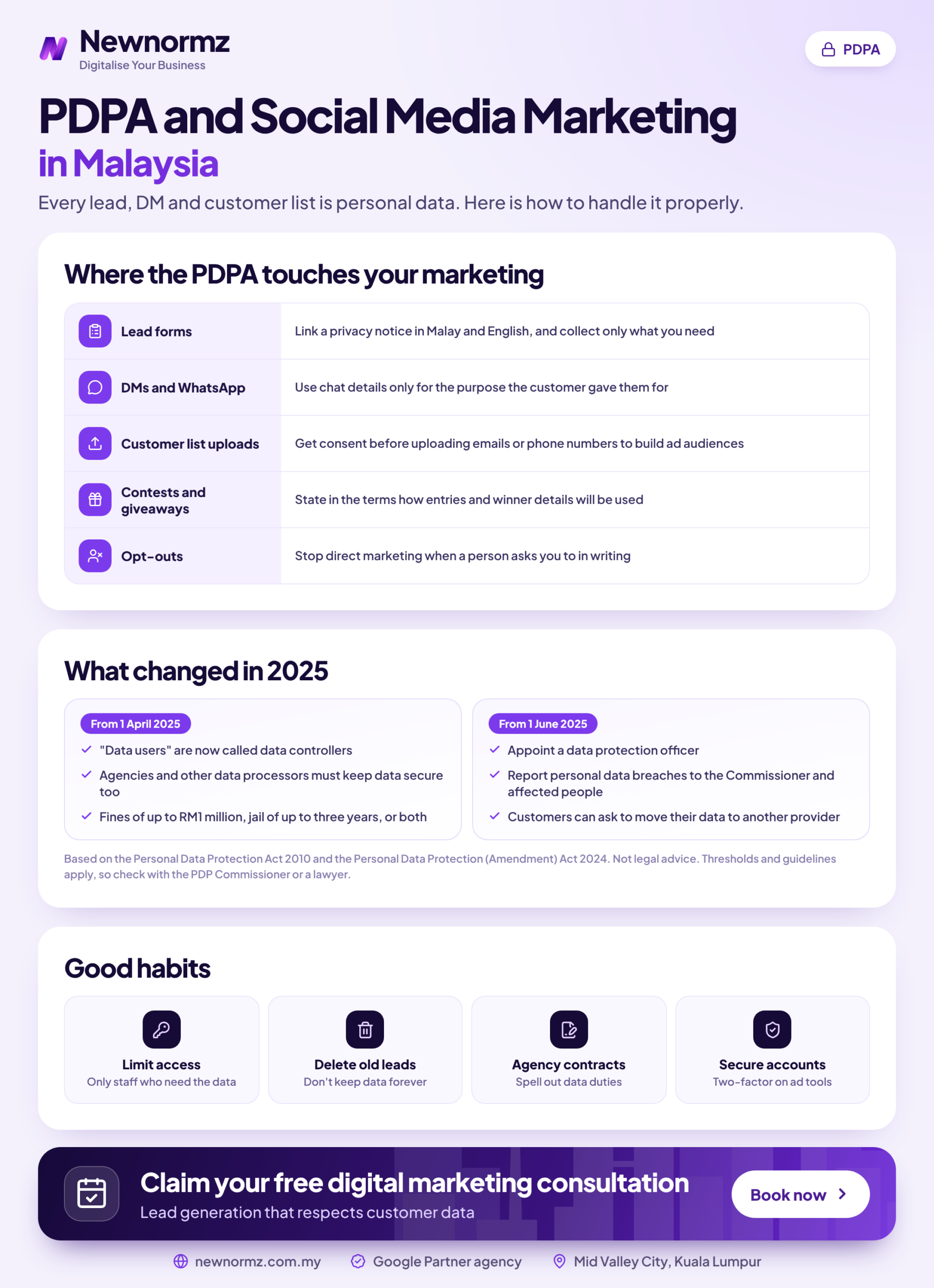
The Personal Data Protection (Amendment) Act 2024 changed several things that matter to anyone responsible for PDPA compliance for marketing Malaysia-based brands run on social. Here is the PDPA amendment 2024 marketing teams need to know, under the amended Act and the Commissioner’s guidelines:
- Data breach notification. Data controllers must notify the Commissioner of a personal data breach, and in some cases the affected people too. A leaked lead sheet counts.
- Data Protection Officer (DPO). Data controllers must appoint a DPO, and the Commissioner’s guidelines set out who this applies to.
- Data processors are directly liable. Processors now carry their own security obligations. That covers your agency, your WhatsApp Business Solution Provider (BSP), and your CRM or chatbot vendor.
- Higher maximum penalties. The maximum penalties for breaching the data protection principles went up substantially. Check the Jabatan Perlindungan Data Peribadi (JPDP) website for the current figures, not a blog post.
- Data portability. People can ask for their data to be transmitted to another data controller.
For a marketer, the practical point about the PDPA penalty Malaysia now sets is simple. “The agency handles the leads” no longer moves the risk off your desk, and a careless processor now carries risk of its own.
Mistake 1: Running Facebook Lead Ads With Meta’s Default Privacy Text Only
✗ Relying on the privacy policy link Meta makes you add
Meta requires a privacy policy link on every Instant Form, so many advertisers assume the form is covered. It isn’t. A link to a generic website policy written in 2019 rarely tells the lead what this specific form collects, who will contact them, or how to say no to marketing.
✓ The fix
Use the Instant Form’s custom disclaimer field. In four or five plain sentences, say what you collect, why (for example “to arrange your consultation”), who will see it (your team, your agency), and how to opt out. If your form setup offers custom consent checkboxes, add a separate, unticked one for marketing messages. This one change fixes most PDPA lead form consent gaps, and it is the first thing we check in any Facebook ads management audit.
The Facebook lead ads PDPA gap also shows up in one less obvious place: the “Higher intent” form type. Its review screen gives people a moment to read your disclaimer before submitting. You may get slightly fewer leads, but people who read your notice before submitting are better leads.
Mistake 2: A Notice Written Only in English
✗ Bilingual ad sets, English-only forms
Section 7(3) of the PDPA says the written notice must be in both the national language and English. Plenty of brands run separate Bahasa Malaysia and Chinese ad sets with carefully localised creative, then send every lead to one English-only form.
✓ The fix
Treat a PDPA notice Bahasa Malaysia English pairing as the minimum on every form. If you run Chinese-language ads, add a Chinese version for clarity too. Build one form per language segment so the notice matches the ad that brought the person in. Our strategists work in English, Bahasa Malaysia and Chinese, and we write the notice alongside the ad copy instead of translating it afterwards.
Mistake 3: Treating a WhatsApp Enquiry as Permission to Broadcast
This is the mistake that costs Malaysian brands the most, because most WhatsApp marketing Malaysia brands run starts with an enquiry. Someone who taps a click-to-WhatsApp ad and asks “how much for a package?” has agreed to a conversation about that question. They have not agreed to your Hari Raya promotion six months later.
Two sets of rules stack here. Under the PDPA’s direct marketing provision, a person can require you to stop processing their data for direct marketing, so you need a clean way to record that. WhatsApp’s own Business Messaging Policy separately requires an opt-in before you send business-initiated messages through the WhatsApp Business Platform (API), and marketing templates fall under that. Break WhatsApp’s rules and you can lose your number’s quality rating or the account. That can happen without the regulator ever being involved.
✗ Adding every chat to a broadcast list
Teams export WhatsApp contacts and blast festive offers to all of them. Some people block or report you, your number gets flagged, and you have no record of who actually agreed.
✓ The fix
Ask for a marketing opt-in inside the chat, after you have answered their question, and record the answer against the contact as your PDPA direct marketing consent record. Broadcast only to people who said yes. That is the WhatsApp broadcast PDPA rule in one line: no recorded yes, no broadcast.
Here is a ready-to-use opt-in message. Send it as the last message of a helpful conversation, not the first.
| English | Bahasa Malaysia |
|---|---|
| Thanks for chatting with [Brand]! Would you like to receive promotions and special offers from us on WhatsApp? Reply YES to agree. You can stop anytime by replying STOP. How we use your data: [link to privacy notice] | Terima kasih kerana menghubungi [Jenama]! Adakah anda ingin menerima promosi dan tawaran istimewa daripada kami melalui WhatsApp? Balas YA untuk bersetuju. Anda boleh berhenti pada bila-bila masa dengan membalas STOP. Cara kami menggunakan data anda: [pautan notis privasi] |
Tag “YES” and “YA” replies as opted in, and make “STOP” remove the contact from every list automatically. If you’d rather have the opt-in flow, templates and tagging set up and run for you, that is what our WhatsApp marketing services cover.
Worked Example: What an Unusable Lead List Really Costs
The example numbers below are for illustration only, not market rates.
| Example scenario | Example figure |
|---|---|
| Leads from click-to-WhatsApp and lead ads over one year | 2,000 leads |
| Example cost per lead | RM20 |
| Media spend already paid (2,000 x RM20) | RM40,000 |
| Leads who opted in to marketing (no opt-in was ever asked) | 0 |
| Cost to reach 2,000 fresh prospects for your 11.11 offer at the same example CPL | Another RM40,000 |
Now run the same example with an opt-in step. If 35% of those 2,000 leads said yes, you would have 700 people you can message for your 11.11 or Hari Raya campaign. Buying that reach again at RM20 a lead would cost RM14,000. That is the real price of skipping one message, and the published fine figures don’t capture it.
Mistake 4: Uploading Your Customer List to Custom Audiences Without Saying So
✗ Assuming hashing makes it fine
Meta hashes the emails and phone numbers in a customer list upload before matching them. Hashing is a security step, not consent. Your customers still handed you their details for a purchase or enquiry, not to be matched against Facebook profiles. Meta’s own Custom Audience terms also put the responsibility for having the right permissions on you.
✓ The fix
A customer list upload Custom Audience PDPA check comes down to two things. First, state in your privacy notice that contact details may be shared with advertising platforms such as Meta for ad matching and measurement. Second, remove anyone who has opted out before every upload. Name the Meta Pixel and Conversions API in the same notice, because both send customer data to Meta as well.
Mistake 5: Leads Sitting in Five Personal Phones and a Shared Spreadsheet
✗ No one controls where social lead data lives
Sales staff reply from personal WhatsApp numbers. A Google Sheet synced from your lead forms is shared by “anyone with the link”. A salesperson who left in March still has every chat. This is the Security and Retention principles failing in practice, and you can’t prove who saw what.
✓ The fix
Move enquiries onto the WhatsApp Business Platform (still widely called the WhatsApp Business API) through a BSP, or onto a shared inbox where staff log in with their own accounts. Restrict sheet access to named people, remove access on the day someone leaves, and set a deletion rhythm (for example, review leads older than 12 months every quarter).
A shared inbox also makes your social media lead generation measurably better: faster replies, no lost chats, and a full history when a lead returns. We go further into reply standards in our guide to handling customer chats on social.
From our audits
The pattern we see most often isn’t a missing notice. It’s a business that can’t answer “which of these contacts agreed to marketing?” When opt-in status isn’t stored anywhere, every later step (broadcasts, uploads, retargeting) carries risk, and every lead you bought goes to waste after the first conversation.
Mistake 6: Asking Health or Financial Questions in a Lead Form Without Explicit Consent
✗ Qualifying questions that collect sensitive personal data
Clinics, aesthetic centres and confinement centres love questions like “What condition are you seeking treatment for?” or “Are you pregnant? Due date?” Health information is sensitive personal data under the PDPA, and processing it needs explicit consent. Insurance and finance forms that ask about income or debts deserve the same care.
✓ The fix
Ask less on the ad form: name, phone, preferred branch, preferred time. Move health or financial questions to a later step where the person ticks a specific consent for that data, such as a booking page or a consented WhatsApp conversation. Your lead quality usually holds up, because the qualifying happens in conversation.
Two separate checks apply here. Check whether your campaign falls under Meta’s special ad categories, which limit targeting options. Healthcare advertisers should also confirm the ad itself meets Malaysian medical advertising rules before it runs. Neither replaces the PDPA, and the PDPA doesn’t replace them.
Mistake 7: Forgetting Your Agency, Chatbot and CRM Are Handling Your Data
✗ No record of which vendors touch lead data
A typical social lead now passes through four to six systems before a salesperson calls. Since the amendment, those processors have security obligations of their own. You still need to know who they are and what your contract with each one says.
✓ The fix
List every vendor, what data it touches, and whether a data processing clause is in place. Fill in the table below today.
| Vendor | Data it touches | Where it’s stored | Who has access | Contract clause in place? |
|---|---|---|---|---|
| Social media agency | Lead form downloads, ad account data | [Ads Manager, agency drive] | [Named staff] | [Yes / No] |
| WhatsApp BSP | Numbers, chat history, opt-in status | [BSP platform, region] | [Agent logins] | [Yes / No] |
| AI chatbot | Chat content, possibly health or budget details | [Vendor servers] | [Vendor, your admins] | [Yes / No] |
| CRM or scheduling tool | Full lead record, appointments | [Tool, region] | [Sales team] | [Yes / No] |
| Meta Pixel and Conversions API | Website events, hashed emails and phones | Meta | [Business Manager admins] | [Named in notice?] |
| Custom Audience uploads | Customer emails and phone numbers | Meta (hashed) | [Who uploads] | [Opt-outs excluded?] |
This table slots straight into a full social media audit template, so the data review happens on the same cycle as your performance review.
Look closest at chatbots. Many teams switch on AI chatbots and automation tools to reply faster without checking where the conversation data goes or whether it trains the vendor’s model. Ask the vendor both questions in writing.
A PDPA-Safe Social Lead Flow, From Ad to Follow-Up
Ad
Run lead ads or click to WhatsApp ads per language segment, with the matching form or greeting for each.
Notice at the point of collection
Put a bilingual custom disclaimer on the Instant Form, or a short notice and privacy link in the first automated WhatsApp reply.
Separate marketing opt-in
Use an unticked form checkbox or the YES/YA chat message above. Never bundle it with the enquiry itself.
Secure inbox
Use the WhatsApp Business Platform or a shared inbox with individual logins. No personal phones, no open sheet links.
CRM tagging
Tag every contact with its source, language and marketing consent (yes or no). Our team works this way as part of its data loop, attributing calls, WhatsApp chats and form leads back to the campaign that produced them.
Audience uploads with exclusions
Build Custom Audiences and broadcast lists from the CRM’s consent field, with opted-out contacts removed every time.
Retention review
Every quarter, delete or anonymise stale leads and remove access for staff and vendors who no longer need it.
Setting this up means getting ads, forms, WhatsApp, CRM and audience uploads working together, and that is usually where in-house setups break. If you’d rather hand the full ad-to-WhatsApp pipeline to one team, a social media marketing agency in Malaysia that runs social alongside search and WhatsApp enquiries can build consent in from the first campaign. Your own legal adviser should still sign off the wording.
FAQ: PDPA and Social Media Marketing in Malaysia
Does the PDPA apply to social media marketing in Malaysia?
Yes, wherever your social media marketing collects or uses personal data in a commercial transaction. That includes lead form answers, WhatsApp numbers and chats, email lists and customer lists uploaded to ad platforms. Posting content on its own is a lower-risk area.
Do I need consent before sending WhatsApp broadcast messages to customers?
In practice, yes. WhatsApp’s Business Messaging Policy requires an opt-in for business-initiated messages, and the PDPA gives people the right to stop direct marketing. Ask for an explicit opt-in in the chat and record it.
Is it legal to upload my customer list to Facebook for Custom Audiences in Malaysia?
It can be, if your privacy notice told customers their details may be shared with advertising platforms and you exclude anyone who opted out. Hashing protects the data in transit but does not replace notice. Meta’s Custom Audience terms also require you to have the necessary permissions.
Does my Facebook lead form need a PDPA notice in both Bahasa Malaysia and English?
Yes. Section 7(3) of the PDPA requires the written notice to be in both the national language and English. Use the Instant Form custom disclaimer to carry both, and add Chinese if you advertise in Chinese.
What changed for marketers under the PDPA amendment in 2024?
The main changes are mandatory data breach notification, DPO appointment, direct obligations for data processors such as agencies and BSPs, higher maximum penalties and a new data portability right. Check the Commissioner’s guidelines for which parts apply to your business and from when.
What is the penalty for breaching the PDPA in Malaysia?
Breaches can lead to fines and, for some offences, imprisonment, and the 2024 amendment raised the maximum penalties. Check the JPDP website for current figures. For most marketers the bigger day-to-day cost is lead lists they can’t legally reuse.
Do clinics need extra consent to collect health details through social media lead forms?
Yes. Health information is sensitive personal data under the PDPA and needs explicit consent. Keep ad forms to contact details, and collect health information at a separate step where the person gives specific consent.
Not sure which of your social leads you can actually message?
We’ll review your lead forms, click-to-WhatsApp flow and follow-up setup with you. Newnormz plans, creates and runs social media and paid social for Malaysian brands, and judges every campaign on enquiries, not just views. 5.0 rating from 214+ Google reviews. Send us a WhatsApp message and a strategist will reply within business hours.
Prefer a form? Free WhatsApp marketing consultation

Bryan Tan is an SEO Specialist and CEO at Newnormz, helping hundreds of businesses achieve first-page rankings on Google. With a passion for driving organic growth, Bryan blends innovative strategies with hands-on experience to optimize websites for maximum visibility. Always at the forefront of the latest SEO insights and trends, he consistently adapts to the evolving digital landscape.