Short verdict
In SEO Malaysia vs Singapore, the ranking systems are the same, but the markets differ enough to need separate pages and separate proof. Singapore is worth entering when a customer there earns you enough to pay for that extra work and your business can actually serve them. If either condition fails, your money will usually work harder in Malaysia.
SEO Malaysia vs Singapore: The Differences That Change Your Plan
The biggest Malaysia Singapore SEO difference is not technical. It is who is searching, what they trust and what a customer is worth. These are the eight differences that should affect your plan.
| Factor | Malaysia | Singapore |
|---|---|---|
| Search language mix | English, Bahasa Malaysia search and Chinese-language search can all matter | Mostly English with local vocabulary, plus Mandarin and Chinese-language search in some sectors |
| Domain and URL signals | .com.my or a Malaysian section with en-my hreflang | .com.sg or a /sg/ section with en-sg hreflang |
| Local proof | Malaysian clients, reviews, press and registrations | Singapore clients, reviews and mentions. Malaysian proof alone is a weak sell |
| Maps eligibility | Available where you have premises or serve customers in person | The same rule applies, so a Malaysian office does not earn a Singapore listing |
| Currency and pricing pages | Ringgit, with SST treatment made clear | Singapore dollars, with GST treatment made clear |
| Payment trust signals | DuitNow and familiar Malaysian bank options | PayNow and familiar Singapore bank options |
| Privacy law | Malaysia’s Personal Data Protection Act 2010 | Singapore’s Personal Data Protection Act 2012, a separate law |
| Tracking setup | Malaysian leads reported on their own | Singapore leads reported on their own, so each market’s return stays visible |
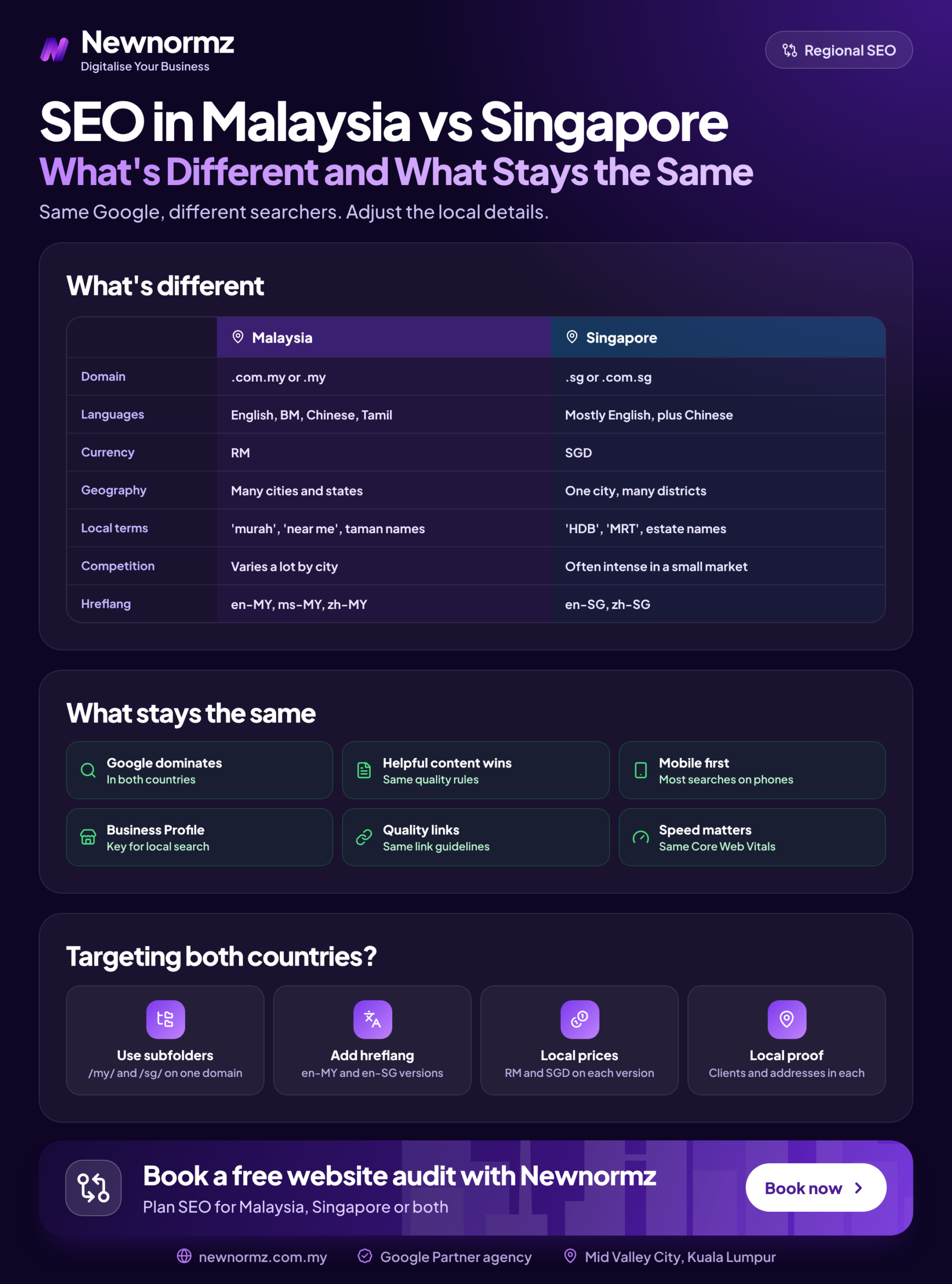
Competition differs too, but no single difficulty score settles it. Singapore is a smaller, concentrated market where regional brands often target the same English terms, so check your own keywords rather than assuming either country is easier.
What Stays the Same on Both Sides of the Causeway
Crawlable pages, sound Core Web Vitals, helpful content and relevant links matter in both countries. So does building trust signals with E-E-A-T, although the evidence you show should suit the reader’s market.
WhatsApp often remains the easiest enquiry path on both sides, so keep it prominent on mobile. Google has also said publicly that no one can guarantee a specific ranking position, and that applies in Kuala Lumpur and Singapore alike.
Google MY vs Google SG: Location Matters More Than the Domain
Google announced in 2025 that it would move country-domain searches to google.com, with results localised by the searcher’s location. “Google MY vs Google SG” is therefore really a question about location and language, not the web address.
Two people can use the same google.com address in Johor Bahru and Tampines and still see different results. Ranking in Singapore from Malaysia means earning relevance for searchers located there, so checking your rank from your own desk tells you little.
How to See What a Singapore Searcher Sees From Malaysia
Preview the results page
Open the Ad Preview and Diagnosis tool in Google Ads, set the location to Singapore and enter your keyword. It lets you look without adding a real impression to any ads.
Switch the country in Ahrefs or Semrush
Do your keyword research for Singapore in the Singapore database. Malaysian volumes and ranking competitors do not carry across.
Filter Google Search Console by country
In the Performance report, add a Country filter for Singapore. This shows the queries and pages already earning impressions there, which makes it your best evidence of real demand.
Treat each check as a sample
Results also vary by device and search history. Look for patterns across several keywords and dates, not one screenshot.
When Malaysia Should Stay Your Main SEO Focus
Statcounter puts Google at roughly 93 to 96% of Malaysian search, and DataReportal’s Digital 2026 report counts 35M+ internet users here. For many businesses, the larger opportunity is still at home.
You are a local-service business
A clinic, workshop or renovation contractor wins customers nearby. Start with ranking on Google Maps locally, because a Singapore page cannot help if those customers will not cross the border.
Your order value is low
Separate pages, proof and tracking are hard to repay from small baskets, especially once cross-border shipping comes out of the margin. If you are still building your base, see how smaller Malaysian businesses compete first.
Your delivery or staffing stops at the border
Traffic you cannot serve is wasted effort. Sort out the operations first, including who answers a Singapore enquiry and who does the work.
You have not captured Bahasa Malaysia demand
Language is a real difference between these markets, because Singapore gives you no equivalent of Malaysia’s BM demand. If multilingual SEO in Malaysia is unfinished, you may have closer customers still waiting.
When Singapore Earns Its Own SEO Budget
When it works
- High-value B2B with long customer relationships
- Professional services you can legally deliver there
- Cross-border services run from Johor Bahru
- Ecommerce that can ship and take payment in Singapore
When it doesn’t
- No Singapore address for a walk-in Maps strategy
- No local proof to show a Singapore buyer
- A sales team that cannot serve the market
Google Business Profile in Singapore follows the same guidelines as anywhere else: the business must make in-person contact with customers during its stated hours. That means a real location customers can visit, or staff who visit customers. A virtual office or mail drop is not a way around it.
Without Maps, you can still compete through organic pages. For the wider groundwork on expanding from Malaysia into Singapore, read that guide before you commit a budget.
One Website or Two: Regional SEO Structure for Both Markets
Regional SEO starts with one decision: where the Singapore pages live. The .com.my vs .com.sg domain debate is really a subfolder vs country domain SEO decision, weighing a clear country signal against the cost of building authority twice.
| Option | Authority | Cost | Upkeep | Best use |
|---|---|---|---|---|
| Subfolder (/sg/) | Most directly shares your existing domain | Lowest | One site, one CMS | Testing Singapore on an SME budget |
| Subdomain | Often needs more building of its own | Medium | Separate setup to maintain | A Singapore site that needs its own platform |
| .com.sg | Starts mostly from zero, with the clearest country signal | Highest | A second site, with its own links and content | A committed, staffed Singapore operation |
Our recommendation: most SMEs should start with a subfolder and hreflang. It is the cheapest way to find out whether Singapore pays. The limit is that a /sg/ section on a .com.my domain still carries a Malaysian country signal, so if the test proves demand but rankings stall, review a .com.sg site at that point.
For hreflang in Malaysia and Singapore, en-my vs en-sg simply tells Google which English page suits which country. Each page must list itself and its counterpart, and both must link back. It helps Google show the right version, but it does not lift a weak page. If you want a hand with the setup, we offer international SEO support.
Why Swapping “Malaysia” for “Singapore” Is Not Localisation
✗ Cloned pages with a find and replace on the country name
It looks quick, but the page adds nothing for a Singapore reader. Ringgit prices or a Malaysian compliance note then show them the page was not written for them.
✓ The fix
Change the pricing currency, proof, service coverage, regulations, FAQs and payment details, including PayNow or DuitNow. Use local vocabulary where it differs. If a page has nothing different to say, don’t publish a Singapore version of it.
If clones already exist, start by finding and fixing duplicate pages. Be just as careful if you plan to move existing URLs into a new structure, as this example shows.
Client example
My Lovely Baby: the cost of moving URLs without a plan
Problem: A site upgrade broke URLs and traffic dropped overnight. This was not a Singapore project, but any restructure carries the same risk.
What we did: We ran a migration audit and recovery.
Result: 100% of lost traffic was recovered, with 85% of target keywords on page 1 within 9 months.
Cost Comparison: A Worked RM Example for Adding Singapore
The real SEO Singapore vs Malaysia cost question is how many jobs it takes to pay back the spend. Every number below is illustrative, so treat this as an example and not a benchmark. Replace them with your own figures.
The example assumes RM4,500 a month of SEO spend, RM1,500 gross profit per Malaysian job and RM4,500 per Singapore job. On that spend alone, break-even is 3 Malaysian jobs versus 1 Singapore job. Singapore then needs extra work, assumed here as RM12,000 for page building spread over 12 months plus RM1,500 a month for links.
| Illustrative example | Malaysia | Singapore, same close rate | Singapore, lower close rate |
|---|---|---|---|
| Gross profit per job | RM1,500 | RM4,500 | RM4,500 |
| Assumed close rate | 30% | 30% | 10% |
| Profit per enquiry | RM450 | RM1,350 | RM450 |
| Monthly SEO spend | RM4,500 | RM4,500 | RM4,500 |
| Assumed pages and links, per month | RM0 | RM2,500 | RM2,500 |
| Total monthly cost | RM4,500 | RM7,000 | RM7,000 |
| Jobs to break even | 3 | About 1.6 | About 1.6 |
| Enquiries to break even, per month | 10 | About 5.2 | About 15.6 |
At the same close rate, Singapore needs about half the enquiries. At 10%, the case flips: each enquiry earns the same RM450 as a Malaysian one, the costs are higher, and you need over 50% more enquiries. A buyer who hesitates to hire across the border can erase the bigger margin, so test your close rate before scaling.
The RM4,500 is our published Growth price, excluding SST, used here as a round figure. International SEO sits in our Enterprise scope at RM6,800+ a month, which would lift the Singapore total to RM9,300 and break-even to about 2.1 jobs.
Timing matters as well. The timeline we give clients shows first ranking movement at day 60 to 90 and traffic and lead growth in months 4 to 8, so budget for months of spending before Singapore pays anything back. If you would rather have this assessed than do it alone, an SEO agency in Malaysia can check the assumptions against your own numbers.
Not sure your margins justify a Singapore section? Ask us to look at your current SEO position first.
How to Decide Between Malaysia, Singapore or Both
The multiples in the second row are a rule of thumb drawn from the maths above, not an industry standard.
Tracking Each Market Separately So You Know Which One Pays
Filter Search Console by country, then segment Google Analytics 4 by country and by the /sg/ folder. If you are unsure which report answers what, here is what Search Console and GA4 each show.
Separate your WhatsApp click events per market, or use a different number for each, because that is where many enquiries will otherwise blur together. Malaysia and Singapore have separate PDPA acts, so check with counsel that each form and tracking setup carries the right notice.
Malaysia vs Singapore SEO: Questions Business Owners Ask
Can one website rank in both Malaysia and Singapore?
Yes, one website can rank in both countries. It works best with separate country pages, hreflang and local proof, because one generic page rarely suits both audiences.
Do I need a .com.sg domain to rank in Singapore?
No, a .com.sg domain is not required to rank in Singapore. It gives a clear country signal, but it also means building a second site’s authority, so most SMEs should test a /sg/ subfolder first.
Is it harder to rank in Singapore than in Malaysia?
It depends on the keyword, so don’t assume either way. Compare the same terms in each country’s database in Ahrefs or Semrush, then look at who actually ranks for them.
Can I use the same content for Malaysian and Singapore pages?
You can reuse your core expertise, but not the page unchanged. Pricing currency, proof, service coverage, regulations, FAQs and payment details should all reflect the market the page serves.
How long does SEO take in a new country?
Expect several months at least, and no fixed date. The timeline we give clients is technical fixes in weeks 2 to 6, first ranking movement at day 60 to 90, traffic and lead growth in months 4 to 8, and compounding authority from months 8 to 12+. A new market may not follow it unchanged, because your domain, proof and competitors there are different.
Find out if your site is ready for Singapore, or should fix Malaysia first
Newnormz runs 200+ month-to-month SEO accounts, with strategists working in English, BM and Chinese.
Free, with no obligation.

Bryan Tan is an SEO Specialist and CEO at Newnormz, helping hundreds of businesses achieve first-page rankings on Google. With a passion for driving organic growth, Bryan blends innovative strategies with hands-on experience to optimize websites for maximum visibility. Always at the forefront of the latest SEO insights and trends, he consistently adapts to the evolving digital landscape.