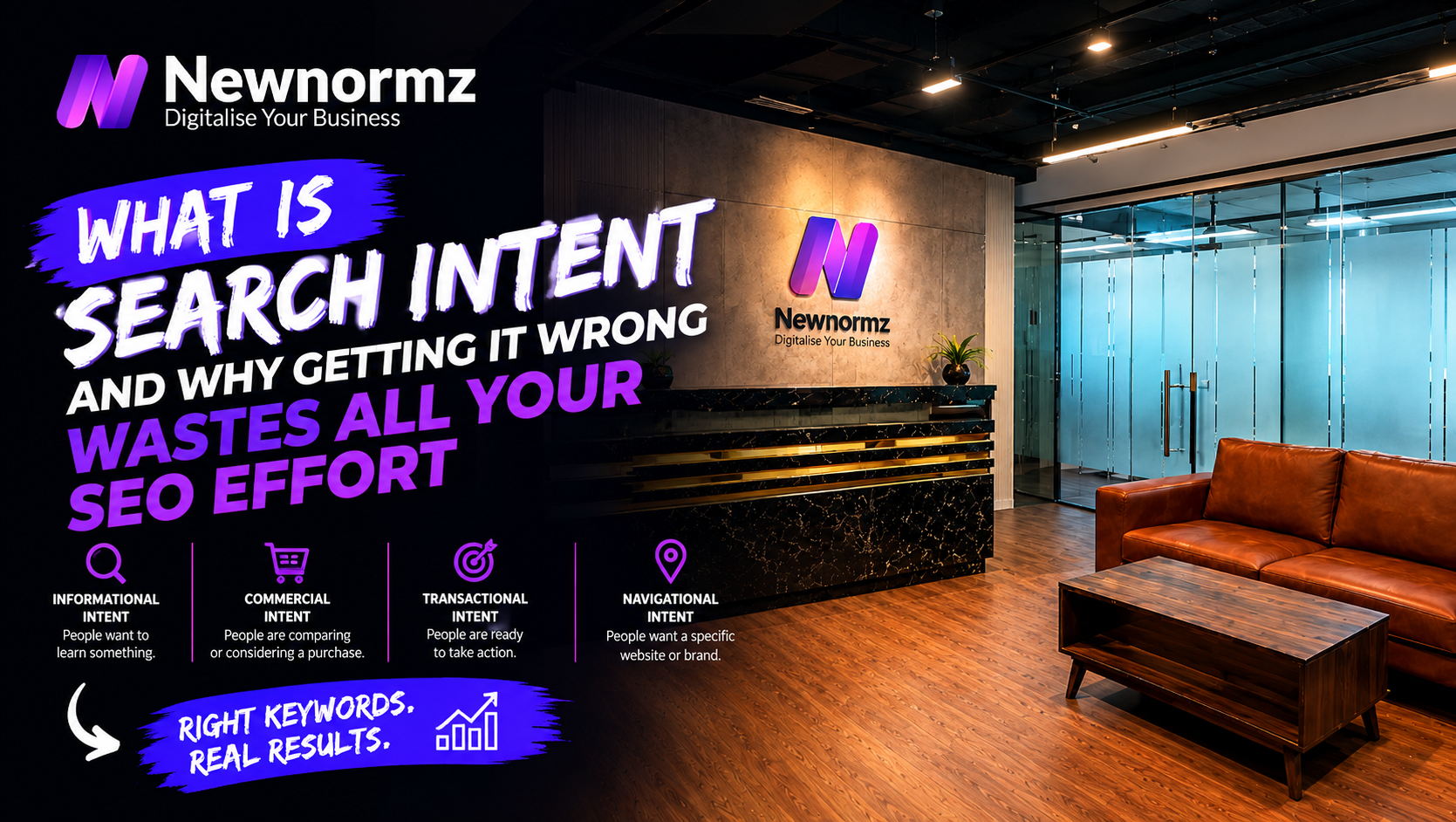
You pay an agency RM3,000 a month and the reports show keywords creeping up. Eight months later your main pages are still stuck on page 2 and WhatsApp is still quiet. In most audits we run, the cause is not lack of effort. It is search intent, meaning what the searcher actually wants to get done when they type a query. The core rule of search intent SEO Malaysia businesses need to know is simple: Google ranks the type of page that satisfies the query, not the page that tries hardest. Put the right keyword on the wrong kind of page and it rarely reaches page 1.
This guide is for Malaysian business owners and marketing managers who are paying for SEO and not seeing results. It covers the six intent mistakes we see most often, how to spot each one in the live Google results in five minutes, and how to fix them without throwing away the work you have already paid for.
Search Intent SEO Malaysia: Why the Right Keyword on the Wrong Page Never Ranks
Statcounter puts Google at roughly 93 to 96% of Malaysian search, so its idea of a “good result” is the only one that matters. Google learns that idea from billions of searches. If people who type a query keep choosing step-by-step guides, Google shows guides. If they keep choosing shop pages, it shows shop pages.
So you are not competing against the other pages on the topic. You are competing against what searchers have already shown they want. A beautifully written service page cannot beat ten guides for a “how to” query, because it answers a question nobody asked.
User intent SEO work is also why “doing everything right” sometimes fails. The technical work, links and content can all be sound, and the page still stalls because it is the wrong format for that search.
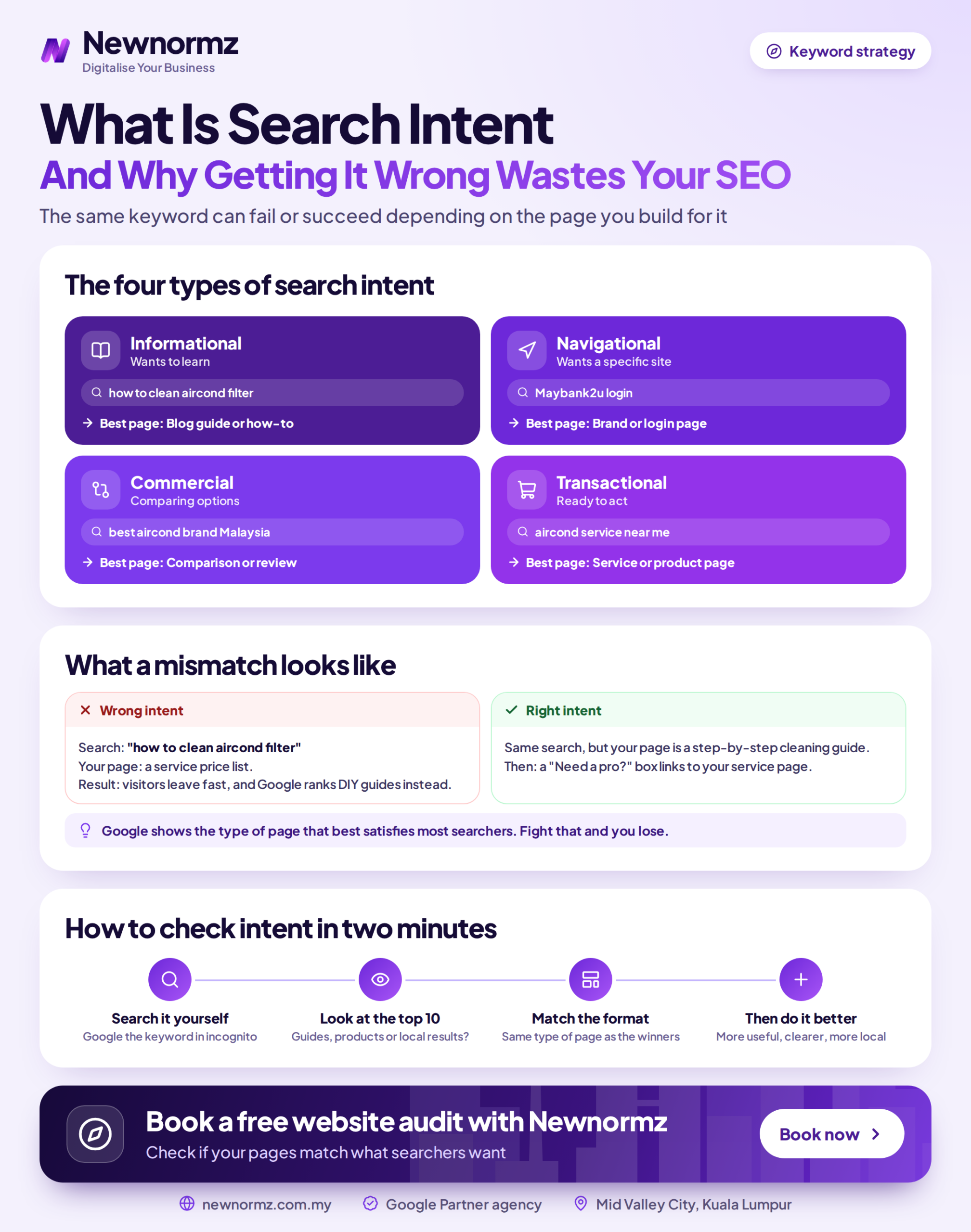
The Four Search Intent Types, With Malaysian Queries for Each
Intent is only one way to sort keywords. If you want the full picture, here are the main keyword types in SEO. For diagnosing a stalled campaign, though, the classic navigational, informational, transactional split (plus commercial investigation) is the one that counts.
| Intent | What the searcher wants | Malaysian example query | Page type that wins |
|---|---|---|---|
| Navigational | Reach a specific site or login | “maybank2u login” | The brand’s own page. Don’t target other brands’ navigational terms. |
| Informational | Learn how to do or understand something | “how to waterproof bathroom floor” | Guides, how-to posts, videos |
| Commercial investigation | Compare options before choosing | “best confinement centre kl review” | Comparisons, reviews, “how to choose” pages |
| Transactional | Buy or book now | “baby stroller harga”, “buy 3 in 1 coffee online” | Product, category and service pages |
| Local (a layer on top) | A business close enough to visit | “dentist near me”, “klinik gigi dekat saya” | Google Business Profile plus a location page |
Mistake 1: Pushing a Service Page for a “How To” Keyword
Picture a renovation contractor in Puchong targeting “how to fix roof leak” with its roof repair service page. The keyword has volume and looks relevant. But Google’s first page for it is DIY guides and YouTube videos, so the service page sits on page 3 no matter how many links point to it.
✗ Matching the topic but not the intent
This happens when the keyword list is built from search volume and nobody looks at what actually ranks. The result is a search intent mismatch: months of optimisation spent on a page Google will never treat as an answer to that query.
✓ The fix
Write the guide the searcher wants, including the honest part about when a leak needs a professional. Then link from the guide to the service page with a clear next step. Point the service page at transactional terms such as “roof leak repair puchong” instead.
From our audits
The pattern we see most often is a keyword list where every term is mapped to a service page because “that’s where the money is”. That is why the first step of our RANKED Framework is Revenue keywords: we pick terms by buying intent, then check the live results to confirm which page type can realistically rank for each one.
Mistake 2: Writing a Blog Post Where Google Wants a Product or Category Page
This is Mistake 1 in reverse. Search “baby car seat” in Malaysia and you’ll see shop category pages, Shopee and Lazada listings, and Shopping ads. A blog post titled “10 Things to Know About Baby Car Seats” is the wrong format for that page of results.
✗ Using content to chase purchase keywords
Blogs are easy to publish and category pages feel like a developer job, so stores take the easy route. The blog never ranks for the buying term, and the category page that could have ranked stays thin.
✓ The fix
Optimise the category page itself. Give it a useful intro, filters, clear prices in ringgit, delivery and stock details, and FAQ schema. Keep the blog for the informational side (“how to choose a car seat for a newborn”) and link it to the category.
My Lovely Baby shows how this plays out. The baby shop has 85% of its target keywords on page 1 within 9 months, including “baby shop”, “baby stroller” and “baby car seat”, and those are terms where shop pages win. Oriental Kopi is a similar case: we optimised its content around the words buyers actually type, such as “kopi”, “white coffee” and “3 in 1 coffee”, and ranked keywords grew 350%. If your catalogue is large, specialist SEO for online stores mostly comes down to getting category pages right.
Mistake 3: Ignoring Commercial Investigation, the Stage Where Malaysian Buyers Compare
Malaysian buyers compare a lot before they spend. Commercial investigation keywords contain words like “best”, “review”, “vs”, “terbaik” and “murah”, and they come from people who are close to buying but haven’t picked a supplier yet.
✗ Jumping from blog post straight to “contact us”
Most sites have awareness content and a service page, with nothing in between. Comparison searchers end up on directories, forums and competitor review pages, and they make their shortlist there.
✓ The fix
Build “how to choose” pages, honest comparisons (including when a cheaper option makes more sense) and transparent pricing pages. Name the criteria a careful buyer would use. That candour is what gets your page bookmarked and shared on WhatsApp.
Mistake 4: Treating Local Intent as Ordinary Organic Intent
Local search intent changes what the results page looks like. When a query brings up a map pack (the Google Maps results), the top of the screen is Business Profiles, not web pages. A great page on its own will not get you into those three slots.
✗ Optimising the website and ignoring Google Business Profile
For “near me” and “dekat saya” searches, the right category, reviews, photos and consistent address details on your profile count as much as the page does. Leave the profile half filled in and you’re missing from the part of the results that gets the calls.
✓ The fix
Treat the profile and the location page as one asset. Match the service names on both, link the profile to the most relevant page (not the homepage), and write location pages that answer local questions such as parking, opening hours and the areas you serve.
Sunway TCM Centre ranks for “Acupuncture KL”, “TCM Malaysia” and “Best TCM in Klang Valley”, with 80% of its target keywords on page 1 within 4 months. Look at the wording of those terms: a treatment plus a place. Those are local-intent queries, and the pages built for them have to answer both halves. If map results show up for most of your keywords, it’s time to look at proper local SEO in Malaysia.
Mistake 5: Mixing Two Intents on One Page
A 3,000-word guide with a booking form every two paragraphs is trying to rank for “what is X” and “X price KL” at the same time. In practice it usually ranks for neither. The guide reader feels sold to, and the buyer has to scroll through a lecture.
✗ Building a hybrid page because it feels efficient
One page per topic looks tidy in a content plan. But Google reads what a page is for, not only the words on it, and a page with two jobs sends mixed signals about which searches it should answer.
✓ The fix
Use this rule to choose the content type for search intent. If the top 3 results share one page type, build that type. Only build a hybrid if the top 10 is genuinely split, for example four guides, four service pages and two directories.
The reason this works is that Google reads a page’s purpose from its structure, headings and entities, not just its keywords. Here is a longer explanation of how Google reads meaning, not just keywords.
Mistake 6: Measuring an Informational Page on Leads
This mistake happens in the reporting, not on the page, and it causes good content to be deleted. A guide gets judged on direct WhatsApp enquiries, scores close to zero, and someone decides “content doesn’t work for us”.
✗ Expecting guides to convert like service pages
Informational readers are early in the journey. They rarely message you on the first visit, but many come back later through a branded search or a service page.
✓ The fix
In Google Analytics 4, set WhatsApp click tracking, calls and form submissions up as key events. Then judge guides on internal clicks to service pages and assisted conversions in the attribution reports. That’s the Data loop step of our RANKED Framework: every call, WhatsApp chat and form is tied back to the page that started it.
A guide that sends readers to your service page has done its job, even if none of them messaged you from it.
Search intent and conversions are connected, but the connection runs across several pages and several visits. For the full method, see our guide to measuring real returns from organic search.
How to Identify Search Intent in Five Minutes (No Paid Tools Needed)
A proper keyword intent analysis does not need software. It needs the live results page, looked at the way your customers see it. Here is the SERP analysis we run first for every target keyword.
Search like a Malaysian customer
Use your phone, in a private window, logged out, from a Malaysian location. Your desktop results are shaped by your own history and will make your site look better placed than it really is.
Count the page types in the top 10
Tally guides, service pages, category or product pages, comparisons, directories and marketplace listings. Seven or more of one type gives you a clear answer.
Note the SERP features
An AI Overview or People Also Ask box points to informational intent. A map pack means local. Shopping ads or Shopee and Lazada listings mean transactional. Video results mean people want to be shown how. The People Also Ask questions also give you a ready-made outline for question-based content that wins searches.
Check the language of the ranking pages
This is the keyword intent Malaysia check most tools skip. If “harga” or “terbaik” queries bring up mostly Bahasa Malaysia pages, an English page is fighting the wrong battle. The same applies to Chinese-language results for some product and medical searches.
Find existing mismatches in Google Search Console
Open the Performance report, filter by page and sort queries by impressions. Queries with high impressions, an average position on page 1 and a CTR under about 1% are a common sign that the page is showing up but isn’t what searchers want.
Semrush and Ahrefs both label keyword intent, and those labels are handy for sorting a list of 500 terms. They are estimates, though. When a tool label and the live results page disagree, go with the live results.
What an Intent Mismatch Actually Costs You in Ringgit
Intent errors feel abstract until you put a number on them. You can check this against your own keyword list in about ten minutes.
Worked example (illustrative maths, not a client case)
Our SEO Starter package is RM2,900 a month for 20 target keywords, or about RM145 of effort per keyword. If 6 of those 20 are mapped to the wrong page type, about 30% of the monthly work (roughly RM870) goes into pages Google is unlikely to rank. Over 12 months that’s around RM10,440. On a RM5,000 retainer with the same ratio, it’s RM1,500 a month.
Run the five-minute check on each keyword in your report and count the mismatches. If you find more than a few, the problem is the keyword mapping, not your budget or your patience. Fixing intent across a full keyword set means page rebuilds, new comparison content and tracking setup, and it’s the sort of work a good SEO agency in Malaysia should do before spending a single month on links.
Search Intent in AI Overviews and ChatGPT Answers
AI answers make intent matter even more. Informational queries are the ones most likely to trigger Google AI Overviews, and industry studies show about 76% of AI Overview citations come from pages already in the traditional top 10. A page that misses the intent and never reaches the top 10 is also left out of the AI answer.
Commercial investigation queries work the same way in ChatGPT. Times Parking is named in ChatGPT answers for “best LPR parking provider”, a typical “best X” comparison query. ChatGPT also names Oriental Kopi for the best kopi brand in Malaysia. Sunway TCM Centre appears in AI Overview results for treatment searches.
The lesson for user intent SEO is the same as before: answer the question that was actually asked, in the format the searcher expects, and you become citable. Here is more on how generative search changes SEO.
Fix or Rebuild? A Decision Rule for Pages With the Wrong Intent
Most guides stop at “match the intent”. The harder question is what to do with the page you already have. The rule underneath every row below is the same: keep the URL wherever it already has authority.
| Your situation | What to do | Why |
|---|---|---|
| Page has backlinks and some rankings, but the wrong format | Rewrite in place to match the winning page type | The URL’s authority carries over to the new version |
| Page has no links, rankings or traffic | Create a new page of the right type and link to it from related pages | There’s nothing to protect, so start clean |
| Right format, wrong language (English page, Bahasa Malaysia results) | Add a BM version on its own URL with hreflang, linked both ways | Each language version can rank for its own searches |
| Blog post targeting a buying term that a category page should own | Retarget the post to an informational variant and link it to the category | Both pages keep their value, each with one job |
| Two pages competing for the same keyword | 301 merge the weaker page into the stronger one | Combines the signals of both pages instead of splitting them |
FAQ
What are the 4 types of search intent in SEO?
The four search intent types are navigational, informational, commercial investigation and transactional. Local intent sits on top of these when the searcher wants something nearby, which is why “near me” and “dekat saya” searches show a map pack.
How do I check the search intent of a keyword?
Search the keyword on your phone, logged out, and count which page type fills the top 10. Then look at the extra features on the page (AI Overview, People Also Ask, map pack, Shopping results), because each one points to a particular intent.
Can one page rank for both informational and transactional intent?
Only when Google’s own results are genuinely split between the two. In most cases the top 3 results share one page type, and a page built for that single intent will outrank a hybrid.
Why is my page ranking but not getting enquiries?
Usually because it ranks for informational queries from people who aren’t ready to buy yet. Check the queries in Google Search Console. If they’re “how” and “what” searches, add a clear path to your service page and measure the page on assisted conversions instead.
Does search intent differ between English and Bahasa Malaysia searches?
Yes, often. A Bahasa Malaysia query with “harga” or “murah” can show quite different pages from its English equivalent, so check each language separately rather than assuming the same page will win both.
Should I rewrite an existing page or create a new one when the intent is wrong?
Rewrite in place if the page already has backlinks or rankings, and create a new page if it has nothing to protect. If two pages compete for the same keyword, 301 merge the weaker one into the stronger.
Want to know which of your target keywords are sitting on the wrong page type?
Newnormz runs SEO for 200+ Malaysian businesses on month-to-month terms, with a written page 1 guarantee and a 5.0 rating from 214+ Google reviews. Send us a WhatsApp message and a strategist will reply within business hours.
Prefer a form? Free SEO audit

Bryan Tan is an SEO Specialist and CEO at Newnormz, helping hundreds of businesses achieve first-page rankings on Google. With a passion for driving organic growth, Bryan blends innovative strategies with hands-on experience to optimize websites for maximum visibility. Always at the forefront of the latest SEO insights and trends, he consistently adapts to the evolving digital landscape.