
Key takeaways
- ✓This guide shows how to find keywords Malaysia customers actually search for, without Ahrefs or Semrush. Put six free sources into one spreadsheet, set aside about three hours, and finish with a 20-keyword shortlist ranked by how directly each term brings in money.
- ✓The six sources are your WhatsApp Business chats and enquiry forms, Google’s own search surfaces, Google Search Console, Google Keyword Planner, Bing Webmaster Tools and, if you sell products, Shopee and Lazada autocomplete.
- ✓A commercial keyword with 590 searches a month can be worth more than an informational one with 5,000, so score your list on intent and job value before volume.
- ✓Free data won’t give you exact volumes or your competitors’ keyword lists. If you have about 20 target keywords and one location, that gap rarely matters.
How to Find Keywords Malaysia Customers Use: What to Set Up First
This is a desk exercise, not a software purchase. Set up the items below first and the six steps will run without interruptions. If your website is brand new, skip the Search Console step for now and come back to it after three months.
Set up before you start
- ✓A spreadsheet with five columns: Keyword, Source, Language, Intent, Notes.
- ✓Your last three months of WhatsApp Business chats, enquiry form submissions and call notes.
- ✓Google Search Console verified for your domain (only if the site is at least a few months old).
- ✓A Google Ads account. It doesn’t need a live campaign or any spend.
- ✓A Bing Webmaster Tools account, which can import your site straight from Search Console.
Before You Open Any Tool, Write Down What Customers Actually Type
The best keyword source in Malaysia costs nothing and sits on your phone. Open WhatsApp Business and read your last 50 enquiries. Copy every phrase a customer used to describe what they wanted, exactly as they typed it, typos and all.
An aircond servicing company in Puchong might find messages like “aircond servis puchong ada slot sabtu?”, “berapa harga chemical wash 1.5hp” and “冷气维修 蒲种”. None of those would come out of a tool that starts from your English service names. Do the same with enquiry forms and the questions your sales team hears on calls.
Malaysia note
Customers search in Bahasa Malaysia, Manglish and Chinese, but most business websites are written only in formal English. That mismatch is why keywords in Bahasa Malaysia are often the easiest wins: demand is real, and few competitors have a page that matches the phrasing. Log the language of every phrase in your spreadsheet so you can see the split.
This step also gives you seed terms for everything that follows. For more background on how local audiences phrase searches, see our guide to keyword research for Malaysian audiences.
Step-by-Step: A Free Keyword Research Workflow for Malaysian Businesses
Free keyword research Malaysia SMEs can run themselves works best in a fixed order. Each tool adds something the one before it can’t show. Google tells you what people type, Search Console what you already rank for, Keyword Planner and Bing roughly how much demand there is, and Trends when it peaks.
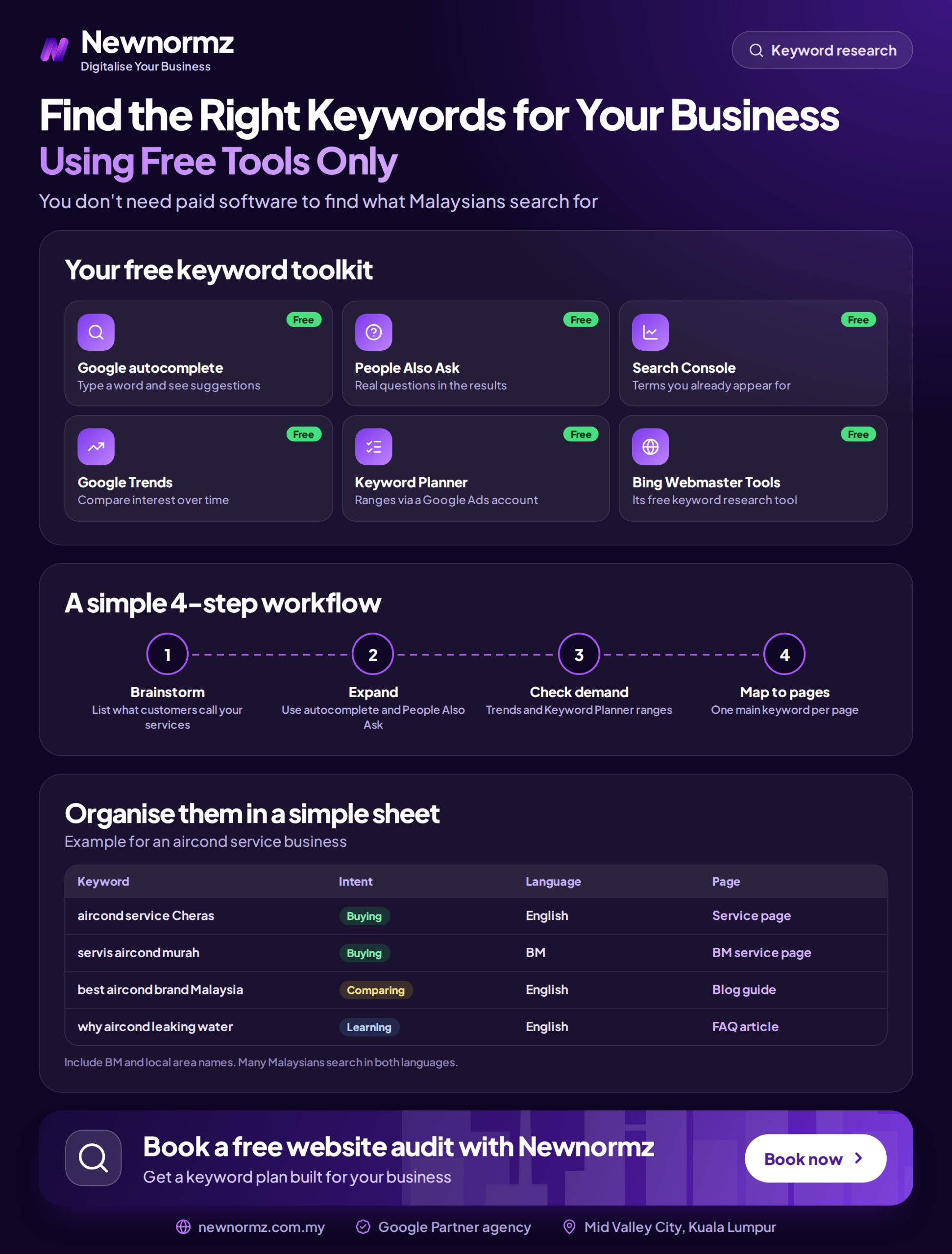
Step 1: Find Keywords Google Suggests Before You Finish Typing
Open an incognito window so your search history doesn’t skew the suggestions, and go to google.com.my. Type each seed term slowly and note every autocomplete suggestion. Then add letters after it (“aircond service a”, “aircond service b”) and modifiers such as “harga”, “murah”, “24 jam” and “near me”.
On each results page, open every People Also Ask box (each one you open loads more questions) and copy the related searches at the bottom. Questions go into your spreadsheet tagged as informational, because they usually become FAQ answers or blog posts rather than service pages.
For local businesses, repeat the process in the Google Maps search bar. Maps suggestions surface the local keywords near me searchers use, such as “aircond service near me 24 jam”, plus neighbourhood names like Bandar Puteri or Taman Kinrara. If Maps is where your customers find you, our guide to local SEO in Malaysia covers what to do with those terms.
Step 2: Pull the Keywords You Already Rank For From Google Search Console
Google Search Console keywords are the only free data based on your own site’s real performance. The useful ones are queries where Google already shows you, but on page 2 or the bottom of page 1.
Open the Performance report
Go to Performance, then Search results, and set the date range to the last three months.
Filter to Malaysia
Add a Country filter set to Malaysia so overseas impressions don’t distort the list.
Switch on impressions and position
Tick Total impressions and Average position, then export the Queries table to Google Sheets.
Keep positions 8 to 30
Filter the sheet to an average position between 8 and 30 and sort by impressions. These are your cheapest wins, because Google already sees your site as relevant to them.
From our audits
Most position 8 to 30 queries already have a page that half answers them. Usually the fix is a sharper title, a new section or a better internal link to that page, not another new page. A new page often splits the signal and makes both rank worse.
Step 3: Get Volume Ranges From Google Keyword Planner Without Spending
You can use Google Keyword Planner free. If account setup pushes you to create a campaign, switch to Expert Mode and create the account without one. Then open Tools, Keyword Planner, Discover new keywords, and paste in up to ten seed terms from your spreadsheet.
Set the location to Malaysia so you see search volume Malaysia-wide rather than global figures. For language, choose “All languages” or run English, Malay and Chinese separately, because BM and Chinese terms are easy to miss otherwise. Accounts with little or no ad spend see ranges (such as 100 to 1K) instead of exact figures. That’s still enough to separate a 10-search term from a 1,000-search one.
The column most people ignore is the top-of-page bid. Advertisers bid more on clicks that turn into money, so a keyword with a high bid relative to the others on your list is a free signal of commercial value. Highlight anything near the top of your bid range.
Step 4: Use Bing Webmaster Tools for Real Numbers
Bing Webmaster Tools has a free Keyword Research tool that shows actual Bing search counts, filterable by country and language. This is where you get single numbers rather than ranges.
Keep the scale in mind. Statcounter puts Google at roughly 93 to 96% of Malaysian search, so Bing’s figures are a small slice of the market. Use them for ratios: if Bing shows “aircond service puchong” at three times “aircond cleaning puchong”, Google demand is probably in a similar proportion.
Step 5: Check Seasonality and BM vs English Interest in Google Trends
In Google Trends, set the region to Malaysia and compare an English term with its BM equivalent, such as “aircond service” against “servis aircond”. The chart shows which phrasing dominates and whether demand rises around periods like Hari Raya or Chinese New Year, which tells you when content needs to be live.
Trends shows relative interest, not volume, and for very low-volume niche terms it often returns nothing useful or a jagged line. Use it for your bigger head terms only. Our guide to building a Google Trends keyword strategy covers the comparison settings in more detail.
Step 6 (Ecommerce Only): Mine Shopee and Lazada Search Bars
Type your product category into the Shopee and Lazada search bars and record the autocomplete suggestions. Marketplaces show the modifiers shoppers actually use: sizes, brands, colours, “murah”, “original”, “ready stock”. These become category and product page keywords.
Turn 200 Raw Ideas Into a 20-Keyword Shortlist That Brings in Enquiries
By now you should have 150 to 250 phrases. Remove duplicates, then score each one from 1 to 3 on four things: intent (does the searcher want to buy?), relevance (do you actually sell this?), competition (judged by hand, below) and value (what is a customer worth?). Commercial intent keywords score highest because they are the ones that turn into enquiries.
| Keyword | Intent | Relevance | Competition (page 1 check) | Value | Score /12 |
|---|---|---|---|---|---|
| aircond service puchong | 3 | 3 | 2 (map pack, local sites) | 3 | 11 |
| servis aircond puchong murah | 3 | 3 | 3 (small sites only) | 2 | 11 |
| aircond chemical wash price | 2 | 3 | 2 | 3 | 10 |
| aircond service malaysia | 2 | 3 | 1 (directories, big brands) | 2 | 8 |
| why aircond leaking water | 1 | 2 | 2 (AI Overview present) | 1 | 6 |
Why 590 Searches Can Beat 5,000
Here is the maths, using assumptions rather than measured data. A commercial term with 590 searches a month, an assumed 5% click share and an assumed 5% enquiry rate gives about 30 visits and 1.5 enquiries a month. That’s about 18 a year. At an RM800 job value, the term is worth up to about RM14,000 a year before your close rate.
Now take an informational term like “how does aircond work” at 5,000 searches. The same 5% click share brings 250 visits, but people asking how an aircond works are not booking a service, so the enquiry rate is close to zero. The bigger number pays for nothing. Most long tail keywords Malaysia customers type follow the same pattern: fewer searches, far more buyers. Our piece on why long-tail phrases convert better goes further.
Volume tells you how many people are asking. Intent tells you how many of them are ready to pay.
Keep the top-scoring 20 or so. That’s a deliberate limit: it’s the same number of target keywords the Newnormz Starter plan works on, and it’s about as many as a small team can write and maintain pages for properly.
How to Judge Keyword Difficulty Without a Difficulty Score
Keyword research without Ahrefs means replacing the difficulty score with your own eyes. Search each shortlisted term in incognito and look at three things on page 1:
- Who ranks. Directories, marketplaces and national brands are hard to displace. Small local sites with thin pages are beatable.
- A map pack. If one appears, your Google Business Profile matters as much as your website.
- An AI Overview at the top. Clicks on informational terms get squeezed, so they drop down your priority list unless being cited is the goal.
How to Check Your Shortlist Is Working
Once pages are live and optimised, check Search Console monthly for your 20 terms, filtered to Malaysia. Rising impressions come before rising clicks. Newnormz tells its own clients to expect first ranking movement from day 60 to 90, so don’t rewrite the list after three weeks.
Mistakes We See When Businesses Do Their Own Keyword Research
Keyword research for small business owners goes wrong in the same three ways over and over.
✗ Chasing the national head term
A Shah Alam law firm targets “lawyer malaysia” and competes with directories and the country’s largest firms for searchers who may live in Penang.
✓ The fix
Target the city and service together (“divorce lawyer shah alam”, “conveyancing lawyer klang”) and earn the national term later.
✗ Ignoring BM and Chinese variants
The list is 100% English because the website is, so whole groups of real searchers never see a matching page.
✓ The fix
Keep at least a few BM and Chinese terms from your WhatsApp list in the shortlist, and give each one a properly written page, not machine translation.
✗ Giving the same keyword to several pages
The homepage, a service page and two blog posts all target “aircond service puchong”, and Google keeps switching between them.
✓ The fix
Add a “Target page” column to your spreadsheet: one keyword, one page. Our guide to fixing keyword cannibalisation shows how to merge or redirect the duplicates.
Built your shortlist and want a second opinion before writing pages? We’ll review it against your site.
Where Free Tools Run Out (and What Paid Tools Actually Add)
Free keyword research tools cover most of what a single-location business needs. Here is what they can’t do, and how much that matters.
| Need | Free tools route | What Ahrefs or Semrush add |
|---|---|---|
| Search volume | Keyword Planner ranges plus Bing ratios | A single estimate per keyword (still modelled, not exact) |
| Competitor keyword gaps | Manual page 1 checks, one term at a time | Full list of terms a competitor ranks for and you don’t |
| Backlink data | Search Console Links report (your site only) | Backlink profiles for any domain |
| Rank tracking history | Search Console average position, 16 months | Daily positions, including competitors |
If you want to see which free tools hold up beyond keyword research, here are the free SEO tools we have tested.
When the list grows past what you can manage by hand, an SEO agency in Malaysia with paid data and multilingual strategists can take over research and tracking, so your team can focus on running the business.
How Newnormz Chooses Keywords That Pay for Themselves
The first step of our RANKED Framework is Revenue keywords, the same money-first scoring described above. Our strategists work in English, Bahasa Malaysia and Chinese, so multilingual variants go on the list from the start instead of being added later.
Client example
Sunway TCM Centre: 80% of target keywords on page 1 within 4 months
Problem: The site needed a technical rebuild, and crawl and indexing issues were holding it back.
What we did: Fixed crawling and indexing, restructured content for AI answers, and targeted a mix of a national term (“TCM Malaysia”), a city-modified service term (“Acupuncture KL”) and a comparison term (“Best TCM in Klang Valley”).
Result: +150% keywords, 80% of target keywords on page 1 within 4 months.
Product variants multiply reach in the same way. Oriental Kopi’s content was built around “kopi”, “white coffee” and “3 in 1 coffee” rather than one brand term, and ranked keywords grew 350%. For ecommerce, My Lovely Baby focused on category terms like “baby shop”, “baby stroller” and “baby car seat”, and reached 85% of target keywords on page 1 within 9 months.
A keyword list only pays off once the pages are written well. Our guide to writing content around your keywords picks up where this one stops. Newnormz runs SEO for 200+ Malaysian businesses on month-to-month terms, with a written page 1 guarantee and a 5.0 rating from 214+ Google reviews.
FAQ: Finding Keywords in Malaysia for Free
Can I do keyword research in Malaysia without paying for Ahrefs or Semrush?
Yes. Search Console, Keyword Planner, Bing Webmaster Tools, Google Trends and your own customer enquiries cover what a single-location business needs. Paid tools mainly add competitor data and single volume estimates.
Why does Google Keyword Planner only show search volume ranges like 100 to 1K?
Google shows ranges to accounts with low or no ad spend and reserves more precise figures for accounts that spend more. Ranges are still useful for comparing keywords, and Bing Webmaster Tools can fill in relative numbers.
How do I find keywords my website already ranks for?
Open the Performance report in Google Search Console and filter the country to Malaysia. Export the queries and look at those with an average position of 8 to 30 first.
Should I target Bahasa Malaysia keywords as well as English ones?
Yes, if your customers use them, and your WhatsApp enquiries will tell you. BM terms often have fewer competing pages, but they need properly written content, not a machine translation.
How many keywords should a small business website target at the start?
About 20, each assigned to one page. That’s enough to cover your main services and locations without spreading your content too thin.
Is Google Trends accurate for small Malaysian search volumes?
Not very. Trends shows relative interest, and for niche terms with little volume it often returns no data or an erratic line. Use it for broader terms and seasonality.
What is a good keyword for a new website with no backlinks?
A specific, commercial long-tail phrase where page 1 is mostly small sites, such as a service plus a neighbourhood. Avoid terms dominated by directories, marketplaces or national brands until the site has some authority.
Free SEO audit
Find out which keywords your site is closest to winning
- ✓A review of your keyword shortlist, scored for intent and value
- ✓The BM and Chinese variants your competitors are missing
- ✓A strategist to talk it through on WhatsApp at +60 17-588 2291

Bryan Tan is an SEO Specialist and CEO at Newnormz, helping hundreds of businesses achieve first-page rankings on Google. With a passion for driving organic growth, Bryan blends innovative strategies with hands-on experience to optimize websites for maximum visibility. Always at the forefront of the latest SEO insights and trends, he consistently adapts to the evolving digital landscape.