Grey hat SEO is the set of tactics that are not clearly banned but are designed to get around the spirit of Google’s rules, such as buying guest posts, using expired domains, or mass-producing content with AI. They can work for a while. They also tend to stop working without warning, and Google has never promised that anything in this zone is safe. If your business depends on Google traffic, treat grey hat as borrowed performance with interest attached.
A Simple Way to Think About It
The Unmarked Parking Spot
🚗 The kerb with no sign
Nobody has ever told you not to park here, and plenty of cars do. Then one morning there is a summons on your windscreen and no one to argue with.
🅿️ The marked bay
A few steps further to walk and slightly less convenient. In return, you never think about it again.
Below, we look at which SEO tactics are the unmarked kerb, and how to tell them apart from the real bays.
What grey hat SEO actually means
SEO is usually described in three colours. White hat follows Google’s guidelines. Black hat breaks them openly, with things like cloaking, hacked sites and hidden text. Grey hat is everything in between: tactics that are not obviously prohibited, or that Google tolerates in small doses, but whose purpose is to manipulate rankings rather than earn them.
The honest problem is that “grey” is a label agencies use, not one Google uses. Google’s published spam policies cover link spam, scaled content abuse, expired domain abuse and site reputation abuse. Many popular grey hat tactics sit right on top of those categories. Whether you get away with it depends on scale, timing and how much attention your site attracts, not on whether it is technically allowed.
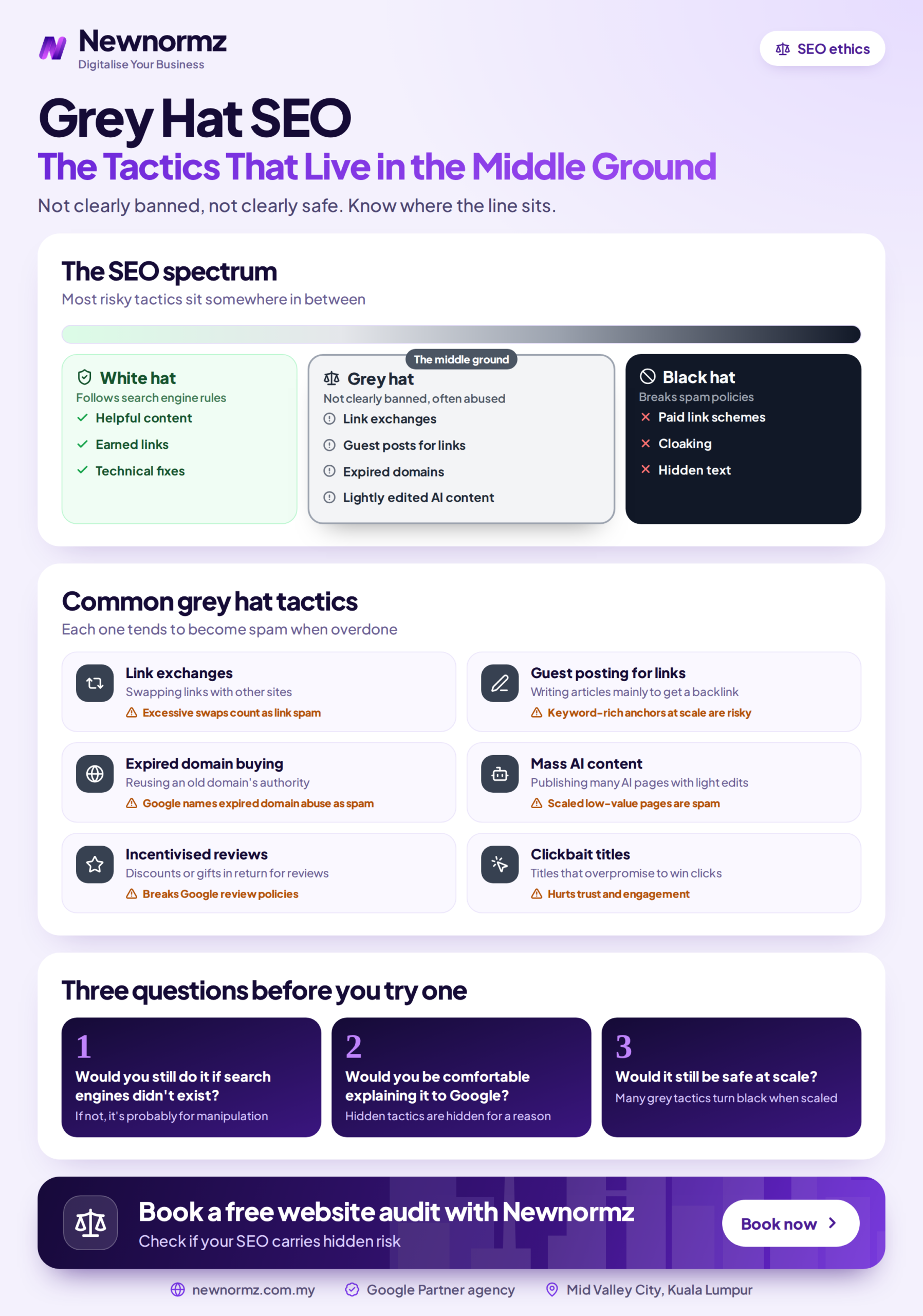
The grey hat tactics Malaysian businesses get offered most
If you have ever received a cold WhatsApp or email promising “DA 50 backlinks, fast results, RM300”, you have met grey hat SEO. These are the tactics we see most often when we audit sites in Malaysia.
| Tactic | Why it is grey | Real risk |
|---|---|---|
| Paid guest posts | Publishing is normal. Paying purely for a followed link goes against Google’s link spam policy. | Links get discounted or a manual action is applied. |
| Expired domains with old backlinks | Buying a domain is legal. Using it to borrow its authority is what Google calls expired domain abuse. | Rankings collapse after a spam update. |
| Mass AI content | AI use is allowed. Publishing hundreds of pages mainly to rank is scaled content abuse. | Whole site loses visibility, not just the weak pages. |
| Link exchanges | A few genuine partner links are normal. Large-scale swapping is link scheming. | Low. It usually just stops helping. |
| Incentivised reviews | Asking for reviews is fine. Rewarding only positive ones breaks review policies. | Reviews removed, profile suspended. |
| Exact-match anchor text everywhere | Anchors are a legitimate signal. Forcing the same keyword on every link looks engineered. | Over-optimisation filters, unstable rankings. |
Why it keeps working just long enough to tempt you
Grey hat SEO survives because Google’s systems are not instant. A tactic can lift rankings for weeks or months before an update catches up. During that window the agency reports a win, and you see a graph going up. The cost arrives later, usually as a sudden drop that is hard to diagnose and slow to recover from.
It also hits some businesses harder than others. A local clinic, restaurant or service business in Malaysia often relies on a handful of searches for most of its enquiries. Google holds roughly 93 percent of Malaysian search market share (Statcounter, May 2026), so losing rankings there is not something you can offset with another channel overnight.
What the safe version looks like
Most grey hat tactics are a shortcut version of something that works properly. The shortcut is tempting because the proper version takes longer. Here is how the same goal looks done cleanly.
- Instead of buying links: publish something worth citing, such as local data, a genuine guide or a useful tool, and pitch it to relevant Malaysian publications and industry bodies.
- Instead of mass AI pages: use AI as a drafting aid, then have someone with real experience edit each page and add what only your business knows.
- Instead of fake or incentivised reviews: build a simple process that asks every customer after service. Our local SEO work usually starts here because it is cheap and sustainable.
- Instead of expired domain tricks: invest in your own domain’s history. It compounds.
Clean SEO is slower to start but it does compound. Oriental Kopi’s two-year campaign added 24,500 more ranking keywords and 468,000 clicks, and Sunway Medispa saw a 700 percent traffic increase over six months. Neither depended on a trick that could be reversed by a spam update.
How to spot a grey hat agency before you sign
You do not need technical knowledge to catch this. You need to ask a few direct questions.
| Question to ask | Red flag answer |
|---|---|
| Where will the backlinks come from? | “Our private network” or “we cannot disclose the sites.” |
| Can I see the sites linking to me each month? | Vague reports with only a link count. |
| What happens if Google updates its algorithm? | “Our methods are update-proof.” |
| Do you guarantee the number 1 position? | “Yes.” Google has said repeatedly that no one can guarantee a specific position. |
If you are comparing providers, our guide to choosing an SEO agency in Malaysia goes through what a transparent engagement should include.
Is grey hat ever worth it?
For a throwaway test site you do not mind losing, maybe. For a business with a real brand, real customers and a domain you want to still be ranking in three years, no. The upside is a temporary lift. The downside is a penalty or algorithmic demotion that can take months to unwind, and sometimes never fully recovers. That is a poor trade for most Malaysian SMEs.
Frequently asked questions
Is grey hat SEO illegal in Malaysia?
No. It is not a legal issue, it is a search engine policy issue. The penalty comes from Google, not from the law, though fake reviews can create separate consumer protection problems.
Can Google detect grey hat tactics?
Often, yes, but not always immediately. Google uses automated systems and manual reviewers. Detection tends to come in waves during spam updates, which is why drops feel sudden.
How do I know if a past agency used grey hat tactics on my site?
Review your backlink profile for unrelated foreign sites, repeated exact-match anchors and links from pages that exist only to sell links. Also check Google Search Console for any manual action notice.
Can I recover after a grey hat penalty?
Usually, yes, but it takes work: removing or disavowing bad links, fixing content and, for manual actions, filing a reconsideration request. Recovery time varies and nobody can promise a date.
Worried your SEO has shortcuts in it?
Get an honest read on what is helping and what is putting your rankings at risk
Newnormz has run SEO campaigns across F&B, healthcare, ecommerce, and local services in Malaysia, backed by a performance guarantee of 70 percent of targeted keywords on Google’s first page.
30 minutes, no obligation, including a review of your backlink profile.

Bryan Tan is an SEO Specialist and CEO at Newnormz, helping hundreds of businesses achieve first-page rankings on Google. With a passion for driving organic growth, Bryan blends innovative strategies with hands-on experience to optimize websites for maximum visibility. Always at the forefront of the latest SEO insights and trends, he consistently adapts to the evolving digital landscape.