SEO for a Malaysian SaaS company is not a traffic exercise. Software buyers research for weeks before they commit, so your site has to meet them at every stage: the problem they search for, the options they compare, and the feature they need. Done well, organic search becomes a channel that compounds and lowers your cost per acquired customer over time. Done badly, it brings visitors who never sign up. No one can honestly promise you a specific ranking position, but you can control whether your pages are built to turn search demand into trials and demos.
A Simple Way to Think About It
Handing Out Flyers vs Answering the Question at the Counter
📄 The flyer at the mall entrance
You hand a leaflet to everyone who walks past. Thousands take one. Almost none of them were looking for what you sell.
🛎️ The person at the counter
Someone walks up and asks for exactly the thing you make, and for who it suits. You only need a clear answer.
The sections below show how to build the second kind of visibility, and why it matters more for software than almost any other category.
Why SaaS SEO Is Different From Standard SEO
A retail brand or a clinic wants footfall and phone calls. A SaaS company wants someone to start a trial, book a demo, or ask for pricing. The buyer is usually solving a business problem, comparing several tools, and often involving more than one person in the decision. That changes how you choose keywords, what you publish, and what you measure.
| Area | Generic SEO | SaaS SEO |
|---|---|---|
| Main goal | Awareness and footfall | Trial sign-ups, demos, qualified pipeline |
| Core pages | Service pages and blogs | Use case pages, comparison pages, feature pages |
| Keywords | Broad, high volume | Long-tail, intent-driven, tied to a problem or feature |
| Conversion | Call or visit | Free trial, demo booking, sign-up |
| Success measure | Rankings and traffic | MQLs, cost per acquisition, pipeline contribution |
The practical result: every keyword you target and every page you publish should connect back to a next step in your funnel. If it does not, it is a traffic expense, not an investment.
Map Keywords to the Buyer Journey
The most common mistake we see from Malaysian SaaS teams is chasing broad, early-stage terms. Ranking for “what is SaaS software” brings readers. It rarely brings sign-ups. A better approach is to group keywords by how a software buyer actually decides.
| Keyword type | Example | Intent |
|---|---|---|
| Awareness | what is saas software malaysia | Informational |
| Problem-based | how to manage remote teams malaysia | Informational leaning commercial |
| Comparison | best project management software malaysia | Commercial |
| Feature-based | HR software with payroll malaysia | Transactional |
| Competitor alternative | alternatives to [tool] malaysia | High commercial intent |
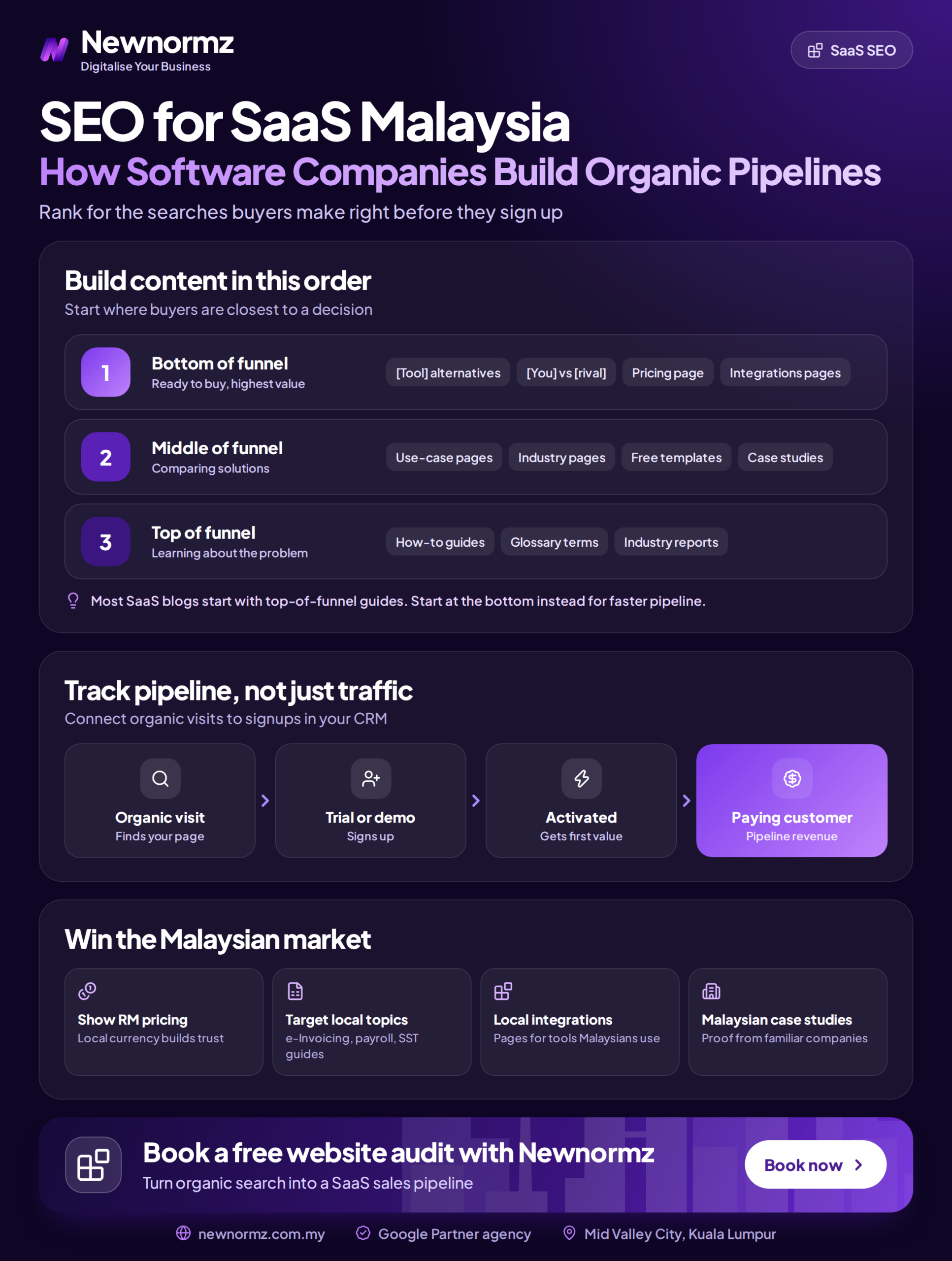
Competitor alternative searches deserve special attention. Someone searching for an alternative to a named tool already knows they need software like yours. They are choosing between options. A page that speaks directly to their frustrations with the incumbent will usually convert better than a generic awareness article.
Three Content Types That Build SaaS Pipeline
1. Use case and persona pages
A generic product page lists features. A use case page answers the question the buyer is actually asking: will this solve my problem? A Malaysian HR software company will usually get further with a page aimed at “leave management software for manufacturing companies in Malaysia” than with one broad HR software page. The specificity matches how people with real problems search.
2. Comparison and alternative pages
Buyers in the evaluation stage compare. A page that sets your product against a named competitor puts you in front of them at the point of highest intent. These pages must be fair. A one-sided comparison that ignores the competitor’s strengths loses credibility fast. An honest page that explains who each product suits best builds trust, and trust is what converts.
3. Problem-led blog content
Top-of-funnel content still matters, but only when it connects to the product. An article on reducing staff turnover in Malaysian SMEs is useful to an HR software company only if it leads naturally to how the software helps. Every informational article needs a clear next step: a trial, a demo, or a conversation.
Technical Problems Common to SaaS Sites
SaaS websites run into technical issues that simpler sites rarely face. These are the ones to check first:
- Marketing pages stuck on the app subdomain. Blocking app.yourproduct.com from indexing is correct for the app itself. But any marketing page hosted there must stay crawlable.
- Thin feature pages. A bullet list of features gives Google little to rank. Each feature page should explain the problem it solves and who it is for.
- Heavy JavaScript and slow load times. Slow pages tend to lose both rankings and conversions. Check your Core Web Vitals before you publish more content on top of a slow base.
- Duplicate content from URL parameters. Filters and pagination can create near-identical URLs that split ranking signals across pages.
Fix these first. Strong content on a weak technical base will underperform.
Build Authority Against Global Competitors
Malaysian SaaS brands often compete with global software names that have years of accumulated authority. You rarely beat them by publishing isolated articles. You close the gap by covering your subject area thoroughly, so Google sees your domain as a real source on it.
A payroll software company, for example, should own the wider conversation around payroll compliance, EPF contributions, SOCSO requirements, and HR administration, not only rank for its product name. When a site covers a topic in depth, pages across that cluster tend to rank better together.
Links matter too, and the best ones for SaaS usually come from:
- Malaysian technology and business publications that cover software and startups
- Industry directories and association websites
- Integration partner pages from complementary software tools
- Original research or benchmark reports that other sites want to cite
Measure Pipeline, Not Just Traffic
Traffic on its own tells you very little about a SaaS business. Track the numbers that connect to revenue:
| Metric | What it tells you |
|---|---|
| Organic trials and demo requests by page | Which pages and keyword clusters actually produce leads |
| Marketing qualified leads from organic | Whether the traffic matches your ideal customer |
| Assisted conversions | Where organic content helped before the buyer converted elsewhere |
| Acquisition cost, organic vs paid | Whether SEO is lowering your cost of growth quarter over quarter |
Measured this way, SEO stops looking like a marketing cost with an uncertain outcome and starts looking like an investment you can track.
Where Paid and Organic Fit Together
If you need fast signals, Google Ads can validate which keywords, use cases, and messages actually convert. You can then build the best performers into a lasting organic programme. This is why we treat paid and organic as one system for SaaS clients rather than competing budgets. If you want a team to run the organic side, our SEO service is built around keyword mapping to the buyer journey, commercial landing pages, and reporting tied to demos and trials.
Frequently Asked Questions
How long does SaaS SEO take to generate pipeline in Malaysia?
It depends on your category, your site’s current condition, and how competitive your keywords are. Many SaaS companies see improved visibility within several months, but qualified pipeline usually builds more slowly because buyers take time to decide. Anyone promising a fixed timeline or ranking is guessing.
Should a Malaysian SaaS company start with SEO or paid ads?
Paid ads are useful for fast validation. Once you know which keywords, use cases, and buyer questions convert, SEO turns them into a channel that keeps working without paying per click.
Which keywords should a SaaS company prioritise?
Start with high-intent terms: competitor alternatives, software comparisons, feature queries, pricing-related searches, and industry-specific use cases. Add problem-led content after those pages are in place.
How should I measure SaaS SEO success?
Look at demo requests, trial sign-ups, MQL growth, assisted conversions, and acquisition cost against paid channels. Rankings and traffic are useful diagnostics, but they are not the result.
Traffic but no demo requests?
Find out what is holding back your SaaS organic pipeline
Newnormz has run SEO campaigns across F&B, healthcare, ecommerce, and local services in Malaysia, backed by a performance guarantee of 70 percent of targeted keywords on Google’s first page.
30 minutes, no obligation, with a review of your keywords, product pages, and conversion flow.

Bryan Tan is an SEO Specialist and CEO at Newnormz, helping hundreds of businesses achieve first-page rankings on Google. With a passion for driving organic growth, Bryan blends innovative strategies with hands-on experience to optimize websites for maximum visibility. Always at the forefront of the latest SEO insights and trends, he consistently adapts to the evolving digital landscape.