You will not outrank Maybank or CIMB for “personal loan Malaysia” on a startup budget, and you don’t need to. Smaller fintech brands in Malaysia win on Google by going after specific, high-intent searches the banks ignore, building deep content on one core product before spreading out, making their licensing and credibility impossible to miss, and fixing the technical problems that quietly hold financial sites back. That approach is slower than buying ads, and no one can honestly promise you a specific ranking. But it builds visibility that keeps working after you stop paying for it, which matters a lot when every click on a finance keyword costs real money.
Malaysians are moving their money online fast. Bank Negara Malaysia reported 11.5 billion e-payment transactions in 2023, and e-money transactions alone rose 26% to 4.0 billion. With 35.4 million internet users and 98% penetration at the end of 2025 (DataReportal Digital 2026 Malaysia), and Google holding about 93% of local search market share (Statcounter, May 2026), most of those customers start by typing a question into Google.
The problem for a growing fintech brand is who else shows up for that question: licensed banks with decades of domain authority, regional payment giants, and startups with venture funding to burn. This article covers what actually works when you’re competing against them with a fraction of the budget.
A Simple Way to Think About It
The Main Road vs the Side Street
🏦 Fighting for the main road
You rent a small shop on the busiest road in town, squeezed between two big bank branches. Thousands of people walk past every day, but they came for the banks, and they keep walking.
🧭 Owning the side street
You open on a quieter street where everyone with one particular problem eventually ends up. Far fewer people pass by, but almost everyone who does walks straight in.
The sections below show you how to find your side streets on Google, and how to make sure people trust you enough to stay once they arrive.
Why Fintech Is One of the Harder Niches to Rank In
Fintech isn’t just another competitive industry. A few things make it harder than most, and a generic SEO playbook usually misses them.
Google holds financial content to a higher standard
Google’s own Search Quality Rater Guidelines put finance in the “Your Money or Your Life” category: topics where bad information can do real harm to someone’s finances. For these topics Google leans much harder on signals of experience, expertise, authority and trust (often shortened to E-E-A-T). A thin blog post that might rank for a recipe query won’t hold up when the query is about loans or investments.
The banks already own the broad terms
Searches like “personal loan Malaysia”, “digital wallet” or “investment app” are dominated by established banks and the biggest platforms. They have years of backlinks and brand searches behind them. Going straight at those terms is usually the most expensive way to get nowhere.
Paid clicks are expensive
Finance keywords are among the most expensive to bid on in paid search, because a single customer can be worth a lot. Google Ads can get you visible quickly, but the visibility stops the day the budget does. For a fintech brand watching its burn rate, organic rankings are what lower your acquisition cost over time.
You can’t write your way out with bold claims
If you’re licensed or registered with Bank Negara Malaysia or the Securities Commission, there are real limits on what you can promise. “Guaranteed approval” or “best returns in Malaysia” might get clicks, but it can create compliance trouble and puts off the careful readers you actually want. Your content has to persuade through clarity, not hype.
Stop Chasing Head Terms. Go After Specific Intent.
This is where a smaller budget stops being a disadvantage. Long-tail searches are longer and more specific, and they come from people who already know what their problem is and are comparing solutions. Fewer people search for them, but the people who do are far closer to signing up.
Compare the person typing “personal loan” with the person typing “SME invoice financing Malaysia no collateral”. The first could be anyone at any stage. The second is a business owner with a cash flow gap who wants a solution this month.
| Search type | Example | Who usually ranks | Realistic for a smaller brand? |
|---|---|---|---|
| Broad head term | “personal loan Malaysia” | Major banks, big comparison sites | Not in the first year |
| Problem-specific | “SME invoice financing Malaysia no collateral” | A mix, often thin or outdated pages | Yes, with a strong, focused page |
| Integration or use case | “payment gateway for WooCommerce Malaysia” | Providers and developer blogs | Yes, especially if you actually support it |
| Comparison and research | “how to compare personal loan rates Malaysia” | Comparison sites, some banks | Yes, if your guide is genuinely more useful |
| Bahasa Malaysia or Chinese | “pembiayaan perniagaan PKS tanpa cagaran” | Often fewer, weaker pages | Often the easiest win of all |
That last row gets overlooked a lot. Many Malaysian fintech sites are English-only, while a real share of their customers search in Bahasa Malaysia or Chinese. If your audience includes them, properly written (not machine-translated) pages in those languages can open up searches where competition is noticeably thinner.
Map every keyword to a buying stage before you write anything. A research-stage query gets an explainer guide. A comparison query gets an honest comparison page. A ready-to-act query gets a product or landing page with a clear next step. If you can’t say what a page is supposed to lead to, it probably shouldn’t exist.
Go Deep on One Topic Before You Go Wide
The common mistake is publishing one article on lending, one on payments, one on investing and one on crypto, all on the same site. To Google, that looks like a brand that knows a little about everything.
The better approach is to pick your core offering and cover it completely. If you do SME financing, that means a connected set of pages: how SME financing works, eligibility, documents required, common reasons applications get rejected, alternatives to bank loans, how to compare licensed providers, and what the repayment terms actually mean. Each page links to the others and back to your main product page.
This is usually called a topic cluster. It tells Google your site is a serious reference on one subject. It also keeps readers moving from page to page instead of leaving after one answer. Most competitors publish one or two standalone posts per topic, so a well-built cluster gives you a depth advantage that keeps growing. Once one cluster is ranking, start the next.
Trust Signals: Where Rankings and Conversions Meet
On a financial site, trust does two jobs at once. It feeds the credibility signals Google looks for on finance topics, and it decides whether a visitor fills in your form or closes the tab. Someone who reaches your application page and can’t find a licence number or a real address will leave, however well that page ranks.
At minimum, your site should have:
- Your Bank Negara Malaysia or Securities Commission licence or registration details, shown clearly on the pages where people make decisions, not hidden in the footer
- HTTPS on every page and subdomain, with no mixed-content warnings
- Named authors on financial content, with short bios that show real experience or credentials
- Real customer testimonials with names and context, not anonymous one-liners
- Press coverage or partnerships with recognised Malaysian institutions, if you have them
- A clear privacy policy and plain-language explanation of how customer data is handled
- A physical office address and a working phone number
To be upfront, Newnormz hasn’t published a fintech case study. The nearest comparison we have is healthcare, which is also a trust-sensitive “Your Money or Your Life” category. For Sunway Medispa, a six-month campaign built on credible, expert-led content produced a 700% traffic increase and 70% more ranking keywords. The industry is different, but the principle carries over: in categories where Google is cautious, credibility is what moves rankings.
Fix the Technical Basics Before You Write More
Publishing more content on a site with technical problems is like pouring water into a leaking bucket. These are the problems that come up most often on fintech sites:
- Slow mobile pages. Most Malaysians browse on their phones, and fintech sites are often heavy with scripts, trackers and app-download banners.
- Duplicate or near-duplicate product pages. Several loan or plan pages with almost the same text compete against each other, and none of them rank well.
- Calculators and rate tools with no surrounding content. A loan calculator on an otherwise empty page gives Google little to understand or rank.
- Missing structured data. FAQ, organisation and product schema help Google understand what your pages are and who is behind them.
- Important pages locked behind login or blocked from crawling. If Google can’t reach it, it can’t rank it.
A proper technical audit finds these problems before they cost you months of content work. It’s usually a one-off cost, and of everything on this list it tends to pay off fastest.
Don’t write off local search
Online-only fintech brands often skip local SEO. But businesses and partners do search for things like “digital lending company Kuala Lumpur” when they want to check a provider is real. A complete Google Business Profile and consistent company details across directories cost little and add one more layer of legitimacy.
Where a Limited Budget Should Actually Go
Here’s a rough picture of how the main options compare for a Malaysian fintech brand. The costs are typical ranges, not quotes. The right mix depends on where your site stands today.
| Tactic | Typical cost | When you’ll see movement | Fit for fintech |
|---|---|---|---|
| Technical SEO audit and fixes | One-off, around RM1,500 to RM3,000 | 1 to 2 months | High. Do this first. |
| Long-tail keyword content | Around RM500 to RM2,000/month | 2 to 4 months | High |
| Topic cluster building | Around RM2,000 to RM4,000/month | 4 to 6 months | Very high over the long term |
| Google Business Profile | Free | Around 1 month | Medium, mostly for credibility |
| Paid search and social ads | Often RM3,000+/month | Immediate | Medium. Useful short term, stops when spend stops. |
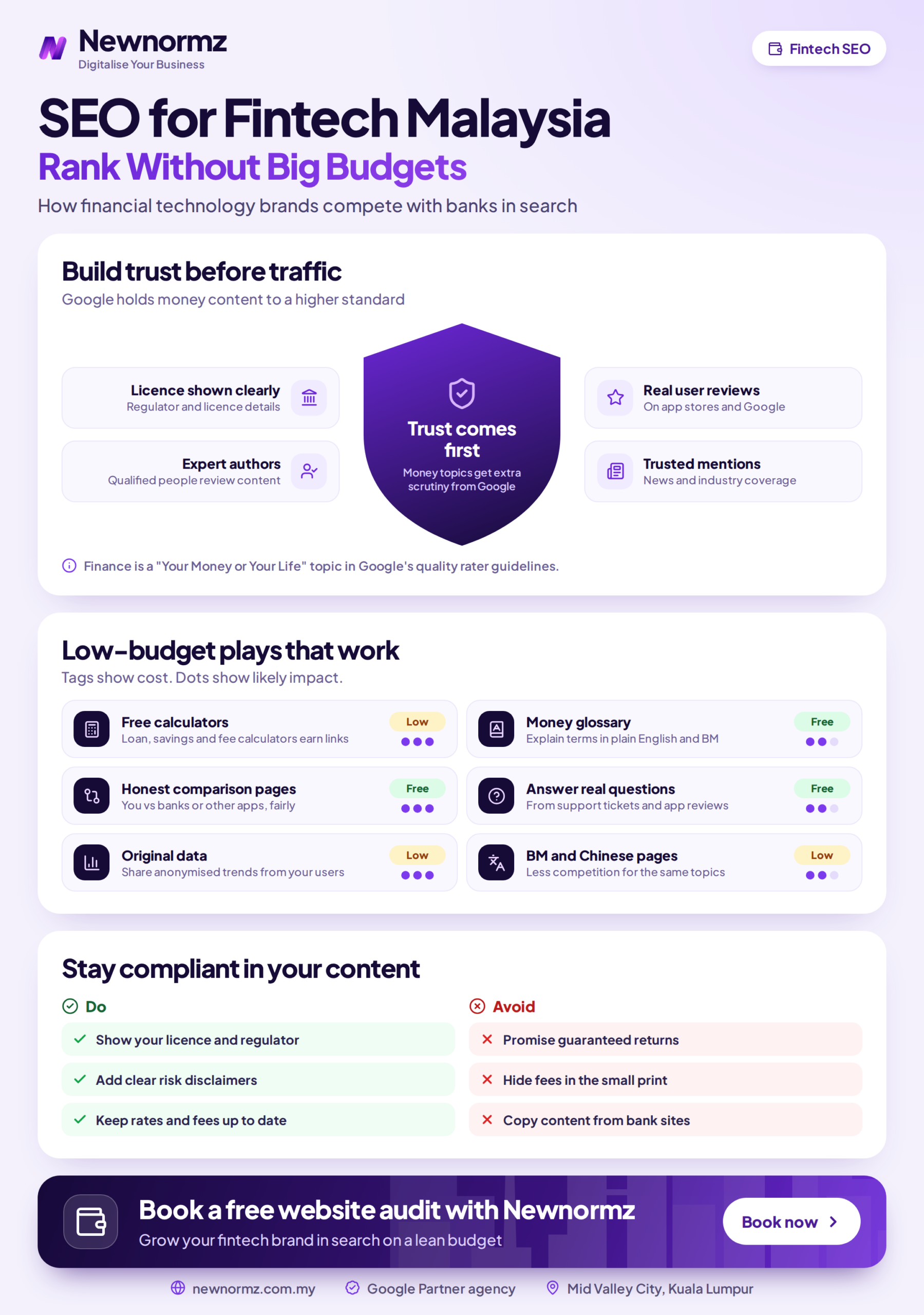
For most early-stage fintech brands, a sensible order is: fix the technical foundation, build one tight topic cluster around your core product with long-tail pages feeding into it, and make trust signals visible across the site. If you need leads this quarter, a small, tightly targeted ads budget can cover the gap while organic rankings build. Ads shouldn’t become the whole plan, though.
On timelines: early keyword movement often shows up within three to four months, and stronger, steadier rankings usually take six months or more. Anyone promising you a specific position by a specific date is promising something Google itself has publicly said no one can guarantee. A good SEO agency in Malaysia should give you a clear plan, honest reporting and targets that are measured, not ranking guarantees for single keywords.
Frequently Asked Questions
How long does SEO for a fintech site take to show results in Malaysia?
Expect early movement on long-tail keywords in roughly three to four months if the technical basics are sound. Competitive commercial terms take longer, often six months or more. Sites with serious technical problems or no existing content take longer still.
Do compliance rules affect what I can publish for SEO?
Yes. If you’re licensed or registered, avoid promises about approval, returns or “best” claims you can’t support, and have someone familiar with your regulatory obligations review financial content before it goes live. Clear, accurate content also happens to be what ranks better on finance topics, so caution doesn’t cost you rankings.
Should a fintech startup spend on SEO or Google Ads first?
It depends on how soon you need leads. Ads give you visibility from day one but cost money on every click, and finance clicks are expensive. SEO takes months but lowers your acquisition cost over time. Many brands run a small, focused ads budget while SEO builds, then cut back on ads as organic traffic picks up.
Is it worth creating Bahasa Malaysia or Chinese content?
If a meaningful share of your customers search in those languages, often yes. Competition is frequently thinner than for the English equivalent. The content has to be properly written for that audience, though. Machine-translated pages tend to read badly and do little for trust or rankings.
Can a small fintech brand ever rank for the big keywords?
Sometimes, eventually. It usually happens as a side effect of building real authority through long-tail pages and topic clusters, not by targeting the head term directly from the start. Treat broad terms as a long-term goal, not where you begin.
Is your fintech site losing searches to the banks?
Find the searches your fintech brand can realistically win
Newnormz has run SEO campaigns across F&B, healthcare, ecommerce, and local services in Malaysia, backed by a performance guarantee of 70 percent of targeted keywords on Google’s first page.
30 minutes, no obligation, with a clear look at your technical issues, trust gaps and the long-tail opportunities you’re missing.

Bryan Tan is an SEO Specialist and CEO at Newnormz, helping hundreds of businesses achieve first-page rankings on Google. With a passion for driving organic growth, Bryan blends innovative strategies with hands-on experience to optimize websites for maximum visibility. Always at the forefront of the latest SEO insights and trends, he consistently adapts to the evolving digital landscape.