No, AI is not replacing SEO in 2026, and treating it as an either/or question sends Malaysian SMEs in the wrong direction. Google still handles roughly 93 percent of all searches in Malaysia, and the same signals that get a page ranked on Google (clear structure, real expertise, credible backlinks, a fast and stable website) are the signals tools like ChatGPT and Perplexity pull from when deciding what to cite. AI search is a new surface sitting on top of the same SEO foundation, not a replacement for it. SMEs that keep investing in SEO while adapting their content for AI answers are the ones showing up in both places. The ones that quietly stop doing SEO because they assume AI will handle discovery for them are the ones that risk disappearing from both.
A Simple Way to Think About It
A Second Entrance, Not a New Building
🚪 The New Entrance
ChatGPT and Perplexity are like a second entrance a shopping mall just added at the back of the building. Shoppers who never used the front door can now walk in through it too.
🏗️ The Building Itself
What greets those shoppers once they are inside, the stock on the shelves, the signage, the staff who actually know the products, is still the same store that earned its place in the mall directory in the first place. Knock that down and it does not matter how many entrances there are.
That is the mechanic worth understanding before deciding where to spend a limited marketing budget in 2026, and it is what the numbers below actually show.
What “AI Replacing SEO” Actually Means for a Malaysian SME
The phrase gets used loosely, so it is worth separating what is actually changing. Two things are happening at once. More people are asking questions directly to chatbots instead of typing them into Google. And Google itself is layering AI-generated summaries on top of its own results for certain searches. Neither of these removes the need for a business to have a website that ranks, loads fast, and clearly explains what it does. It just means there is now a second place that content needs to perform well: inside an AI-generated answer, not only on a results page.
For a Malaysian SME selling services in a specific state or city, most customers are still typing a query into Google, checking a few results, glancing at reviews, and then calling or messaging. That behaviour has not gone away. What has changed is that a growing minority now start that same journey inside a chat window instead, which means the content needs to work in both places, not that one channel has cancelled the other.
The Numbers Behind the 2026 Panic
Gartner’s widely cited prediction was that traditional search engine volume would fall by 25 percent by 2026 as chatbots take on more of the questions people used to type into Google. It is a real forecast worth taking seriously, and it is part of why so many business owners are now asking whether SEO still matters.
What the actual data from Malaysia shows so far is a slower shift than that forecast implies. StatCounter recorded Google holding 93.03 percent of Malaysia’s search engine market in May 2026, against a global share of 91.27 percent that same June. DataReportal’s Digital 2026 Malaysia report put the country at 35.4 million internet users and 98 percent internet penetration at the end of 2025. That is a large, still-growing online population, and the overwhelming majority of their search behaviour is still running through Google. AI adoption is real and worth planning for, but it has not yet displaced Google as the primary discovery channel for Malaysian customers.
| Factor | Traditional SEO (Google) | AI Search (ChatGPT, Perplexity, AI Overviews) |
|---|---|---|
| Malaysia’s search share | About 93 percent of all searches, per StatCounter | Still a small slice, but growing each year |
| Best for | Local searches, transactional queries, comparison shopping | Complex research questions, summarised, multi-source answers |
| How to win | On-page SEO, backlinks, a complete Google Business Profile | Structured, well-cited content that is easy to quote accurately |
| What it takes to build | A full technical and on-page SEO audit, then months of consistent work | The same underlying content, structured so it can be lifted into an answer |
Why AI Search Still Runs on SEO’s Foundations
AI tools do not invent answers from nothing. They pull from indexed, crawlable content that already demonstrates depth, clear structure, and credibility, which is largely the same content that ranks well in a normal SEO campaign. A page with thin content, no internal structure, and no external sites linking to it is unlikely to rank on Google, and it is equally unlikely to get cited in an AI-generated answer. The two systems are reading the same signals for different purposes.
This is why a business that ranks well on Google but never shows up in AI answers usually has a specific, fixable gap: missing structured data, answers buried in paragraphs instead of stated plainly, or simply not enough depth on the page for a model to quote with confidence. It is rarely a case of Google working and AI search being unreachable for that business. It is closer to a maintenance gap than a strategic one.
4 Signs Your Malaysian SME Can’t Afford to Skip SEO in 2026
- Your website sits on page two or lower for the services you sell in your own state or city, while competitors occupy page one.
- Competitors are showing up in Google’s AI Overviews and local map packs for searches your business should be winning, and you are not.
- Nobody on your team has the time to track algorithm updates, Core Web Vitals, or shifting keyword demand alongside day-to-day operations.
- You genuinely do not know whether your website’s content is structured in a way ChatGPT or an AI Overview could actually cite.
Any one of these on its own is manageable. Two or more together usually means local SEO and technical health need a proper audit rather than another guess.
What Actually Changes: Adapting Without Abandoning SEO
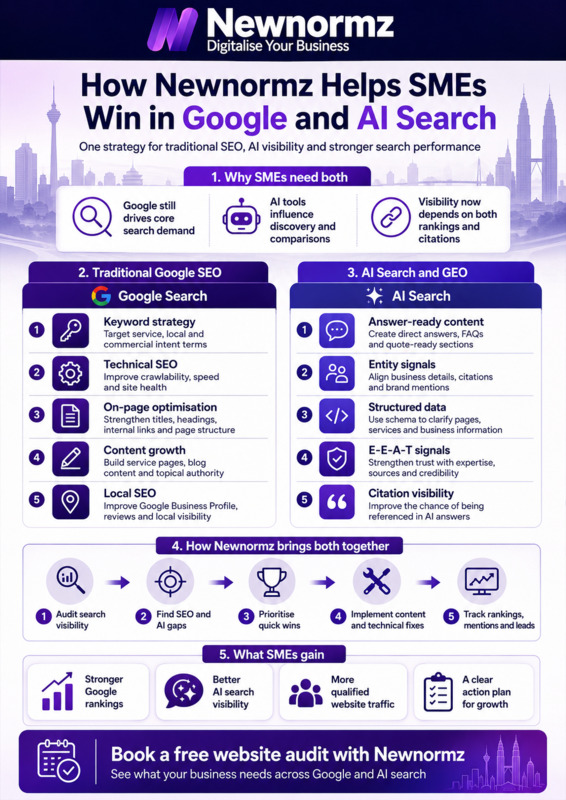
The practical shift for 2026 is not moving budget away from SEO. It is making sure the content SEO produces is also structured well enough to be quoted by an AI system: clear headings, direct answers stated early, and enough real depth that a model has something worth citing.
SEO also compounds in a way AI citations have not yet proven to. Newnormz’s two-year campaign for Oriental Kopi grew organic traffic by 43,300 visitors, added 6.31 million impressions, and put 24,500 additional keywords into ranking positions, all from content assets that keep earning visibility long after they were published. An AI platform’s citation behaviour can shift the next time it updates its model. A well-built, well-linked page keeps working. The sensible position for an SME in 2026 is to keep building that durable base while making sure it is also readable by AI tools, not to pick one over the other.
Keep Your Business Visible Across Every Search Channel
SEO is not being replaced. It is being asked to do a bit more: still win rankings on Google, and now also be structured well enough to earn a citation inside an AI-generated answer. Malaysian SMEs that treat this as one coordinated strategy, rather than two competing projects, are the ones showing up wherever their customers are actually searching.
Frequently Asked Questions
If AI Overviews answer the question directly, why do I still need to rank on Google?
Because AI Overviews and citations are pulled from pages that already rank well or are already well-structured and credible. Not ranking on Google makes it less likely a page ever gets pulled into an AI answer in the first place, so the two goals depend on each other rather than competing.
How do I know if my business is being cited by ChatGPT or Perplexity at all?
You have to check manually by asking the questions your customers would ask and seeing what comes back, since there is no equivalent of Google Search Console for AI citations yet. Newnormz checks this as part of its free website audit alongside standard Google ranking data.
Should I move budget from SEO into AI-specific optimisation?
No. AI visibility is built on the same technical and content foundation as SEO, so splitting budget into two separate efforts usually just duplicates work. The more effective approach is one campaign that produces content structured to win both.
Does Newnormz handle both Google rankings and AI search visibility in one campaign?
Yes. Technical SEO, on-page content, local signals, and answer-ready content structure are built into the same campaign rather than sold as separate add-ons.
What happens to my SEO investment if Google’s search share keeps shrinking?
Based on Malaysia’s current numbers, Google still holds around 93 percent of search, so that risk is smaller today than the headlines suggest. Even if it changes, well-built SEO content, clear structure, real expertise, credible links, is exactly what AI platforms already draw on, so the investment does not become worthless if the channel mix shifts.
Still Wondering If AI Killed SEO?
Find Out Exactly Where You Stand on Google and AI Search
Newnormz has run SEO campaigns across F&B, healthcare, ecommerce, and local services in Malaysia, backed by a performance guarantee of 70 percent of targeted keywords on Google’s first page.
30 minutes, no obligation, and you will know exactly where Google and AI search currently send your customers.

Bryan Tan is an SEO Specialist and CEO at Newnormz, helping hundreds of businesses achieve first-page rankings on Google. With a passion for driving organic growth, Bryan blends innovative strategies with hands-on experience to optimize websites for maximum visibility. Always at the forefront of the latest SEO insights and trends, he consistently adapts to the evolving digital landscape.