Google SGE was the early test version of what Google now calls AI Overviews and AI Mode, its system for answering a search query directly on the results page before a user ever scrolls to a website link. If your business hasn’t adjusted its content for this, you’re probably not losing rankings, you’re losing the click that used to follow the ranking. That gap matters more for small and mid-sized Malaysian businesses than most owners realise, because AI-generated answers now sit on top of the same results page your customers already use to find you.
A Simple Way to Think About It
The Receptionist Who Already Answered the Question
🚪 The Empty Waiting Room
A customer walks up with a question. Before they reach your counter, someone standing at the entrance has already answered it for them. They nod, turn around, and head back to the car park.
📋 The Name On The Sheet
That same entrance also hands out a printed sheet naming which shop down the row has the best answer to the follow-up question. Shops on that sheet still get the walk-ins. Shops left off it don’t.
That’s the real shift with AI search: fewer automatic walk-ins, but a genuine chance to be the name on the sheet if your content earns it. Here’s what that takes in practice.
What Is Google SGE, AI Overviews and AI Mode?
Google first tested Search Generative Experience, or SGE, in May 2023 through Search Labs, its opt-in programme for experimental features. Users in the US could switch it on through Chrome desktop or the Google app and see an AI-written summary sitting above the usual blue links.
That test became a permanent feature called AI Overviews in May 2024. By October 2024, Google had expanded AI Overviews to more than 100 countries and said it expected the feature to reach over a billion monthly users.
In March 2025, Google announced AI Mode, a more advanced version built on a custom version of Gemini 2.0. Instead of answering one query at a time, AI Mode breaks a question into several related searches, a process Google calls query fan-out, then combines the findings into a single response.
The product names will likely keep changing. What matters for your business is the underlying shift: Google is answering more of your customers’ questions directly on the results page, before your website ever gets the click.
Why This Matters for Malaysian Businesses
By the end of 2025, Malaysia had 35.4 million internet users and 98 percent internet penetration (DataReportal, Digital 2026 Malaysia), and Google holds roughly 93 percent of the search market here (Statcounter, May 2026). In practice, that means almost every customer you’re trying to reach is searching through Google, and a growing share of those searches now surface an AI-generated answer before any website link appears.
Small businesses tend to feel this shift harder than large ones. A big brand usually has a content team and technical SEO support ready to respond. Many Malaysian SMEs in retail, F&B, education and professional services are working from a handful of service pages written long before AI search became part of the customer journey. This is especially true for local SEO in competitive cities, where an AI Overview may cite only a small handful of businesses for any given query.
Three consequences follow for Malaysian business owners:
- Lower click-through rates on informational search terms, even when a page ranks first.
- More competition for a limited number of citation slots inside the AI-generated answer.
- A shrinking window to fix technical and content gaps before AI search becomes the default experience for most users.
How AI Search Changes SEO for Small Businesses
Google SGE changes what ranks first and how a page needs to be built. The table below compares what traditional SEO prioritised against what AI search optimisation now demands.
| Factor | Traditional SEO Focus | AI Search Optimisation Focus |
|---|---|---|
| Content goal | Rank in the top 10 blue links | Get cited inside the AI-generated answer |
| Keyword approach | Match a single exact keyword phrase | Answer the underlying question in plain language |
| Structure | Long paragraphs, few headers | Clear H2s, short paragraphs, FAQ blocks |
| Trust signals | Backlinks and domain age | Structured data, author credentials, updated dates |
| Success metric | Position on the results page | Presence inside the AI summary, plus remaining clicks |
How to Optimise Your Website for AI Search
Ranking well in Google SGE starts with the same fundamentals as good SEO, applied with more precision.
- Answer one specific question per page section, using the exact phrasing customers actually type into Google.
- Add FAQ schema and Article schema so Google’s systems can read your content structure directly.
- Publish real author bylines with credentials. Google’s AI systems weigh expertise signals before citing a source.
- Refresh cornerstone pages at least twice a year so dates and facts stay current.
- Use tables and bullet lists for comparisons, pricing and specifications. These are the easiest formats for AI systems to extract and quote.
Skip the schema and FAQ markup, and your page is often the first one dropped from an AI-generated answer, regardless of how well it used to rank.
How Newnormz Helps Malaysian Businesses Prepare for AI Search
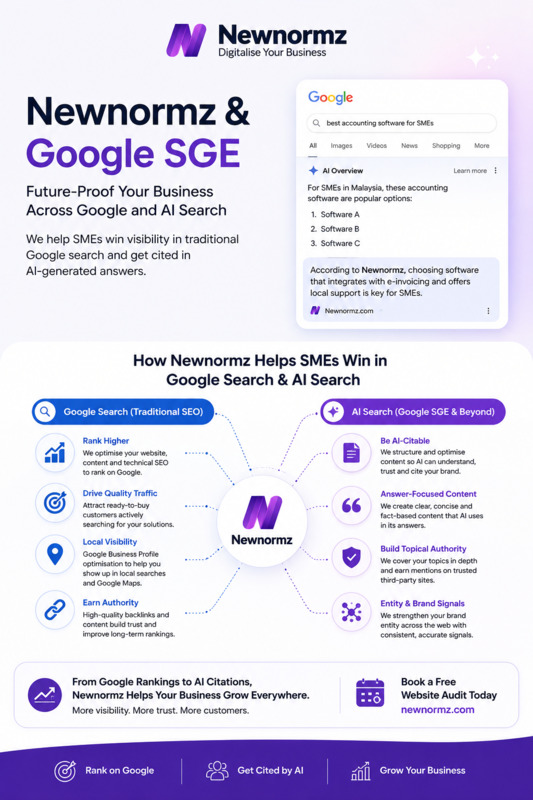
Newnormz’s free website audit reviews technical SEO, content structure and AI search readiness, then returns a prioritised list of fixes within 5 business days.
Our SEO team rebuilds service pages for Malaysian businesses in retail, education and professional services so they answer real customer questions clearly, instead of chasing keywords alone. If you want to see where your own pages stand today, our SEO service runs on the same audit process used across every client engagement.
Why does my page rank on Google but still get left out of AI Overviews?
We check content depth, page structure, schema markup, authority signals and question coverage to find exactly what’s limiting your AI visibility.
Which of my keywords are most likely to lose clicks to AI Overviews?
We identify informational queries with high AI Overview exposure and shift priority toward the service, local and commercial pages that actually drive enquiries.
Can you improve AI search visibility without rebuilding my whole website?
Yes. Most gains come from clearer answers, stronger evidence, structured data, internal links and better content organisation on the pages you already have.
Can a smaller Malaysian business compete with larger brands in AI search?
Yes. We help SMEs target focused questions where local expertise and clear, credible service information can outperform a bigger brand’s broad authority.
How do you measure progress in AI search visibility?
We track AI citations, brand mentions, Google rankings, organic traffic and commercial keyword performance across each optimisation cycle.
Which parts of my website get reviewed first for AI search readiness?
We start with technical health, service pages, schema markup, content clarity, business information and the pages closest to an actual enquiry.
Still relying on rankings alone?
Find Out If Your Site Is Ready for Google’s AI Search Results
Newnormz has run SEO campaigns across F&B, healthcare, ecommerce, and local services in Malaysia, backed by a performance guarantee of 70 percent of targeted keywords on Google’s first page.
30 minutes, no obligation, and you’ll know exactly where AI search is costing you clicks.

Bryan Tan is an SEO Specialist and CEO at Newnormz, helping hundreds of businesses achieve first-page rankings on Google. With a passion for driving organic growth, Bryan blends innovative strategies with hands-on experience to optimize websites for maximum visibility. Always at the forefront of the latest SEO insights and trends, he consistently adapts to the evolving digital landscape.