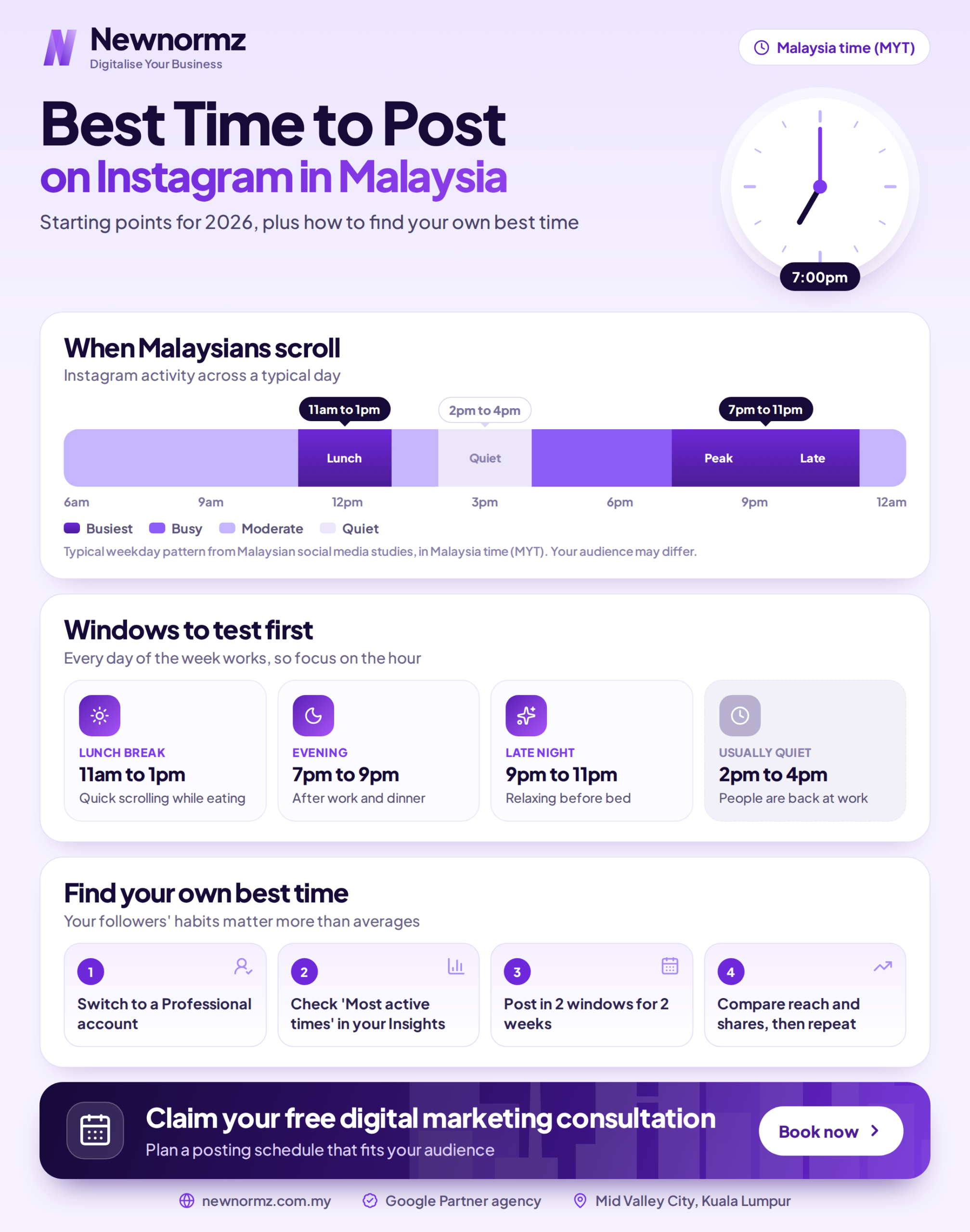
If you only remember one rule, post between 12pm and 2pm, or between 7pm and 10pm, Malaysia time. Lean into Tuesday through Thursday over Mondays and Fridays. Malaysians check Instagram on the lunch break, during the evening commute, and again after dinner, and those three windows account for most of the scrolling that happens in a given day. The exact minute matters less than showing up inside one of those windows consistently, then adjusting based on what your own Instagram Insights tell you after a few weeks of testing.
A Simple Way to Think About It
Posting on Instagram Is Like Setting Up a Roadside Stall
🌃 Selling to an Empty Street
Imagine setting up a food stall at 3am. The food is good and the price is fair, but the street is empty and nobody walks past to notice.
🍜 Catching the Lunch Crowd
Now set up the same stall at 12.30pm outside an office block, right when everyone spills out looking for lunch. The queue forms itself.
Your Instagram post is the stall. If nobody is walking past when you put it up, the algorithm reads that silence as a sign to stop showing it around. The schedule below is about finding out when your street is actually busy.
Why Posting Time Actually Moves the Needle in Malaysia
Instagram treats early engagement as a quality signal. Likes, saves and shares in the first hour after you post push it in front of more people. Post at 3am MYT and that hour lands while your audience is asleep, so the algorithm reads the silence as disinterest and shows the post to fewer people afterwards.
The Malaysian audience makes this worth getting right. Malaysia had 16.76 million Instagram users as of May 2026, or 46.9% of the population, with the 25 to 34 age group the single largest segment at 6.4 million users. DataReportal separately counts 30.7 million social media user identities in the country, equal to 85% of the population. That is a dense, mobile-first audience with predictable daily habits: a commute scroll from around 7am to 9am, a heavy lunch session from 12pm to 2pm, and the longest session of the day after dinner from about 8pm onwards. Being in the feed when those sessions start is the cheapest engagement win most brands are leaving on the table.
If your Instagram is getting reach but those followers never actually convert into enquiries, the gap is usually on the website side, not the posting schedule. That is what our SEO service in Malaysia exists to fix, alongside the social channel.
What the Big Platform Studies Say, and Where They Fall Short for Malaysia
Four large studies dominate this topic, and all four are useful as a starting hypothesis rather than a final answer, because they are global datasets weighted heavily toward Western accounts.
| Study | Sample size | Peak times found |
|---|---|---|
| Sprout Social | Nearly 2 billion engagements across roughly 307,000 profiles | Consistent Mon-Fri, 9am to 4pm, with Tuesday and Wednesday peaking |
| Buffer | 9.6 million posts | Thursday 9am, Wednesday 12pm and 6pm; evenings 6pm-11pm won most days; Friday weakest |
| Hootsuite | Over 1 million posts | 3pm-9pm Mondays, 5pm Wednesdays, 4pm-5pm Thursdays |
| Later | Over 6 million posts | Weekday mornings and early evenings, Tuesday to Thursday strongest |
The pattern that repeats across all four: midweek wins, lunch and evening windows win, and Friday afternoon through Saturday morning sags. Those behaviours translate reasonably well to Malaysia. It is mostly the clock times that need local adjustment, since Malaysian lunch, commute and after-dinner habits do not line up exactly with a US or UK workday.
Best Times to Post in Malaysia, Day by Day (MYT)
Translating those global findings onto Malaysian daily habits gives the schedule below. Treat it as a starting point: run it for four to six weeks, then check Instagram Insights, because a nasi lemak stall in Petaling Jaya and a B2B firm in KL Sentral will not share the exact same peak.
| Day | Best windows (MYT) | Why it works in Malaysia |
|---|---|---|
| Monday | 12pm-1pm, 8pm-9pm | Mornings are meeting-heavy; lunch is the first real scroll of the week |
| Tuesday | 11am-1pm, 7pm-9pm | Midweek engagement climbs; strong in every major study |
| Wednesday | 12pm-2pm, 8pm-10pm | Peak day across most studies; after-dinner scrolling is heaviest midweek |
| Thursday | 9am-10am, 12pm-1pm, 8pm-9pm | Buffer’s single best slot, plus lunch and night sessions |
| Friday | 11am-1pm, post by 11.30am | Get ahead of Friday prayers and lunch; afternoons fade as the weekend starts |
| Saturday | 10am-12pm, 8pm-10pm | Late-morning browsing plus night leisure scrolling |
| Sunday | 7pm-10pm | Long, relaxed wind-down session before the work week starts |
Two adjustments the global data cannot see on its own. Friday midday shifts around Friday prayers, so publish before 11.30am rather than after. And during Ramadan, activity moves toward sahur (roughly 4am to 5.30am) and after terawih (roughly 10pm to midnight), which changes the whole shape of the day.
Best Times by Content Format
Reels: evenings, 7pm to 10pm
Reels are leisure content, and leisure happens at night. The evening peak that Buffer found, roughly 6pm to 11pm, maps neatly onto Malaysia’s after-dinner scroll.
Carousels: lunch, 12pm to 2pm
Carousels reward attention, and a lunch break gives people time to swipe through one. Buffer’s analysis found carousels earn 109% more engagement than Reels, which makes them the highest-leverage format most Malaysian brands underuse.
Stories: throughout the day
Stories surface whenever a follower opens the app, so there is no single best slot. Post two to four a day, and save polls or questions for the evening, when replies are most likely.
A Sample One-Week Schedule for a Malaysian Brand
Here is a concrete week for a hypothetical KL cafe chain targeting office workers and weekend families, all times in MYT.
| Day / Time | Format | Content idea |
|---|---|---|
| Mon, 12.15pm | Carousel | “5 lunch sets under RM20” with prices per slide |
| Tue, 8.00pm | Reel | 15-second behind-the-counter prep clip with trending audio |
| Wed, 12.30pm | Story + poll | “Ayam masak merah or rendang tomorrow?” poll to drive replies |
| Thu, 9.00am | Single image | New seasonal drink announcement, caption asks a question |
| Fri, 11.15am | Carousel | Weekend family promo, posted ahead of Friday prayers |
| Sat, 10.30am | Reel | Customer reactions or a “day at the cafe” montage |
| Sun, 8.30pm | Carousel | Next week’s menu preview to catch the Sunday-night scroll |
The logic behind it: carousels land at lunch when people have both time to swipe and an appetite, Reels land at night when leisure scrolling peaks, and Friday goes out early to beat the weekend drop-off. After four weeks, compare reach per slot in Insights and reallocate toward whatever is actually working for that specific account. This kind of consistent, locally-timed presence also pairs well with local SEO, since customers who find a business on Google often check the Instagram before they commit to visiting.
Common Mistakes to Avoid
| Mistake | Fix |
|---|---|
| Copying US posting times without converting them | Check whether a study reports audience local time or a fixed timezone before applying it |
| Posting and disappearing | Stay online for the first 30 to 60 minutes and reply to comments as they come in |
| Ignoring your own Insights data | Your own follower activity beats any global benchmark, including the one in this article |
| Chasing the perfect minute over consistency | Four to five posts a week in good windows beats two posts a month at the “ideal” moment |
| Treating timing as the whole strategy | Timing amplifies content that already works; it cannot rescue content that does not |
Frequently Asked Questions
What is the single best time to post on Instagram in Malaysia?
If you only post once a day, aim for 12pm to 1pm MYT on a weekday, ideally Tuesday to Thursday. The lunch-break scroll is the most reliable engagement window for Malaysian audiences, and midweek days consistently outperform Mondays and Fridays.
Is it better to post in the morning or at night in Malaysia?
Night generally wins, particularly 8pm to 10pm, because after-dinner scrolling is the longest session of the day. Mornings work well for time-sensitive announcements, since commuters check their feeds between 7am and 9am, but leisure formats like Reels still perform best at night.
Do global studies like Sprout Social’s actually apply to Malaysia?
Partially. The datasets are global and weighted toward Western accounts, but most report results in the audience’s local time, so the underlying patterns (midweek peaks, lunch and evening windows) transfer reasonably well. Treat them as a starting hypothesis, then validate with your own Instagram Insights over four to six weeks.
How does Ramadan change the best posting times?
During Ramadan the whole engagement curve shifts later. Activity rises before sahur, roughly 4am to 5.30am, dips through the fasting day, then surges after iftar and terawih from around 9.30pm to midnight. Brands targeting Malay-Muslim audiences should shift key posts into that window for the month.
How often should a Malaysian brand post on Instagram?
Aim for four to six feed posts a week plus daily Stories. That volume keeps you active in the algorithm’s favour without exhausting your content pipeline. Consistency at that level, placed in the lunch and evening windows, beats daily posting at random times with rushed content.
How do I find my own account’s best posting time?
Open Instagram Insights, go to the audience tab, and check most active times. Then run a simple test: post similar content in three different slots over four weeks and compare reach and engagement per slot. Your own data beats any published benchmark, including this one.
Posting at the right time, but reach still flat?
Get a Free Audit of Your Instagram, Website and Search Funnel
Newnormz has run SEO campaigns across F&B, healthcare, ecommerce, and local services in Malaysia, backed by a performance guarantee of 70 percent of targeted keywords on Google’s first page.
30 minutes, no obligation, no jargon.

Bryan Tan is an SEO Specialist and CEO at Newnormz, helping hundreds of businesses achieve first-page rankings on Google. With a passion for driving organic growth, Bryan blends innovative strategies with hands-on experience to optimize websites for maximum visibility. Always at the forefront of the latest SEO insights and trends, he consistently adapts to the evolving digital landscape.