SEO for manufacturers and suppliers in Malaysia means making your factory’s real capabilities, materials, certifications and minimum order quantities visible on Google, so a procurement buyer can find, evaluate and shortlist you before they ever pick up the phone. Around 71% of B2B buyers start their research with a plain Google search, and most don’t contact a supplier until they’re already roughly 70% through deciding who to buy from. If your capability pages don’t show up during that research window, you aren’t being compared against competitors. You simply aren’t in the conversation.
A Simple Way to Think About It
The Locked Warehouse and the Open Showroom
🔒 The Locked Warehouse
A factory with the shutters down and no sign out front. A buyer driving past has no idea what’s inside, so they keep driving to the next address instead.
🪟 The Open Showroom
A factory with its specs, certifications and sample parts laid out in the front window. A buyer can see exactly what you make before they ever knock on the door.
That’s the difference a handful of well-built capability pages make, and the sections below show exactly what belongs on them.
Why Manufacturing SEO Works Differently
Nobody buys a supplier on impulse. A procurement engineer comparing tolerances, lead times, certifications and capacity does it over weeks or months, and research shows B2B buyers spend only about 17% of that entire journey actually meeting with potential suppliers. The other 83% happens before you’re in the room, mostly on Google and on supplier websites. Your capability pages have to do the selling while nobody is on a call with them.
The demand is already there. Manufactured goods made up 86.2% of Malaysia’s total exports, worth RM110.55 billion in a single month during 2024, so overseas buyers are actively sourcing suppliers like you. Most of that sourcing starts with a search you may not be ranking for. Unlike consumer e-commerce, you’re not chasing thousands of low-value clicks either. A single qualified enquiry can be worth tens of thousands of ringgit over a supply contract, so ranking for a handful of precise terms beats broad traffic every time. That’s why a focused SEO service pays back faster for manufacturers than it does for most consumer brands.
How B2B Buyers Actually Search
Buyers don’t type “good factory” into Google. They search by process, material, certification, industry and location, often stacking several together. Your keyword strategy should mirror that specificity, not fight it.
| Search Type | Example Query | Buyer Intent |
|---|---|---|
| Generic (low value) | manufacturer Malaysia | Unclear, mostly researchers and students |
| Process and location | plastic injection moulding supplier Malaysia | High, sourcing a specific capability |
| Material and spec | food-grade stainless steel fabrication Johor | High, has a defined requirement |
| Certification-led | ISO 9001 certified electronics contract manufacturer | Very high, quality-gated procurement |
| Industry and MOQ | low MOQ automotive rubber parts supplier | Very high, ready to request a quote |
The pattern holds every time: the more precise the query, the closer that buyer is to raising a purchase order. Building a dedicated page for each real process, material and served industry is how you capture that intent. Pair it with a fast site, because 53% of mobile visitors abandon a page that takes longer than 3 seconds to load, and procurement staff increasingly do this research on their phones between meetings.
The Pages That Win Enquiries
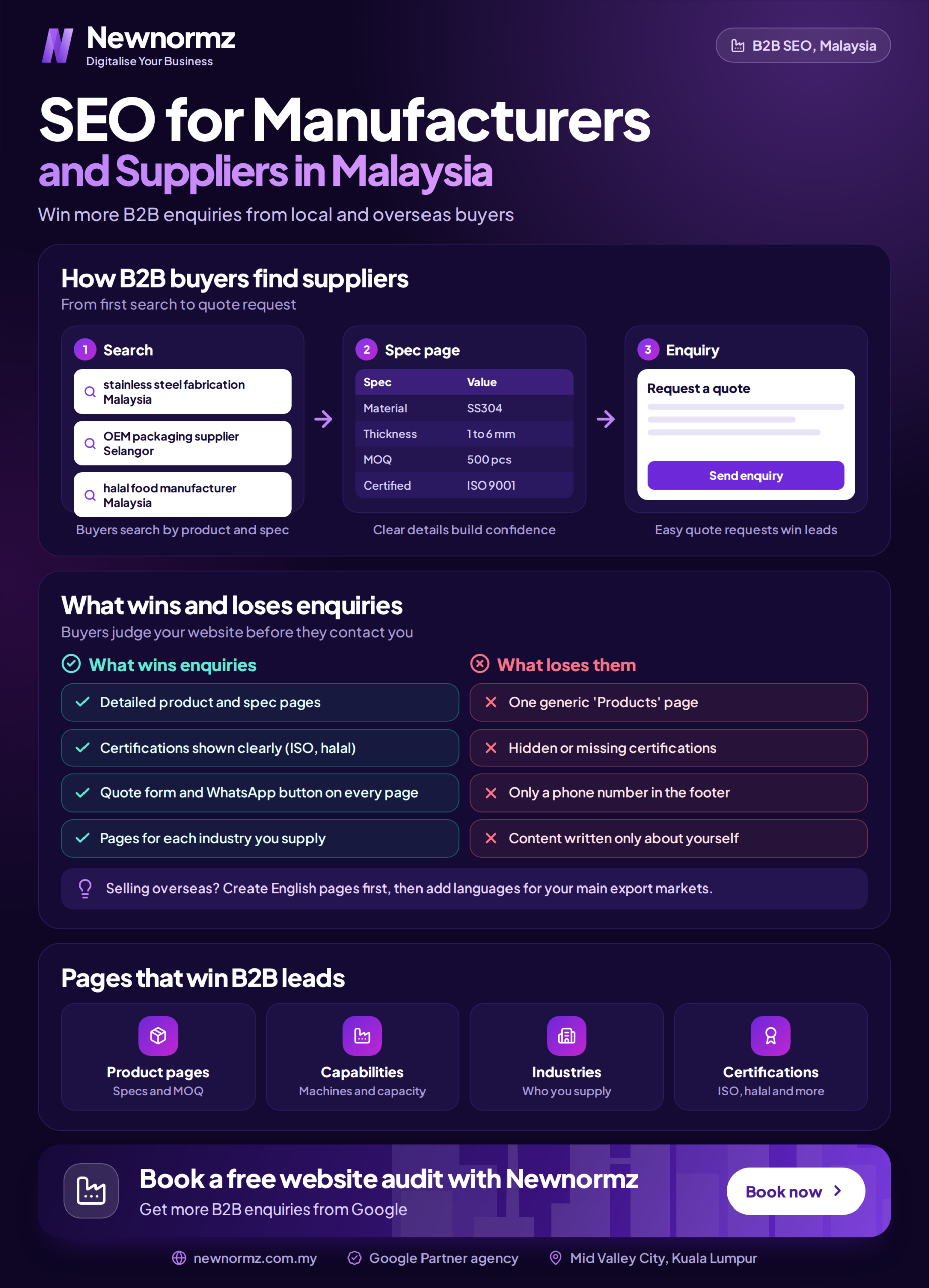
Your homepage doesn’t win B2B deals. Dedicated capability and product pages do. Each one should answer a buyer’s checklist without forcing them to email you first: what you make, what materials and tolerances you handle, which certifications you hold, which industries you serve, your minimum order quantity and typical lead times, and a clear way to request a quotation.
This matters because the shortlist forms before anyone contacts you. With around two-thirds of B2B buyers now preferring a rep-free research experience, the page has to earn its own place on that shortlist. A clean page structure, backed by solid local SEO for buyers sourcing nearby, is what turns an anonymous visit into a named enquiry.
A Capability Page That Actually Converts
Here’s a sample structure for a supplier targeting the query “plastic injection moulding supplier Malaysia.” Every element on the page answers a question a procurement buyer would otherwise have to ask you directly.
| Element | Sample Content |
|---|---|
| Title tag | Plastic Injection Moulding Supplier Malaysia, ISO 9001, [Company] |
| Meta description | ISO 9001 certified plastic injection moulding in Malaysia. Tolerances to ±0.02mm, low MOQ from 1,000 units, 3 to 4 week lead times. |
| Materials handled | ABS, PP, PC, Nylon, POM and glass-filled engineering plastics |
| Certifications | ISO 9001:2015 quality management, RoHS compliant |
| MOQ and lead times | From 1,000 units, tooling 4 to 6 weeks, production 3 to 4 weeks |
| Enquiry CTA | “Upload your part drawing for a quote within 48 hours” |
A page built this way ranks for the capability term and pre-qualifies the buyer at the same time. By the time they click the enquiry button, they already know you fit their spec, which shortens the sales cycle and raises close rates.
Common Mistakes to Avoid
| Mistake | Why It Costs You Enquiries |
|---|---|
| One catch-all “Products” page | Cramming every capability onto a single page means you rank for nothing specific |
| Certifications hidden in a PDF | Google struggles to weigh credentials it can’t read as on-page text |
| No MOQ or lead times listed | Buyers filter out suppliers who make them ask. Silence reads as “not a fit” |
| Ignoring page speed | A slow site bleeds enquiries before the content is even read |
| No language or location signals | English-only pages miss export buyers researching in other languages, and vague pages miss local buyers filtering by state |
The Manufacturing SEO Checklist
- Build a dedicated page for every core process, material and served industry
- Put capability keywords in the title tag, H1 and first paragraph
- List materials, tolerances, certifications, MOQ and lead times as on-page text, not a PDF
- Add a clear enquiry or quotation CTA above the fold on every capability page
- Include location signals for local buyers and clear export details for overseas ones
- Confirm pages load in under 3 seconds on mobile
- Add internal links between related capability pages
- Review Google Search Console monthly for the capability terms you’re gaining or losing
Frequently Asked Questions
What is manufacturing SEO?
It’s optimising a factory or supplier website so B2B buyers find your capabilities, certifications, materials and MOQ on Google. It focuses on specific, high-intent search terms rather than broad traffic, because a single qualified industrial enquiry can be worth tens of thousands of ringgit.
How long does SEO take for a manufacturer?
Most manufacturers see meaningful ranking movement within three to six months, with stronger enquiry volume by six to twelve months. Because B2B keywords are specific and less contested than consumer terms, well-built capability pages can rank faster than many owners expect.
Which keywords should a supplier target?
Stack process, material, certification, industry and location terms together, such as “ISO 9001 metal stamping supplier Selangor.” Avoid generic phrases like “manufacturer Malaysia,” which mostly attract researchers and students rather than buyers ready to request a quote.
Can overseas buyers find a Malaysian factory through SEO?
Yes. Overseas procurement teams routinely start on Google, and manufactured goods dominate Malaysia’s exports. Capability pages with clear certifications, export details, materials and MOQ let international buyers shortlist you during research, well before they ever email.
Is SEO better than trade shows for suppliers?
They complement each other rather than compete. Trade shows create bursts of contacts, while SEO delivers enquiries every day at a lower ongoing cost. Buyers Google the suppliers they meet at events anyway, so strong capability pages reinforce every other channel you use.
Can overseas buyers actually find your factory on Google?
Get a Free Audit of Your Capability Pages and Technical Health
Newnormz has run SEO campaigns across F&B, healthcare, ecommerce, and local services in Malaysia, backed by a performance guarantee of 70 percent of targeted keywords on Google’s first page.
30 minutes, no obligation, no jargon.

Bryan Tan is an SEO Specialist and CEO at Newnormz, helping hundreds of businesses achieve first-page rankings on Google. With a passion for driving organic growth, Bryan blends innovative strategies with hands-on experience to optimize websites for maximum visibility. Always at the forefront of the latest SEO insights and trends, he consistently adapts to the evolving digital landscape.