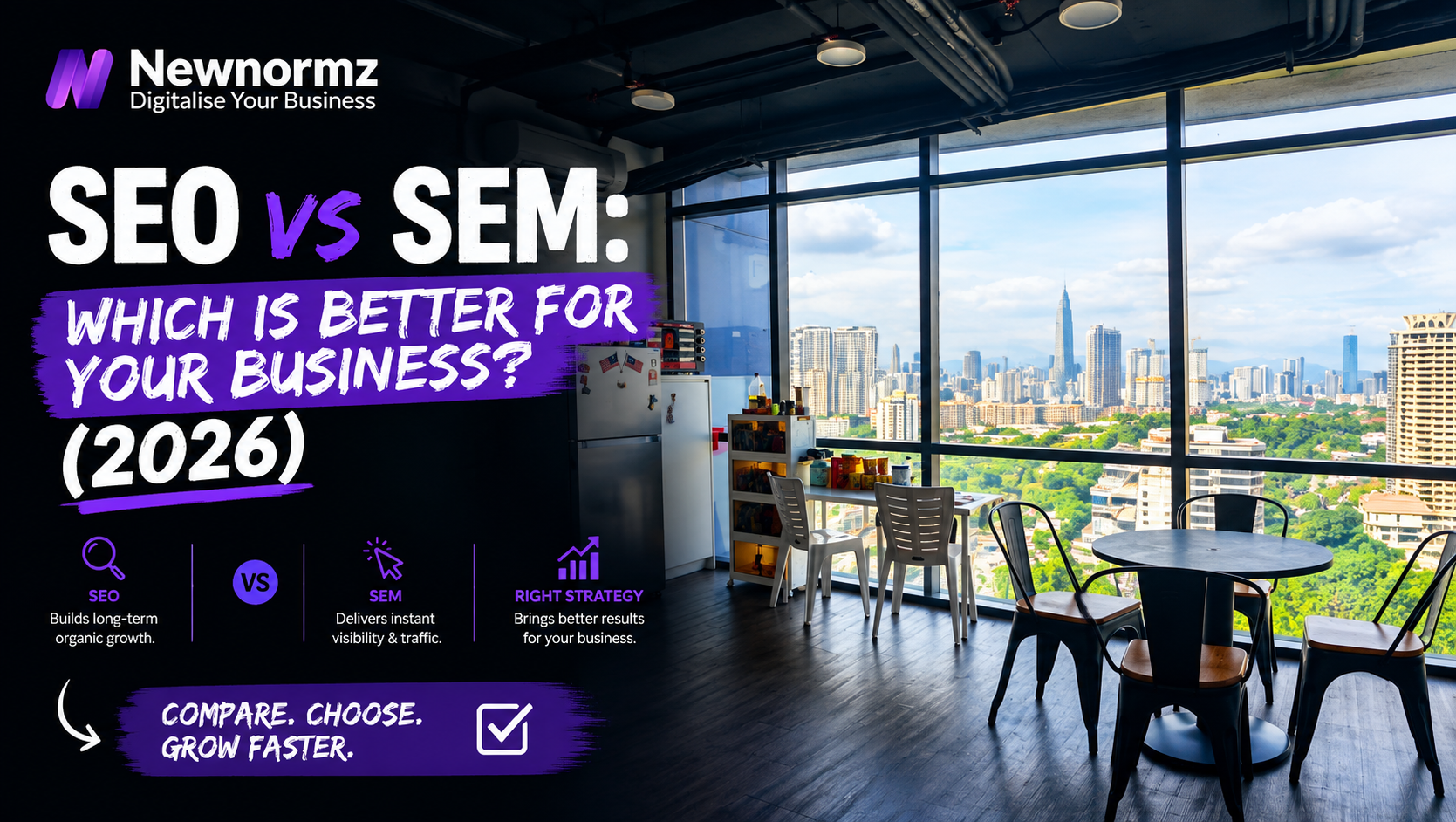
There is no single winner between SEO and SEM. SEM (paid search, mainly Google Ads) gets you on page one today, but every click has a price and the traffic disappears the moment you stop paying. SEO earns clicks for free, but it takes months of technical work, content and links before Google trusts your page enough to rank it there. Most Malaysian businesses that grow steadily use both at once: paid to fill the gap while organic rankings are still building, then organic to bring the cost per lead down once those rankings land.
Who This Guide Is For
If you are a business owner or marketing manager in Malaysia trying to decide where a limited budget goes, this is written for you: service businesses, e-commerce brands and B2B teams weighing a Google Ads campaign against a longer-term SEO investment. If you have ever asked “should I pay for ads now or wait for rankings,” keep reading.
A Simple Way to Think About It
Renting a Shop Lot vs Owning One
💸 Renting the Storefront
You pay rent every month for a shop lot on a busy street. The foot traffic is real and it starts the day you move in, but the moment you stop paying rent, you hand back the keys and the traffic goes with them.
🏠 Owning the Building
You spend months fixing up a rundown shoplot nobody wanted. It takes far longer before customers start walking in, but once it is done, nobody can evict you from that corner.
Below, we put real Malaysian numbers behind both sides of that trade-off, including what each channel actually costs per lead.
SEO and SEM, Defined Properly
SEO (Search Engine Optimisation) is the work of earning unpaid rankings: fixing technical issues, publishing content that answers real search queries, and building the kind of site authority that tells Google your page deserves a place on page one. You pay for the work, not for the click.
SEM (Search Engine Marketing) technically covers all search marketing, including SEO, but in everyday use it means paid search: bidding on Google Ads to appear above or alongside the organic results, and paying every time someone clicks. When people ask “SEO vs SEM,” what they are really comparing is free-but-slow versus paid-but-instant.
Put simply: paid search rents attention, SEO owns it. Rented attention shows up fast and vanishes when the budget stops. Owned attention takes time to earn but keeps compounding long after the invoice is paid.
Why the Choice Matters More in 2026
Malaysia’s search market is enormous and still growing: the country had 35.4 million internet users and 98% internet penetration at the end of 2025, and Google handles roughly 93% of all Malaysian searches. That is a huge amount of demand sitting behind a search box, and whichever channel you skip is demand you are leaving for a competitor to catch.
Search behaviour itself is also shifting. AI overviews and richer result pages mean fewer searchers click through to any website at all, paid or organic, which rewards businesses that show up in more than one place on the results page rather than betting everything on a single tactic. At the same time, paid competition for commercial keywords keeps getting more expensive, while a well-built organic page from years ago can still be earning free clicks today at no extra cost. Betting your entire budget on one channel is riskier in 2026 than it used to be.
Not sure whether to put your next ringgit into SEO or paid ads? Newnormz runs a free SEO audit and website health check that shows exactly what is holding your rankings back. Get your free website health check.
Cost, Speed and ROI Compared
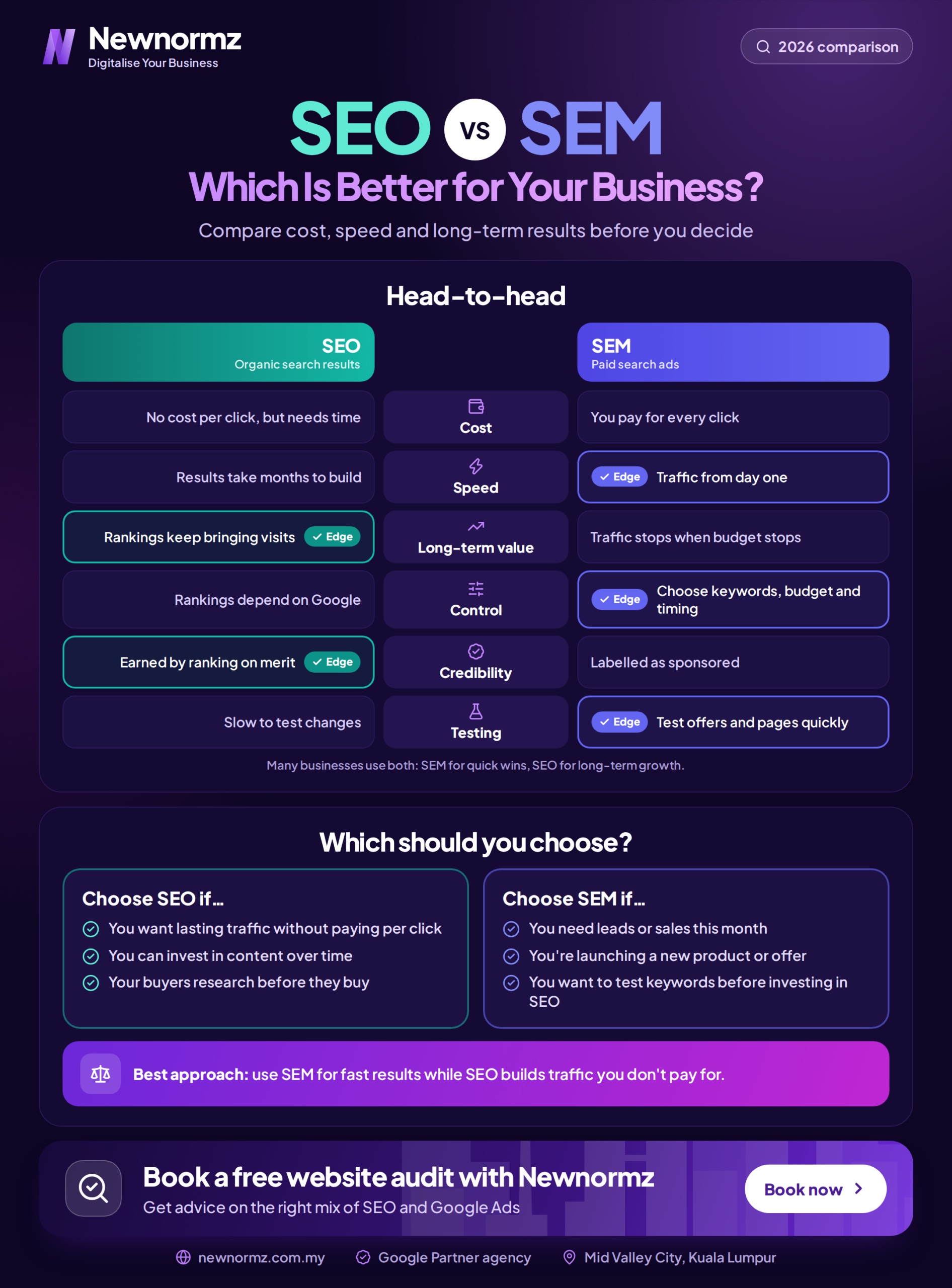
The clearest comparison looks at what actually hits your P&L: how fast results show up, what you pay for them, and what happens the day you stop.
| Factor | SEM (Paid Search) | SEO (Organic) |
|---|---|---|
| Time to first traffic | Same day | Typically 3 to 6 months |
| Payment model | Pay per click, roughly RM3 to RM8 in Malaysia | Fixed effort or retainer, clicks are free once you rank |
| What happens when you stop | Traffic stops immediately | Rankings and traffic persist for months |
| Best suited for | Launches, promotions, fast demand testing | Long term, defensible lead flow |
Two real Newnormz campaigns show both ends of that timeline. Times Parking, a parking management client, ran a six-month SEO campaign that produced 528,000 impressions, 416 ranking keywords and 31,500 clicks, proof that organic does not always need a year to move. Oriental Kopi, an F&B brand, ran a two-year campaign that grew traffic by 43,300 visitors, hit 6.31 million impressions, added 24,500 ranking keywords and reached 468,000 clicks, all without paying per click once those pages ranked. That second number is what compounding actually looks like: the same pages kept earning long after the initial work was billed.
A Real Malaysian Keyword, Both Ways
Take a commercial keyword a KL aircond company would fight for: “aircond service KL.” Here is what each channel realistically delivers for that one term, using current benchmark ranges rather than invented figures.
| Metric | SEM (Google Ads) | SEO (Organic) |
|---|---|---|
| When you appear on page one | Day 1, as soon as ads go live | Month 5 to 8, once the page ranks |
| Cost per click | Roughly RM4.50 | RM0 once ranked |
| Monthly cost | Roughly RM900 in ad spend for 200 clicks | Roughly RM1,800 fixed retainer, not billed per click |
| If you pause it | Enquiries drop to zero the next day | Ranking and enquiries continue for months |
Read it this way: in month one, SEM wins outright. RM900 buys 200 real clicks while the SEO page is still crawling toward page one and earning almost nothing. By month eight, the picture flips. The organic page is bringing in 200 or more clicks a month at zero cost per click, so the effective cost per lead keeps falling while the paid campaign is still paying RM4.50 a click.
The practical move is to run Google Ads from day one to capture buyers immediately, while the organic page builds in parallel. Once it ranks, dial back paid spend on that keyword and redeploy it to terms you do not yet rank for. That sequencing is exactly what our SEO agency in Malaysia runs with clients who want both speed and a falling cost per lead.
Common Mistakes to Avoid
Treating it as either or. The businesses that grow fastest almost always run both, using paid to fund the wait for organic.
Expecting SEO in 30 days. Very few new pages reach the top 10 within a year, so a 30-day deadline leads to quitting right before the results arrive.
Pausing ads the instant rankings appear. Test the drop in enquiries first. Some keywords still need paid coverage for share of voice against competitors.
Ignoring conversion rate. A cheap click that never converts costs more than an expensive click that does. Fix the landing page before you argue about channel.
Skipping conversion tracking. Without it, you cannot tell which channel actually produced the enquiry, and budget gets allocated on guesswork instead of data.
The SEO vs SEM Decision Checklist
Need leads this month? Start with SEM for immediate visibility.
Want a lower cost per lead a year from now? Start SEO in parallel, not later. Sunway Medispa, a healthcare client, saw a 700% traffic increase and 70% more ranking keywords within six months, so “later” often costs you months you did not need to lose.
Launching or running a promotion? Paid search is the faster lever for anything time-bound.
Thin content and weak site health? Fix the SEO foundation before scaling ad spend, since a broken landing page wastes clicks from both channels equally.
Tight budget? Run a small paid test to validate demand, then put the keywords that convert into your SEO plan.
Is conversion tracking actually working? Confirm it on both channels before spending another ringgit.
Is SEO or SEM better for a small business in Malaysia?
It depends on urgency. If you need enquiries this month, SEM gives you visibility for a predictable cost per click. If you want a lower cost per lead over the next year, invest in SEO alongside it. Most small businesses start with paid, then shift budget toward organic as rankings build.
How long before SEO beats SEM on ROI?
For a well-executed campaign, organic ROI typically overtakes paid ROI somewhere around the six to nine month mark, then keeps pulling ahead. Before that, paid usually wins because the organic page is still climbing. Plan for paid to carry you through the first two quarters while SEO matures underneath it.
Can I just run SEO and skip paid ads?
You can, but expect very little traffic for the first several months while pages climb the rankings. That is fine if you have time and no urgent revenue pressure. If you need leads now, skipping paid means losing buyers who would have clicked an ad today rather than waited for you to rank.
Does running Google Ads help my SEO rankings?
Not directly. Paid clicks do not boost organic rankings. Indirectly, paid campaigns hand you keyword and conversion data that sharpens your SEO strategy, and the brand searches ads generate can support organic performance over time. Treat the two as complementary channels feeding one funnel, not as one improving the other’s ranking position.
What is a realistic budget split between SEO and SEM?
A common starting point is heavier on paid early, for example around 70% paid and 30% SEO in the first three months, then rebalancing toward SEO as rankings appear. The right split depends on your margins, sales cycle and how competitive your keywords are, so review it every quarter against actual cost per lead rather than sticking to a fixed ratio.
Not sure where your next ringgit should go?
Get a Clear SEO vs SEM Answer for Your Business
Newnormz has run SEO campaigns across F&B, healthcare, ecommerce, and local services in Malaysia, backed by a performance guarantee of 70 percent of targeted keywords on Google’s first page.
30 minutes, no obligation, and you will leave knowing exactly where paid and organic should each go.

Bryan Tan is an SEO Specialist and CEO at Newnormz, helping hundreds of businesses achieve first-page rankings on Google. With a passion for driving organic growth, Bryan blends innovative strategies with hands-on experience to optimize websites for maximum visibility. Always at the forefront of the latest SEO insights and trends, he consistently adapts to the evolving digital landscape.