ROAS (return on ad spend) is the revenue you earn for every RM1 you put into advertising, calculated as revenue from ads divided by cost of ads. Spend RM10,000 on Google or Meta ads and generate RM40,000 in tracked sales, and your ROAS is 4x. That number tells you almost nothing on its own though, because it ignores product cost, shipping and overheads. Whether 4x is good or bad depends entirely on your gross profit margin, which is why the businesses that get ROAS right always work out their break-even number first, then treat everything above it as the real target.
A Simple Way to Think About It
Counting the Catch vs Counting the Profit
🎣 The fisherman who counts fish
He comes back to shore and proudly counts how many fish he hauled in that day. It looks like a great trip on paper.
💰 The fisherman who counts what’s left
He subtracts the fuel, the bait and the crew’s wages first. That number tells him whether it’s actually worth going out again tomorrow.
ROAS is the fish count. Break-even ROAS, which we cover below, is what’s left in your pocket.
What Is ROAS and the Formula
ROAS stands for return on ad spend. It measures how much revenue your advertising generates relative to what you paid for it.
ROAS = Revenue from ads ÷ Cost of ads
Spend RM10,000 and generate RM40,000 in tracked sales, and your ROAS is 4x, sometimes written as 4:1 or 400%. It’s the fastest read on whether a campaign is pulling its weight, and most Google Ads and Meta dashboards surface it front and centre for exactly that reason. But ROAS only looks at top-line revenue. It doesn’t know what the product cost you, what shipping ate up, or what you pay staff, so it should never be the only number you check before deciding a campaign is working.
ROAS vs ROI vs Break-Even ROAS
These three get confused constantly, and the confusion is what costs Malaysian advertisers real money.
ROAS compares revenue to ad spend only. ROI (return on investment) compares profit to total cost, including product cost, shipping and overheads. A campaign can show a strong 4x ROAS and still post a negative ROI once every cost is counted. Break-even ROAS is the minimum you need just to stop losing money, and it’s driven entirely by your margin.
The formula that actually matters:
Break-even ROAS = 1 ÷ Gross profit margin
A brand with a 50% margin breaks even at 2x. A dropshipper with a 25% margin needs 4x just to break even, which means a “good-looking” 3x for that dropshipper is actually a loss.
What Counts as a Good ROAS
A common rule of thumb points to 4x as a strong benchmark, but averages shift by platform and industry, and by year. The average ecommerce ROAS dropped 4% year over year in 2025, landing at 2.87x. Google tends to outperform Meta because it captures people already searching with intent to buy: Google search campaigns average around 5.17:1 ROAS, while Meta sits lower, closer to 1.86x across industries.
Here’s how typical ranges break down by category. Treat these as a reference point, not a target, because your own break-even ROAS is the number that actually decides whether a campaign is profitable.
| Scenario | Google Ads ROAS | Meta Ads ROAS | Read |
|---|---|---|---|
| Beauty / cosmetics | ~6.1x | ~3.2x | High intent, strong returns |
| General ecommerce average | ~3.5x | ~1.9x | Solid, watch your margin |
| Apparel / retail | ~2.3x | ~1.8x | Competitive, thin |
| Healthcare / services | ~2.2x | ~1.2x | Hard, needs high margin |
The pattern that holds across all four: a business with a 25% to 35% margin is usually healthy somewhere between 3.0x and 5.0x. A high-margin brand can be profitable at 2.0x. A low-margin one may need 5.0x or more just to make sense. Add a 20% to 30% buffer above your own break-even before you call any campaign a genuine win.
How to Improve Your ROAS
Improving ROAS isn’t about spending more. It’s about getting more revenue out of the same or a smaller budget. Work through these levers in order, they compound.
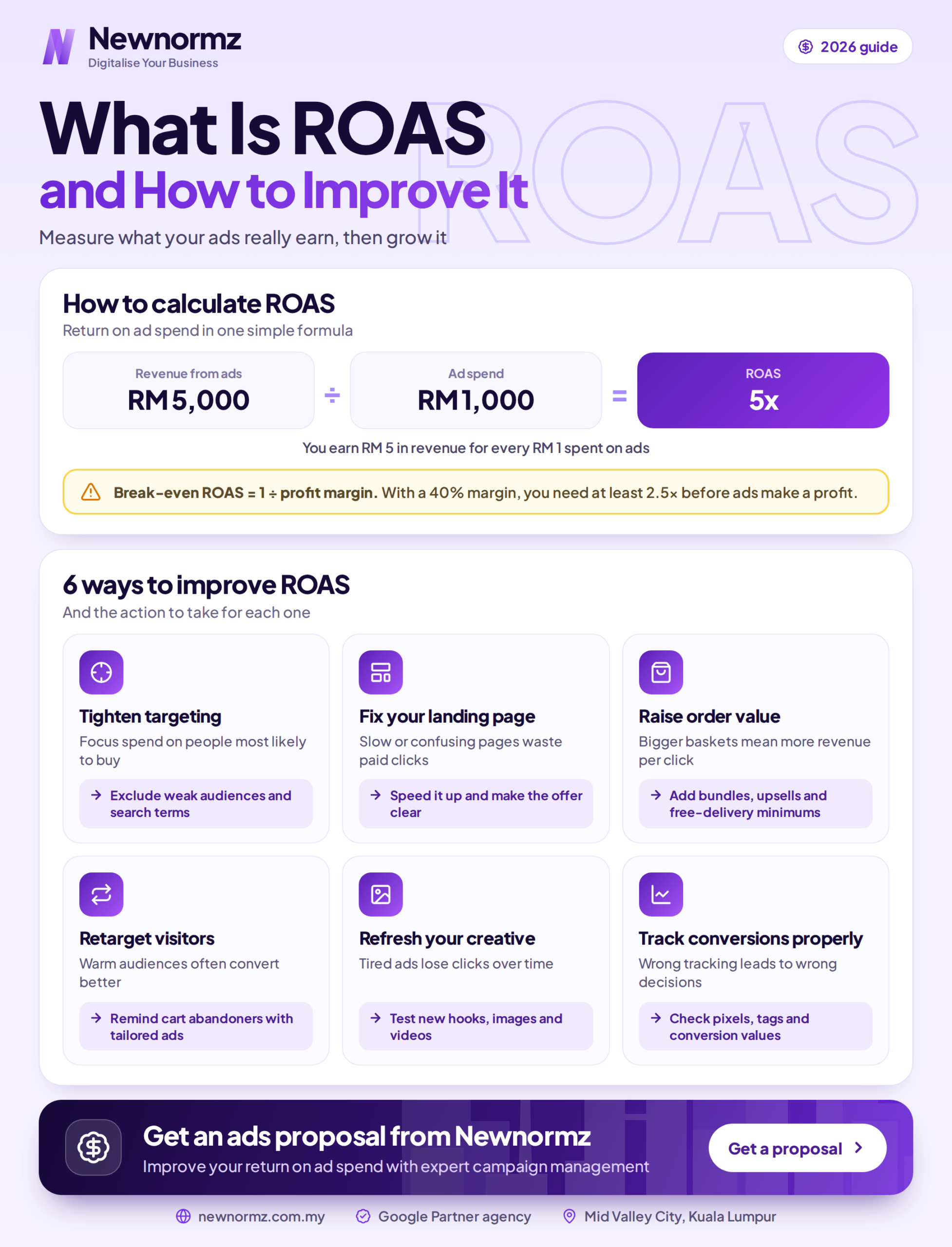
1. Tighten targeting
Narrow to the audiences, locations and devices that actually buy. On Meta, cut broad audiences that click but never purchase. On Google, review search terms weekly and pause the ones draining budget without converting.
2. Add negative keywords
Negative keywords stop your Google ads showing for searches that were never going to convert. Filtering out terms like “free,” “jobs” or “DIY” cuts wasted clicks fast. This is usually the single fastest lever on a search account.
3. Fix landing page speed
Traffic is worthless if the page it lands on can’t convert. Speed is brutal here: conversion rates fall by an average of 4.42% for every additional second of load time between 0 and 5 seconds, and 53% of mobile users abandon a site that takes over 3 seconds to load. Fixing this lifts ROAS across every campaign pointing at that page at once, without touching a single bid.
4. Sharpen the offer and creative
A stronger offer, a clearer headline or a better bundle can double a conversion rate without changing spend at all. On Meta specifically, refresh creative before it fatigues, and test one variable at a time so you know what actually moved the number.
5. Match the bidding strategy to your data
Once you have enough conversion volume, move from manual bidding to a target ROAS strategy. Feed the algorithm clean, accurate conversion tracking, because it will optimise toward whatever signal you give it, wrong or right.
6. Cut wasted spend
Audit where the money is leaking: non-converting keywords, dead ad sets, placements with real spend and zero sales. Reallocating that budget toward your proven winners is often the single biggest jump in ROAS you’ll get all quarter.
A Worked Example
Take a Malaysian ecommerce brand spending RM10,000 a month on Google Ads and generating RM40,000 in tracked revenue, a 4x ROAS. Now apply two of the levers above: cut RM2,000 of wasted spend on non-converting search terms, and lift the landing page conversion rate from 2.0% to 2.5%.
| Metric | Before | After improvements |
|---|---|---|
| Ad spend | RM10,000 | RM8,000 |
| Clicks (at RM2 CPC) | 5,000 | 4,000 |
| Conversion rate | 2.0% | 2.5% |
| Orders | 100 | 100 |
| Revenue (RM400 avg order) | RM40,000 | RM40,000 |
| ROAS | 4.0x | 5.0x |
Cutting RM2,000 of wasted spend only loses the 1,000 clicks that were never converting anyway. The higher conversion rate keeps orders at 100 and revenue at RM40,000. Same revenue, RM8,000 in spend instead of RM10,000, and ROAS climbs from 4.0x to 5.0x, a 25% improvement without one extra ringgit of budget.
Common Mistakes to Avoid
- Treating ROAS as profit. A 4x ROAS can still lose money once product cost and overheads are counted.
- Ignoring break-even ROAS. Without knowing your margin-based break-even, you can’t tell a winning campaign from a losing one.
- Scaling spend on a weak page. More traffic to a slow, unconvincing landing page just wastes budget faster.
- Broken or missing conversion tracking. If tracking is wrong, your ROAS is fiction and the algorithm is optimising toward noise.
- Chasing the highest possible ROAS. A very high ROAS often just means you’re under-spending and leaving sales volume on the table.
Frequently Asked Questions
What does ROAS stand for?
Return on ad spend. It measures the revenue your advertising generates for every ringgit you put in. Spend RM10,000 and earn RM40,000, and your ROAS is 4x, the quickest way to judge whether a Google or Meta campaign is pulling its weight financially.
What is a good ROAS in Malaysia?
There’s no universal number. A business with 25% to 35% margins is usually healthy between 3.0x and 5.0x. High-margin brands can be profitable at 2.0x, while low-margin sellers may need 5.0x or more. Your own break-even ROAS, based on your actual margin, is the benchmark that matters.
How do I calculate break-even ROAS?
Divide 1 by your gross profit margin. A 50% margin gives a break-even ROAS of 2x, RM2 back for every RM1 spent just to cover costs. A 25% margin needs 4x. Always target above break-even, with a 20% to 30% buffer for actual profit.
What’s the difference between ROAS and ROI?
ROAS compares revenue to ad spend only. ROI compares profit to total cost, including product cost, shipping and overheads. A campaign can show a strong 4x ROAS and still have a negative ROI once every cost is counted. Use ROAS for a quick campaign read, and ROI for the real profitability decision.
Does Google Ads or Meta give better ROAS?
Google Ads usually delivers a higher ROAS because search captures people already looking for your product. Search campaigns often average above 5x, while Meta sits lower, around 1.9x across industries. Meta tends to win on reach and demand generation instead, so the right platform depends on your goal and where the buyer is in the funnel.
Can my ROAS be too high?
Yes. A very high ROAS, 10x or more, often means you’re under-spending and leaving sales volume untapped, which can point to too small a budget or targeting that’s too narrow. Sometimes a lower ROAS at a higher spend earns more total profit, and total profit is what actually matters.
Not sure your ad spend is turning a profit?
Get a Free Website and Landing Page Health Check
Newnormz has run SEO campaigns across F&B, healthcare, ecommerce, and local services in Malaysia, backed by a performance guarantee of 70 percent of targeted keywords on Google’s first page.
30 minutes, no obligation. We’ll show you exactly what’s costing your ROAS before you spend another ringgit.

Bryan Tan is an SEO Specialist and CEO at Newnormz, helping hundreds of businesses achieve first-page rankings on Google. With a passion for driving organic growth, Bryan blends innovative strategies with hands-on experience to optimize websites for maximum visibility. Always at the forefront of the latest SEO insights and trends, he consistently adapts to the evolving digital landscape.