Topical authority SEO means covering one subject so completely, and connecting those pages so clearly, that Google treats your site as a reliable source on it. It usually beats chasing individual keywords because it gives you a base that every new article builds on, instead of a pile of pages that each have to fight alone. It is slower to build, and no one can promise you a specific ranking, but the results hold up better when Google changes its systems.
A Simple Way to Think About It
One Book vs a Whole Section
📕 One book on the shelf
A bookshop with a single title on a subject. You flip through it, and then you walk to the shop that looks like it knows more.
📚 A full section
A bookshop with a whole aisle on that subject, sorted from beginner to expert. You stay, and you come back next time you need something.
Google makes the same judgement about websites. The rest of this article shows what that looks like in practice and what it takes to build the aisle.
What Topical Authority SEO Actually Means
Topical authority is how much Google trusts your site on a specific subject. You earn it by answering the full range of questions people have about that subject: the basics, the comparisons, the pricing, the mistakes, the next steps. You do not earn it by publishing one good article and hoping.
Keyword-led SEO asks, “Which phrase can I rank for?” Topical authority SEO asks, “What would someone need to read before they trust us with this?” The second question produces a content plan. The first produces a list.
Google does not publish a “topical authority score”, so treat the term as a working description of what its systems appear to reward, not an official metric. What you can see is the pattern: sites that cover a subject thoroughly tend to rank across many related searches, not just one.
Why Chasing Keywords Alone Stops Working
Older SEO matched pages to exact phrases. Google now reads for intent and context, and it looks at what the rest of your site says about the subject. A page that targets a keyword but sits alone, with no supporting content around it, gives Google little reason to rank it above a site that has covered the whole topic.
The usual pattern we see with Malaysian SMEs looks like this:
- Articles chosen because a keyword tool showed decent volume, not because they belong together.
- Publishing in bursts, then going quiet for months.
- Pages that never link to each other, so nothing signals which one matters most.
- Thin coverage of the subject the business actually sells.
The result is a site that looks busy but does not look like it knows anything in particular.
Keyword SEO vs Topical Authority SEO
| Factor | Keyword-led SEO | Topical authority SEO |
|---|---|---|
| Starting point | A single search term | A whole subject and its questions |
| Content plan | One keyword, one article | Connected pillar and cluster pages |
| What each new page gets | Little help from the pages around it | A boost from the coverage already built |
| Speed | Can win quickly on low-competition terms | Slower start, stronger over time |
| Ease of copying | Easy. A competitor writes the same page. | Hard. A competitor has to match the depth. |
| Lead quality | Mixed. Visitors often arrive with one question. | Better. Visitors have read several answers first. |
Keyword work still has a place. A quick-win page on a low-competition term can bring in traffic while the bigger structure is being built. The mistake is treating it as the whole strategy.
How Topical Authority Gets Built
Pillar pages and clusters
A pillar page covers a broad subject in depth. Cluster articles each take one narrower question within it, and all of them link back to the pillar and to each other. An accounting firm might build a pillar on SME tax compliance, with clusters on payroll obligations, director fees, and filing timelines. Each article makes the others more believable.
Writing for the full intent
Google reads content closer to how an informed person would. Using the real terms of your industry and answering what the searcher actually needs matters more than repeating a target phrase. Write the answer a client would want, including the awkward parts such as cost and limits.
Internal links that show structure
Your links tell Google which pages matter and how your knowledge is organised. Vague or missing links leave that unclear. Descriptive anchor text between related pages fixes it, and it also helps readers find the next thing they need.
Why This Suits Malaysian SMEs
Most SMEs cannot outspend a national brand on broad, competitive terms. Topical authority lets you pick a narrower ground and own it. A logistics company in Penang, for example, could go deep on warehouse management, last mile delivery, and local freight planning, instead of trying to rank for “logistics Malaysia” on day one.
Language matters too. Many Malaysians search in English, Bahasa Malaysia, or Chinese, and a complete topic plan should ask which of those your customers actually use. For businesses serving a specific area, pairing topic depth with local SEO gives you both the expertise signal and the location signal.
Google is where the audience is. Statcounter puts its share of Malaysian search at about 93% (May 2026), so a site that Google understands clearly has a real advantage.
What Broad Coverage Looks Like in Real Numbers
We cannot attribute a result to one tactic, since every campaign combines several. But the campaigns where a site ends up ranking for a wide spread of related searches share a pattern. Oriental Kopi, an F&B client, ran a two-year SEO campaign and gained 24,500 more ranking keywords, 6.31M impressions, and 468,000 clicks. Sunway Medispa, in healthcare, saw a 700% traffic increase and 70% more keywords ranking over six months.
Growth in the number of keywords ranking, not just movement on one, is what topic coverage tends to produce. Your own result will depend on your competition, your site, and how consistently the plan is carried out.
How We Build It at Newnormz
Within our SEO service, topical authority is a structured, long-term piece of work, not a content calendar. It runs in five steps.
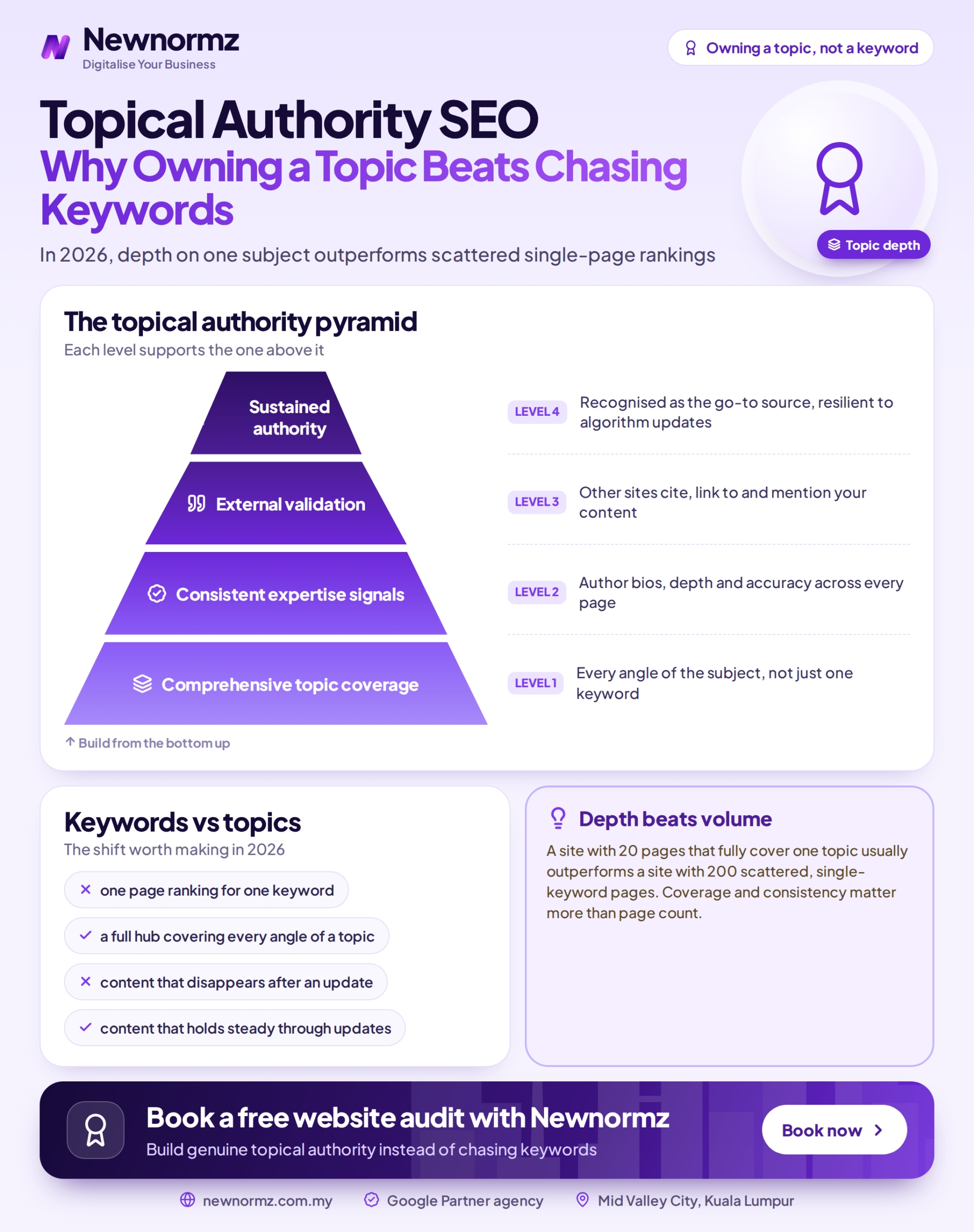
- Topic mapping. We list the questions, concerns, and subtopics around your business before any writing starts.
- Pillar and cluster structure. We decide which pages anchor the topic and which support them.
- Content with commercial intent. Each piece educates the reader and points naturally toward your product or service.
- Internal link work. We connect pages so both readers and Google can follow the structure.
- Tracking. We watch rankings, traffic, and lead quality across the cluster and adjust as it grows.
We often start with what you already have. Restructuring, linking, and refreshing existing pages can close gaps before a single new article is needed.
Frequently Asked Questions
How long does it take to build topical authority?
Many sites see stronger movement within three to six months, but it depends on your competition, your site’s current strength, and how much content the topic needs. Anyone promising an exact date is guessing.
How many articles do I need?
There is no fixed number. A content gap analysis against the top-ranking sites in your niche shows which pillar pages and supporting articles are missing.
Do I have to publish constantly?
No. Fixing and connecting existing pages often comes first. After that, steady publishing against a plan works better than bursts of unrelated posts.
Does it work for local businesses in Malaysia?
Yes, provided the topics reflect how Malaysians actually search, including language and location. A narrow, well-covered niche is often easier for a local business to win than a broad national term.
Does it improve lead quality?
Usually, yes. Visitors who have read several of your answers arrive better informed, so enquiries tend to be more serious than those from a single-keyword landing page.
Is your site a visitor or a resident?
Find the gaps in your topic coverage before your competitors fill them
Newnormz has run SEO campaigns across F&B, healthcare, ecommerce, and local services in Malaysia, backed by a performance guarantee of 70 percent of targeted keywords on Google’s first page.
30 minutes, no obligation, and we will show you where your topic coverage is thin.

Bryan Tan is an SEO Specialist and CEO at Newnormz, helping hundreds of businesses achieve first-page rankings on Google. With a passion for driving organic growth, Bryan blends innovative strategies with hands-on experience to optimize websites for maximum visibility. Always at the forefront of the latest SEO insights and trends, he consistently adapts to the evolving digital landscape.