If you need enquiries this month, paid ads are the only search channel that can deliver them on demand. If you want your cost per lead to fall over time instead of rising every year, organic search is the channel that gets you there, but it takes months, not weeks. Most Malaysian SMEs don’t have to pick one forever. The practical answer is usually to run Google Ads on your highest-intent keywords now, build SEO on the pages that matter underneath, and move budget away from ads one keyword at a time as organic rankings take over.
A Simple Way to Think About It
The Metered Tap and the Well
🚰 The metered tap
Turn it on and water comes out right away. Every litre shows up on the bill, and the moment you stop paying, it runs dry.
🪣 The well
Weeks of digging with nothing to show for it. Once you hit water, it keeps coming up without a meter ticking.
Most businesses that grow steadily have both: the tap for when they need water today, and a well they keep digging underneath it. Here’s how to decide how much of each you need.
How Each Channel Actually Gets You Customers
Both channels show up on the same Google results page, and in Malaysia that page matters. Google holds around 93% of the local search market (Statcounter, May 2026), and the country had 35.4 million internet users at the end of 2025, about 98% of the population (DataReportal Digital 2026 Malaysia). Your customers are searching. The question is how you get in front of them.
Organic search: you earn the position
Organic results are the unpaid listings under the ads. You get there by having the most useful, trustworthy, technically sound page for what the searcher wants. Nobody can buy that position, and Google has said publicly many times that nobody can guarantee a specific ranking either. What you can do is make your site the obvious best answer, and keep it that way.
In Malaysia that often means covering the same intent in more than one language. Someone looking for a confinement centre might type in English, Bahasa Malaysia, or Chinese, and those are three different sets of results. An organic strategy that only targets English leaves the other two open to competitors.
Paid ads: you rent the position
With Google Ads, you bid in an auction to appear above or beside the organic results, and you pay when someone clicks. A campaign can go live the same day. You choose the keywords, the locations, the hours, and the budget, and you can change any of them tomorrow.
The trade-off is simple. Your visibility lasts exactly as long as your budget does. Turn off the campaign and you disappear from that spot right away.
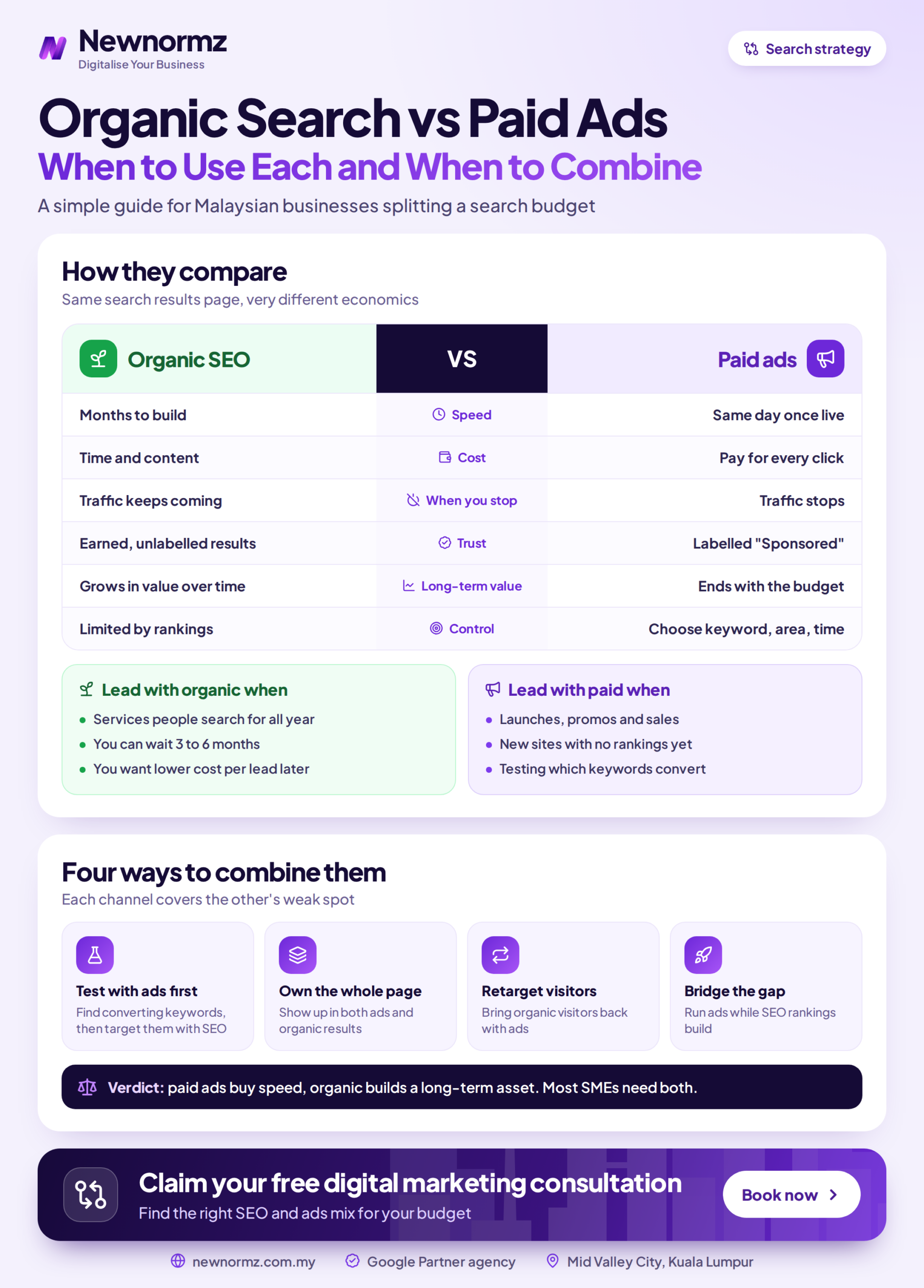
Organic Search vs Paid Ads, Side by Side
| Factor | Organic search (SEO) | Paid ads (Google Ads) |
|---|---|---|
| Speed | Usually months before meaningful traction | Live within hours of launch |
| How you pay | Content, technical work, and expertise up front. No fee per click | Every click costs money, for as long as you run it |
| When you stop | Rankings fade gradually, not overnight | Traffic stops the same day |
| Control | Limited. Google decides who ranks | High. You pick keywords, areas, times, and budget |
| Cost trend over time | Cost per lead tends to fall as rankings build | Tends to rise as more competitors enter the auction |
| Best for | Steady, year-round demand and long-term lead flow | Launches, promotions, testing, and urgent pipeline gaps |
When SEO Should Lead
Make organic search your main investment when most of these are true for you:
- People search for what you sell all year. Clinics, legal and accounting firms, renovation, education, F&B, and ecommerce all see steady search demand. Every month you rank, you collect leads you would otherwise pay for.
- You can wait six to twelve months for the payoff. SEO is slow at the start. If your cash flow can’t survive that wait, lead with ads and build SEO alongside.
- Your ad costs keep going up while results stay flat. That usually means the auction is getting crowded. Organic rankings are the only way to reach those same searchers without paying the rising price per click.
- Your customers research before they buy. For bigger decisions, people compare several pages before they enquire. Showing up organically across those searches builds familiarity that one ad click can’t.
The compounding is real when it’s done properly. Over a two-year campaign, Oriental Kopi grew traffic by 43,300, earned 6.31 million impressions and 468,000 clicks, and ranked for 24,500 more keywords. None of those clicks came with a per-click bill. Shorter campaigns can move quickly too: Sunway Medispa saw a 700% traffic increase and 70% more keywords ranking within six months. The key word there is “can”. Results depend on your starting point and how competitive your niche is, and anyone promising a fixed ranking position is promising something Google itself says isn’t possible.
When Paid Ads Should Lead
Ads are the better first move when speed or flexibility matters more than long-term cost:
- You need leads now. A new business, a new branch, or a sudden gap in your pipeline can’t wait for rankings. Ads put your offer in front of people who are searching today.
- You’re running something time-bound. Raya promotions, 11.11 and 12.12 sales, year-end offers, and event launches have a short window. SEO can’t turn on and off with the calendar. Ads can.
- You’re testing a new service, area, or audience. A few weeks of ad data tells you which keywords actually convert and which messages people respond to. That’s much cheaper than spending months building organic content around the wrong keywords.
One example from our own work: a confinement centre in KL had a budget of RM2,550 a month and needed enquiries quickly. Pairing Google Ads with the SEO work got them qualified leads within 30 days, well before organic rankings alone could have.
When to Run Both, and How to Hand Off Between Them
For most SMEs with the budget for both, running them together works better than choosing one. The point isn’t to double your spend. It’s to give each channel a clear job and let it hand the work over to the other.
Use ads to cover the gap while SEO builds
Run ads on your highest-intent keywords from day one. Build organic pages for those same keywords at the same time. When a page starts ranking well and holding steady, pull ad spend back on that keyword and put it toward the next target. Done keyword by keyword, your blended cost per lead should come down over time.
Here’s how that might look for an accounting firm in KL. It runs ads on “SST filing service KL” for immediate enquiries while building an organic page for “corporate tax advisory Malaysia”. When the organic page ranks and holds, the ad budget for that keyword group moves somewhere else.
Let ad data decide what SEO should target
Your Google Ads search terms report shows exactly what people typed before they enquired. That’s the most reliable keyword research you’ll get, because it’s based on actual conversions and not search volume estimates. Build your organic content around the terms that convert.
Cover your brand name
Competitors can bid on your brand name in Google Ads, which puts their ad above your own listing when someone searches for you. A small branded campaign is usually cheap, because your relevance for your own name is high, and it keeps that spot yours.
Take up more of the results page on your most valuable searches
For the handful of keywords that drive most of your revenue, showing up in both the ad slot and the organic results takes up more of the page and leaves less room for competitors. That’s worth paying for on those few terms, but not across your whole keyword list.
| Your situation | Lead with | Why |
|---|---|---|
| New business, no rankings yet | Ads first, SEO started in parallel | You need revenue while the organic foundation builds |
| Seasonal promo or launch | Ads | The window is too short for SEO to matter |
| Established service, steady demand | SEO | Year-round searches reward long-term rankings |
| Cost per click keeps rising | Shift toward SEO | Organic reach doesn’t get pricier as the auction gets crowded |
| Testing a new service or area | Ads | Fast, cheap proof of demand before investing in content |
| Competitors bidding on your brand | Both | A branded campaign protects the spot your organic listing can’t |
The Mistakes That Waste the Most Money
- Switching ads off before any organic base exists. Leads go from steady to zero overnight, and there’s nothing underneath to catch the fall.
- Sending ad clicks to a weak landing page. You pay for every visitor either way. A slow or unclear page turns good traffic into wasted budget.
- Doing SEO for keywords nobody searches. Ranking first for a phrase with no search demand looks good in a report and does nothing for your business.
- Running the two channels as separate projects. When the ads team and the SEO team never compare notes, you pay twice to learn the same lessons, and ad data never gets used to shape your content.
How We Decide the Mix for a Client
We don’t start with a channel. We start with the numbers: how much search demand exists for what you sell, in which languages, what your competitors already rank for and bid on, how quickly you need leads, and what a customer is worth to you. That tells us whether the first ringgit should go to ads, to our SEO service, or to both. It also tells us when to start moving budget from one to the other.
Sometimes the honest answer is that SEO won’t pay off for your situation, for example a one-off event or a product with almost no search demand. When that’s the case, we’ll tell you.
Frequently Asked Questions
How long does SEO take to show results in Malaysia?
Most businesses start seeing meaningful movement within three to six months, with stronger returns building over the following year. Competitive niches and brand-new domains take longer. Anyone quoting an exact date for a specific ranking is guessing.
Should a new business start with Google Ads or SEO?
Usually both, with ads doing the heavy lifting early on. Ads bring in enquiries while you have no rankings, and SEO started on day one means you aren’t still starting from zero a year later.
How much should I spend on Google Ads?
It depends on your industry’s click costs and how many leads you need. Work backwards: estimate your cost per click, your landing page conversion rate, and the number of enquiries you want each month. For reference, the KL confinement centre mentioned above got qualified leads within 30 days on RM2,550 a month.
If I rank organically for a keyword, should I stop bidding on it?
Often yes, but test it first. Pause the ads on that keyword for a few weeks and watch your total leads. If they hold steady, move the budget elsewhere. If they drop noticeably, the ad was bringing in extra clicks, and it may be worth keeping for your most valuable terms.
Do organic rankings disappear if I stop SEO?
Not overnight like ads do, but they do slip over time as competitors keep publishing and improving their pages. Think of SEO as maintenance on the well you’ve dug, not a one-off job.
Not sure where your next ringgit should go?
Find out whether SEO, ads, or both will bring you the most leads for your budget
Newnormz has run SEO campaigns across F&B, healthcare, ecommerce, and local services in Malaysia, backed by a performance guarantee of 70 percent of targeted keywords on Google’s first page.
30 minutes, no obligation, and a clear view of where your search budget is working and where it isn’t.

Bryan Tan is an SEO Specialist and CEO at Newnormz, helping hundreds of businesses achieve first-page rankings on Google. With a passion for driving organic growth, Bryan blends innovative strategies with hands-on experience to optimize websites for maximum visibility. Always at the forefront of the latest SEO insights and trends, he consistently adapts to the evolving digital landscape.