
SEO competitor analysis means looking at the sites that outrank you on Google and working out why they win: which keywords send them traffic, which pages do most of the work, who links to them, and how their site performs technically. You can do most of it in a few hours with Google itself and one keyword tool. The mistake most Malaysian businesses make is copying what they find. The value is in the gaps: the searches your rivals rank for badly, the questions nobody answers well, and the local and language-specific terms the bigger players ignore. Treat third-party traffic numbers as rough estimates, not facts. What matters is the direction they point you in.
A Simple Way to Think About It
The Busiest Stall at the Pasar Malam
🍢 Copying the menu
You see the longest queue at the satay stall, so you open a satay stall right next to it. Customers still walk past you to the one they already know.
🥤 Watching the queue
You notice everyone in that queue is thirsty and there is no drinks stall anywhere nearby. You sell them drinks, and the long queue becomes your customer base too.
The five steps below are about finding the drinks stall: the demand your competitors create but don’t fully serve.
Why this matters more in Malaysia than you might think
Google handles roughly 93% of search in Malaysia (Statcounter, May 2026), and the country had 35.4 million internet users at the end of 2025, about 98% of the population (DataReportal Digital 2026 Malaysia). Almost everyone you want to sell to is searching on one platform. So the first page of Google for your main keywords is a small, crowded space, and the handful of sites on it are taking most of the clicks.
Malaysian search is also messier than the tools assume. The same customer might search “klinik gigi Cheras”, “dentist near me”, and a Chinese-language query in the same week. Most competitors only optimise for the English version. That alone is often the first gap worth checking.
Step 1: Find your real search competitors
Your search competitors are not always your business competitors. Type your five or six most important keywords into Google (use an incognito window, and set your location to the city you actually serve) and write down who ranks in the top five for each.
You will usually find three kinds of sites:
- Direct rivals selling the same thing in the same area.
- Directories and marketplaces that list businesses like yours.
- Publishers and blogs writing “best of” lists and guides.
A Kuala Lumpur accounting firm, for example, might find its real search competition is a directory, a comparison blog, and a Penang firm it has never heard of. Those are the sites to study, whether or not you recognise the names. For searches with local intent, also note who shows up in the Google Maps results. That is a separate race, and it is won mostly through local SEO work like your Google Business Profile and reviews rather than your website alone.
Step 2: Work out which keywords actually feed them
Put a competitor’s domain into a tool like Ahrefs, Semrush, or Ubersuggest and look at their top organic keywords. Ignore the vanity terms. You are looking for three things:
- Keywords where they sit in positions 4 to 10. They rank, but not strongly. These are the most realistic targets because Google already sees the topic as relevant and the top spot isn’t locked in.
- Long-tail questions they rank for by accident. A page written for one thing that happens to rank for a specific question it barely answers. A page built to answer that question properly has a real shot.
- Location and language variants. City and neighbourhood terms, Bahasa Malaysia phrasing, and Chinese-language searches your rivals don’t cover at all.
A word of caution: the traffic figures these tools show are modelled estimates, and they are often less accurate for Malaysian keywords because the data samples are smaller. Use them to compare competitors against each other and spot patterns. Don’t put them in a business plan.
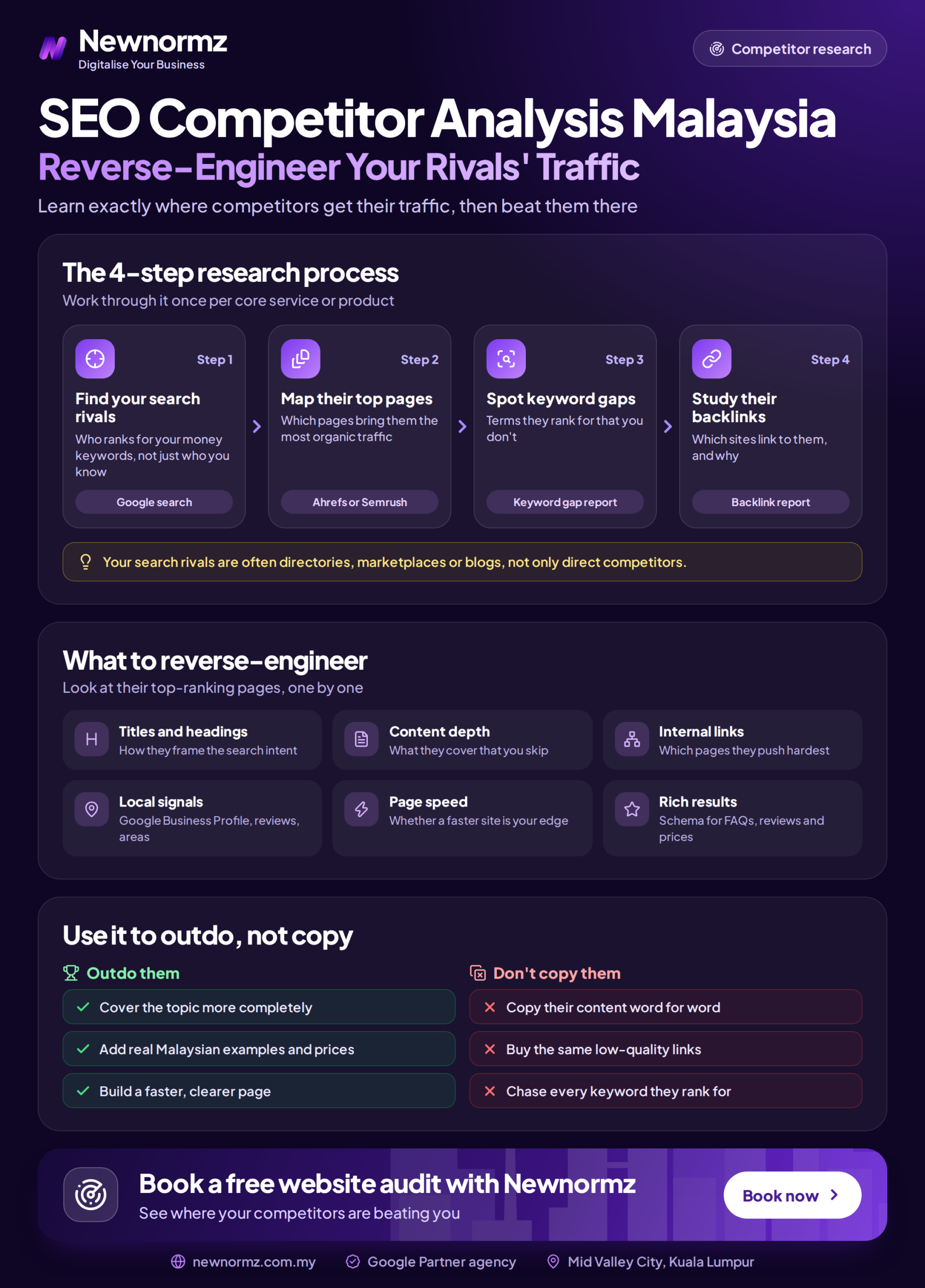
Step 3: Study the pages doing the heavy lifting
On most sites, a small number of pages bring in most of the organic traffic. Find those pages for each competitor (the “top pages” report in most tools shows this) and read them properly. Ask yourself:
- What question is this page really answering, and does it answer it well?
- Is it current, or is it quoting prices and rules from three years ago?
- Does it use a format searchers clearly want, like a price table, a comparison, or a step-by-step guide?
- What would a customer still need to know after reading it?
That last question is where your opportunity lives. If a competitor ranks with a thin or outdated page, a genuinely more useful page can overtake it. Not overnight, and not guaranteed, but it is one of the more reliable openings in SEO. Longer is not automatically better. More useful is.
Step 4: Look at who links to them, then filter hard
Links from other reputable sites are still one of the clearest signals Google uses to judge authority. Pull a competitor’s backlink list and sort it into two piles: links you could realistically earn, and links you can’t.
A link from a national news story about their founder is hard to replicate. A listing in a Malaysian industry association directory, a supplier’s partner page, or a local business feature often isn’t. The realistic pile is your to-do list. Skip anything that looks bought or spammy. If a competitor’s profile is full of those, it is a risk they are carrying, not a strategy to copy.
Step 5: Compare the technical basics
Run your site and your top competitors through Google’s free PageSpeed Insights, then open each one on your own phone. Check how fast pages load on mobile, whether the layout jumps around as it loads, and whether the site structure makes it easy to find the important pages.
Technical SEO rarely wins rankings on its own, but it can quietly lose them. If a competitor has strong content on a slow, clumsy site, that’s an opening. If their site is fast and clean and yours isn’t, that’s the gap to close before anything else.
What to look at, and what to do with it
| Area | What you’re looking for | What to do with it |
|---|---|---|
| Keywords | Terms where they rank 4 to 10, plus local and language variants they miss | Build or improve a page aimed squarely at each one |
| Top pages | Thin, outdated, or incomplete pages that still rank | Write the page that answers what theirs leaves out |
| Backlinks | Directories, associations, and partners that link to rivals but not you | Work through the realistic ones; ignore anything that looks bought |
| Technical | Mobile speed, layout stability, clear site structure | Fix your own weak spots first; they cap everything else |
| Google Maps results | Who appears in the map pack, and how many reviews they have | Strengthen your Google Business Profile and review flow |
What competitor analysis can’t tell you
Being honest about the limits saves you from bad decisions.
- You can’t see their conversions. A competitor might rank for a keyword that brings them traffic and zero customers. Before chasing a keyword, ask whether the person searching it is likely to buy from you.
- The numbers are estimates. Every third-party tool is modelling traffic from outside. Only the site owner’s Google Search Console shows the real figures.
- Nobody can promise you their spot. Google has said publicly and repeatedly that no one can guarantee a specific ranking position. Analysis tells you where to aim, not where you’ll land.
- Copying has a ceiling. If your page is a rewrite of theirs, Google has little reason to prefer yours. You win by being more useful, not more similar.
Turning the findings into a plan
The output of a good competitor analysis is a short, prioritised list, not a 40-page report. Usually it looks something like: fix these two technical issues, improve these three existing pages, write these five new ones, and chase these ten realistic links. Then track your own rankings monthly and repeat the analysis every quarter or so, because your competitors aren’t standing still either.
Expect this to compound over months, not weeks. For context, our campaigns for Times Parking reached 528,000 impressions and 416 ranking keywords over six months, and Sunway Medispa saw a 700% traffic increase in the same timeframe. Oriental Kopi’s two-year campaign grew to 6.31 million impressions and 24,500 more ranking keywords. Six months is where results usually start to become clear. The biggest gains come from staying consistent after that.
If you’d rather have someone run the analysis and do the work that follows, that’s what our SEO service is built around: finding the gaps in your market and closing them in the order that matters most for your business.
Frequently asked questions
Do I need paid tools to analyse my competitors?
Not to start. Google search itself, PageSpeed Insights, and your own Search Console will get you surprisingly far. Paid tools like Ahrefs or Semrush save a lot of time on keyword and backlink research, and most offer trials or limited free versions if you want to test them first.
How long before the changes show up in rankings?
Improvements to existing pages can start moving within a few months, but it varies with how competitive the keyword is. Authority built through backlinks takes longer. Plan for around six months before judging whether the strategy is working.
Can a small Malaysian business outrank a much bigger competitor?
On their main head terms, often not quickly. On specific local searches, niche questions, and Bahasa Malaysia or Chinese-language queries, frequently yes. Big sites tend to cover broad topics and leave the specific ones underserved. That is where smaller businesses win.
How many competitors should I analyse?
Three to five is enough. Pick the sites that show up most often across your key searches. Analysing more usually adds noise, not insight.
How often should I repeat the analysis?
A full review every three to six months works for most businesses, with a quick check of your main keywords monthly. Repeat it sooner if a new competitor suddenly appears above you.
Not sure why your competitors outrank you?
Find the gaps your rivals are leaving open, and which ones are worth chasing first.
Newnormz has run SEO campaigns across F&B, healthcare, ecommerce, and local services in Malaysia, backed by a performance guarantee of 70 percent of targeted keywords on Google’s first page.
30 minutes, no obligation, and a clear look at where your competitors are beating you in search.

Bryan Tan is an SEO Specialist and CEO at Newnormz, helping hundreds of businesses achieve first-page rankings on Google. With a passion for driving organic growth, Bryan blends innovative strategies with hands-on experience to optimize websites for maximum visibility. Always at the forefront of the latest SEO insights and trends, he consistently adapts to the evolving digital landscape.