A high conversion website is not the prettiest one in your industry. It is the one where a visitor understands what you do within a few seconds, trusts you enough to act, and can contact you without any friction. In 2026 that comes down to a few unglamorous basics: one clear job per page, fast loading on a mobile connection, trust signals Malaysian buyers actually look for, and a contact path that fits how people here prefer to reach a business (often WhatsApp, not a long form). No design trick guarantees a conversion rate, and anyone promising “market dominance” from a redesign alone is overselling. What you can do is remove the reasons people leave, then test and improve with real data.
A Simple Way to Think About It
The Beautiful Shop vs The Busy Kopitiam
🛍️ The beautifully decorated shop
Everyone who walks in admires the interior. Nobody can find the cashier, so they take a photo and leave with nothing.
☕ The busy kopitiam
Plastic chairs, no decor to speak of. But the moment you sit down, you know exactly how to order, and everyone gets served.
Most business websites in Malaysia are built like the first shop. The sections below cover how to build yours more like the second, without giving up a professional look.
Why a good-looking website still fails to convert
Here is a pattern we see all the time in audits. A business spends real money on a redesign. The new site looks sharp. Traffic holds steady or even grows. Enquiries stay flat.
The reason is almost never the colour palette. It is usually one of these:
- The homepage talks about the company (“We are a leading provider of innovative solutions”) instead of the visitor’s problem.
- There are five competing buttons on the first screen, so nobody clicks any of them.
- The page is heavy and slow on a phone, and people leave before it finishes loading.
- There is nothing on the page that proves you are a real, established business.
- The only way to get in touch is a ten-field form that feels like a job application.
None of these are design problems in the artistic sense. They are clarity, speed, and trust problems. Which is good news, because all three can be fixed without a full rebuild.
Give every page one job
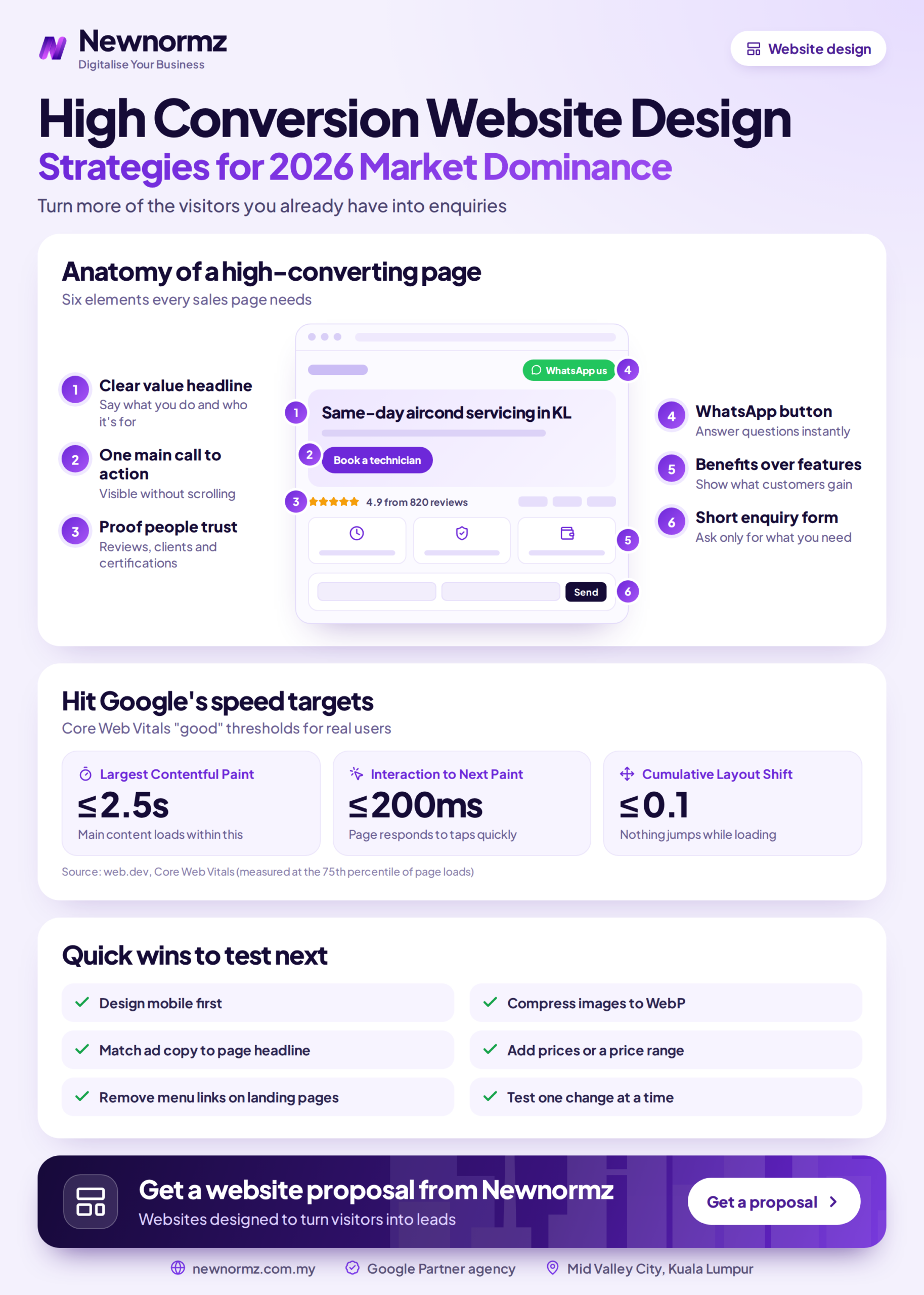
This single change fixes more low-converting pages than anything else we do. Before you touch the layout, write down the one action you want a visitor to take on that page. Request a quote. Book a consultation. Message on WhatsApp. Buy the product.
Then check the first screen a visitor sees (on a phone, not your office monitor) against three questions:
- What is this? A plain-language headline that says what you do and who it is for.
- Why should I care? One line on the outcome you deliver, not a list of features.
- What do I do next? One primary button, visually obvious, with a specific label like “Get a Quote in 24 Hours” instead of “Submit” or “Learn More”.
If a visitor has to scroll or think to answer any of those, you are losing people at the door. Secondary links can exist. They just should not compete visually with the main action.
Speed and mobile are the foundation, not a finishing touch
Malaysia had 35.4 million internet users and 98% internet penetration at the end of 2025 (DataReportal Digital 2026 Malaysia), and a large share of your visitors will arrive on a phone, often on mobile data rather than office fibre. A page that feels fine on your desktop can feel painfully slow to them.
Google measures page experience through Core Web Vitals, which roughly translate to three plain questions: does the main content show up quickly, does the page stay still while it loads, and does it respond quickly when you tap something? These affect both your search visibility and how many visitors stay long enough to convert.
What actually slows Malaysian business sites down
- Uncompressed hero images and background videos that are several megabytes each.
- Page builders and themes loaded with features you never use.
- Too many plugins, chat widgets, and tracking scripts all firing on page load.
- Hosting located far from your visitors, with no content delivery network in front of it.
Design for thumbs as well. Buttons large enough to tap, phone numbers that dial when tapped, forms that bring up the right keyboard for each field. These small details decide whether a mobile visitor finishes the action or gives up halfway.
Trust signals Malaysian buyers actually check
Before anyone hands over their phone number, they want to know you are real. Especially in B2B and in healthcare, where the cost of choosing the wrong provider is high. The trust signals that tend to carry weight locally are practical ones:
- A physical office address and a working local phone number, visible without hunting.
- Your SSM company registration number in the footer.
- Real case studies with real numbers, from brands your prospects recognise.
- Recent Google reviews, ideally linked or embedded rather than screenshot quotes nobody can verify.
- Relevant licences, certifications, or industry memberships, shown near the point of action rather than buried on the About page.
- Content in the language your buyers search in. If a big share of your customers search in Bahasa Malaysia or Chinese, an English-only site is quietly turning them away.
Generic stock photos of smiling people in suits do the opposite. They signal that you had nothing real to show.
Common conversion killers and what to do instead
| Conversion killer | Why it hurts | What to do instead |
|---|---|---|
| Vague headline about “innovative solutions” | Visitors cannot tell in a few seconds whether you solve their problem | State what you do, for whom, and the result, in plain words |
| Several competing buttons on the first screen | Too many choices and people choose nothing | One primary action per page, everything else visually secondary |
| Long enquiry form | Every extra field is another reason to quit | Ask only what sales needs for the first call; offer WhatsApp as an alternative |
| Pop-up on arrival | Interrupts people before they know what you offer, and is awkward to close on mobile | Remove it, or trigger it only after meaningful engagement |
| Heavy images and scripts | Slow loading on mobile data drives people away before they see the offer | Compress images, cut unused plugins, use a CDN and nearby hosting |
| No proof you are a real business | Buyers will not risk contacting a company they cannot verify | Show address, SSM number, real reviews and real case studies |
Make contacting you as easy as it is in real life
A lot of Malaysian buyers would rather send a quick WhatsApp message than fill in a form and wait for an email. If your site only offers a form, you are asking people to change their habits to talk to you. Most won’t.
A practical setup for most local businesses:
- A WhatsApp button that opens a chat with a short pre-filled message, so the visitor does not have to think about what to type.
- A short form (name, phone, one question) for people who prefer it.
- A tap-to-call number for urgent enquiries.
- Tracking on all three, so you know which pages and channels actually produce leads.
And then the part no website can fix: someone has to reply quickly. The best-designed enquiry path in the world is wasted if leads sit unanswered for two days.
Custom build or template? The honest answer
You will hear agencies claim templates always underperform. That is not true. A lean, well-configured theme with good content can convert perfectly well. What hurts is the bloated multipurpose theme with every slider and animation switched on, or a template that forces your content into a structure that does not match how your customers buy.
A custom build is worth the extra cost when your sales process is genuinely specific (multi-step quotes, product configurators, several distinct audiences), when speed problems cannot be fixed on your current setup, or when you need full control over structure for SEO. If none of those apply, fixing the clarity, speed, and trust issues above on your existing site is often the smarter first move.
Traffic and conversion are two different problems
A high-converting site with no visitors converts nothing. A site with plenty of visitors and a weak page wastes them. You need both, and it helps to know which one is actually holding you back.
On the traffic side, SEO compounds over time. Oriental Kopi’s two-year SEO campaign with us grew traffic by 43,300 and generated 6.31 million impressions and 468,000 clicks. Sunway Medispa saw a 700% traffic increase over six months. That kind of visibility only turns into revenue when the pages people land on are built to convert, which is why a solid SEO service should always look at what happens after the click, not just rankings.
When you need answers faster, paid traffic is the quickest way to test a page. For a KL confinement centre, we paired a focused landing page with Google Ads on a RM2,550 monthly budget and generated qualified leads within 30 days. Paid traffic tells you quickly whether a page’s message and offer work, and those lessons then feed back into the rest of the site.
Structure pages so AI search can understand them too
More people now get answers from AI tools and AI summaries in Google before they ever click a link. The same things that help humans convert also help these systems understand your page: a clear heading structure, direct answers to real questions, specific facts rather than slogans, and proper structured data.
Be realistic about this. Google has publicly stated that no one can guarantee a specific ranking position, and the same applies to being cited in an AI answer. What you control is whether your page is clear and credible enough to be a strong candidate. A page written in vague marketing language gives these systems nothing to quote.
Test with real behaviour, not opinions
Once the obvious problems are fixed, improvement comes from watching what real visitors do. Session recordings and heatmaps show where people hesitate, what they tap that is not clickable, and where they give up.
One honest caveat: proper A/B testing needs a decent amount of traffic to produce reliable results. If your page gets a few hundred visitors a month, a split test will mostly measure noise. For smaller sites, you will learn more from recordings, from asking your sales team which questions prospects always ask, and from making one clear change at a time and watching enquiries over a few weeks.
Get Google Analytics and conversion tracking set up properly before you change anything. Without a baseline, you cannot tell whether a redesign helped or hurt.
Frequently asked questions
What is a good website conversion rate?
It depends heavily on your industry, your offer, and where your traffic comes from, so industry averages can mislead. A B2B service page and an ecommerce product page are not comparable. The more useful benchmark is your own: measure your current rate accurately, then work on improving it month by month.
Do I need a full redesign to improve conversions?
Often not. Rewriting the headline, simplifying the first screen, cutting form fields, adding WhatsApp, and fixing page speed can make a real difference on your existing site. A full rebuild makes sense when the underlying platform is too slow or too rigid to fix.
Does website design affect SEO?
Yes. Page speed, mobile usability, and clear content structure all affect how Google evaluates your pages. A well-structured, fast site also keeps visitors engaged longer, which makes your SEO traffic worth more.
Should my website be in Bahasa Malaysia or Chinese as well as English?
If a meaningful share of your customers search in those languages, yes. Proper translated pages (not machine-translated widgets) let you rank for those searches and make those visitors far more comfortable enquiring.
How often should I review my website’s conversion performance?
Check your key numbers monthly and do a deeper review every quarter, plus after any major campaign, redesign, or change to your offer. Conversion problems tend to creep in quietly, through a new plugin, a broken form, or an outdated promotion.
Getting traffic but not enough enquiries?
Find out exactly where your website is losing potential customers.
Newnormz has run SEO campaigns across F&B, healthcare, ecommerce, and local services in Malaysia, backed by a performance guarantee of 70 percent of targeted keywords on Google’s first page.
30 minutes, no obligation, with a clear list of what is slowing your site and stopping visitors from getting in touch.

Bryan Tan is an SEO Specialist and CEO at Newnormz, helping hundreds of businesses achieve first-page rankings on Google. With a passion for driving organic growth, Bryan blends innovative strategies with hands-on experience to optimize websites for maximum visibility. Always at the forefront of the latest SEO insights and trends, he consistently adapts to the evolving digital landscape.