
Expanding from Malaysia into Singapore may seem simple. The markets are close, the language overlap is familiar, and the audience may look similar on the surface.
But Google does not treat Malaysia and Singapore as the same market.
A website that ranks well in Malaysia may not automatically appear for Singapore searches. Without the right international SEO setup, businesses risk poor visibility, confused country targeting, or even competing against their own Malaysian pages.
International SEO requires the right domain structure, hreflang setup, market-specific keywords, and localised content that matches how customers search in each country.
Digital marketing agency Nenormz builds international SEO foundations that support cross-border growth.
This guide explains what it takes to rank across markets, and the common mistakes that stop brands from gaining visibility outside Malaysia.
Book a free website audit call with Newnormz and let the team map out your expansion plan.
What International SEO Actually Does for a Malaysian Business
International SEO helps your website send clearer market signals to Google so your overseas pages can rank for the countries you want to target.
Your website needs to show Google which pages are meant for Malaysia, which pages are meant for Singapore, and which language or location each page should serve.
Newnormz helps businesses avoid costly SEO mistakes during regional expansion. Instead of creating random country pages or duplicating existing Malaysian content, we build a cleaner international SEO structure that supports long-term search growth.
International SEO helps your business enter new markets with a stronger search foundation, clearer targeting, and a better chance of turning regional traffic into qualified enquiries.
Where International SEO Gets Complicated in Malaysia and Singapore
Singapore and Malaysia are neighbouring markets but they behave very differently in search. Understanding this gap is the first step to building a strategy that works in both.
| Factor | Malaysia | Singapore |
| Primary search language | English + Bahasa Malaysia | English (dominant) |
| Search behaviour | Mix of informational and transactional | High transactional intent |
| Competitor landscape | SME-heavy, lower domain authority | MNC-heavy, higher domain authority |
| Google vs others | Google dominant | Google dominant |
| Buying decision style | Price-sensitive, research-heavy | Convenience-focused, trust-driven |
| Local SEO signals | Google Maps + Waze strong | Google Maps strong |
A keyword like “accounting software” attracts different search intent in each market.
Malaysian users tend to search for affordable solutions and compare features. Singaporean users often search for compliance-ready tools that meet IRAS standards.
Applying Malaysian keyword research to a Singapore campaign leads to content that ranks for the wrong queries and converts at a fraction of the rate it should.
Domain Structure: The Decision That Shapes Everything

Before any content is written or any link is built, your domain structure determines how much authority each market version of your site can accumulate. There are three approaches, each with clear trade-offs.
1. Country-Code Top-Level Domains (ccTLDs)
A dedicated .sg domain sends the strongest geographic signal to Google. It ranks faster in Singapore because the domain itself is a trust indicator for local users and search engines alike.
The catch: You build domain authority from zero. If your main .com.my site has three years of backlinks and content history, none of that transfers. This approach suits businesses with the budget to run two separate SEO programmes simultaneously.
2. Subdirectories
Adding a /sg/ subfolder to your existing domain (yoursite.com/sg/) allows you to keep all domain authority consolidated. This is the approach most mid-sized Malaysian brands should start with because it extends existing SEO equity rather than splitting it.
The catch: Geographic signals are weaker than a ccTLD. Hreflang implementation becomes essential to compensate.
3. Subdomains
A structure like sg.yoursite.com gives you some geographic clarity but Google generally treats subdomains as separate sites, meaning you lose much of the authority benefit of subdirectories. Most SEO professionals recommend subdirectories over subdomains for international expansion unless there is a strong technical reason otherwise.
Hreflang: The Most Misunderstood Element of International SEO

Hreflang is an HTML attribute that tells Google which version of a page to display based on the user’s language and location.
For Malaysian brands targeting Singapore, a correctly implemented hreflang setup prevents duplicate content penalties and ensures each market sees the right version of your content.
A typical hreflang setup for a Malaysia-Singapore expansion looks like this:
• lang=”en-MY” for the Malaysian English audience
• lang=”en-SG” for the Singaporean English audience
• lang=”ms” for Bahasa Malaysia content, if applicable
• x-default for users outside both target regions
The errors Newnormz most commonly finds during SEO audits of brands attempting Singapore expansion are incomplete hreflang tag pairs, incorrect language codes, and hreflang attributes that point to pages returning 404 errors.
Any one of these issues can cause Google to ignore the entire hreflang setup and serve pages unpredictably.
Book a free website audit with the Newnormz and we will check your entire international SEO configuration.
Localised Content: What Singapore Users Actually Search For

Technical setup gets your site into the right market. Localised content gets your site to rank within it.
Singapore content requires adjustments that go beyond swapping “ringgit” for “Singapore dollar” or referencing Orchard Road instead of Bukit Bintang.
Singaporean searchers use different terminology, respond to different trust signals, and have higher baseline expectations around credibility and specificity.
1. Keyword Research for the Singapore Market
Standard Malaysian keyword research tools pull data from the .my market. A separate keyword research exercise targeting Singapore reveals:
- Different volume levels for the same terms (some high-volume MY keywords have near-zero SG volume)
- Singapore-specific terminology (“CPF” instead of “EPF”, “HDB” instead of “PR1MA”)
- Higher competition for transactional queries from established Singapore brands and multinational competitors
- Opportunity gaps in long-tail keywords for SEO, service-specific queries where Singapore competitors have weak content coverage
2. Content Tone and Trust Signals
Singaporean buyers tend to respond to precision and proof. Vague claims underperform compared to content that references specific regulations, certifications, case studies with measurable outcomes, or credentials verifiable by the reader.
If you are selling B2B services into Singapore, your content should reference ACRA compliance, relevant MAS guidelines where applicable, and Singapore-specific business context.
Generic Southeast Asia positioning does not convert in a market that considers itself distinctly different from its neighbours.
Technical Checklist for Malaysia-Singapore International SEO

Before launching any Singapore-facing content, confirm the following technical foundations are in place:
- Correct domain structure chosen and implemented (ccTLD, subdirectory, or subdomain)
- Hreflang tags installed on all international pages with correct language and region codes
- Google Search Console properties set up separately for each market version of your site
- Sitemap submitted for each market version
- Page speed passing Core Web Vitals for Singapore-based users (check via PageSpeed Insights with Singapore as the test location)
- Server or CDN configured to deliver content quickly to Singapore IP addresses
- No duplicate content between MY and SG versions without proper canonical or hreflang signals
- Local schema markup referencing Singapore business details where applicable
Learn more about how to review semantic SEO with our technical SEO checklist.
Common Mistakes Malaysian Brands Make in International SEO
After working with Malaysian businesses across multiple industries, Newnormz consistently sees the same errors surface when brands attempt cross-border SEO without a structured approach.
- Assuming shared language means shared search intent: English in Malaysia and English in Singapore produce different keyword opportunities and different conversion triggers.
- Launching Singapore content without hreflang: Google may serve the wrong page to the wrong market, splitting ranking signals and confusing the algorithm.
- Using Malaysian business citations for Singapore local SEO: Google My Business listings, directories, and NAP data need separate Singapore entries for local search visibility.
- Building links only from Malaysian sources: Singapore-facing pages benefit from backlinks from .sg domains and Singapore-based publications, not just Malaysian sites.
- Setting unrealistic timelines: International SEO in a new market typically takes 6 to 12 months to show consistent results. Brands that expect Singapore rankings within 60 days consistently underinvest and then abandon the effort prematurely.
Learn more about how to implement multilingual SEO for Malaysia and Singapore.
How Newnormz Approaches International SEO for Malaysian Clients
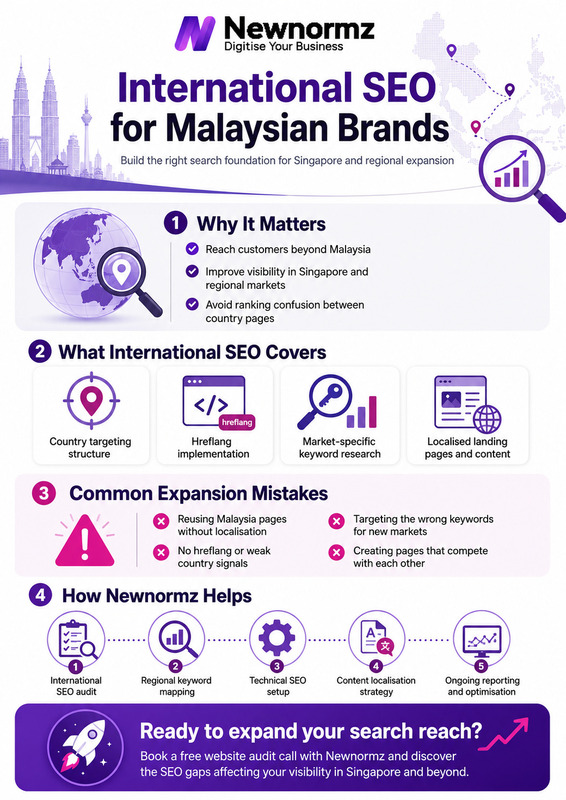
Newnormz builds international SEO strategies that are market-specific from the first session.
Rather than adapting a generic framework, the team conducts a dedicated market entry audit that covers domain configuration, competitor analysis in the target country, keyword mapping, and a content gap analysis comparing your current pages against what ranks in the new market.
We develop a three-phase approach: technical setup and audit, Singapore-specific content build-out, and ongoing authority development through Singapore-relevant backlinks and digital PR.
Each phase has defined deliverables and timelines so clients can track progress without uncertainty.
The team also manages the internal risk of international expansion, ensuring that the push into Singapore does not inadvertently weaken existing Malaysian rankings through poorly configured canonicals or overlapping keyword targeting.
Prepare Your Website for Regional Search Growth
Entering Singapore or other Southeast Asian markets is easier when your website is built with clear country targeting.
The right international SEO setup helps Google understand which market each page is meant for, while giving potential customers content that feels relevant to how they search and buy locally.
This can make the difference between simply publishing overseas-focused pages and actually gaining qualified visibility in a new market.
With the right structure, keywords, and localisation strategy, your website can support regional expansion without weakening the rankings you have already built in Malaysia.
Book a free website audit call with Newnormz and get a practical review of your site’s regional search readiness, including technical targeting and content opportunities for Singapore and other countries.
Frequently Asked Questions About International SEO for Malaysian Brands

As the Core Strategists at Newnormz, we don’t just follow digital trends, we engineer them. Our team bridges the gap between technical precision and creative growth, ensuring that every SEO campaign, ad spend, and web interface serves a single purpose: scaling your business with measurable ROI. By blending data-driven insights with a deep understanding of market psychology, we transform digital presences into high-performance engines. At Newnormz, our strategy is simple: Think bigger, optimize faster, and lead the norm.