SEO works for FMCG brands in Malaysia because shoppers research products on Google before they pick something off a shelf or add it to a cart. The work is not a homepage tweak. It means mapping every product category to the way people actually search, building product and category pages that answer those searches, covering both English and Bahasa Malaysia, and making sure shoppers can find where to buy. Nobody can guarantee a specific ranking, and results build over months, not weeks. But for brands with large product ranges, organic search is one of the few channels where the buyer arrives already looking for what you sell.
Google, Temasek and Bain & Company reported that Southeast Asia’s digital economy reached US$218 billion in GMV in 2023, with Malaysia contributing US$23 billion. Add the fact that Malaysia had 35.4M internet users at the end of 2025 (DataReportal Digital 2026 Malaysia), and Google holds roughly 93% of the local search market (Statcounter, May 2026). Search is where product decisions start.
Someone typing “best cooking oil Malaysia” or “halal snack brand online” is already in discovery mode. If your products do not show up, a competitor’s will. This guide covers what FMCG SEO involves, where most consumer goods websites go wrong, and how to approach it in this market.
A Simple Way to Think About It
Two Products, Same Supermarket
📦 Left in the stockroom
A good product sitting out the back with no label. Shoppers walk the aisle, see nothing, and pick whatever is in front of them.
🛒 At eye level, clearly labelled
The same product, placed where people look, with a label that says what it is. Shoppers reach for it without thinking twice.
Google is the aisle now. The sections below cover how to get your range onto the right shelf.
Why FMCG Needs Its Own SEO Approach
TV, radio, outdoor ads and in-store promotions build recognition. What they often miss is the research moment before purchase. Malaysian shoppers compare products on Google, marketplace listings, retailer sites and social media before deciding what goes in the cart.
FMCG also has problems most other industries do not:
- Dozens or hundreds of SKUs across several categories
- Competition from supermarkets, marketplaces, distributors and rival brands, all targeting the same searches
- Shoppers searching in English, Bahasa Malaysia and sometimes Chinese
- Buying behaviour that differs across Kuala Lumpur, Selangor, Penang, Johor and other markets
- Product pages that must build brand awareness and drive the sale at the same time
An agency that optimises your homepage, adds a few keywords and stops will not move a catalogue like that. A proper SEO service for consumer goods starts with the range itself.
The Four Pillars of FMCG SEO
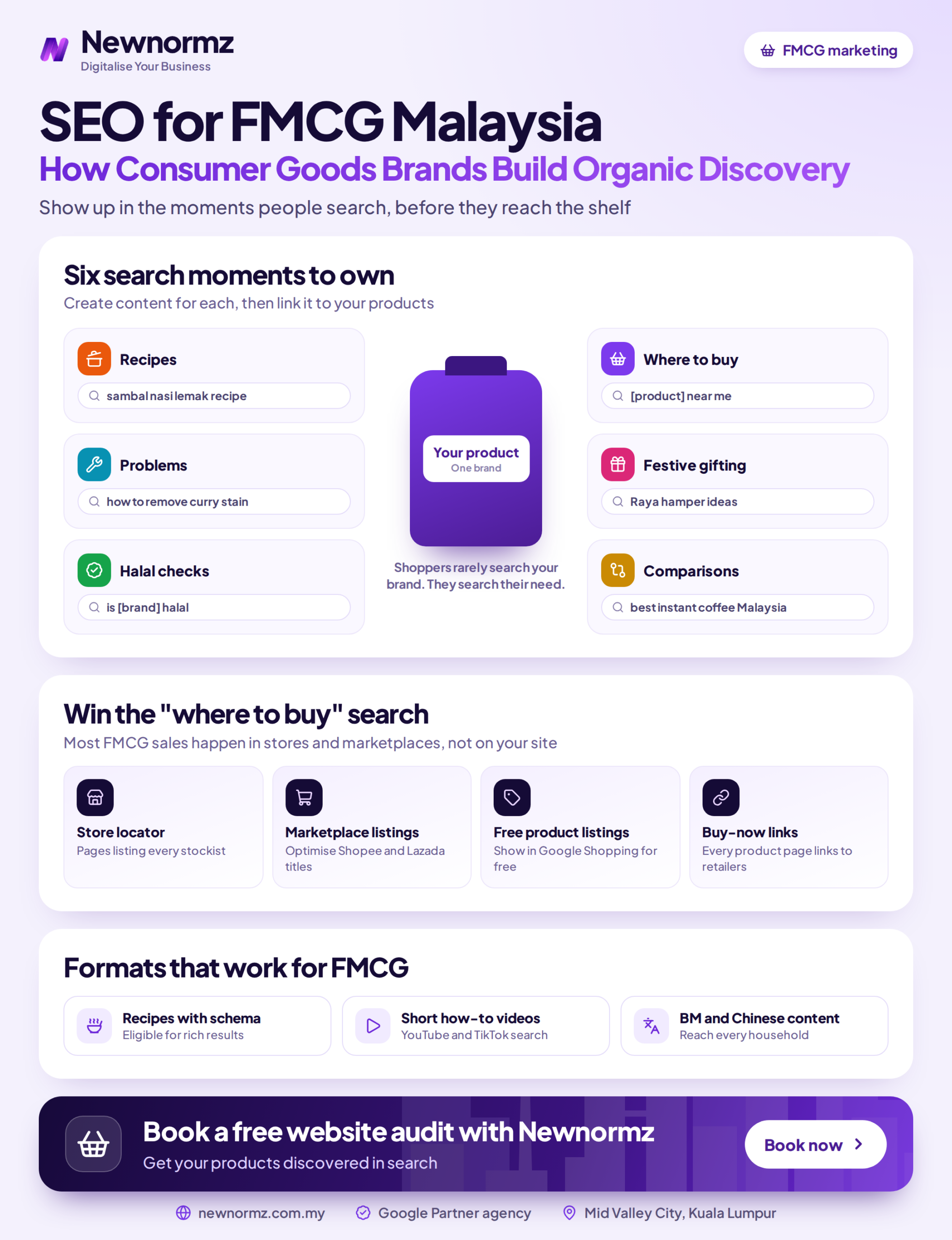
1. Product and category pages
Most FMCG sites treat product pages like digital brochures: an image, an ingredient list, nothing else. Google has little to work with. Each page needs a title tag and description that reflect how people search, a product description written for shoppers rather than copied from the distributor sheet, and structured data (schema markup) so Google can show richer results.
With a large catalogue this is not a one-off job. It needs a repeatable template and a clear order of priority, starting with the categories that have the most search demand.
2. Keywords matched to buying stage
Shoppers search in layers, and each layer needs different content:
- Awareness: broad category searches like “healthy biscuits Malaysia” that introduce your brand to new buyers.
- Consideration: comparisons and “best of” queries, where your brand needs to be in the conversation.
- Purchase: brand and product searches from people who are nearly ready to buy.
Short, competitive category terms and longer, specific phrases behave very differently. Mapping both to the right stage keeps you from spending months chasing a keyword that will never convert.
3. Bahasa Malaysia and English content
Malaysian search is bilingual, and plenty of people mix both languages in one query. A brand that publishes only in English gives up a real share of organic traffic. Doing this properly means running keyword research separately in each language, writing natively for each audience rather than translating, and signalling language and regional targeting correctly in the site’s technical setup. Chinese-language search is worth testing where your product has a strong following in that audience.
4. Local search and “where to buy”
If your products are sold through physical retail or regional distributors, searches like “where to buy [product] in Petaling Jaya” or “nearest health food store KL” are high-intent traffic. Local SEO covers it: a maintained Google Business Profile where relevant, location pages that list real stockists, and consistent business listings across the Klang Valley and beyond.
How Each Tactic Serves an FMCG Goal
| Tactic | What it does for FMCG | What to check first |
|---|---|---|
| Keyword research | Finds the searches shoppers use at each buying stage | Is every product category mapped to real search terms? |
| On-page optimisation | Helps product and category pages rank for relevant queries | Titles, descriptions and schema across the SKU range |
| Content marketing | Answers research questions and builds trust before purchase | Coverage in both Bahasa Malaysia and English |
| Local SEO | Connects searchers to stockists and nearby retail | Google Business Profile and location pages |
| Technical SEO | Keeps the site crawlable, fast and usable on mobile | Indexation issues and Core Web Vitals on image-heavy pages |
Five Gaps That Cost FMCG Brands Organic Traffic
These are the problems we look for first on consumer goods sites. Many sites have several at once.
- Thin product descriptions. Pages with only a name, a photo and a line or two of copy give Google little reason to rank them.
- Missing schema markup. Product, breadcrumb and FAQ markup helps Google understand and display your pages. Many FMCG sites have none of it.
- Bare category pages. A grid of products with no supporting content struggles to rank for category-level searches.
- Slow mobile performance. Core Web Vitals are part of how Google assesses page experience, and image-heavy product pages often fail on mobile.
- No link-building plan. On-page work gets you into the race. For competitive terms, links from credible sites help you stay there.
An audit that covers on-page signals, site structure, Core Web Vitals and competitor rankings shows you which of these is holding you back before any money is spent on fixes.
What Results Look Like, and How Long They Take
Be sceptical of anyone promising fast FMCG rankings. Google has said publicly that no one can guarantee a specific position, and consumer goods categories are crowded. Expect the first visibility gains after a few months, with stronger growth building as pages mature and coverage widens.
For a sense of scale, our F&B client Oriental Kopi ran a 2-year SEO campaign that delivered 43,300 traffic growth, 6.31M impressions, 24,500 more ranking keywords and 468,000 clicks. Food and beverage is not identical to wider FMCG, but the pattern is the same: broad product coverage, compounding over time.
Good reporting should tie SEO to signals you can act on: category impressions, organic traffic quality, product page engagement, enquiries and visibility against competitors.
Frequently Asked Questions
How long does FMCG SEO take to show results?
It depends on your category, competition and how much needs fixing. Early visibility gains often appear within a few months, and larger traffic and product discovery gains tend to build over the following months. Anyone quoting a fixed ranking date is guessing.
Do FMCG brands need both Bahasa Malaysia and English SEO?
In most cases, yes. Shoppers often use different words and different intent in each language, so each needs its own keyword research instead of a straight translation.
Why do product and category pages matter so much?
They are the pages that match high-intent searches, such as comparing product types, ingredients, benefits and brands, or looking for where to buy. If they are thin, your brand is invisible at the moment of choice.
Does technical SEO really matter for an FMCG website?
Yes. Large catalogues often cause crawling and indexing problems, and image-heavy pages can be slow on mobile. Fixing these makes every other piece of SEO work harder.
Is local SEO relevant if we sell through retailers?
Often it is. Stockist searches and “where to buy” queries come from people close to purchase. Location pages and Google Business Profile signals help connect them to a store that carries your products.
Is your FMCG brand visible when shoppers search?
Find out which product categories can win more organic demand
Newnormz has run SEO campaigns across F&B, healthcare, ecommerce, and local services in Malaysia, backed by a performance guarantee of 70 percent of targeted keywords on Google’s first page.
30 minutes, no obligation, and we will show you where your product and category pages are losing visibility.

Bryan Tan is an SEO Specialist and CEO at Newnormz, helping hundreds of businesses achieve first-page rankings on Google. With a passion for driving organic growth, Bryan blends innovative strategies with hands-on experience to optimize websites for maximum visibility. Always at the forefront of the latest SEO insights and trends, he consistently adapts to the evolving digital landscape.