Most Malaysian manufacturers don’t have a demand problem. They have a visibility problem. Engineers and procurement teams now shortlist suppliers on Google long before they pick up the phone, so the factories that win are the ones whose product and capability pages show up for the exact technical terms buyers type. The strategy that works in 2026 is simple to describe and slow to build: use SEO on detailed spec pages for durable inbound leads, use Google Ads to cover high-value terms while that SEO matures, make your website easy for an engineer to request a quote from, and get every inquiry to a salesperson fast. Trade shows still have a place, but as a supporting touchpoint, not the main source of your pipeline.
A Simple Way to Think About It
The Booth and the Phone Book
🎪 Waiting at the booth
You pay for three days of floor space and hope the right buyer happens to walk past on the one afternoon they need what you make.
📒 Being in the buyer’s phone book
When a line goes down at 4pm on a Tuesday, the engineer opens the one book they always check. Your name is already in it.
The sections below explain how to become the name in that book, and what to do once the call comes in.
How Industrial Buyers in Malaysia Find Suppliers Now
The market is there. Malaysia’s manufacturing sector grew 8.2% year on year in April 2026, with sales of RM175.0 billion that month. The question isn’t whether buyers are spending. It’s whether they can find you when they are.
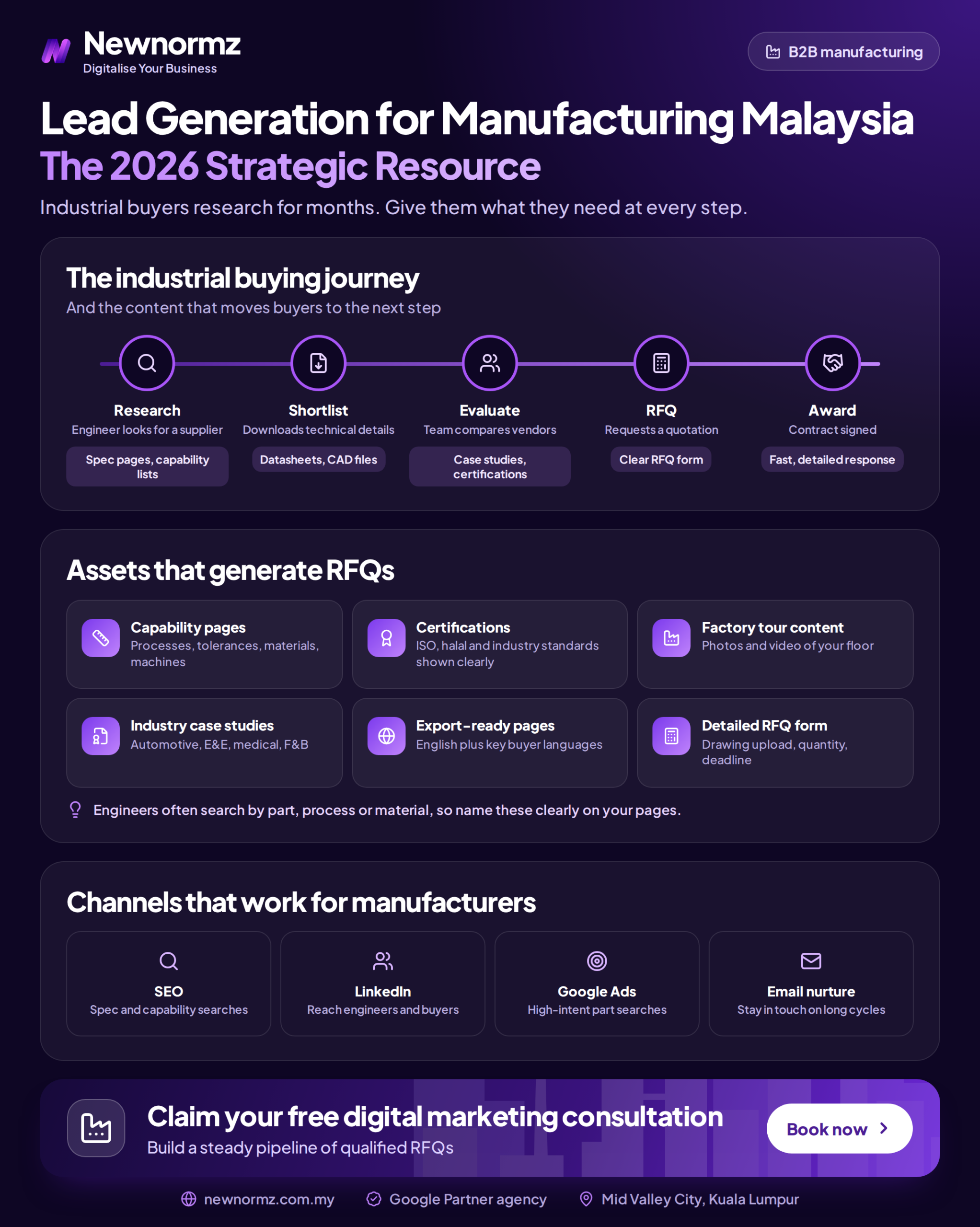
Here is how a typical sourcing search starts. A plant engineer in Penang needs a new supplier for precision-machined aluminium parts. They don’t call five vendors. They search Google for the part, the material, the tolerance, and often the location. They open three or four supplier websites, check capabilities and certifications, and shortlist two. By the time your sales team hears from them, the comparison is already half done.
That behaviour matters because of where it happens. Malaysia had 35.4 million internet users at the end of 2025, about 98% of the population (DataReportal, Digital 2026 Malaysia), and Google holds roughly 93% of the local search market (Statcounter, May 2026). For practical purposes, if you aren’t visible on Google, you aren’t on most shortlists.
Two things make industrial search different from consumer search:
- The terms are specific. Buyers search for processes, materials, standards, and part types, not “best factory Malaysia”. The volume per keyword is small, but the intent behind each search is high.
- The language varies. Engineers in MNCs mostly search in English. Owner-run SMEs and local procurement teams sometimes search in Bahasa Malaysia (for example “pembekal” plus the product) or in Chinese. If your site only covers one language, you are invisible to part of your market.
Why Manufacturing Leads Behave Differently
If you’ve ever hired a general marketing agency and been disappointed, this is usually why. Manufacturing leads don’t behave like retail leads, and campaigns built for retail fail here.
- Low volume, high value. Ten good RFQs a month can matter more than a thousand website visitors. Measuring success by traffic alone will mislead you.
- Long cycles. A first inquiry can take months to become a purchase order, especially if it involves sampling, qualification, or vendor registration.
- Several decision makers. The engineer who finds you is rarely the person who signs. Your website has to satisfy the engineer (specs), procurement (pricing structure, lead times, terms), and management (credibility, certifications).
Any lead generation plan that ignores these three facts will produce numbers that look good in a report and do nothing for your sales team.
The Channels That Actually Produce Industrial Leads
No single channel does everything. Here is an honest comparison of the main options for Malaysian manufacturers.
| Channel | What it does well | Where it falls short | Realistic timeline |
|---|---|---|---|
| SEO | Captures buyers searching specific parts, processes, and materials. Keeps working without paying per click. | Slow to start. Needs real technical content, not generic blog posts. | Early movement in 3 to 6 months; competitive terms take longer. |
| Google Ads (Search) | Puts you in front of active buyers right away, on terms you choose. | Stops the day the budget stops. Without careful keyword exclusions, it wastes money on students and job seekers. | Clicks from day one; lead quality usually needs a few weeks of tuning. |
| LinkedIn Ads | Targets job titles, industries, and company sizes. Useful for reaching named accounts. | Expensive per click. Better for staying visible than for catching an urgent need. | Slow burn; judge it over months, not weeks. |
| Trade shows | Face-to-face trust. Good for strengthening existing relationships. | Fixed dates and high cost per event. Buyer needs don’t follow the exhibition calendar. | Tied to the event, then quiet. |
| Email nurturing and CRM | Keeps you in mind during long procurement cycles. | Only works once you have leads. Useless if there is nothing worth sending. | Ongoing; pays off on deals already in motion. |
SEO: the channel that compounds
For most manufacturers, a proper SEO service is the long-term foundation, because it targets the specific searches engineers actually make. The work is less glamorous than people expect. It means one well-built page per product line or capability (CNC machining, injection moulding, sheet metal fabrication, whatever you do), with real specifications, materials, tolerances, certifications, and industries served. It means spec sheets published as readable web pages, not only as PDFs Google struggles to understand. And it means a technically sound site that loads fast and works on a phone.
Niche B2B audiences are small, but SEO still works for them. Times Parking isn’t a manufacturer, but it sells a parking management service to a narrow commercial audience. In a 6-month campaign it reached 416 ranking keywords, 528,000 impressions, and 31.5K clicks. The lesson for a factory is the same: a narrow market still searches, and whoever shows up consistently gets the inquiry.
One honest caveat. Google has stated publicly that no one can guarantee a specific ranking position. Anyone promising you “number one for your main keyword” is selling something Google itself says doesn’t exist.
Google Ads: the bridge while SEO matures
SEO takes months. Your sales targets don’t wait. Google Ads let you appear for your highest-value terms now, and they show you which keywords actually bring in RFQs. That data then tells you which SEO pages to build first. The key for industrial campaigns is discipline: tight keyword lists, aggressive exclusions (jobs, internships, “free”, “DIY”, “course”), and landing pages that go straight to the relevant product rather than the homepage.
Where trade shows still fit
Don’t drop exhibitions entirely if your customers expect to see you there. Just stop treating them as your pipeline. Use them to meet buyers who already found you online, and make sure every visitor you meet can look you up afterwards and find a website that backs up what your booth promised.
What Your Website Has to Do for an Engineer
Traffic is wasted if the site can’t turn a curious engineer into an inquiry. In our experience, the industrial websites that convert share a few traits:
- Specs up front. Engineers want capacities, tolerances, materials, and certifications (ISO 9001, IATF 16949, and so on) without hunting for them. If they have to email you to find out whether you can do the job, many won’t bother.
- A short RFQ form. Ask for what you need to quote, plus an option to attach a drawing. Ten required fields loses people.
- A WhatsApp option. In Malaysia a lot of B2B conversations start on WhatsApp. Give buyers that route alongside the form.
- Mobile performance. Supplier checks often happen on a phone, between meetings or on the factory floor. A slow, cramped mobile site makes you look less capable than you are.
- Proof. Industries served, types of clients, photos of your actual facility and equipment. Stock photos of handshakes do nothing for an engineer.
AI Search: What Actually Changes for Manufacturers
Procurement teams are starting to use AI tools like ChatGPT, Perplexity, and Google’s AI Overviews to build early supplier lists. Optimising for this is often called Generative Engine Optimisation, or GEO.
The honest version: GEO isn’t a separate magic channel. AI tools pull their answers from pages they can read and trust. A manufacturer with clear, detailed, well-structured capability pages, consistent company information across the web, and real mentions in industry directories and publications is in a much better position to be cited than one with a thin brochure site. Most of the work that helps you rank on Google also helps you show up in AI answers. Nobody can guarantee an AI tool will name you, and you should be sceptical of anyone who says they can.
From Inquiry to Purchase Order: Building the Pipeline
This is where most manufacturers lose deals they already earned. Marketing produces an inquiry, it sits in a shared inbox for three days, and by the time sales replies, the buyer has already moved on with a faster competitor.
Fixing it doesn’t require expensive software. It needs a few clear rules:
- Define a sales-ready lead. Agree with your sales team on what counts: a specific part or process, a rough quantity, a timeline, a real company. Everything else goes into nurturing, not into your salespeople’s call list.
- Set a response standard. Decide who replies to new inquiries and how fast, and hold to it. Same business day is a reasonable minimum for an RFQ.
- Track the source of every lead. Put inquiries into a CRM, even a simple one, with the page or ad they came from. Within a few months you’ll know which products and keywords actually produce orders, and you can move budget accordingly.
- Close the feedback loop. Sales should tell marketing every month which leads were good and which were junk. That single conversation improves targeting more than any tool.
- Nurture the slow ones. A buyer who isn’t ready this quarter may be ready next year. Occasional useful emails (new capabilities, certifications, case examples) keep you on their list without being a nuisance.
How to Choose a Lead Generation Partner
A manufacturer’s marketing partner needs to understand both search and industrial buying. These questions separate the two quickly.
| Question to ask | Why it matters | Red-flag answer |
|---|---|---|
| How will you measure success? | Impressions and clicks don’t fill a production schedule. Qualified inquiries do. | “We’ll send you a monthly traffic report.” |
| How will you write about our technical products? | Engineers spot vague copy instantly and leave. | “Our writers can cover any topic.” (With no plan to interview your engineers.) |
| Can you guarantee our ranking? | Google says no one can guarantee a specific position. A clearly defined performance commitment is different from a promised spot. | “Yes, number one for your main keyword, guaranteed.” |
| How do you handle Bahasa Malaysia and Chinese search? | Part of your buyer base doesn’t search in English. | “Everyone in B2B searches in English.” |
| What happens after someone fills in the form? | Leads that aren’t tracked and followed up are wasted spend. | “That’s up to your sales team.” |
Frequently Asked Questions
How long before we see real leads?
With Google Ads, you’ll get clicks almost immediately, but expect a few weeks of tuning before the inquiries are consistently qualified. With SEO, early movement usually shows in 3 to 6 months, and competitive terms take longer. Purchase orders come later again, because industrial buying cycles are long. Plan your budget around that reality, not around quick wins.
Our product is very niche. Is anyone even searching for it?
Usually yes, just not in large numbers. Niche industrial terms get low search volume, but the people searching them are often ready to buy, and there is less competition for the top spots. A handful of well-matched inquiries a month can be worth more to a factory than thousands of casual visitors.
Should we start with Google Ads or LinkedIn?
For most manufacturers, Google Ads first. It catches people who are actively searching for what you make right now. LinkedIn is better for staying visible to specific companies and job titles over a long cycle, and it works best once you know which accounts you want to reach.
Should we stop going to trade shows?
Not necessarily. If your key customers expect to meet you there, keep going. Just don’t rely on them as your main lead source. Treat them as a way to deepen relationships, and make sure your online presence is strong enough that people you meet can find and trust you afterwards.
What’s the difference between lead generation and demand generation?
Lead generation captures buyers who already have a need and want a quote. Demand generation builds awareness before the need exists, so you’re already known when it arrives. Most manufacturers should start with lead generation, because it pays for itself sooner, then add demand generation once the inbound pipeline is working.
Are buyers finding your factory, or your competitor’s?
Find out where your manufacturing website is losing qualified RFQs.
Newnormz has run SEO campaigns across F&B, healthcare, ecommerce, and local services in Malaysia, backed by a performance guarantee of 70 percent of targeted keywords on Google’s first page.
30 minutes, no obligation, and a clear view of which product searches you’re missing.

Bryan Tan is an SEO Specialist and CEO at Newnormz, helping hundreds of businesses achieve first-page rankings on Google. With a passion for driving organic growth, Bryan blends innovative strategies with hands-on experience to optimize websites for maximum visibility. Always at the forefront of the latest SEO insights and trends, he consistently adapts to the evolving digital landscape.