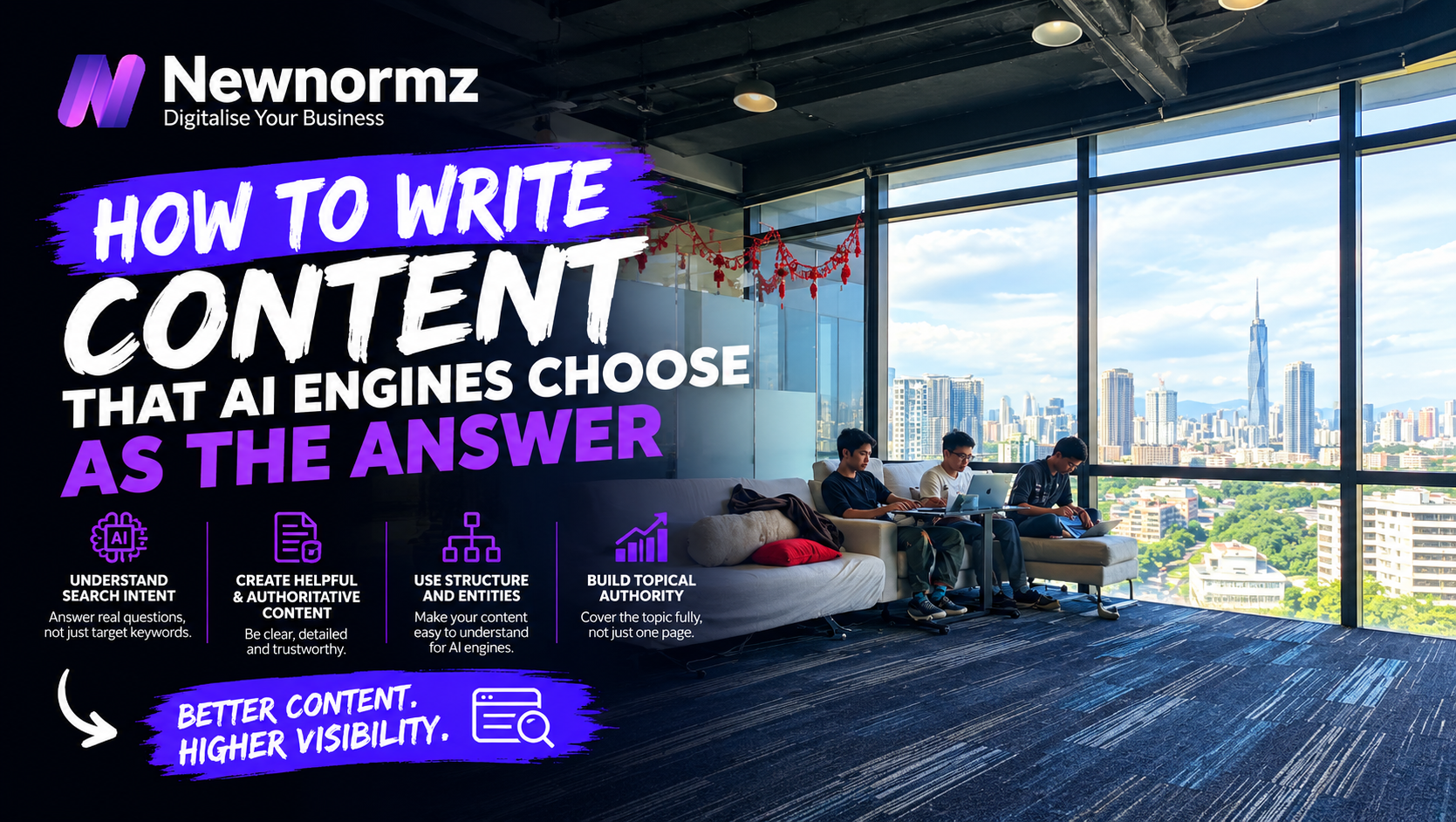
AI engines like Google AI Overviews, ChatGPT and Perplexity don’t pick whole websites. They pick passages: short, clear chunks of text that answer a question directly and can be quoted without extra context. So the job is to make every section of your page work as a standalone answer. Give the answer in the first sentence, use headings that match how people actually phrase the question, back claims with specific, real evidence, and keep the basic SEO in place so the page can be crawled and indexed at all. Nobody can guarantee that an AI engine will cite you. Anyone who promises that is guessing. What you can do is make your content the easiest, safest option for the engine to quote, and that is something you control.
A Simple Way to Think About It
The Reporter on Deadline
📞 The source who warms up first
A reporter calls you for a quote, and you spend five minutes on background before you get to the point. They thank you politely and print what someone else said.
📰 The source who answers first
Another expert answers the question in their first sentence, then explains why. That line is the one that ends up in the article.
The sections below show how to be the second kind of source on every page of your website.
What AI Engines Actually Do When They Pick an Answer
When someone asks Google, ChatGPT or Perplexity a question, the tool doesn’t read the whole web from scratch. It pulls a set of pages it already considers relevant, breaks them into passages, and builds an answer from the passages that respond to the question most clearly and with the least risk of being wrong. Then it cites the sources it used.
That has two consequences for how you write.
First, the engine is judging sections, not your whole article. A 3,000-word guide with one good paragraph buried in the middle can lose to a 600-word page where every section is clean and direct.
Second, the engine is cautious. It prefers text it can quote without twisting the meaning. Vague, hedged or padded writing is harder to quote safely, so it usually gets passed over.
It’s also worth knowing what Google has said publicly. Its guidance for AI features in Search says there are no special extra requirements to appear in AI Overviews beyond normal SEO fundamentals. The page needs to be indexed and eligible to show in Search. So this isn’t a replacement for SEO. It’s SEO with more attention on how each passage reads once it’s pulled out of the page.
The shift is already showing up in traffic data. Previsible’s AI traffic analysis found that AI-referred sessions grew 527% between January and May 2025, from 17,076 to 107,100 sessions across 19 GA4 properties. That’s still small next to traditional organic search, but it’s growing quickly, and the people arriving from those answers have usually already been told your business is relevant.
Why This Matters More for Malaysian Businesses
Malaysia had 35.4 million internet users and 98% internet penetration at the end of 2025 (DataReportal, Digital 2026 Malaysia). Google holds roughly 93% of the Malaysian search market (Statcounter, May 2026). Almost all of your potential customers are online, and most of them are searching on a platform that now puts an AI answer above the regular results for many questions.
There’s also a language angle that most local content ignores. Malaysians search in English, Bahasa Malaysia and Chinese, and often mix them in one query. Plenty of businesses only publish in English, so for many BM and Chinese-language questions there are only a handful of strong local pages to choose from. If you serve those audiences, publishing clear answers in their language is one of the less crowded ways to get cited.
Location-based questions work differently again. For queries like “best confinement centre in KL” or “dentist near Mid Valley,” AI answers lean heavily on Google Business Profile data and local signals, not just blog content. That side of things is handled through local SEO, and it’s worth doing alongside your content work.
How to Write a Page That Gets Chosen
None of what follows is a trick. Each point is about removing a reason for the engine to skip your text.
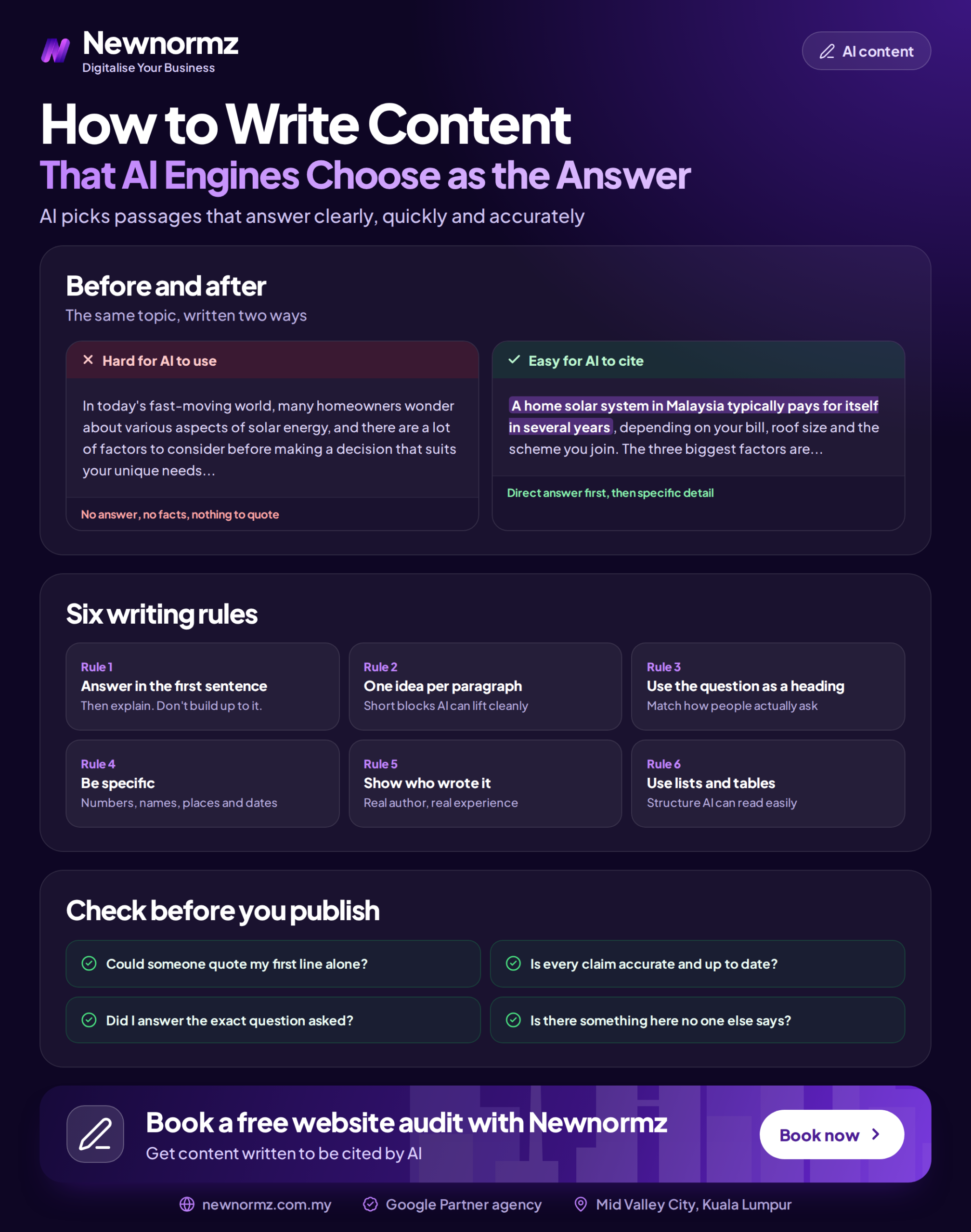
1. Answer first, explain second, in every section
Most people know to answer the question early in the article. Fewer do it under every heading. If your H2 asks “How much does SEO cost in Malaysia?”, the first sentence underneath should give a range or a clear way to estimate it. Background and caveats come after that.
A good test: cover everything except the first two sentences of a section. Do those two sentences answer the heading on their own? If not, rewrite them until they do.
2. Make each section stand on its own
The engine might quote your fourth section without the three before it. Phrases like “as mentioned above” or “this approach” (with no reminder of which approach) lose their meaning once the passage is pulled out. Name the thing again. Repeating the subject feels a bit clunky to the writer, but it makes the passage quotable.
3. Write headings the way people type questions
A heading like “The Secret Sauce” tells neither a reader nor a machine what’s underneath it. “How long does SEO take to work?” does. Check Google’s People Also Ask boxes and your own customer enquiries (WhatsApp messages, sales calls, email) for the exact wording people use, then use that wording in your headings.
4. Be specific, but only with things you can prove
Vague claims don’t get quoted because there’s nothing in them to quote. “We help clients grow their traffic” says nothing. “Sunway Medispa saw a 700% traffic increase over a 6-month SEO campaign” is a fact an engine can lift and attribute.
The flip side matters just as much. Don’t make up numbers or repeat statistics you can’t trace back to a source. AI engines compare claims across sources, and a figure that doesn’t match anything else on the web is more likely to count against you than help. If you don’t have a real number, explain the reasoning instead.
5. Show where your knowledge comes from
Engines and readers both trust content more when it’s clear who wrote it and why they would know. Name a real author or team. Refer to work you’ve actually done. When you cite an outside figure, name the source in the sentence itself. First-hand experience is the one thing a generic competitor page can’t copy.
6. Answer the follow-up question too
Someone asking “how much does a corporate website cost” will usually want to know next what affects the price, how long it takes, and what’s included. A page that covers the main question and the obvious follow-ups is more useful than one that stops at the surface. That doesn’t mean padding. It means thinking one or two questions ahead of the reader.
7. Keep the technical basics clean
The best paragraph on the web gets no citations if the engine can’t read it. Make sure the page is indexed and not blocked, that key information is in plain HTML text rather than inside an image or PDF, and that the page loads properly on mobile. If you use FAQ or article schema, it must match what’s visibly on the page.
What Gets Skipped vs What Gets Cited
Here’s what these changes look like on a real page.
| Element | Usually skipped | More likely to be cited |
|---|---|---|
| Opening | Three paragraphs about how the industry has changed | The first sentence answers the question, and the next ones explain it |
| Headings | Clever labels like “The Magic Formula” | The question as people actually type it |
| Claims | “We deliver great results” | A named, specific, verifiable result |
| Sections | Depend on context from earlier in the page | Make sense when read on their own |
| Sources | Statistics with no source, or numbers that don’t match anywhere else | A named source in the sentence, or plainly stated first-hand experience |
| Format | Key details locked in an image, slider or PDF | Key details in plain, crawlable text |
What You Can’t Control (and Shouldn’t Pretend To)
Being honest about the limits is part of doing this properly.
AI answers aren’t fixed. The same question can bring up different sources on different days, for different users, or when it’s worded slightly differently. Google has said publicly many times that no one can guarantee a specific ranking position, and AI citations are even less predictable than the blue links.
Measurement is also imperfect. Google includes AI Overview data in the overall Web search figures in Search Console, so you can’t cleanly separate it. For ChatGPT and Perplexity, the clearest signal is referral traffic in GA4 from domains like chatgpt.com and perplexity.ai. Track that trend over months, and don’t read too much into any single week.
What you can control is the quality of the material you give the engines. Clear, specific, well-structured content tends to do well in traditional rankings and AI answers alike, so the work pays off either way.
Where to Start If You Already Have a Blog
Most Malaysian businesses don’t need more articles. They need the ones they already have to work harder. Start with the pages that already get impressions in Search Console, since those are pages Google already considers relevant. Then go through them in this order:
- Rewrite the first sentence under each heading so it answers the heading directly.
- Replace vague headings with real customer questions.
- Swap generic claims for specific results you can verify, or cut them.
- Add a short FAQ only where readers genuinely have follow-up questions.
- Check that nothing important is trapped in images or blocked from crawling.
Our Oriental Kopi campaign is a useful reminder of what consistent work adds up to: over two years, it reached 6.31M impressions and 468,000 clicks, with 24,500 more ranking keywords. Results like that come from steady, structured improvements over time, not one big rewrite. If you’d rather have a team handle the audit and the rewrites, that’s what our SEO service is built for.
Frequently Asked Questions
Is writing for AI engines different from normal SEO?
It builds on SEO rather than replacing it. Crawling, indexing, relevance and authority still decide whether your page is considered at all. Writing for AI engines adds more focus on how each passage reads once it’s quoted on its own.
Do I need an llms.txt file or special AI markup?
Google hasn’t said it uses llms.txt, and its own guidance for AI features in Search points back to standard SEO fundamentals. Structured data like FAQ or article schema can help engines understand a page, but only when it matches what’s visibly on the page. Clear writing matters far more than any file.
Will Google penalise content written with AI tools?
Google has said publicly that it judges content on quality and helpfulness, not on how it was produced. The risk with AI-written content is that it’s often generic and full of unverified claims, which makes it less likely to be cited. Use AI tools to draft if you like, but add real expertise and check every fact before publishing.
Should I publish in Bahasa Malaysia or Chinese as well?
If your customers search in those languages, yes. Write properly in each language, not with a machine translation pasted over the English version. There’s often less competition for well-written BM and Chinese answers, which gives you a better chance of being the source an engine picks.
How long until I see my content cited in AI answers?
Updated pages usually need to be recrawled before anything changes, which can take anywhere from days to weeks. Being cited consistently tends to build over months as your pages gain authority. Treat it as part of a longer SEO effort, not a quick fix.
Is your content being passed over by AI search?
Find out which of your pages AI engines can quote, and which ones they skip.
Newnormz has run SEO campaigns across F&B, healthcare, ecommerce, and local services in Malaysia, backed by a performance guarantee of 70 percent of targeted keywords on Google’s first page.
30 minutes, no obligation, with a page-by-page look at how ready your content is for AI answers.

Bryan Tan is an SEO Specialist and CEO at Newnormz, helping hundreds of businesses achieve first-page rankings on Google. With a passion for driving organic growth, Bryan blends innovative strategies with hands-on experience to optimize websites for maximum visibility. Always at the forefront of the latest SEO insights and trends, he consistently adapts to the evolving digital landscape.