In three months, NKH Chartered Accountants went from no presence in Google’s AI Overviews to appearing for 14 queries we tracked. Monthly organic traffic rose from 820 to 1,490 sessions, and organic leads went from about 4 a month to about 11. We didn’t use a secret AI trick to get there. We rewrote their pages so each one answered a real question directly, made it obvious who the firm is and where it operates, and built supporting content around their core services. Nobody can guarantee a spot in an AI answer, Google included. What you can do is make your content the easiest thing for Google to quote. This is what that looked like in practice.
A Simple Way to Think About It
Two Experts, One Journalist on Deadline
🎙️ The expert who rambles
They know the subject inside out, but every answer runs for ten minutes and never lands on one clear sentence. The journalist thanks them politely and leaves them out of the story.
📰 The expert who gives the quote
Same knowledge, but they open with a clear two-line answer and their name and title attached. They end up quoted in print the next morning.
NKH started out as the first expert. Below is how we turned them into the second.
Why AI Answers Matter for Malaysian Businesses Now
Google holds roughly 93% of the Malaysian search market (Statcounter, May 2026), and Malaysia had 35.4 million internet users at the end of 2025 (DataReportal). When Google puts an AI Overview at the top of a results page, it’s effectively choosing which businesses most Malaysians see first for that question.
For many informational queries, the AI Overview now sits above the traditional links. A prospect who types “accounting fees for small business Malaysia” might read a summary before they scroll at all. If your firm is cited in that summary, you’re in the conversation from the start. If you’re not, you may have lost them before they reach the results.
Answer Engine Optimisation (AEO) means structuring your content so these AI systems can easily pull an answer from it and attribute it to you. It isn’t a replacement for SEO. Google has said publicly that you don’t need anything special to appear in AI Overviews beyond the usual search fundamentals. AEO takes those fundamentals and pushes them further toward clear answers that can stand on their own when quoted.
The Starting Point: Good Content That AI Couldn’t Use
NKH Chartered Accountants is a professional accounting firm in Malaysia. Like most firms in its category, it got almost all its new business from referrals. The website worked and the content was competent, but organic visibility was low and search brought in about four leads a month.
The brief was to make search a real enquiry channel without spending more on ads.
The site was already indexable and read fine for a human. The trouble was that the answers to real client questions sat in the middle of long paragraphs, so an AI system scanning for a quotable answer had nothing clean to take. Our audit kept finding the same five problems:
| What we found | Why it held the site back |
|---|---|
| Answers buried in long paragraphs | No single passage answered a question cleanly enough to be quoted |
| No FAQ sections on key service pages | The follow-up questions prospects actually ask had nowhere to live |
| Missing structured data (FAQPage, LocalBusiness) | Google had to guess what the business was and where it operated |
| Page wording didn’t match how people search | Pages described services in firm language, not in the words prospects type |
| No clear definitions of common accounting terms | “What is X” queries, the easiest ones for AI to answer, went to other sites |
What We Changed
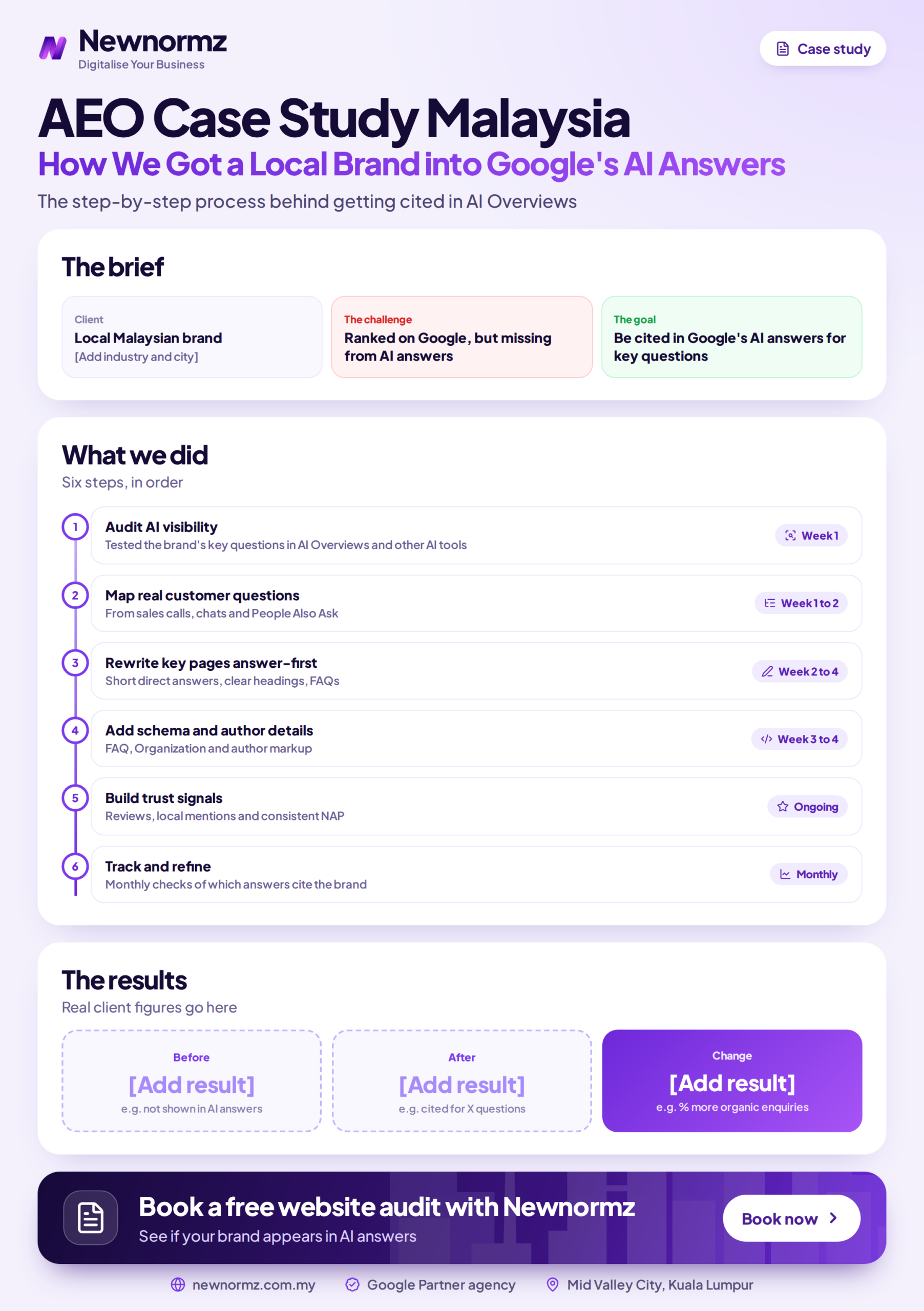
1. Rebuilt each page around a real question
We started with the 20 questions Malaysian SME owners search most often when they look for accounting help. Some examples: “how to file SST Malaysia”, “what does a company secretary do”, and “accounting fees for small business Malaysia”.
We rewrote each service page so it answered at least one of those questions clearly within the first 150 words, with the detail underneath. This is the journalist’s quote from the analogy above: one clean answer up top that makes sense even when it’s lifted out of the page. It also helps human readers, who usually want the answer before the explanation.
2. Added proper FAQ sections
Each major page got an FAQ with five to eight questions, and each answer ran 40 to 80 words. That’s long enough to be useful and short enough to quote. We marked the FAQs up with FAQPage schema as well.
We should be clear about the schema. Since August 2023, Google has shown FAQ rich results mainly for well-known government and health sites, so the markup won’t get an accounting firm those expandable FAQ snippets. What it still does is label each question and answer clearly for machines. We think the bigger benefit came from the FAQ content itself, because it gave Google dozens of short, direct answers to choose from.
About six weeks after these changes went live, two NKH pages started showing up in AI Overviews for accounting queries in Malaysia. It was the first visible sign that the work was paying off.
3. Made the firm’s identity and location clear
The old pages leaned on vague phrases like “our services” and “the team”. People can work out what that means. Machines have a harder time. We replaced those phrases with the firm’s full name, specific service names, and consistent references to Malaysia and the cities NKH serves.
We also added LocalBusiness schema with complete name, address, and phone details, along with business categories and service areas. This is basic local SEO work, and it’s what makes a firm eligible for “near me” and city-specific queries, where AI answers increasingly favour businesses whose location Google can confirm.
4. Built supporting content around the core services
Google doesn’t judge one page on its own. It looks at whether the whole site seems to be a credible source on the topic. So we wrote supporting blog articles on related accounting questions and linked each one back to the relevant service page.
The result is a cluster: a service page in the middle and a set of articles around it that answer the follow-up questions. Taken together, they show Google that the firm covers Malaysian accounting topics in depth, not just one keyword.
The Results After Three Months
| Metric | Before | After 3 months |
|---|---|---|
| AI Overview appearances (tracked queries) | 0 | 14 |
| Monthly organic sessions | 820 | 1,490 (+82%) |
| Average position, target queries | 18.4 | 6.1 |
| Branded search volume | Low | Roughly 3x |
| Leads from organic search | ~4 per month | ~11 per month |
The headline number is 14 AI Overview appearances, including several high-intent queries where NKH had no organic presence at all before.
The figure we’d point you to is average position, which moved from 18.4 to 6.1. AI visibility and traditional rankings rose together. That’s what we expected, because the changes that make a page easy to quote also make it a better search result. If someone sells you AEO as something separate from good SEO, be sceptical.
We’ll also be honest about attribution. Organic leads nearly tripled, but we can’t credit every one of them to the AI Overviews. Better rankings, more traffic, and higher brand search all happened during the same three months. What we can say is that the full set of changes turned search from a minor channel into a steady source of enquiries, with no increase in ad spend.
What This Means for Your Business
This approach isn’t specific to accountants. Any service business whose prospects ask questions before they buy can use it: legal, healthcare, education, logistics, home services. Most Malaysian SME websites still look like NKH’s did before. The content is fine, but the answers are buried, the business identity is vague, and there’s no structure for a machine to work with.
That gap is your opportunity, and it won’t stay open forever. Your competitors’ sites will get this treatment sooner or later. The firms that restructure first get to build up visibility while the field is still thin. If you’d rather not do it yourself, this work is now a standard part of a proper SEO service, not an expensive extra.
Frequently Asked Questions
Can anyone guarantee my business will appear in Google’s AI Overview?
No. Google decides what appears in AI Overviews, and the sources it cites can change from one day to the next for the same query. Anyone who promises a guaranteed AI Overview spot is overselling. What you can control is how easy your content is to understand, trust, and quote.
How long does AEO take to show results?
For NKH, the first AI Overview appearances came about six weeks after the FAQ and restructuring work went live, and the broader results built up over three months. Your timeline will depend on your site’s current authority and how competitive your queries are, so treat those numbers as one data point and not a promise.
Do I need to stop doing regular SEO to focus on AEO?
No. AEO builds on SEO and doesn’t replace it. In this case, rankings and AI visibility improved together. If a page doesn’t rank reasonably well to begin with, it’s much less likely to be cited in an AI answer.
Is FAQ schema still worth adding?
It’s cheap to add and helps label your content clearly, but don’t expect FAQ rich snippets, which Google now limits mostly to government and health sites. The real value comes from writing genuinely useful FAQ answers. The schema is a small extra on top.
Does this work for Bahasa Malaysia or Chinese-language searches?
The principles are the same in any language: direct answers, a clear business identity, and supporting content. If many of your customers search in Bahasa Malaysia or Chinese, you need properly written pages in those languages. An English page won’t answer a question someone asked in Malay.
Is your website ready for AI search?
Find out what’s stopping Google from quoting your business
Newnormz has run SEO campaigns across F&B, healthcare, ecommerce, and local services in Malaysia, backed by a performance guarantee of 70 percent of targeted keywords on Google’s first page.
30 minutes, no obligation, including a check of where your content falls short for AI answers.

Bryan Tan is an SEO Specialist and CEO at Newnormz, helping hundreds of businesses achieve first-page rankings on Google. With a passion for driving organic growth, Bryan blends innovative strategies with hands-on experience to optimize websites for maximum visibility. Always at the forefront of the latest SEO insights and trends, he consistently adapts to the evolving digital landscape.