SEO helps a Malaysian online store by getting its category and product pages in front of people who are ready to buy. These are searches like “buy air fryer online Malaysia” or “running shoes under RM300”, not “what is an air fryer”. It does this by matching each buying keyword to the right page, fixing the technical problems that stop Google from indexing your catalogue properly, and giving your pages more useful content than a copied manufacturer description. It won’t beat Shopee or Lazada on every broad product term, and nobody can honestly guarantee you a specific ranking position. What it does well is win the more specific, high-intent searches where your own store can compete, and those visitors buy on your site without a marketplace taking a commission.
A Simple Way to Think About It
Two Crowds, Very Different Wallets
🌧️ The shop full of people sheltering from the rain
The shop is packed and looks like it’s doing great. Then the rain stops, everyone walks out, and the till is still empty.
🛒 The shop people walk into holding a list
Fewer people come through the door. But every one of them came in looking for something you sell, and most leave carrying a bag.
Ecommerce SEO is about choosing which crowd you’re trying to attract. The sections below cover how to go after the second one.
What Counts as a Buying Keyword
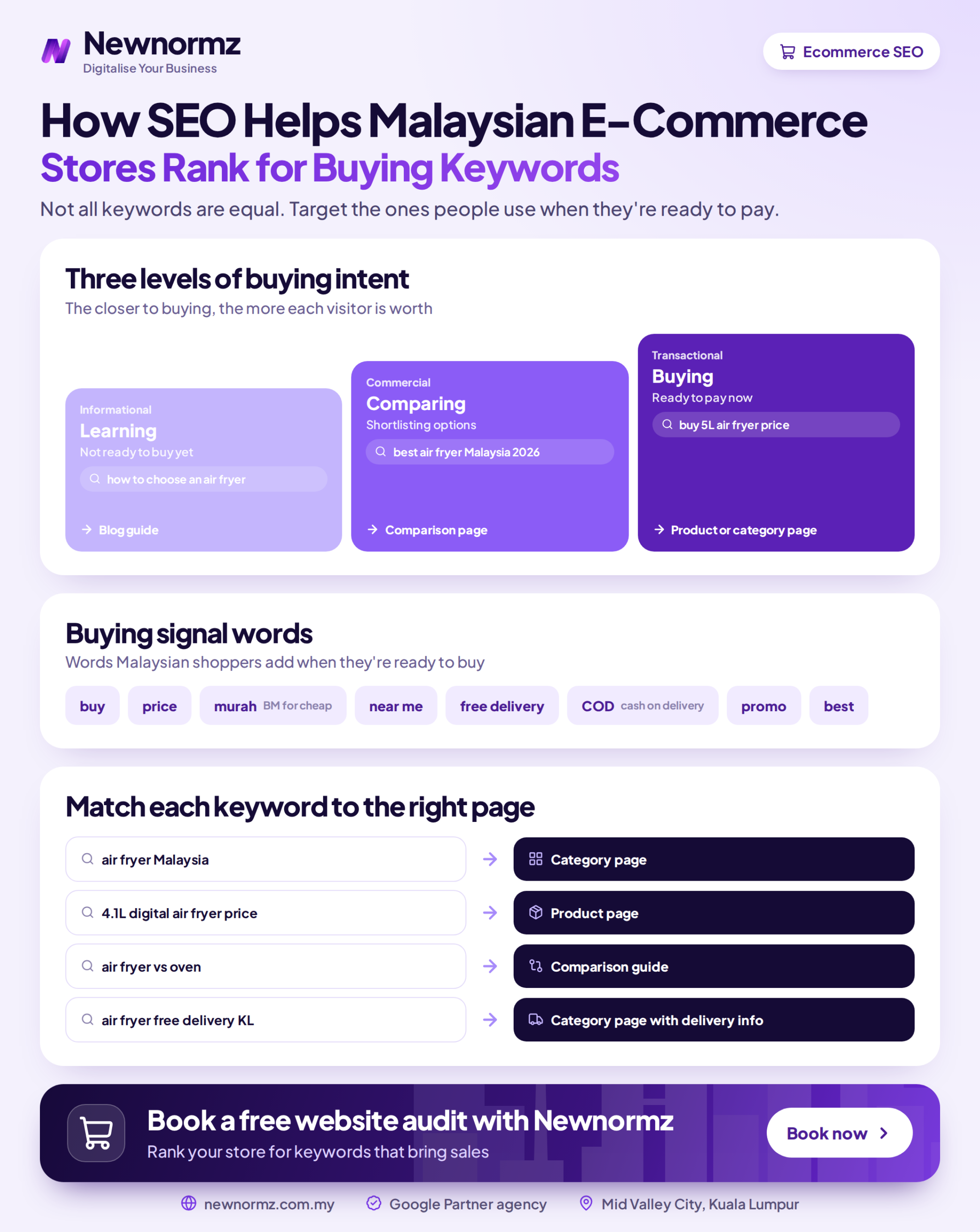
A buying keyword is a search where the person has mostly made up their mind. They know what they want and they’re deciding where to buy it. You can usually spot one by the words around the product: “buy”, “price”, “online”, “murah”, “Malaysia”, a brand and model number, a size, or a budget in ringgit.
The mistake I see most often is a store owner looking at search volume alone. “Air fryer” gets a lot of searches. Plenty of those people are still at the curious stage, and the results page is full of marketplaces, reviews, and recipe content. “Philips air fryer XL price Malaysia” gets far fewer searches, but the person typing it has their card ready.
| Keyword type | Malaysian example | What the searcher wants | Page that should rank |
|---|---|---|---|
| Informational | “air fryer vs oven” | Still learning, not buying yet | Blog post or guide |
| Commercial comparison | “best running shoes under RM300” | Narrowing down options within a budget | Filtered category page or buying guide |
| Transactional category | “baju kurung moden online” | Ready to browse a range and buy | Category page |
| Transactional product | “Philips air fryer XL price Malaysia” | Knows the exact item, comparing sellers | Product page |
That last column matters most. Google decides what kind of page to show for each search. For transactional searches it almost always shows category and product pages, not blog posts. If you write a 2,000-word article to rank for “buy office chair Malaysia”, you’re giving Google the wrong type of page, and it will usually rank someone else’s category page ahead of yours.
Why Your Category Pages Do Most of the Work
On most online stores, category pages are where the commercial traffic comes from. A category page targets a group of related buying searches at once (“women’s running shoes”, “kasut lari wanita”, “running shoes for women Malaysia”), and it gives the visitor a range of products to choose from straight away.
The problem is that most Malaysian store owners leave their category pages as nothing but a product grid. There’s no text explaining the range, no guidance on sizing or materials, and no internal links to related categories. Google has very little to work with, so it falls back on stores that give it more to go on.
A well-optimised category page usually has:
- A title and H1 that match how people actually search, not your internal product taxonomy.
- A short intro above the grid and more useful copy below it: who the range suits, how to choose, delivery coverage across Peninsular and East Malaysia.
- Links to closely related subcategories, so both shoppers and Google can move through the catalogue easily.
- One clean, indexable URL, not dozens of filter variations competing with each other.
The Technical Problems That Quietly Hold Stores Back
Ecommerce sites break in ways a five-page company website never does. A catalogue of a few hundred products with filters, variants, and seasonal stock can create thousands of URLs, and many of them shouldn’t be in Google at all. These are the issues I check first on any store audit.
| Problem | What it does to rankings | Typical fix |
|---|---|---|
| Filter and sort URLs getting indexed | Near-identical pages compete with each other, and Google spends its crawl time on junk instead of your real pages | Canonical tags, noindex on low-value filters, and indexable pages only for filters people actually search (e.g. “under RM100”) |
| Manufacturer descriptions copied word for word | Your page is identical to dozens of other sellers, so there’s no reason for Google to pick yours | Rewrite descriptions for your top sellers first, adding local details like voltage, warranty, and delivery times |
| Out-of-stock pages deleted | The page loses any rankings and links it had built up, and visitors land on 404 errors | Keep the page live with a restock note and alternatives, or redirect it to the closest matching product or category |
| No product structured data | Price, stock status, and ratings don’t show in search results, so your listing looks plainer than competitors’ | Add Product schema with price in MYR, availability, and reviews where they’re genuine |
| Slow, heavy mobile pages | Shoppers on mobile data leave before the page loads, and Google evaluates your site based on the mobile version | Compress images, cut unnecessary apps and scripts, and lazy-load images below the fold |
None of this is glamorous, but on a store with a large catalogue it’s often where the quickest wins are. Fixing indexing alone can bring pages that Google was ignoring back into contention.
Competing With Shopee, Lazada, and the Big Retailers
Let’s be honest about this part. Search “wireless earbuds” in Malaysia and the first page is largely marketplaces and large retailers. Their domains carry enormous authority, and a new independent store isn’t going to outrank them on that term in a few months. Anyone who tells you otherwise is overselling.
What you can do is compete where they’re weak. Marketplace listings are built for the platform, not for Google. Their pages tend to be generic, thin on useful copy, and spread across many sellers. That leaves room for a specialist store on searches that are more specific:
- Attribute searches: “waterproof hiking shoes wide fit”, “tudung bawal cotton premium”.
- Budget searches: “office chair under RM500 with lumbar support”.
- Use-case searches: “baby car seat for Myvi”, “rice cooker for small family”.
- Brand and model searches for brands you’re an authorised seller of, where you can offer local warranty details a marketplace seller often can’t.
Each of these brings in less traffic than the broad term. Together, a few hundred of them can make up most of a store’s organic revenue, and every sale comes through your own checkout instead of a marketplace taking its cut.
Don’t Ignore Bahasa Malaysia and Chinese Searches
Malaysian shoppers don’t all search in English, and many switch languages depending on the product. Fashion, modest wear, and household goods often get heavy Bahasa Malaysia searches (“kasut sukan murah”, “langsir siap jahit”). Some categories, such as health supplements, tea, and baby products, get a meaningful share of Chinese-language searches.
A lot of competitors only optimise in English, so this is often low-hanging fruit. It doesn’t mean translating your whole site. Start by checking which non-English searches already bring you impressions in Google Search Console, then build or adapt the category pages that match them. A badly machine-translated page usually does more harm than good, so get a native speaker to review anything you publish.
How Long It Takes, and What Growth Actually Looks Like
With 35.4 million internet users in Malaysia at the end of 2025 (98% penetration, according to DataReportal) and Google holding around 93% of local search market share (Statcounter), organic search is where most of your potential customers start. But SEO compounds slowly. Expect the first few months to go mostly on technical fixes and category page work, with visible movement on long-tail buying keywords after that, and more competitive terms taking longer.
The pattern holds across industries. None of the following are online stores, but they show how SEO results build over time. In a 6-month campaign for Times Parking, the site went from almost no visibility to 416 ranking keywords and 528,000 impressions. Over 2 years with Oriental Kopi, the brand gained 24,500 more ranking keywords and 6.31M impressions. That’s what happens when results stack up instead of disappearing the moment spending stops.
For a new store that needs sales now, the sensible move is often to run Google Ads on your best buying keywords while SEO builds. The ads data also tells you which keywords actually convert, so you know which category pages are worth optimising first. As organic rankings come in, you can reduce ad spend on those terms.
If you’d rather have a team handle the technical audit, category structure, and keyword mapping for you, that’s exactly what a dedicated SEO service covers.
Frequently Asked Questions
Does SEO work for Shopify and WooCommerce stores in Malaysia?
Yes. Both platforms can rank well. They just have different technical quirks. Shopify creates some duplicate product URLs through its collection paths, and WooCommerce can create a lot of indexable filter and tag pages. Neither is a dealbreaker, but each needs configuring properly rather than leaving the defaults.
Should I write blog posts for my online store?
Only where they serve a real search. Blog content works well for comparison and how-to-choose searches, and it can link people to your category pages. It won’t rank for transactional searches like “buy X online”, because Google wants to show a page where you can actually buy the product.
I already sell on Shopee. Is my own website still worth optimising?
For most brands, yes. Marketplace traffic belongs to the platform. You pay commission on every sale, you’re shown right next to competitors, and you don’t own the customer relationship. Organic traffic to your own site gives you margin and customer data that a marketplace never will. Most stores do best running both.
Can anyone guarantee my products will rank number one?
No. Google has stated publicly, more than once, that nobody can guarantee a specific ranking position. Be wary of any agency that promises “#1 on Google”. A credible commitment covers a measurable share of targeted keywords on page one, not a particular spot for a particular term.
Is your store showing up when shoppers are ready to buy?
Turn buying searches into sales on your own store, not someone else’s marketplace.
Newnormz has run SEO campaigns across F&B, healthcare, ecommerce, and local services in Malaysia, backed by a performance guarantee of 70 percent of targeted keywords on Google’s first page.
30 minutes, no obligation, with a look at which buying keywords your store could realistically win.

Bryan Tan is an SEO Specialist and CEO at Newnormz, helping hundreds of businesses achieve first-page rankings on Google. With a passion for driving organic growth, Bryan blends innovative strategies with hands-on experience to optimize websites for maximum visibility. Always at the forefront of the latest SEO insights and trends, he consistently adapts to the evolving digital landscape.