Short verdict
A backlink is a link from another website to yours, and Google cares far more about who is linking than how many links you have. The short answer to “what are backlinks in SEO” for websites in Malaysia: each one works like an outside recommendation. How much it counts depends on how relevant and trusted the linking site is. One link from a Malaysian publication with real readers can outweigh hundreds of bought ones, and the bought ones can get your site penalised.
Most SME owners first hear about backlinks in a sales pitch: “We’ll build 500 backlinks for you this month.” That pitch treats links like stock you can buy by the carton. Google doesn’t see them that way. This guide shows you how Google reads a link, which links help and which hurt, and a six-step routine for earning your first good links without paying anyone. By the end, you’ll be able to judge any link offer that lands in your WhatsApp.
What Are Backlinks in SEO? Why Google Treats a Link Like a Recommendation
Google’s founders, Larry Page and Sergey Brin, built the search engine around an idea called PageRank. The logic was simple: if lots of pages link to a page, it’s probably useful, and a link from an important page is worth more than one from an obscure page. Google now uses many more signals than it did in the late 1990s, but links are still one of them.
Google says so itself. Its Search Central documentation on link best practices states that Google uses links to discover new pages to crawl and as a signal when judging how relevant a page is.
Backlinks explained in one line: a backlink is any link on someone else’s website that points to a page on yours. So what is a backlink in SEO terms beyond that? It’s the part of your search presence you can’t fully control. That’s exactly why Google trusts them more than anything you say about yourself on your own site.
For off-page SEO, Malaysia’s search market runs almost entirely on Google. Statcounter puts Google’s share of Malaysian search at roughly 93 to 96%, so how Google judges your links decides how your site performs in search.
Not Every Link Counts the Same: Relevance, Trust and Placement
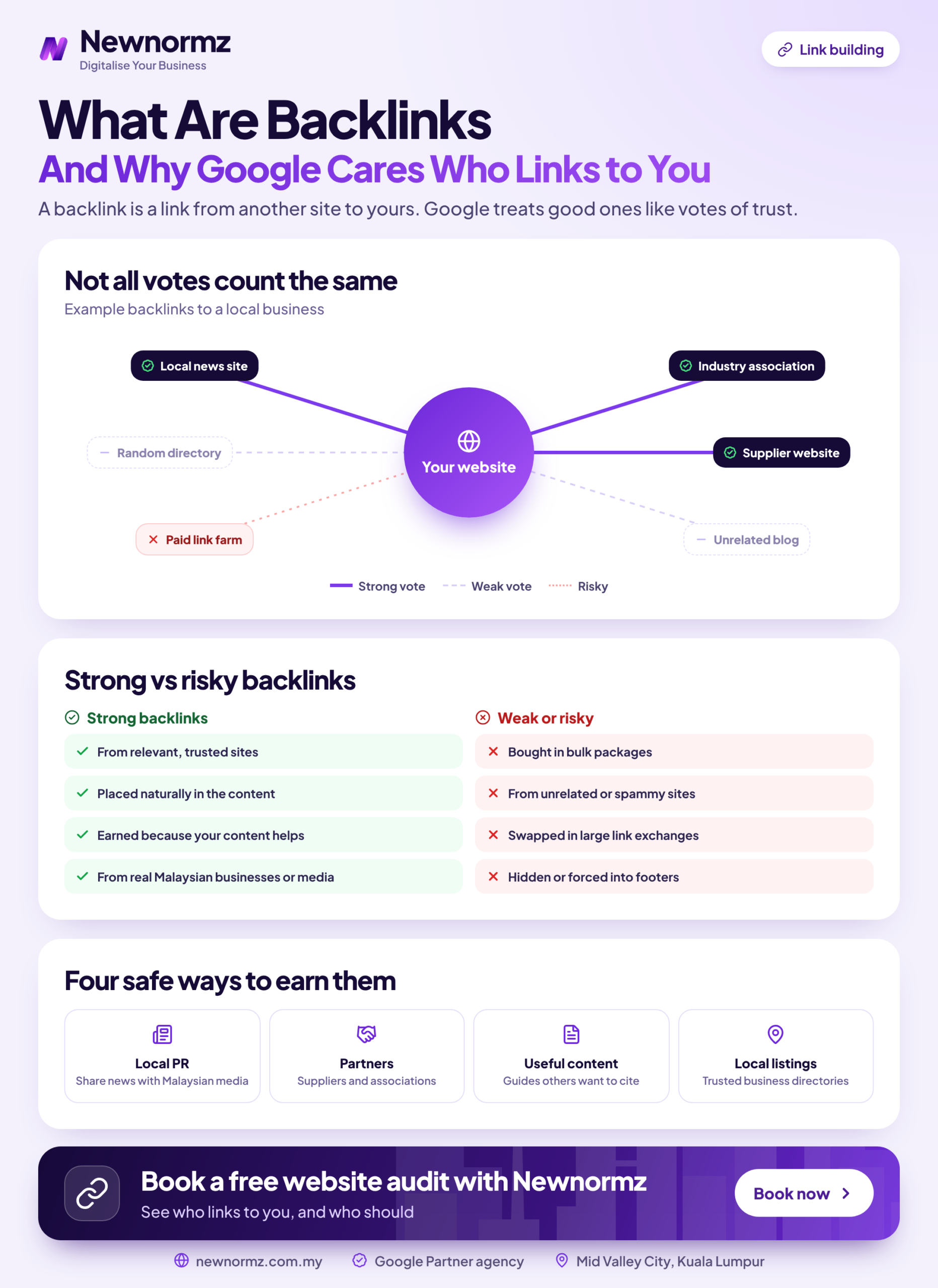
Relevance. A link to a Cheras confinement centre from a Malaysian parenting site makes sense. The same link from a foreign car parts blog doesn’t, and Google can tell the difference.
Trust. The quality backlinks Malaysia businesses should want come from sites that have real readers and some editorial standard, where a person decided your page deserved the link. A site that publishes anything for a fee isn’t making that judgement, so its links tell Google nothing.
Placement. A link inside the body of an article, surrounded by related text, carries more meaning than one buried in a footer, a sidebar or a list of 200 “partners”.
This is also why SEO tools report referring domains separately from total backlinks. Ten links from one website aren’t ten votes. They’re one site’s opinion repeated ten times. Links from 50 different relevant sites usually tell Google far more than 500 links from three.
What Anchor Text Tells Google About Your Page
Anchor text is the clickable wording of a link. Say a parenting blogger writes “we stayed at a confinement centre in Cheras” and links those words to your page. Google now has a description of your page written by someone other than you.
The trouble starts when every link uses the same keyword. Links people give naturally come with mixed anchors: your brand name, your URL, “this place”, “their packages”. If most of your links say exactly “best confinement centre KL”, the profile looks manufactured. Google’s spam policies name keyword-rich anchor text in large-scale guest posts, forum comments and widgets as link spam.
Dofollow vs Nofollow Backlinks, Plus Sponsored and UGC
A “dofollow” link is simply a normal link with no attribute. The word is SEO slang, not real code. The three attributes below tell Google something about the relationship between the two sites. Since 2019, Google has treated all of them as hints rather than strict rules.
| Attribute | What it tells Google | Where you’ll see it | Does it pass value |
|---|---|---|---|
| No attribute (followed) | An editorial link, given freely | Article body copy, supplier pages, association directories | Yes, if the site is relevant and trusted |
| rel=”nofollow” | The site doesn’t want to vouch for the page | Some news portals, forums, social platforms | Usually not directly, though Google may still consider it |
| rel=”sponsored” | The link was paid for or is an advert | Advertorials, sponsored posts, affiliate links | No, and Google expects it on every paid link |
| rel=”ugc” | A user added the link, not the site owner | Blog comments, forum posts, review sections | Usually not directly |
Nofollow links still have value. They send real visitors, put your brand in front of new readers and often lead to followed links later. Here’s more on how nofollow links still help.
Good Links vs Harmful Links: Malaysian Examples
Use this table to judge the link sources Malaysian businesses actually run into, from editorial features to the “1,000 backlinks for RM99” offers that turn up on WhatsApp. For each one, ask what Google asks: would this link exist if nobody were trying to buy a ranking?
| Link source | Why Google values it or doesn’t | Verdict |
|---|---|---|
| Feature on a Malaysian news portal (English, BM or Chinese) | Editors chose to mention you, and the site has real local readers | Good |
| Supplier or distributor “where to buy” page | Proves a real business relationship in your industry | Good |
| Industry or trade association member directory | Members are checked, and the topic matches your business | Good |
| University, event or community sponsor page | Ties your brand to a real activity. It should carry rel=”sponsored” | Good for trust and visibility |
| Local partner’s blog post | Relevant, written for their own customers, placed in body copy | Good |
| “1,000 backlinks for RM99” packages | Mass-produced on sites with no readers. Buying links to rank breaks Google’s spam policies | Harmful |
| Private blog networks (PBNs) | Sites built only to pass links, a pattern Google’s systems actively look for | Harmful |
| Blog comment and forum spam | Usually marked nofollow or ugc anyway, and the pattern is listed as link spam | Harmful or worthless |
| Unrelated foreign directories | No connection to a Malaysian business or its customers | Worthless at best |
| Link swaps (“link to me and I’ll link to you”) | Google’s spam policies name excessive link exchanges | Harmful at scale |
The rule for buying backlinks, Malaysia or anywhere else, is simple: if a link is paid for, it should carry rel=”sponsored”, and then it passes no ranking value. Be especially wary of any offer that bundles links with “guaranteed page 1”. Google has said publicly that no one can guarantee a specific ranking position. A seller who promises one is telling you how they work.
From our audits
When a new client’s rankings have stalled, one of the first things we check is the link profile, and we keep finding the same leftover from a past bulk package: hundreds of links from unrelated foreign blogs and directories, many using the same exact-match keyword as anchor text. Getting rid of those toxic backlinks takes far longer than buying them did. Someone has to review every linking domain and ask site owners to remove links. If Google has issued a manual action, you also need a disavow file and a reconsideration request. The real cost is the months spent cleaning up instead of earning real links.
Backlinks vs Internal Links vs Brand Mentions: What Each One Actually Does
Agency reports often call all three of these “links”. They do different jobs.
| Type | Who controls it | What it signals to Google | What it does for AI answers |
|---|---|---|---|
| Backlink | Other site owners | Someone outside your business vouches for your page | Helps your page rank, which is where most AI citations come from |
| Internal link | You | Which of your pages matter most and how they relate | Helps crawlers and AI systems see how fully you cover a topic |
| Brand mention (unlinked) | Other sites, reviewers, journalists | Your business is a real, known entity (part of E-E-A-T) | Gives AI tools more sources describing who you are and what you do |
Internal links are the only one of the three you control completely, and they’re often the cheapest win. Building authority with internal links passes the value of your existing backlinks on to the pages that need it.
Brand mentions matter more every year because of Google AI Overviews and tools like ChatGPT. Industry studies put about 76% of AI Overview citations on pages that already rank in Google’s traditional top 10, so ranking still comes first. AI tools also learn about your brand from how often, and how consistently, other sites describe you, whether they link to you or not.
Newnormz client Times Parking, for example, is named in ChatGPT answers for “best LPR parking provider”. That came from a full SEO programme, not from any single tactic, but it shows that brand authority across the web carries into AI answers. That work falls under AI search optimisation.
Why Backlinks Are Important for SEO, and When They Matter Less Than You Think
Links still matter. When two pages answer a query equally well, the one with stronger, more relevant links tends to win. That’s why the debate about whether backlinks still rank in 2026 keeps ending in yes. But you should cost them honestly.
An illustrative example (made-up numbers, not anyone’s real quote): a seller offers 100 backlinks for RM500. That’s RM5 a link, which sounds cheap. Then you look at the sites. None of them have real readers or anything to do with your industry, and all of them sell links to anyone. Each link is worth close to nothing, but the risk is real. If those links lead to a manual action, you pay again in audit time, removal requests and months of held-back rankings.
Compare that with one link from your supplier’s “where to buy” page. It costs you an email and about 30 minutes. The link is relevant, it comes from a real business in your industry, and you’ll never have to clean it up. Count the cost per useful link and the free one wins easily. The cheap offer is the expensive one. That’s why backlinks are important: SEO rewards pages that real businesses are willing to vouch for, not pages with the biggest link count.
Your cheapest good backlink will probably come from an email to a business you already work with.
Links also aren’t always what’s holding you back. If you’re starting from zero, our guide to ranking a brand-new website sets out what to do first. Everyone else can use these rules:
Link Building Basics in Malaysia: How to Earn Your First Legitimate Backlinks
You don’t need an agency to get your first links. You need a list of contacts, a free tool and a few hours each month. These are the link building basics Malaysia SMEs can run in-house, and they show you how to get backlinks Malaysia-based customers will actually see. Once they’re in place, our guide to deeper link building strategies covers the next stage.
Check backlinks free in Google Search Console
Open Google Search Console and go to the Links report. It shows your top linking sites, your most-linked pages and your most common anchor text, and it costs nothing. Note any sites you don’t recognise, and look at the Manual actions report while you’re logged in.
List the businesses you already work with
Think suppliers, distributors, landlords, franchisors and clients you’ve done projects for. Many have a “where to buy”, “our partners” or “projects” page. Send a short WhatsApp message or email asking to be listed, with your exact business name and URL.
Claim your trade and association listings
Trade associations, chambers of commerce and professional bodies in your sector often run member directories. These links are relevant and verified, and spammers find them hard to get. Skip general directories that accept anyone who pays.
Pitch one useful local insight
Malaysian publications in English, BM and Chinese all need sources. Offer one real data point from your own business, such as what your customers asked about most this year, or an expert comment on a news story in your industry. Pitch the publication your customers actually read, in their language.
Turn brand mentions into links
Search Google for your business name and look for pages that mention you without linking. Email the writer, thank them for the mention and ask if they’d add a link. A site that already speaks well of you has every reason to say yes.
Track new referring domains every month
Search Console lists your links, but Ahrefs and Semrush show new and lost referring domains over time. Our roundup of tools for tracking new links compares the options. Keep a simple monthly log so you can see which of the steps above actually brought in links.
None of these steps is complicated, but the work never really finishes. Links come from relationships, and relationships need follow-up every month, on top of content, technical fixes and reporting. That’s why Newnormz treats link earning as authority work under the Notability pillar of its RANKED Framework, not as bulk buying. If you’d rather hand it to a team that runs 200+ month-to-month SEO accounts, see how our SEO agency in Malaysia works.
Want to know which of your current backlinks are helping and which are dead weight? We’ll check them as part of a free SEO audit.
Frequently Asked Questions About Backlinks
Is it safe to buy backlinks in Malaysia?
No. Buying links to influence rankings breaks Google’s spam policies, wherever your business is based. Paying for a sponsored article is fine if the link carries rel=”sponsored”, but then it passes no ranking value. Most bulk packages sold through WhatsApp and online listings come from sites with no real readers.
How many backlinks does a website need to rank on Google in Malaysia?
There’s no fixed number. It depends on the keyword and on the sites you’re competing against. Check how many referring domains the pages currently ranking for your keyword have in Ahrefs or Semrush, then aim for relevant links rather than matching their count.
Do nofollow links help SEO at all?
Yes, though mostly indirectly. Since 2019 Google has treated nofollow as a hint, so it may consider some of these links. They also bring visitors and brand awareness, and sometimes lead to followed links from people who find you through them.
Can bad backlinks hurt my website’s ranking?
They can, but most of the time Google just ignores them. Google says its systems discount most spammy links automatically. A clear pattern of bought or manipulative links, though, can lead to a manual action, which shows up in Search Console’s Manual actions report. If you get one, clean up the links and use the disavow tool. If you haven’t got one, you rarely need to disavow anything.
Are backlinks still important now that Google shows AI Overviews?
Yes. Industry studies put about 76% of AI Overview citations on pages already in Google’s top 10, and backlinks are one of the signals that get pages there. Mentions of your brand on trusted Malaysian sites also help AI tools recognise your business.
Free SEO audit
Find out which of your backlinks are helping and which are holding you back
- ✓A review of your referring domains and anchor text, with any toxic patterns flagged
- ✓A check of your Search Console for manual actions and lost links
- ✓A shortlist of realistic link opportunities in your industry, from suppliers to Malaysian publications

Bryan Tan is an SEO Specialist and CEO at Newnormz, helping hundreds of businesses achieve first-page rankings on Google. With a passion for driving organic growth, Bryan blends innovative strategies with hands-on experience to optimize websites for maximum visibility. Always at the forefront of the latest SEO insights and trends, he consistently adapts to the evolving digital landscape.