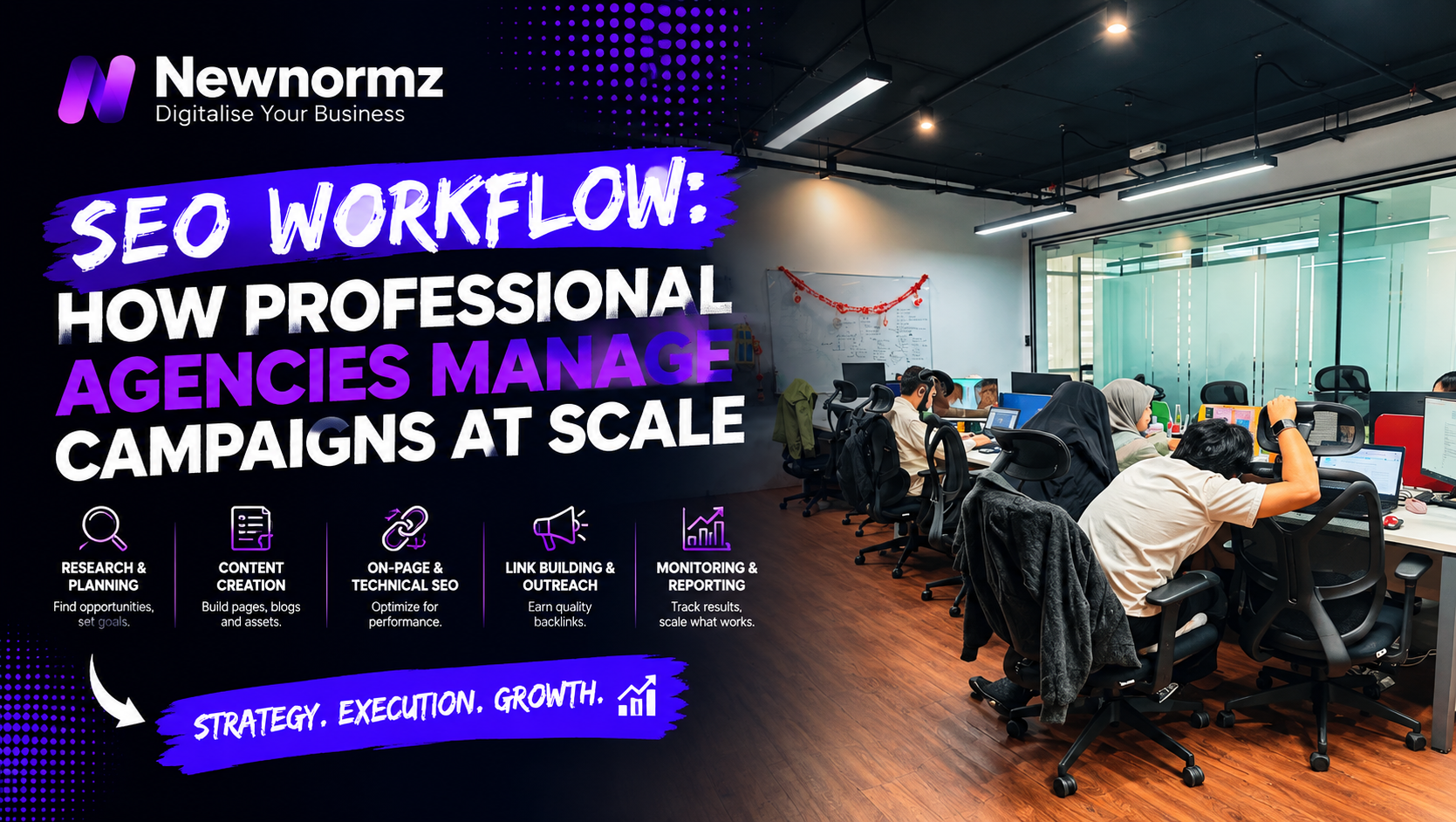
A professional agency runs SEO for many clients at once because it repeats the same process every time, not because it has one genius doing everything. In a good SEO workflow, every campaign goes through the same stages in the same order: audit, keyword mapping, technical fixes, content, authority building and reporting. Each stage has a clear owner, a clear output and a monthly rhythm. If an agency can’t tell you what happens in month one, month three and month six, it doesn’t have a workflow. It is improvising, and improvised SEO stops working once the agency gets busy.
A Simple Way to Think About It
The Home Cook vs the Restaurant Kitchen
🍳 Cooking from memory
A talented home cook agrees to feed 200 wedding guests. The first ten plates are great. By plate 150 they’ve forgotten the salt and the rice has gone cold.
👨🍳 Cooking from a system
A restaurant kitchen gives every station a written prep list. The 200th plate tastes exactly like the first one.
The sections below walk through what that prep list looks like for an SEO campaign, stage by stage.
Why Workflow Matters More Than Talent at Scale
Most SEO failures aren’t caused by bad strategy. They’re caused by things that never got done. A redirect gets missed during a site migration. A blog post goes live without internal links. A Google Business Profile category stays wrong for eight months because nobody was assigned to check it.
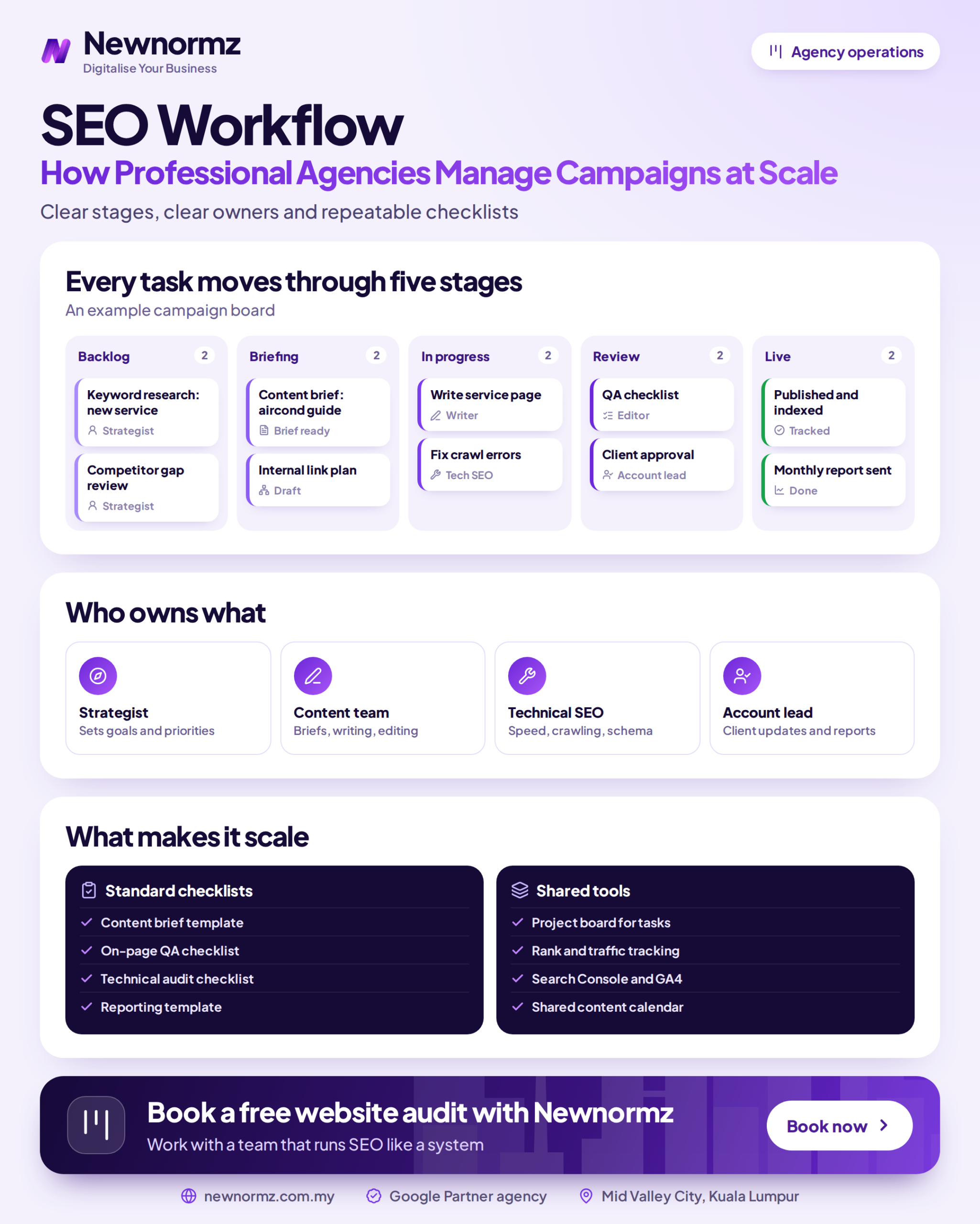
When an agency handles three clients, one sharp consultant can keep all of that in their head. When it handles thirty, they can’t. A workflow takes everything that has to happen out of individual people’s heads and puts it into a process, so nothing depends on someone remembering.
This matters to you as a client because SEO results compound. Our Oriental Kopi campaign ran for two years and brought 43,300 in traffic growth, 6.31M impressions, 24,500 more ranking keywords and 468,000 clicks. Numbers like that don’t come from one clever trick in month two. They come from doing the right work every month for 24 months in a row, without the quality slipping when the agency takes on new clients.
The Six Stages of a Professional SEO Workflow
Agencies label these stages differently, but every serious one covers the same ground. What matters is that each stage produces something concrete you can see, and that the stages happen in the right order. Writing content before the keyword map is done is like painting a house before the walls go up.
| Stage | What happens | What you should receive |
|---|---|---|
| 1. Onboarding and audit | Access to Search Console, analytics and the CMS. Full crawl of the site, competitor review, baseline rankings recorded. | An audit document with issues ranked by impact, plus a baseline you can measure against later. |
| 2. Keyword research and mapping | Target keywords grouped by search intent and assigned to specific pages, including Bahasa Malaysia and Chinese variants where your customers use them. | A keyword map: one page per intent, no two pages competing for the same term. |
| 3. Technical fixes | Indexing problems, site speed, broken links, redirects, structured data and mobile issues fixed in priority order. | A change log showing what was fixed and when. |
| 4. On-page and content | Existing pages optimised first, then new content briefed, written, reviewed and published on a fixed schedule. | A content calendar and briefs you approve before anything is written. |
| 5. Authority and local signals | Earning relevant links, managing your Google Business Profile, keeping local citations consistent. | A list of links earned and profile updates made, with sources named. |
| 6. Reporting and iteration | Monthly review of rankings, traffic, clicks and conversions, then next month’s priorities adjusted based on what moved. | A report that explains what changed and why, not just a dashboard screenshot. |
Stages one to three are mostly front-loaded into the first two or three months. Stages four to six then repeat every month. That loop is where the long-term gains come from.
How Agencies Keep Quality Consistent Across Dozens of Clients
A list of stages isn’t enough on its own. What separates a professional SEO workflow from a nice slide in a pitch deck is the machinery underneath it.
Checklists for repeated tasks
Every page that goes live passes the same pre-publish check: title tag, meta description, heading structure, internal links, image alt text, schema where it applies, mobile rendering. It sounds boring, and that’s the point. Checklists catch the mistakes that experienced people make when they’re busy.
Clear ownership
Each task has one named owner. “The team will handle it” usually means nobody will. In a well-run agency, the strategist owns the keyword map, a technical specialist owns site health, writers own drafts, an editor owns quality, and an account lead owns your results and your communication.
A fixed monthly rhythm
Professional agencies work in cycles. Early in the month they review last month’s data and set priorities. In the middle they execute. At the end they report. Because the rhythm doesn’t change, you always know when to expect updates, and work doesn’t drift for weeks without anyone noticing.
Human review on anything that touches your brand
Tools and AI speed up research, crawling and first drafts. They don’t replace judgment. Content that makes claims about your business, your prices or your results should always be checked by a person who understands your industry before it goes live.
What Changes for Malaysian Campaigns
A workflow copied from a US or UK agency template will miss things that matter here. Malaysia had 35.4M internet users at the end of 2025, a 98% penetration rate (DataReportal Digital 2026 Malaysia), and Google holds around 93% of Malaysian search market share (Statcounter, May 2026). Almost all of your customers are online and searching on Google, but they don’t all search the same way.
A Malaysian SEO workflow should account for:
- Multilingual keyword research. The same customer might search “klinik gigi Subang”, “dentist Subang Jaya” or a Chinese-language query depending on who they are. Your keyword map needs to reflect that, not just translate English terms.
- Local intent built into the process. For service businesses, a large share of searches includes a town or “near me”. Google Business Profile management and local SEO belong in the monthly loop, not on a one-time setup list.
- Industry-specific review steps. Healthcare and aesthetics content needs extra care with claims. Our Sunway Medispa campaign delivered a 700% traffic increase, 54,000 impressions and 70% more keywords ranking in six months, and that kind of growth in a regulated category only lasts when every piece of content is checked properly before it goes live.
What a Workflow Can and Can’t Do
Honesty matters here. A good workflow makes results more likely and more consistent. It doesn’t control Google. Google has said publicly, more than once, that nobody can guarantee a specific ranking position. Algorithm updates, new competitors and changes in what Google shows on the results page can all move rankings in ways no process fully prevents.
What a workflow does guarantee is that the work actually gets done, on time, to a consistent standard, and that problems get spotted early. Our Times Parking campaign reached 528,000 impressions, 416 ranking keywords and 31.5K clicks in six months. A result like that depends on dozens of small tasks being done right every month. The workflow is what makes sure they are.
How to Check an Agency’s Workflow Before You Sign
You don’t need to be an SEO expert to tell whether an agency has a real process. Ask these questions and listen to how specific the answers are.
| Question to ask | Why it matters | Red-flag answer |
|---|---|---|
| What exactly happens in the first 30 days? | Shows whether onboarding and the audit are a real, repeated process. | “We’ll start optimising right away.” |
| Can I see a sample keyword map? | Proves they plan pages around search intent rather than guessing. | A plain list of keywords with no pages assigned. |
| Who works on my account, and what does each person own? | Clear ownership is what stops tasks being dropped. | “Our whole team handles everything.” |
| Do I approve content before it goes live? | Protects your brand and catches wrong claims about your business. | “We publish directly to save time.” |
| What does a monthly report include? | Good reports explain what changed and what happens next. | Ranking screenshots only, with no actions or next steps. |
An agency that answers all five clearly, with examples, almost certainly runs a real process. If you want to see how we structure ours, our SEO service page lays out what each phase of a campaign includes.
Frequently Asked Questions
How long before an SEO workflow starts showing results?
The first two to three months usually go into the audit, the keyword map and technical fixes. You’ll often see early movement in impressions during that time, with traffic and leads building over the following months. Competitive industries take longer.
Does a big agency workflow mean my account gets less attention?
Not if it’s run properly. A good workflow handles the repetitive tasks so the strategist can spend their time on decisions specific to your business. The thing to avoid is an agency with no process, where attention goes to whichever client complains loudest.
Can I run this SEO workflow in-house?
Yes, if you have people covering strategy, technical SEO and content, plus the time to keep up the monthly rhythm. Most small and mid-sized Malaysian businesses find it hard to keep all six stages going alongside their day jobs, and that’s usually when outsourcing makes sense.
Where do paid ads fit alongside an SEO workflow?
They work best side by side. Ads can bring leads while SEO is still building, and ad data shows which keywords actually convert, which feeds back into the keyword map. Our KL confinement centre client paired the two on a RM2,550/month budget and saw qualified leads within 30 days.
Is your SEO following a process or just improvising?
See the exact workflow we’d run for your business, stage by stage.
Newnormz has run SEO campaigns across F&B, healthcare, ecommerce, and local services in Malaysia, backed by a performance guarantee of 70 percent of targeted keywords on Google’s first page.
30 minutes, no obligation, and you’ll leave with a clear view of what your first 90 days should look like.

Bryan Tan is an SEO Specialist and CEO at Newnormz, helping hundreds of businesses achieve first-page rankings on Google. With a passion for driving organic growth, Bryan blends innovative strategies with hands-on experience to optimize websites for maximum visibility. Always at the forefront of the latest SEO insights and trends, he consistently adapts to the evolving digital landscape.