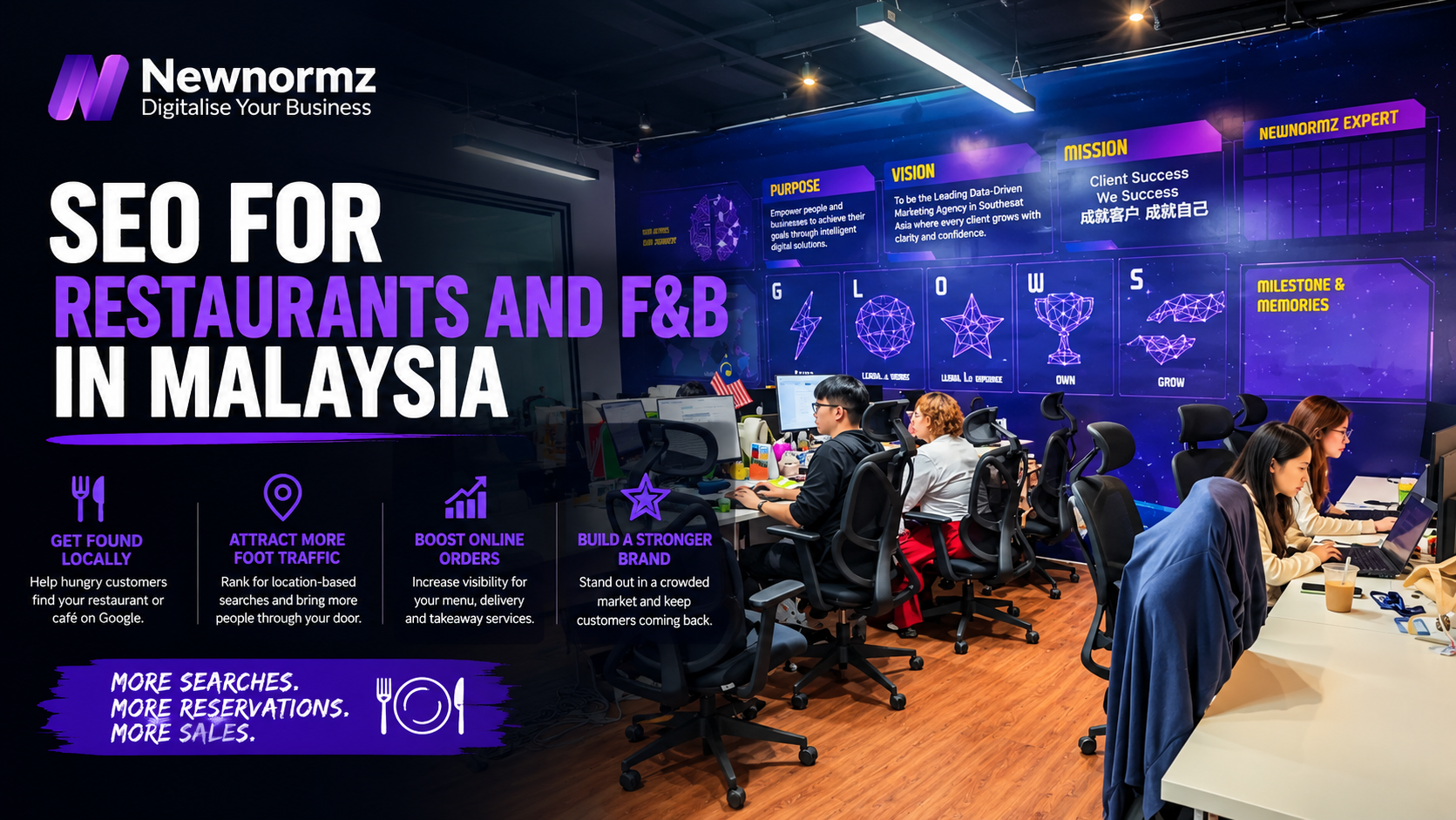
SEO for restaurants and F&B outlets in Malaysia means making sure your cafe, kopitiam or restaurant shows up first when someone nearby searches Google, Google Maps or types a craving plus “near me.” In practice that comes down to four things: a fully completed Google Business Profile, menu and location pages Google can actually read, a steady flow of reviews sitting above 4 stars, and consistent listings across GrabFood, Foodpanda and TripAdvisor. Get those four right and you show up before the competitor two doors down does, without paying for every click.
A Simple Way to Think About It
Two Restaurants on the Same Street
🚪 The Shop With No Sign
Good food, friendly staff, fair prices, but nothing outside to tell people it exists. Hundreds of hungry people walk past every single day and never know to come in.
💡 The Shop With a Sign You Can See From Both Ends of the Street
Same food, same prices. The only difference is people notice it before they’ve even decided where to eat, so they walk straight in instead of the place next door.
Your Google Business Profile, menu pages and reviews are that sign. Everything below is about building one that hungry Malaysians can actually see.
Why Local Search Decides Where Malaysians Eat First
Diners don’t flip through a directory anymore. They open Google or Maps, type a craving plus a location, usually while standing outside somewhere or scrolling on the way to lunch, and pick from whatever shows up in the first few results. Around 64% of diners check Google search or Maps before deciding where to eat, and a large majority of that browsing happens on a phone with the decision already time-pressured. If you’re not in that first screen, you’re simply not on the shortlist that day.
The market backing this up is not small. Malaysia’s restaurant sector is projected to hit RM56.1 billion in sales in 2025, which is good news until you realise it also means more outlets competing for the same three or four map spots in your neighbourhood. Searches follow a district-plus-dish pattern: “brunch cafe in Bangsar,” “halal ramen KL,” “dim sum PJ.” A generic restaurant name with no local signal attached simply doesn’t match how people actually search. That’s the gap local SEO is built to close, and unlike ads, the visibility it earns doesn’t disappear the moment you stop paying for it.
Your Google Business Profile Is the New Shopfront
For most restaurants, the Google Business Profile (GBP) does more first-contact work than the website. It’s what feeds the Map Pack, the boxed set of local results that sits above the standard organic links, and landing in that pack is the single highest-leverage move available in restaurant SEO.
Completeness is what moves the needle. A complete profile makes customers roughly 70% more likely to visit, and about 2.7 times more likely to consider the business reputable in the first place, yet most outlets leave half the fields blank. Fill in the primary category, cuisine attributes, accurate opening hours, a real menu link, ordering and reservation links, and photos of actual dishes rather than stock images. Post an update weekly. Reply to every review, good or bad, within a day if you can manage it.
Menu and Location Pages Built to Get Found
Your website still has a job to do, mainly through menu and location pages that capture dish-specific and district-specific searches. Someone typing “brunch cafe in Bangsar” or “halal ramen KL” should land on a page that names that exact dish and that exact area, not a homepage that only mentions your brand.
What each page actually needs
Descriptive titles and headings that include the district and the dish, not just the outlet name. Real, crawlable menu text instead of a menu locked inside a PDF or a photo Google can’t read at all. Fast mobile loading, because the bulk of food searches happen on phones and a slow page loses an impatient, hungry visitor in seconds. Restaurant and Menu structured data, so Google has a chance to display prices, hours and ratings directly in the results.

Reviews Are the Trust Layer That Converts
Reviews are what turn a listing into an actual booking. Around 94% of diners say online reviews influenced their decision to try somewhere new, and Google is where most of them look first. Volume, recency and whether you reply all feed into ranking, not just how the stars look on the page.
The threshold is unforgiving: roughly a third of diners won’t eat somewhere rated below 4 stars, and industry research on review scores has linked a one-star rating lift to a 5 to 9% revenue increase. Protecting your average is a direct revenue lever, not a vanity metric. A QR code on the table linking straight to your Google review form, a reply within 24 hours on every review, and photos that stay current all help. Getting listed on GrabFood, Foodpanda and TripAdvisor adds citations and referral traffic on top of that, which reinforces the same local authority signals.
Where Instagram and TikTok Fit In
Search and social increasingly work as one funnel. Close to 45% of diners say they use Instagram or TikTok to find new places to eat, and younger Malaysians in particular start with a scroll before they ever open Maps. Social content doesn’t move your Google ranking directly, but strong content drives branded searches, and branded searches do feed local relevance.
Treat Instagram as a discovery engine that funnels into search rather than a channel that stands apart from it. Geotag every post, use district and dish hashtags, and point the bio link at a fast menu or reservation page rather than a slow homepage. Consistent, appetising visuals give people a reason to go and search your name.
| Local Ranking Signal | Why It Matters | Quick Win |
|---|---|---|
| Complete GBP profile | 2.7x more likely to be seen as reputable | Fill every field, add a real menu link |
| Review rating and volume | About a third of diners avoid sub-4-star venues | Ask at the table, reply within 24 hours |
| Mobile menu page speed | Most food searches happen on a phone | Compress images, drop the menu PDF |
| Fresh photos | Higher click-through and consideration | Add a handful of new dish photos monthly |
| Directory listings | Extra citations and referral orders | Claim GrabFood, Foodpanda, TripAdvisor with matching NAP |
What This Looks Like in Real Numbers
We ran a two-year SEO campaign for Oriental Kopi, an F&B brand, and the trajectory shows why this compounds rather than plateaus. Over that period, traffic grew by 43,300 visitors, impressions reached 6.31 million, the site picked up 24,500 additional ranking keywords, and clicks rose to 468,000. That’s a national brand with a longer runway, so a single-outlet cafe won’t see numbers at that scale, but the pattern holds at any size: a complete profile, crawlable menu pages and a steady review engine don’t just lift you once, they keep lifting you as long as you maintain them.
Mistakes That Keep Restaurants Off the Map Pack
Menu as a PDF or image. Google can’t read it, so every dish-level search that could have found you is lost. Inconsistent NAP. A mismatched name, address or phone number across GBP, your site and directories confuses both Google and diners. Ignoring reviews. Silence on a bad review reads as neglect and erodes exactly the trust diners are checking for. Slow mobile pages. A heavy homepage that takes several seconds to load sends hungry, impatient searchers straight back to the results page. One page for multiple outlets. Each location needs its own page and its own Business Profile, not a shared page that dilutes both.
What is restaurant SEO?
It’s the work of optimising your online presence so diners find you in Google search, Google Maps and “near me” queries. That covers your Google Business Profile, menu and location pages, reviews, photos and local directory listings, all working together to put your restaurant in front of nearby people who are ready to eat right now.
How long does restaurant SEO take to work?
Google Business Profile fixes can lift visibility within a few weeks. Competitive Map Pack rankings and menu-page traffic usually build over three to six months, and reviews and fresh content keep compounding after that. The earlier you start, the sooner you’re holding the top local spots instead of chasing them.
Is Google Business Profile enough on its own?
It’s the single most important asset, but it’s not enough alone. A complete profile gets you into the Map Pack, while fast menu pages, structured data, consistent citations and steady reviews are what sustain that ranking and actually convert searchers into diners. Treat GBP and your website as one connected system, not two separate tasks.
Do online reviews really affect my rankings?
Yes. Review volume, average rating, recency and whether you reply are all local ranking signals, and they heavily influence whether someone clicks through at all. With most diners reading reviews before choosing and a meaningful share avoiding anything under 4 stars, a well-managed review profile lifts both your position and your conversion rate.
Can I do restaurant SEO myself?
You can handle the basics yourself: claiming your profile, filling in every field, asking for reviews, posting photos. Technical work like structured data, page speed and multi-location structure usually needs specialist help. Most Malaysian F&B owners start solo and bring in an SEO agency once they want consistent Map Pack rankings across every outlet.
Diners searching nearby but landing on a competitor?
Find out what’s keeping your restaurant off the Map Pack
Newnormz has run SEO campaigns across F&B, healthcare, ecommerce, and local services in Malaysia, backed by a performance guarantee of 70 percent of targeted keywords on Google’s first page.
30 minutes, no obligation. We’ll show you exactly what’s costing you bookings.

Bryan Tan is an SEO Specialist and CEO at Newnormz, helping hundreds of businesses achieve first-page rankings on Google. With a passion for driving organic growth, Bryan blends innovative strategies with hands-on experience to optimize websites for maximum visibility. Always at the forefront of the latest SEO insights and trends, he consistently adapts to the evolving digital landscape.