
Programmatic SEO works when you pair a real, structured dataset with a template that genuinely answers a specific search query, and it fails the moment you swap a variable into boilerplate text with nothing underneath it. Google’s scaled content abuse policy, active since March 2024, targets pages built primarily to manipulate rankings, not the use of templates itself. The safe way to scale is to confirm real search demand for every variable, back each page with unique data, and cut anything that doesn’t clear that bar.
A Simple Way to Think About It
The Photocopier vs. The Directory
🖨️ The Photocopier
A machine that copies the same flyer over and over, stapling a new city name to the top each time. The message underneath never changes, and after the first few doors, people stop reading past the headline.
📇 The Directory
A directory that records a real phone number, address, and set of hours for every shop it lists. Anyone who opens it to a random page still finds something they can actually use.
Most programmatic SEO programs fail because they build the photocopier and call it the directory. Below is how to tell which one you’re actually building, and how to fix it before you publish page one.
What Programmatic SEO Actually Is
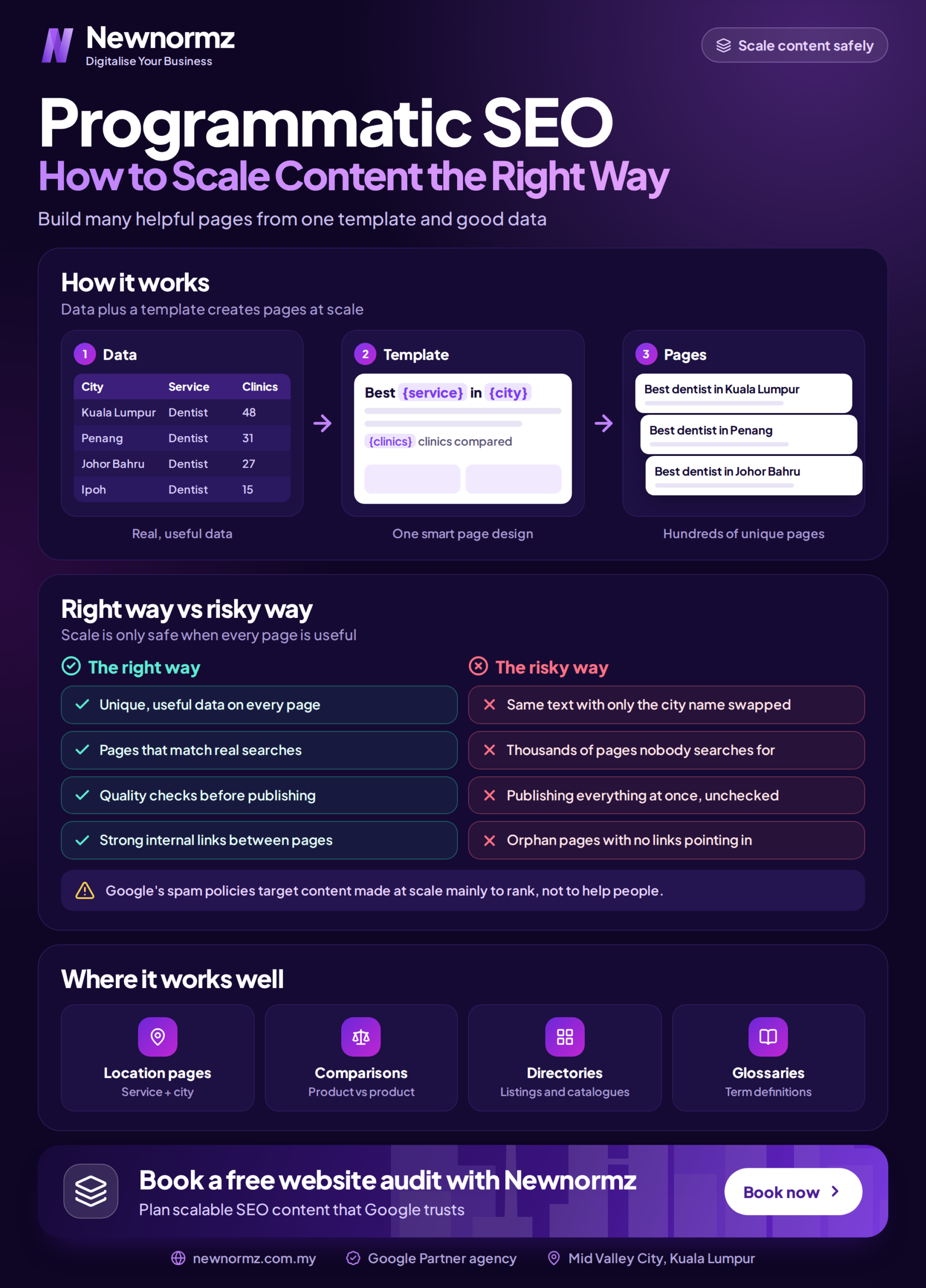
Programmatic SEO combines three ingredients: a fixed URL pattern, a fixed page template, and a data table that fills in the template’s variables. Instead of writing a thousand pages by hand, you write the structure once and let a spreadsheet or database populate every variation. A travel site might generate a page for every “flights from {origin} to {destination}” route. A SaaS company might build a page for every “{tool A} vs {tool B}” comparison.
The scale this can reach is real. Zapier paired a template system with a database of more than 7,000 app integrations to generate over 800,000 indexed pages, a footprint that now drives more than 2.6 million monthly organic visits. Wise built thousands of programmatic pages to cover currency and transfer queries. Neither is a content farm. Both are structured answers to structured questions, which is the entire point of the method.
The Three Conditions That Have to Hold at Once
Programmatic SEO works when all three of these are true together. Miss one and the whole program underperforms, no matter how good the other two are.
1. You have real, differentiated data
Each page needs information a searcher cannot get from a generic article: prices, counts, ratings, specifications, or curated picks. If the only thing that changes between pages is the city name in the heading, that isn’t data, it’s padding.
2. The template genuinely answers the query
A good template mirrors what the searcher actually wants: a direct answer near the top, a data-rich middle, and supporting context around it. The structure stays fixed, but the substance has to shift meaningfully from page to page.
3. Real search demand exists for every variable
This is the discipline most teams skip. Before generating a page, confirm people actually search for that combination. Generating pages for zero-volume terms wastes crawl budget and dilutes the rest of the site. If you’re not sure whether your dataset clears this bar, an outside SEO service can usually tell you in an afternoon, before you build anything.
Healthy Pages vs. Thin Pages
The failure mode of programmatic SEO is thin content: pages that exist because a template made them cheap, not because they serve a searcher. Multiply a weak page by a thousand and you don’t get a thousand assets, you get a thousand liabilities.
| Signal | Healthy Page | Thin Page |
|---|---|---|
| Unique data per page | Real counts, prices, or curated picks | Only a swapped keyword |
| Search demand | Verified, meaningful monthly volume | Zero or near-zero volume |
| User value | Answers a specific, real need | Padding wrapped around a variable |
| Typical outcome | Steady, compounding organic growth | Sharp ranking loss once flagged |
Google’s Scaled Content Abuse Policy
Google drew a clear line on this in 2024. Its scaled content abuse policy targets pages generated primarily to manipulate search rankings, whether they’re produced by automation, by humans, or by a mix of both. The key phrase is “primarily to manipulate.” A template is not the problem. Intent and value are.
The March 2024 core and spam update backed this up in practice, cutting the amount of low-quality, unoriginal content Google surfaced in search results by roughly 45%, ahead of its own 40% target. Sites that had leaned hardest on large volumes of thin, near-identical automated pages were among the ones hit hardest in that rollout, and the damage was rarely contained to the weak pages alone. A large set of low-quality pages can drag down how Google perceives the rest of the domain, pulling strong pages down with it.
Programmatic pages built on rich, genuinely useful datasets remain fully compliant with this policy. The distinction was never the method, it’s whether each page earns its place in the index on its own.
A Worked Example: One Template, Built the Right Way
Here’s a concrete build for a hypothetical directory site listing cafes by city, the kind of city-by-city page set that’s really a scaled version of local SEO, and lives or dies on the same fundamentals. The URL pattern is fixed, the template sections are fixed, and the variables are pulled row by row from a data table.
URL pattern: /best-cafes-in-{city}/
<h1>The {count} Best Cafes in {city} (2026)</h1>

<p>Looking for great coffee in {city}? We tracked
   {count} cafes and ranked them by ratings,
   ambience, and value. Our top pick: {top_pick}.</p>

<section>Editor's top pick: {top_pick}</section>
<section>Full ranked list: {cafe_table}</section>
<section>Neighbourhood guide for {city}</section>
<section>FAQ: opening hours, wifi, pricing in {city}</section>
Each page is generated from one row of a data table. The template stays identical, and the data is what makes every page genuinely different:
| City | Count | Top Pick |
|---|---|---|
| Kuala Lumpur | 42 | VCR |
| Penang | 28 | China House |
| Johor Bahru | 19 | The Replacement Lodge |
This passes the quality bar because every page carries a real cafe count, a real curated top pick, and a full ranked list unique to that city. Strip out the data and you’d have three empty templates, which is exactly what Google’s policy penalises. The data is the asset. The template is just the shape it takes.
Common Mistakes That Sink a Programmatic Program
| Mistake | Why It Costs You |
|---|---|
| Building pages for zero-volume terms | If nobody searches the variable, the page has no job to do |
| Variable injection with no real data | Swapping a city name into boilerplate is the definition of thin content |
| Publishing everything at once | You lose the chance to catch quality problems before they scale |
| Ignoring internal linking | Orphaned pages waste crawl budget and often never get indexed |
| No quality floor | Without a minimum data threshold, weak rows slip through and drag the set down |
Before you generate a single page, it helps to lock in a short checklist: confirm real demand for every variable, set a minimum data threshold and suppress any row that can’t meet it, build clean internal links so pages are discoverable, launch in controlled batches, and audit periodically to prune anything that never earns impressions.
Frequently Asked Questions
Is programmatic SEO against Google’s guidelines?
No. It’s fully allowed when each page delivers genuine value. Google’s scaled content abuse policy targets pages made primarily to manipulate rankings, not the use of templates. If every page answers a real query with real data, you’re operating well inside the guidelines.
How many pages can I safely publish?
There’s no fixed cap. Zapier runs over 800,000 pages successfully. The real limit is quality: publish only as many pages as you have genuine search demand and unique data to support, scale in batches, and stop the moment quality starts slipping.
What’s the difference between programmatic SEO and AI-written content?
Programmatic SEO assembles pages from structured data and a template. AI content is text generated by a language model. The two can overlap, but they’re not the same thing, and Google judges both on the same standard: usefulness, not method.
How do I know if a page is too thin?
Ask whether the page would still be useful with the template stripped away. If only a swapped keyword remains, it’s thin. Healthy pages carry unique data such as counts, prices, ratings, or curated picks that a searcher can’t find in a generic article.
Will a batch of thin pages hurt the rest of my site?
It can. Google weighs site-wide quality signals, so a large set of thin pages can drag down the pages that were performing well too. It’s safer to publish fewer excellent pages than thousands of weak ones that put the whole domain at risk.
Scaling content but worried about the risk?
Find Out If Your Site Can Handle Programmatic Pages Without a Penalty
Newnormz has run SEO campaigns across F&B, healthcare, ecommerce, and local services in Malaysia, backed by a performance guarantee of 70 percent of targeted keywords on Google’s first page.
30 minutes, no obligation, and no jargon.

Bryan Tan is an SEO Specialist and CEO at Newnormz, helping hundreds of businesses achieve first-page rankings on Google. With a passion for driving organic growth, Bryan blends innovative strategies with hands-on experience to optimize websites for maximum visibility. Always at the forefront of the latest SEO insights and trends, he consistently adapts to the evolving digital landscape.