Key takeaways
- ✓This is a complete SEO content brief Malaysia teams can copy straight into Google Docs. It has five groups of fields: keywords and intent, reader and angle, outline, proof and compliance, and handover.
- ✓Most thin or off-target drafts fail before the writer types a word. The usual cause is a brief that left the search intent, the angle or the approved proof blank.
- ✓A Malaysian brief needs three fields that US templates skip: the language and script (EN, BM or CN, written natively), WhatsApp as the conversion action, and a “do not claim” field for regulated industries.
- ✓A proper brief takes 45 to 60 minutes. Avoiding a single rewrite round usually covers that time.
Use this checklist every time you commission an article from a freelancer, a junior writer or an agency, and before you refresh an old page. If you’re the writer, it also works as a list of things to ask your client for before you accept the job.
Why a Bad SEO Content Brief Costs You More Than a Bad Writer
When a draft comes back generic, most managers blame the writer and look for a new one. The next writer gets the same one-line brief (“write 1,500 words on aircond servicing, include keywords”) and sends back the same kind of draft. The writer was never the problem. The brief was.
Here’s an illustrative example with hypothetical numbers. Say you pay a freelancer RM300 per article and RM100 for each rewrite round, and your own time costs the business about RM80 an hour. A vague brief leads to a first draft, two rewrites and about four hours of your reviewing and commenting. That one article now costs RM300 + RM200 + RM320 = RM820, and it goes live three weeks late.
Now take the same article with a full brief. You spend about an hour writing the brief and an hour reviewing one draft, which comes to RM300 + RM160 = RM460. Across ten articles a quarter, the gap is RM3,600 plus several weeks of publishing time. Learning how to brief content for SEO properly is the cheapest fix in your whole content budget.
Group 1: Search Intent and Keyword Fields Every SEO Brief Writer Must Fill In
The first question in any list of what to include in a content brief is “what will someone type into Google, and what do they expect to find?” Keyword research for content can come from Semrush, Ahrefs or the free tools, but the most underused source is the page’s own data in Google Search Console. In the Newnormz RANKED Framework this step is “Revenue keywords”: the brief starts from terms that lead to enquiries, not from whatever has the most volume.
Group 1 checklist: keywords and intent
- ✓One primary keyword, and only one.
- ✓5 to 12 secondary keywords, with a note on where each one fits (H2, FAQ, table header).
- ✓A search intent label: informational, commercial, transactional or local.
- ✓The format Google currently ranks for this query (listicle, step-by-step guide, product or service page, local pack).
- ✓The People Also Ask questions that show up for the primary keyword.
- ✓Search Console queries the page already gets impressions for, if you’re refreshing an existing URL.
The field people most often get wrong is intent, and the usual mistake is a brief that chases two intents at once. “Aircond service price” and “how to clean aircond yourself” sound related, but the first searcher wants to hire someone and the second wants to avoid hiring anyone. One page can’t satisfy both. Before writing anything else, search the primary keyword and look at what Google shows. If the top results are price pages, a 2,000-word guide won’t win, however well it’s written.
Choosing the Language Version Before the Keywords
Malaysians searching in English, Bahasa Malaysia and Chinese describe the same need in different ways. A BM searcher may type “servis aircond murah” where an English searcher types “aircond service KL”, and a Chinese searcher may use different terms again in simplified characters. Bahasa Malaysia search also mixes in a lot of informal spelling and English loanwords, which a word-for-word translation will miss.
So the brief must state the language and script, list keywords researched in that language, and never ask the writer to translate an English article. Newnormz strategists work in English, Bahasa Malaysia and Chinese for this reason: each version gets its own keyword research. For more on how this changes structure and tone, see our guide to adapting content for BM and Chinese readers.
Group 2: The Reader, Angle and “What We Know That They Don’t”
This group decides whether the article adds anything new or just restates the top five results. Google’s guidance on helpful, people-first content asks whether a page gives original information or analysis. A writer can only deliver that if the brief tells them what it is.
Group 2 checklist: reader and angle
- ✓The reader in one sentence: who they are and what situation they’re in.
- ✓The decision they’re trying to make by the end of the page.
- ✓The angle: the one argument this article makes that competing pages don’t.
- ✓Three information-gain points, such as a worked example, a local nuance or a mistake you see often.
- ✓First-hand experience or data the writer may use (E-E-A-T): staff quotes, photos, internal figures, real customer questions.
The angle is the field most often left blank, because filling it in means the person commissioning the article has to have an opinion. “Write about aircond servicing” isn’t an angle. “Most homes don’t need a chemical wash every year, and here’s how to tell when you do” is one. Without it, the writer falls back on the safe average of what already ranks, which is exactly what Google has no reason to promote.
The experience field matters most in sectors where trust decides the sale. A writer can’t invent a technician’s view or a clinic’s patient questions, so the brief has to supply them. Our guide to showing real experience and expertise covers what kinds of evidence count.
Group 3: Content Outline SEO Fields (Headings, Entities and Answer Blocks)
A content outline built for SEO isn’t a list of topics. Under each heading, it tells the writer what that section has to prove.
Group 3 checklist: outline
- ✓An H2 and H3 outline, with a one-line note under each heading saying what the section must deliver.
- ✓Entities to cover: the tools, brands, concepts and places a complete answer would name.
- ✓FAQ questions taken from People Also Ask, Search Console and real customer enquiries.
- ✓A one-sentence direct answer for each question, so the page can be quoted in Google AI Overviews and marked up with FAQ schema markup.
Weak headings lead to weak sections, because the writer fills the space the heading allows. Put the specific version in the brief yourself:
| Weak H2 in a brief | Specific H2 in a brief |
|---|---|
| Benefits of Aircond Servicing | Normal Wash or Chemical Wash: How to Tell Which Your Unit Needs |
| Note to writer: “explain benefits” | Note to writer: “list the three symptoms our technicians check, then give the rule for each” |
The entity list stops articles from feeling thin. Google judges whether a page covers a topic completely partly by whether it mentions the things a knowledgeable person would mention. Our explainer on covering entities Google understands shows how to build that list from the search results.
The direct-answer field is the “Everywhere answers” part of the RANKED Framework. Sunway TCM Centre is a good example of why it belongs in the brief. Newnormz restructured its pages for AEO, putting clear answers at the top of each section, and the clinic got 80% of its target keywords onto page 1 within 4 months and now appears in Google AI Overview results for treatment searches. If you want writers to produce answer blocks AI engines quote, write the answer sentence into the brief rather than hoping they find it.
Group 4: Links, Proof and Compliance Limits
This is the group that protects your brand. Leave it empty and a writer under deadline will fill the gaps with whatever sounds plausible.
Group 4 checklist: links, proof and limits
- ✓Internal link targets, each with a suggested anchor and the section it belongs in.
- ✓Sources the writer may cite, named exactly (for example, a specific Google documentation page).
- ✓Client results, prices and figures approved for use, copied in word for word.
- ✓A “do not claim” list of banned promises, superlatives and regulated wording.
In Malaysia, the “do not claim” field is required for regulated sectors. Medical clinics must follow the Malaysian Medical Council’s advertising guidelines, which restrict things like testimonials and claims of superiority. Financial and legal businesses have their own regulators and publicity rules. Any content that collects or discusses personal data, such as enquiry forms or patient stories, has to respect the Personal Data Protection Act 2010 (PDPA). A freelance writer can’t be expected to know all of this, so the brief has to spell it out.
✗ The brief says “add some stats” and gives no source
The writer searches, finds a number on a content farm or simply makes one up, and “studies show 78% of Malaysians…” ends up on your site under your name. On a medical or finance page, that’s a credibility problem and possibly a compliance one.
✓ The fix
List the exact figures the writer may use, each with its source, and add one line: “If a number isn’t in this list, don’t include it. Write around it.” It takes two minutes and removes the risk.
Group 5: Format, Conversion and Handover Details
The last group turns a good article into a page that gets enquiries and is delivered on time.
Group 5 checklist: format and handover
- ✓A target word count range based on the pages currently ranking, not a habit number.
- ✓Draft meta title (60 characters or fewer) and meta description.
- ✓The conversion action, which for most Malaysian service businesses is a WhatsApp click, not a form.
- ✓Image needs: what each image must show and who supplies it.
- ✓Deadline, number of review rounds included, and who gives final approval.
The CTA field is the one people overlook. Malaysian customers usually prefer to message a business on WhatsApp Business rather than fill in a form, so the brief should say where the WhatsApp button goes and what the pre-filled message says. This is also how you measure the article. The “Data loop” stage of the RANKED Framework tracks call, WhatsApp and form enquiries back to the page that produced them, which only works if the brief specified the action in the first place.
Word count needs the same discipline. If the top five results for a local service query are about 800 words, asking for 2,500 adds padding, not depth. The brief should also stick to one keyword cluster per page, as the Oriental Kopi campaign shows.
Client example
Oriental Kopi: +350% ranked keywords from clear keyword clusters
Problem: A national F&B and retail brand needed its pages to rank for the product terms coffee buyers actually type.
What we did: Optimised content around distinct clusters (“kopi”, “white coffee”, “3 in 1 coffee”), added full schema and fixed ecommerce technical issues.
Result: +350% ranked keywords. Over a 2-year campaign: 24,500 more ranking keywords, 6.31M impressions and 468,000 clicks. Client for 4 years.
If your team doesn’t have time to brief every article in-house, our SEO content writing service builds the brief and the article together.
Not sure whether your existing articles were briefed against the right keywords? We’ll check them for you.
Some businesses would rather hand the whole chain to one team: keyword mapping, briefing, writing and tracking. That’s the work our SEO services in Malaysia cover, with strategists who brief natively in English, Bahasa Malaysia and Chinese.
A Filled-In SEO Content Brief for Malaysia: Sample Template for a KL Service Page
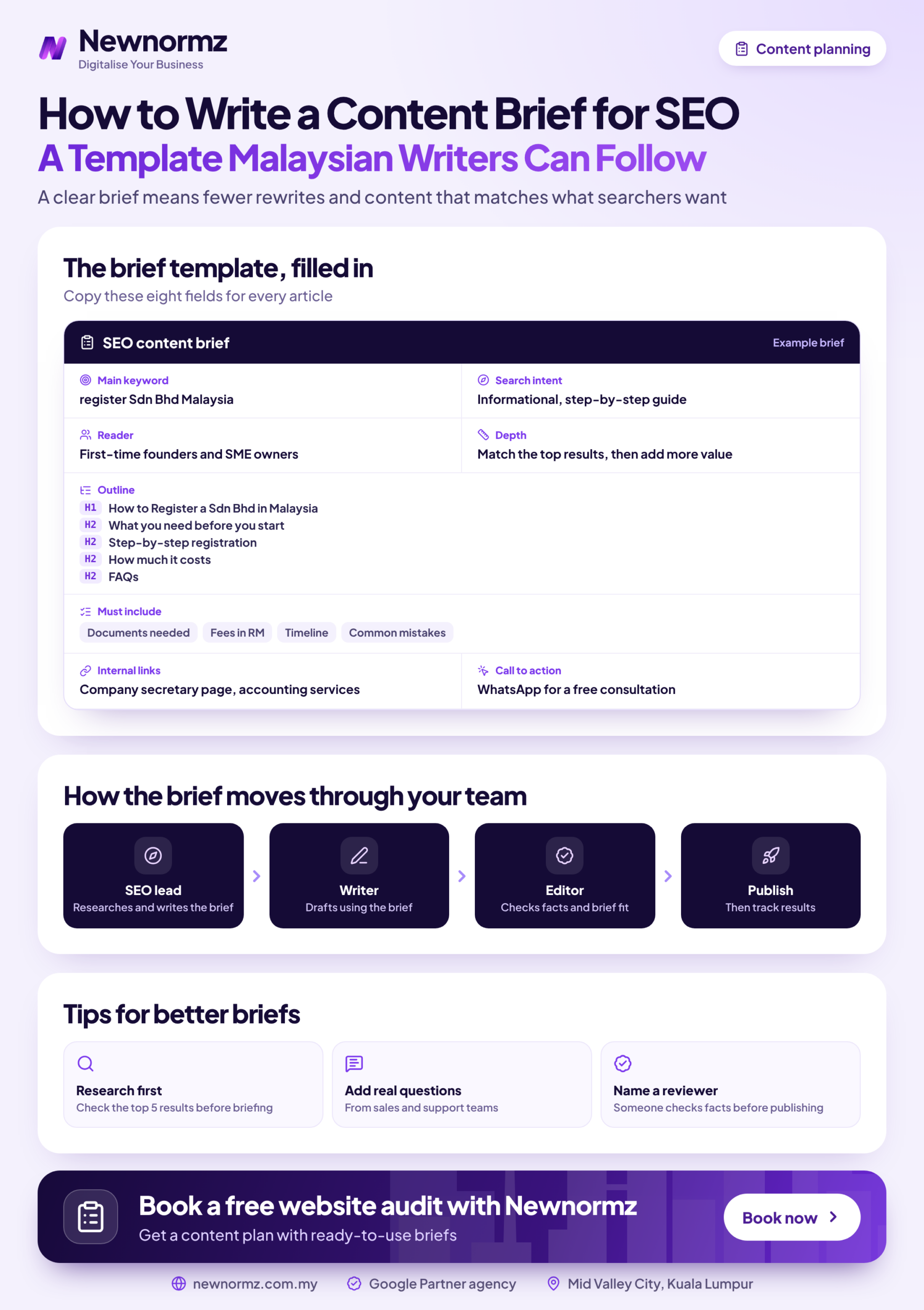
Below is an SEO writing brief example for a hypothetical aircond servicing company in Kuala Lumpur. It’s a sample, so swap in your own topic. Copy the first two columns into Google Docs and you have a reusable content brief template for writers.
| Field | What to write | Sample entry |
|---|---|---|
| Language and script | One language per brief | English. BM version gets its own brief and keyword research. |
| Primary keyword | One term | aircond service KL |
| Secondary keywords | 5 to 12, with placement notes | aircond chemical wash, aircond cleaning price, aircond not cold, inverter aircond service (H2s and FAQ) |
| Search intent and SERP format | Intent label plus what Google shows | Commercial and local. Map pack plus service pages with price lists. |
| Reader and decision | One sentence each | A Klang Valley homeowner whose unit is leaking or not cold, deciding which service to book. |
| Angle | The argument competitors don’t make | Most units don’t need a chemical wash every visit. Here’s how a technician decides. |
| Experience to use | Real inputs the writer can’t invent | Lead technician’s 3-symptom checklist (interview notes attached), before and after coil photos |
| Outline | H2s with one-line notes | H2: Normal wash or chemical wash (give the rule). H2: Price list by unit type (use rate card only). |
| Entities | Things a complete answer names | Inverter and non-inverter units, refrigerant gas top-up, evaporator coil, drainage pipe, wall-mounted and cassette units |
| FAQ and direct answers | Question plus a one-sentence answer | “How often should I service my aircond?” Answer per technician’s recommendation in notes. |
| Approved proof | Exact figures with sources | Published rate card, current Google review rating from the company’s profile |
| Do not claim | Banned promises and wording | “Cheapest in KL”, electricity savings percentages, same-day service guarantees |
| Internal links | URL, anchor, section | Chemical wash service page, from the comparison H2 |
| CTA | Action and placement | WhatsApp button after price list and at end. Pre-filled text: “Hi, I’d like a quote for aircond service in [area].” |
| Format and handover | Length, meta, deadline, rounds | Length to match top-ranking pages. Draft meta included. Due in 7 days, one review round, marketing manager approves. |
Which Brief Gaps to Fix First (Impact vs Effort)
If your current briefs are one line long, don’t try to fix everything at once. Start with the gaps that cause the most rewrites for the least effort.
| Brief gap | Impact on rankings or rewrites | Effort to fix |
|---|---|---|
| Missing search intent | High. Wrong format means a full rewrite, not edits. | Low. About 10 minutes reading the search results. |
| No angle | High. The draft comes back generic and has no reason to outrank anyone. | Medium. Needs someone with an opinion on the topic. |
| No entity list | Medium. Thin topical coverage, weaker for AI answers. | Low. Pull from People Also Ask and the top results. |
| No approved proof | High for YMYL topics. Invented stats and compliance risk. | Low, once you keep a master list of approved figures. |
| No CTA | Low for rankings, high for leads. The page ranks but nobody messages you. | Very low. Two minutes. |
From Our Audits
From our audits
The pattern we see most in client content audits isn’t a bad brief. It’s several good-looking briefs written months apart on nearly identical keywords, such as “aircond service KL”, “aircond servicing Kuala Lumpur” and “best aircond service near me”. The resulting articles compete with each other and none of them ranks well. The fix comes before briefing: keep a keyword-to-URL map, one primary keyword per URL, and check it before any new brief is written. If the keyword is already taken, the brief becomes an update to that page.
Once the brief passes that check, the writing itself is the easier part. Our step-by-step guide to turning the brief into a ranking post picks up from there.
SEO Content Brief FAQs
What should an SEO content brief template include?
An SEO content brief template should include the primary and secondary keywords, search intent, reader and angle, an annotated outline with entities and FAQ answers, approved proof and banned claims, and the CTA and handover details. In Malaysia, add the language and script for the article and a compliance field for regulated industries.
How long should a content brief for writers be?
Most good content briefs for writers fit on one to two pages in Google Docs. Length matters less than completeness: a short brief with a clear angle and approved proof beats a long one full of generic SEO instructions.
Do I need a separate brief for Bahasa Malaysia or Chinese versions of an article?
Yes, each language version needs its own brief with its own keyword research. BM and Chinese searchers phrase their needs differently from English searchers, so a translated brief targets terms nobody types.
How do I brief content for SEO if I don’t have Semrush or Ahrefs?
You can brief content well with Google Search Console and Google search itself. Search Console shows the queries your pages already appear for, and the live results show the format Google prefers, the People Also Ask questions and the entities competitors cover.
Can I use AI to write an SEO content brief?
AI can draft the mechanical fields, such as keyword lists, outline ideas and FAQ questions. The fields that decide quality need a person: the angle, the first-hand experience, the approved proof and the compliance limits.
Find out if your content was briefed for the right keywords
Newnormz runs SEO for 200+ Malaysian businesses on month-to-month terms, with a written page 1 guarantee and a 5.0 rating from 214+ Google reviews. Our free audit checks whether each page maps to one keyword, whether it matches search intent, and where you’re missing AI citations.
No obligation. Or WhatsApp us on +60 17-588 2291.

Bryan Tan is an SEO Specialist and CEO at Newnormz, helping hundreds of businesses achieve first-page rankings on Google. With a passion for driving organic growth, Bryan blends innovative strategies with hands-on experience to optimize websites for maximum visibility. Always at the forefront of the latest SEO insights and trends, he consistently adapts to the evolving digital landscape.