
SEO works well for Malaysian accounting and audit firms because the people searching for you have already made the decision to hire someone, they just haven’t picked who yet. A finance director typing “audit firm in Kuala Lumpur” or a founder typing “SST filing services Malaysia” isn’t browsing, they’re on a deadline. Rank for that search, back it up with real credentials and genuine reviews, and you’re on the shortlist. Don’t rank, and it doesn’t matter how good the actual work is: you were never considered.
A Simple Way to Think About It
The Firm at the End of the Corridor vs. the Firm on the Main Street
🚪 Referrals only
An accountant who only gets clients through referrals is like an office at the end of an unmarked corridor. If you already know someone who’s been there, you’ll find it. If you don’t, you never will.
🏢 Visible on Google
A firm that ranks is like one with a proper shopfront on the main street. People walk past, see the sign, check the reviews, and step in when they actually need help.
Referrals are still worth having, but they cap out fast. What builds the shopfront is covered below: the pages, the local signals and the trust markers that make a stranger pick up the phone.
Why accounting and audit firms are such a good fit for SEO
Accounting services are relationship purchases with long client lifetimes. Nobody hires an auditor on a whim, and when they do search, the intent is sharp and the timeline is short. That combination, high value per client and clear buying intent, is exactly what makes organic search worth the investment even though search volume for accounting terms is modest compared to consumer categories.
The numbers back this up. 71% of B2B buyers start their journey with a Google search, and around 70% of small business owners search online before hiring an accountant. If your firm isn’t visible when that search happens, you’re simply not in the conversation. Local intent and trust then decide what happens next.
| Buyer behaviour | Figure | What it means for your firm |
|---|---|---|
| B2B buyers who start with a Google search | 71% | If you’re not ranking, you’re not being considered |
| Small business owners who search before hiring an accountant | ~70% | Your website is pitching before you ever speak to them |
| Google searches that carry local intent | 46% | Location pages and a complete Google Business Profile aren’t optional |
| Near-me searchers who visit a business within 24 hours | 76% | Ranking locally converts quickly once the basics are in place |
| Consumers who won’t use a business rated below four stars | 68% | A weak rating quietly cancels out a strong ranking |
Build a dedicated page for every service line
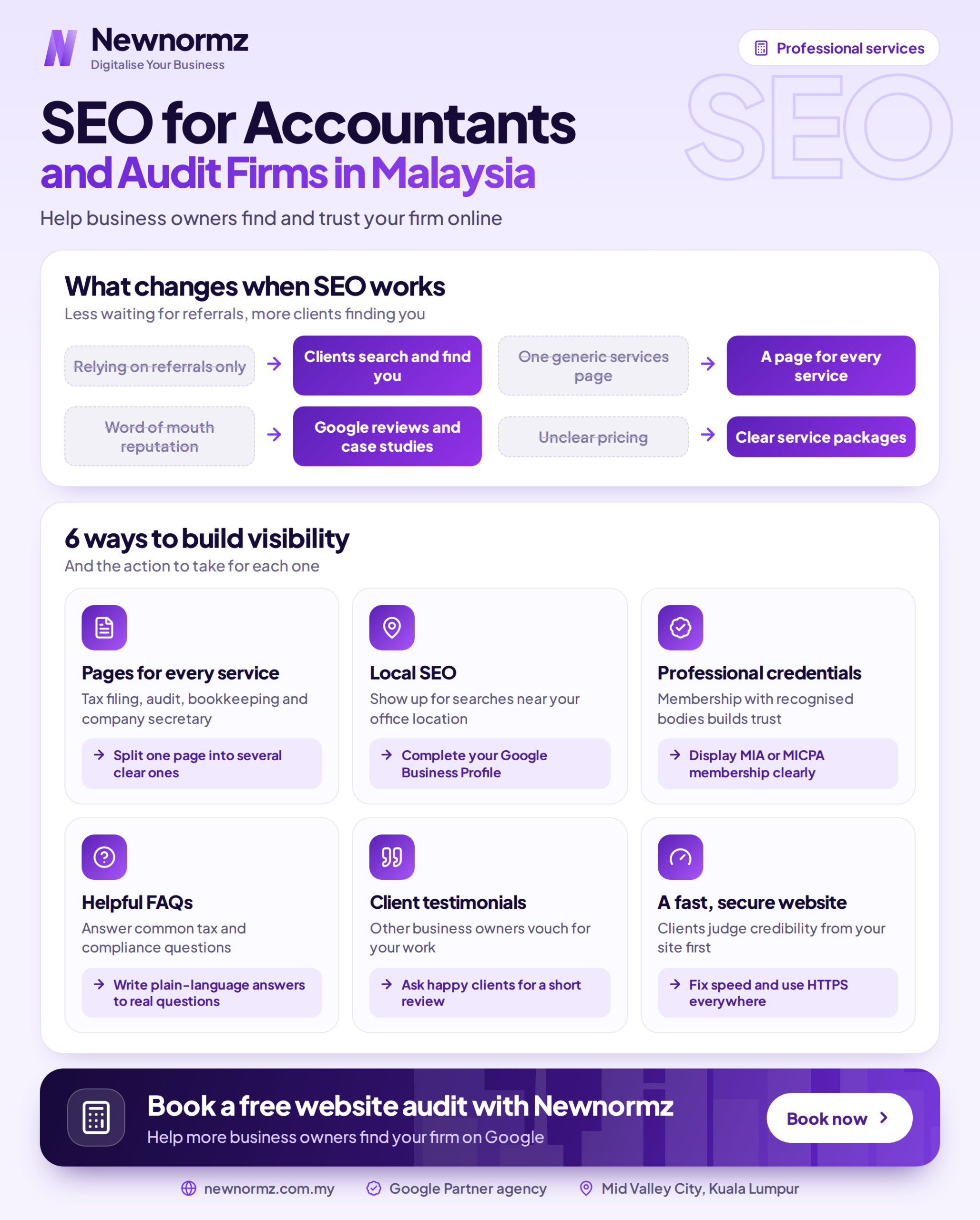
One generic “Services” page cannot rank for statutory audit, corporate tax, SST compliance, bookkeeping and advisory at the same time. Each of those is a different search, made by a different person, at a different stage of urgency. Give each one its own page, with its own title, heading and detail, and Google has a clear reason to rank it for that specific query instead of burying it under a broader term you’ll never win.
Pair each service with a location
“Audit firm in Petaling Jaya” or “tax agent Kuala Lumpur” converts far better than “accountant” on its own, and it faces a fraction of the competition. Build a page, or at minimum a clear section, for each service and city combination you actually serve. Don’t stretch to cities you can’t realistically service; a page that doesn’t match reality will only cost you trust once someone calls.
Local SEO decides who makes the shortlist
Most businesses want a firm they can meet, or at least one that feels local and reachable. That’s why local SEO carries so much weight for accounting practices: a complete, verified Google Business Profile with the correct name, address, phone number and service list, paired with an active process for earning genuine client reviews. With 97% of consumers reading reviews before choosing a local business and 68% ruling out anything under four stars, your rating is doing as much work as your ranking. A firm that ranks first but sits at 3.4 stars will still lose the enquiry to the firm ranking third with a 4.8.
Prove expertise the way clients (and Google) actually check for it
Financial topics sit in Google’s “your money or your life” category, so pages need to show genuine expertise, not just claim it. Publish real profiles for partners and managers: MIA membership, ACCA, CPA or CA qualifications, licence status, sector experience and specific case results. Add clear office details and named contacts. A firm with three anonymous paragraphs of copy and no named partner is asking Google, and every prospect who lands there, to take its competence on faith.
Write for the questions clients ask before they call
Plain-language guides on real questions, such as when a company is legally required to have a statutory audit, or how SST registration actually works, capture prospects earlier in their search and build the topical authority Google rewards. Keep this content strictly informational: useful, accurate and free of anything that reads like advice given to a specific reader.
Get the technical foundation right
None of the above matters if the site is slow, breaks on mobile, or is hard for Google to crawl. Keep the technical basics solid and follow Google’s own SEO fundamentals so every service page actually gets indexed and understood. If you’re still deciding who should own this work, our SEO services in Malaysia page covers what a full engagement looks like.
Where the compliance line sits
Marketing for accounting and audit services has to stay inside the profession’s advertising and conduct standards. That means accurate, informative content, no guarantees about tax outcomes or savings, and nothing that reads as financial or tax advice given to a specific reader. Check anything client-facing against the rules that apply to your practice and membership before it goes live. Good SEO fits comfortably inside these limits anyway, because it rewards being genuinely useful, not making bold promises.
What a well-built service page actually looks like
Here’s how a single “SST filing services Malaysia” page comes together, from what a searcher sees in Google to the trust markers that convert a click into an enquiry.
| Page element | What it should do |
|---|---|
| Title tag | Name the service and the city: “SST Filing Services Malaysia | Registered Tax Agents in KL” |
| Meta description | State the outcome and prompt an action, not just describe the service |
| H1 and opening paragraph | Answer the query directly in the first two sentences: what the service covers and who handles it |
| Trust elements below the fold | MIA membership and licence status, named partner credentials, a concrete result, and a clear way to book a consultation |
Mistakes that quietly cap what your firm ranks for
- One generic services page. It can’t rank for audit, tax and advisory at once, build one page per service line instead.
- Ignoring reviews. With 68% of buyers ruling out anything under four stars, a weak rating quietly kills enquiries your ranking already earned.
- Thin partner profiles. Missing credentials and MIA membership weaken the expertise signals Google looks for on financial pages.
- No local signals. Without a verified profile and location pages, you miss the 46% of searches that carry local intent.
- Overpromising on outcomes. Guarantees about tax savings can breach conduct rules and undermine the trust you’re trying to build.
The accounting firm SEO checklist
- A dedicated page for each service line, targeting service plus city
- A verified, complete Google Business Profile
- An active process to earn genuine client reviews
- Real partner profiles with credentials and MIA membership
- Plain-language guides answering common client questions
- A fast, mobile-friendly, secure technical foundation
- A fast enquiry response process so hard-won leads don’t go cold
Frequently Asked Questions
Does SEO actually work for accounting and audit firms in Malaysia?
Yes. With 71% of B2B buyers starting on Google and each retainer worth a meaningful amount, even a handful of organic leads a month can pay for the work several times over. It takes dedicated service pages and consistent local SEO to get there, not a single “services” page.
What keywords should an accounting firm actually target?
Pair a specific service with your location, such as “audit firm in Kuala Lumpur” or “SST filing services Malaysia” rather than broad terms like “accountant”. These convert better and face less competition, and each service deserves its own page.
How long does it take to see results?
Most firms see early movement in three to four months and meaningful gains in six to nine months, depending on competition and the site’s existing authority. A focused page for a less contested city or service can move sooner than a broad national term.
How much do reviews actually matter for an accounting firm?
A lot. 97% of consumers read reviews before choosing a local business, and 68% won’t use one rated below four stars. For a trust-critical service like accounting, reviews decide how many of your rankings actually turn into enquiries.
Does compliance change how accounting SEO should be done?
Yes. Marketing has to stay inside the profession’s advertising and conduct standards, so avoid guarantees on tax outcomes and never present content as advice. Good SEO already rewards being accurate and useful, so the two fit together well.
Should a firm do SEO, Google Ads, or both?
Both have a role. Google Ads brings enquiries immediately but stops the moment you stop paying. SEO takes longer to build but keeps producing leads without a per-click cost. Many firms run ads for near-term volume while building SEO for the long run.
Losing prospects to firms that simply rank higher?
Find out what’s actually holding your accounting firm’s rankings back
Newnormz has run SEO campaigns across F&B, healthcare, ecommerce, and local services in Malaysia, backed by a performance guarantee of 70 percent of targeted keywords on Google’s first page.
30 minutes, no obligation, no jargon.

Bryan Tan is an SEO Specialist and CEO at Newnormz, helping hundreds of businesses achieve first-page rankings on Google. With a passion for driving organic growth, Bryan blends innovative strategies with hands-on experience to optimize websites for maximum visibility. Always at the forefront of the latest SEO insights and trends, he consistently adapts to the evolving digital landscape.