DeepSeek SEO is the practice of making your content easy for DeepSeek’s AI assistant to find, trust, and quote when someone asks it a question your business could answer. DeepSeek works in two layers: a base model trained on a fixed snapshot of data, which you cannot influence after the fact, and a live web search mode that behaves much like a normal search engine, crawling and reading pages in real time. You cannot buy, submit, or request a place in DeepSeek’s training data. What you can control is whether your site is crawlable, whether your facts are stated plainly enough for a machine to extract them, and whether other credible sources on the web back up what you’re claiming about your own business.
A Simple Way to Think About It
The Encyclopedia Already Printed vs. The Reporter on the Phone
🔒 Waiting to Be Remembered
Getting written into an encyclopedia that has already gone to print takes months, and there is no form to fill in and no editor to call. Whatever made it onto the page is there, and everything that happened after the deadline simply does not exist to the reader.
📞 Being Found on the Spot
A reporter who picks up the phone and asks around today will find whatever is true today, including the shop that only opened last week. That is a door you can actually knock on.
DeepSeek’s training data is the encyclopedia already printed. Its web search mode is the reporter on the phone, and the rest of this article is about how to make sure that reporter finds you.
What DeepSeek Actually Is
DeepSeek is a Chinese AI lab that released a family of reasoning models, most notably DeepSeek-R1 in January 2025, which drew global attention for matching the performance of far more expensive rivals at a fraction of the training cost. It runs a free chat app and website, alongside an API that other products build on top of. Like ChatGPT, Claude, and Gemini, its chat interface has an optional web search mode: switch it on and the assistant looks at live pages before answering, rather than relying only on what it learned during training.
In a market where SEO in Malaysia is increasingly a fight for visibility across both classic search results and AI assistants, being the source an AI system trusts is starting to matter alongside where you rank on Google.
How DeepSeek Actually Finds Information About Your Business
Two separate things determine whether DeepSeek knows about you, and they behave completely differently.
The first is the model’s training data, a fixed snapshot frozen at a point in the past. If your business, product, or service did not have a strong footprint on the public web before that cutoff, it likely is not baked into the model’s memory, and there is no submission process to fix that after the fact.
The second is live web search. When a user has search switched on, or asks a question that triggers it automatically, DeepSeek fetches and reads pages much the way a search engine does. It needs your site to be crawlable, indexable, and not blocked by robots.txt or a login wall. This is the layer where ordinary technical SEO habits, fast pages, clean HTML, no accidental noindex tags, still matter directly, because an AI assistant that cannot load your page cannot quote it either.
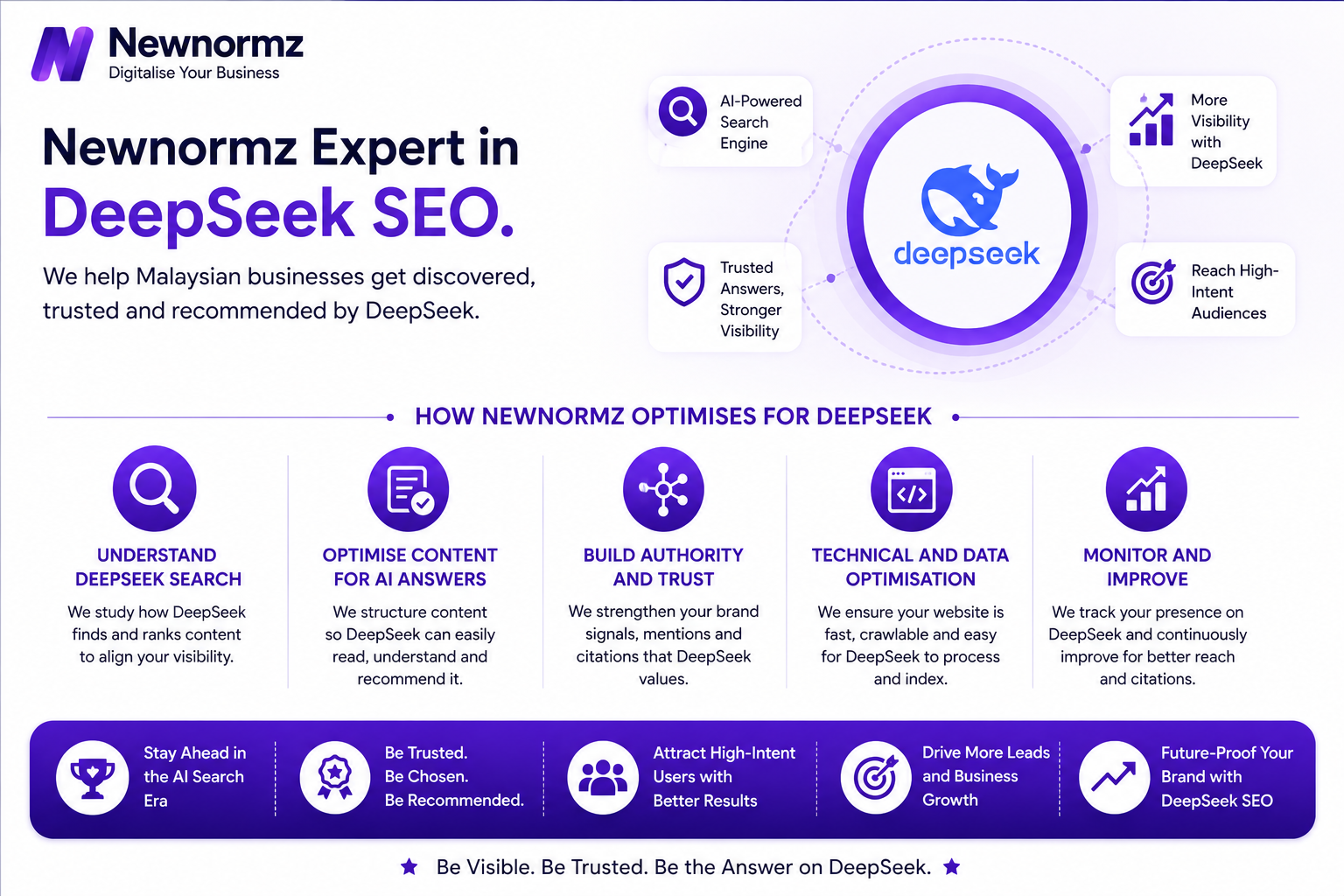
What Content DeepSeek’s Search Tends to Favor
Direct answers near the top. A page that states the fact or answer in the first few sentences is easier for an AI system to lift cleanly than one that buries it under paragraphs of scene-setting.
Facts stated plainly, not implied. “Our confinement centre in KL costs RM6,800 for a 26-day package” is something a model can extract. “Affordable pricing tailored to your needs” is not.
Structured data. Schema markup that clearly labels prices, ratings, addresses, and FAQs gives the crawler a machine-readable version of the same facts, reducing the chance the model misreads your page.
Corroboration elsewhere on the web. DeepSeek, like other AI systems, tends to trust claims that show up consistently across several independent sources rather than a single self-published page. A business mentioned the same way on its own site, in a directory listing, and in a genuine third-party review is easier to trust than one making the claim about itself alone, the same self-serving problem that keeps review schema from producing stars on your own testimonials.
This is also why the fundamentals of local SEO, consistent business details across your Google Business Profile, directories, and your own site, matter for AI visibility too, not just the local map pack.
DeepSeek SEO vs. Traditional Google SEO
| SEO Factor | Still Matters for DeepSeek? |
|---|---|
| Backlinks from credible sites | Yes, used as a trust signal much like it is with search engines |
| Keyword stuffing | No, plain factual language extracts better than keyword density |
| Page speed and crawlability | Yes, DeepSeek’s search cannot quote a page it cannot load |
| Meta descriptions | Indirectly, they do not feed the model but still drive clicks from any results it surfaces |
| Schema markup | Yes, it makes facts easier for the model to extract correctly |
| Paying for a citation or “AI ad” placement | No, there is currently no way to pay for a DeepSeek citation |
Common Mistakes to Avoid
The recurring errors we see are less about technical setup and more about expectations. Businesses assume there is a portal to submit their site to DeepSeek the way you’d submit a sitemap to Search Console; there isn’t. Some write marketing copy so vague that a model has nothing concrete to extract from it, then wonder why an AI answer never mentions them. Others run aggressive bot-blocking security plugins that quietly block AI crawlers along with spam traffic, which cuts them out of the live web search layer entirely without anyone noticing. None of these will throw an error message; they just quietly mean your business never comes up.
Frequently Asked Questions
Can I pay DeepSeek to recommend my business?
No. There is no advertising or paid placement system for citations inside DeepSeek’s chat answers today. The only lever available is making your content easy to find, trust, and extract.
Will optimising for DeepSeek hurt my Google rankings?
No. The fundamentals overlap heavily: crawlable pages, clear factual content, and credible mentions elsewhere on the web help with both. You are not choosing one over the other.
Does DeepSeek use Google’s search index?
DeepSeek has not publicly detailed the exact source behind its web search feature. The safer approach is to treat it as its own crawler and keep your site generally open and readable to automated visitors, rather than assuming any one search engine’s index guarantees coverage.
How is this different from optimising for ChatGPT or Claude?
The underlying principles overlap: clear facts, structured data, and third-party corroboration help across most AI assistants. Each one has its own crawler behaviour and update pace, so results on one will not always show up on another at the same time.
How long before changes to my site show up in a DeepSeek answer?
There is no fixed timeline. It depends on when the search layer next fetches your page and whether the model treats your content as strong enough to cite, so treat these changes as improving your odds rather than flipping a switch.
Not Showing Up When AI Assistants Answer For You?
Get an SEO and AI Visibility Audit That Covers DeepSeek Too
Newnormz has run SEO campaigns across F&B, healthcare, ecommerce, and local services in Malaysia, backed by a performance guarantee of 70 percent of targeted keywords on Google’s first page.
30 minutes, no obligation, including a check of how AI assistants currently see your site.

Bryan Tan is an SEO Specialist and CEO at Newnormz, helping hundreds of businesses achieve first-page rankings on Google. With a passion for driving organic growth, Bryan blends innovative strategies with hands-on experience to optimize websites for maximum visibility. Always at the forefront of the latest SEO insights and trends, he consistently adapts to the evolving digital landscape.