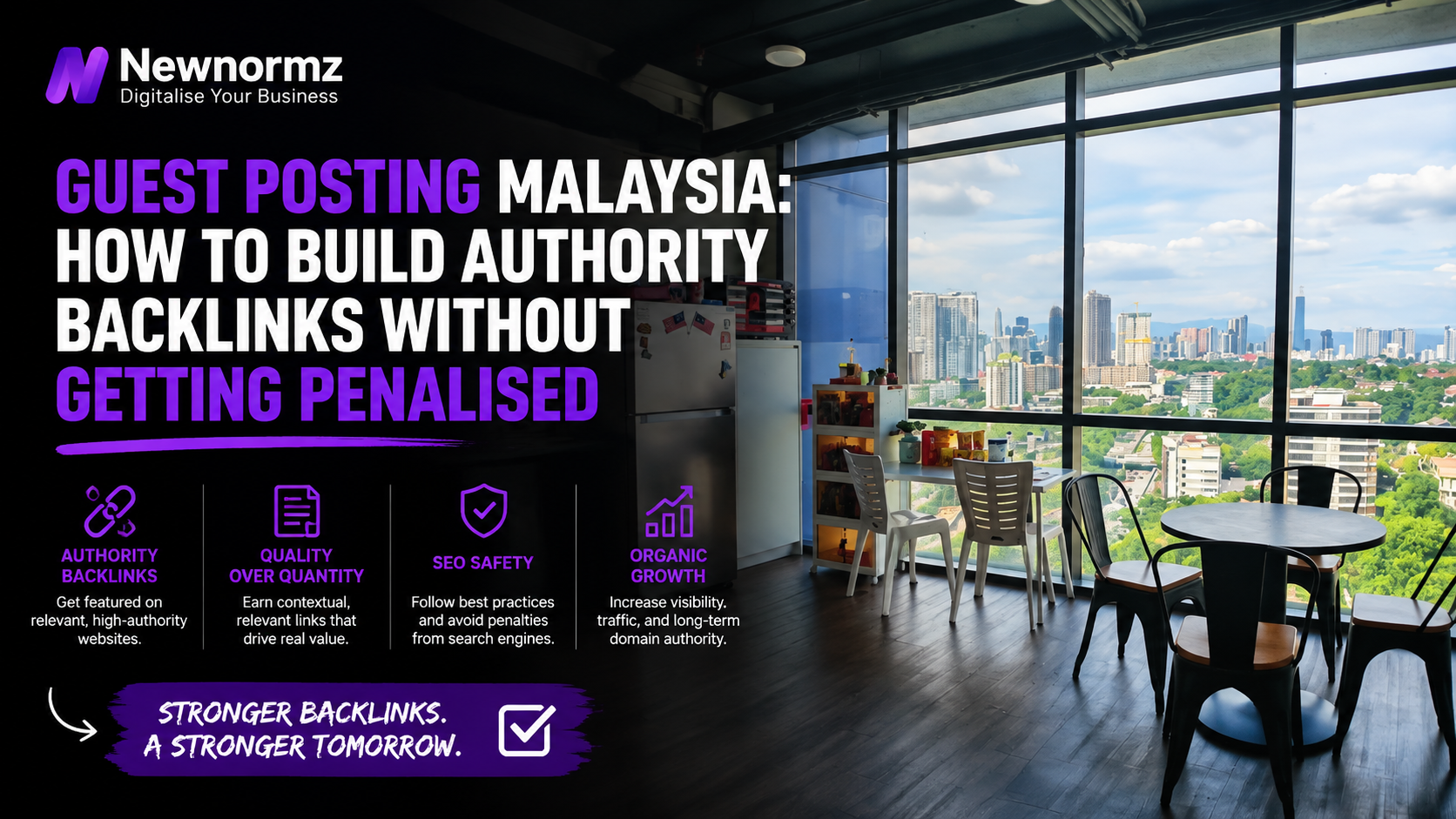
Guest posting still works in Malaysia, but only when the backlink is a side effect of a genuinely useful article on a relevant site, not the product being sold. Google’s own guidelines require any paid or exchanged link to carry a rel=”sponsored” or rel=”nofollow” tag, and sites built purely to host paid links, commonly called private blog networks, get penalised rather than ranked. If a vendor is selling you “50 guest posts with dofollow links” and nothing else, you’re buying a liability. If you’re contributing real content to sites your customers already read, you’re building authority the way Google actually rewards it.
A Simple Way to Think About It
A Sign You Rent vs an Introduction You Earn
🚩 Rented Shopfront Sign
Paying a stranger to hang your sign in their shop window for a week. The moment you stop paying, it comes down, and regulars who walk past every day already know it was never really theirs to give.
✅ A Trusted Introduction
A shopkeeper you’ve done real business with telling a customer, “you should check them out.” That word travels on its own, and it doesn’t disappear the day the invoice is settled.
That difference, rented versus earned, is exactly what separates guest posts Google rewards from the ones that get a site flagged. Here’s how to tell which side of that line you’re actually standing on.
What Guest Posting Actually Buys You in Malaysia’s Search Market
A backlink from a relevant site tells Google that someone other than you thinks your content is worth pointing to. That’s the entire mechanism. It’s not magic, and it’s not a loophole; it’s one of several trust signals Google uses alongside content quality, site health, and relevance to the searcher.
In a market where Google handles roughly 93 percent of searches in Malaysia (Statcounter, May 2026) and the country has around 35.4 million internet users (DataReportal Digital 2026 Malaysia), the sites your customers actually read carry real weight when they link to you. A backlink from a site nobody in your industry visits carries almost none, no matter how the vendor prices it.
Why Some Guest Posts Get Sites Penalised
Guest posting doesn’t get penalised. Link schemes disguised as guest posting do. Google has been consistent on this for years: exchanging money, free products, or reciprocal links for a placement is fine, as long as the link is marked sponsored or nofollow so it doesn’t pass ranking credit as if it were an organic editorial mention. The problem starts when that disclosure is skipped, when the anchor text is stuffed with exact-match keywords, or when the “guest post” runs on a site that exists only to sell links to whoever pays.
Google has also said repeatedly, in its own public communications, that no one, including Google itself, can guarantee a specific ranking position. Any vendor promising a page-one spot from a batch of guest post links is making a claim Google itself won’t make.
What a Safe, Effective Guest Post Looks Like
The test is simple: would this article exist, and would this link make sense, even if search rankings didn’t exist at all? A safe guest post is written for the host site’s actual readers, sits on a site that operates in or near your industry, and links to your page because the link is genuinely useful in context, not because it was the deliverable.
This is the same standard we apply when we build out a client’s SEO service plan: a link-building calendar that prioritises three relevant, well-read placements over thirty generic ones, because that’s what actually moves rankings and referral traffic together.
| Sign You’re Building Authority Properly | Sign You’re Buying a Future Penalty |
|---|---|
| The site publishes regularly on topics in or near your industry | The site accepts posts on any topic from any advertiser willing to pay |
| The article adds real information, data, or a genuine opinion | The article is 300 filler words wrapped around one commercial link |
| The anchor text reads naturally in the sentence around it | The anchor text is the exact same target keyword every single time |
| You could name the editor and describe the site’s actual readership | You only know the site exists through a “guest post package” vendor |
| Paid or exchanged placements are marked sponsored or nofollow | Paid placements are dressed up to look like organic editorial links |
Where to Actually Find Guest Posting Opportunities in Malaysia
The best opportunities rarely come from a cold outreach template. They come from industry associations, trade publications, local business directories with editorial sections, and sites you already read yourself because they cover your space. If you serve a specific city or district, sites with a genuine local audience also feed directly into local SEO, since a link from a site your actual local customers visit does double duty: referral traffic now, and a relevance signal for search later.
A short list of five sites you could name and defend to a client beats a spreadsheet of fifty you found through a marketplace. Relevance and a real readership are the two filters that matter; everything else is negotiable.
How Guest Posting Fits Into a Full SEO Strategy
Backlinks, including the ones earned through guest posting, are one input into a much larger system. In Oriental Kopi’s two-year SEO campaign, organic traffic grew by 43,300 visitors and the site added 24,500 more ranking keywords, but that came from a full programme covering content, technical health, and authority building together, not link building alone. The same holds for Sunway Medispa’s six-month campaign, which lifted traffic by 700 percent with 70 percent more keywords ranking. Guest posting can support results like these; it can’t produce them on its own.

Frequently Asked Questions
Does guest posting still help SEO rankings in Malaysia?
Yes, when it builds genuine relevance and referral traffic rather than acting as a shortcut. A single well-read, relevant placement is worth more than dozens of unrelated ones, and Google has said repeatedly that no tactic, including guest posting, can guarantee a specific ranking position.
Is paying for a guest post against Google’s rules?
Paying for the content isn’t the issue; paying for the link without disclosing it is. Google requires paid or exchanged links to carry a rel=”sponsored” or rel=”nofollow” attribute. A vendor that guarantees a dofollow link for a fee and never mentions tagging it is the part that puts you at risk.
How many guest post backlinks does a Malaysian business actually need?
There’s no fixed number. A handful of relevant, well-placed links on sites your customers actually read will do more for your rankings and credibility than a large batch of unrelated ones.
What’s the difference between guest posting and a private blog network?
A legitimate guest post runs on a real site with its own audience and editorial standards. A private blog network is a group of sites built specifically to manufacture backlinks, and Google actively looks for and penalises that pattern.
Can guest posting alone fix poor rankings?
No. Backlinks are one part of a larger system that includes site speed, content quality, technical health, and local relevance. Treat guest posting as one piece of a broader SEO strategy, not a standalone fix.
Not sure if your backlink profile is helping or hurting you?
Get an honest audit of your Malaysian SEO and link profile before you spend on guest posts
Newnormz has run SEO campaigns across F&B, healthcare, ecommerce, and local services in Malaysia, backed by a performance guarantee of 70 percent of targeted keywords on Google’s first page.
30 minutes, no obligation, and a plain answer on where your current links stand.

Bryan Tan is an SEO Specialist and CEO at Newnormz, helping hundreds of businesses achieve first-page rankings on Google. With a passion for driving organic growth, Bryan blends innovative strategies with hands-on experience to optimize websites for maximum visibility. Always at the forefront of the latest SEO insights and trends, he consistently adapts to the evolving digital landscape.