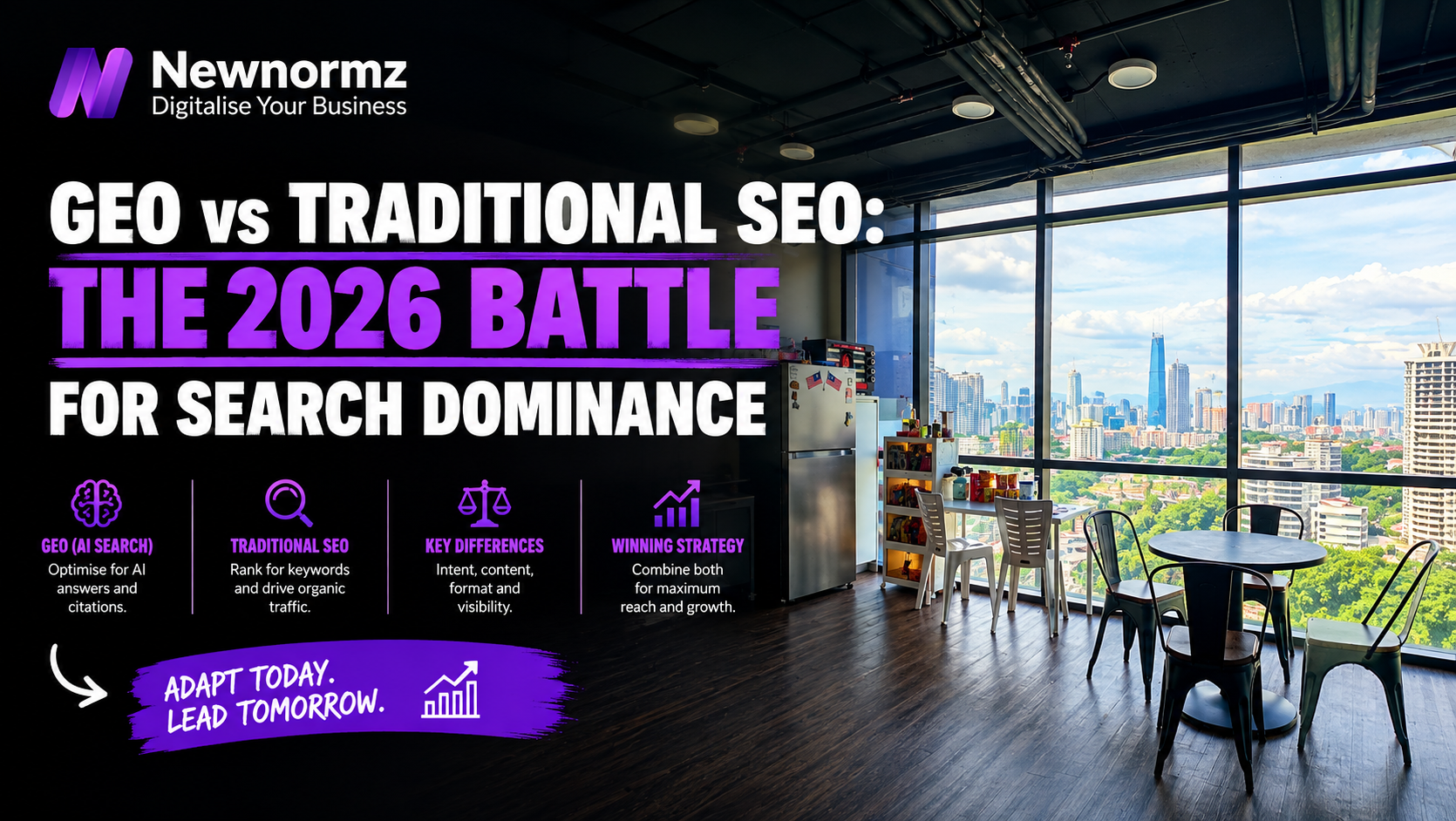
GEO (Generative Engine Optimisation) is not a replacement for traditional SEO. Traditional SEO gets your pages found and ranked in Google’s results. GEO gets your brand named and cited inside AI-written answers from tools like ChatGPT, Perplexity and Google’s AI summaries. The two share most of the same foundations: a fast, crawlable site, real expertise and credible mentions elsewhere on the web. Most Malaysian businesses should run both, starting with a solid SEO base and layering GEO on top. Nobody can guarantee a ranking or an AI citation, so be wary of anyone who does.
A Simple Way to Think About It
The Mall Directory and the Friend Who Knows
🗺️ The mall directory
A board at the entrance lists every shop in order. You still have to pick one and walk over yourself.
💬 The friend who knows
You ask where to go and they name one shop. You rarely check the board after that.
Both send customers your way, but they reward different things. The sections below show what each one looks for and how to prepare for both.
What Traditional SEO Still Does
Traditional SEO is about earning a position in Google’s list of results. Google crawls your pages, indexes them and ranks them using signals such as relevance, page experience and the quality of sites linking to you. The searcher sees a list and chooses.
This is still where most Malaysian search happens. Google holds roughly 93% of the local search market (Statcounter, May 2026), and Malaysia had 35.4M internet users at the end of 2025 (DataReportal Digital 2026 Malaysia). Traditional SEO also still produces results. Times Parking’s 6-month campaign delivered 528,000 impressions, 416 ranking keywords and 31.5K clicks. Oriental Kopi’s 2-year campaign produced 6.31M impressions and 468,000 clicks.
Our SEO service is built on exactly this work, and it is also the base that GEO depends on.
What GEO Adds
GEO focuses on being included in the answer itself. When someone asks an AI tool for the best clinic, agency or supplier, it pulls from sources it considers credible and writes one response. If your brand is not among those sources, you do not appear, however well your page ranks.
That changes what you optimise for. Instead of only asking “does this page rank?”, you also ask “would an AI tool trust this page enough to quote it?” In practice that means:
- Putting the direct answer at the top of the page, then the detail.
- Stating clear facts, definitions and real numbers that are easy to lift out.
- Showing who wrote the content and why they are qualified.
- Being mentioned consistently on other credible sites, directories and review platforms.
- Using structured data so machines can read your business details without guessing.
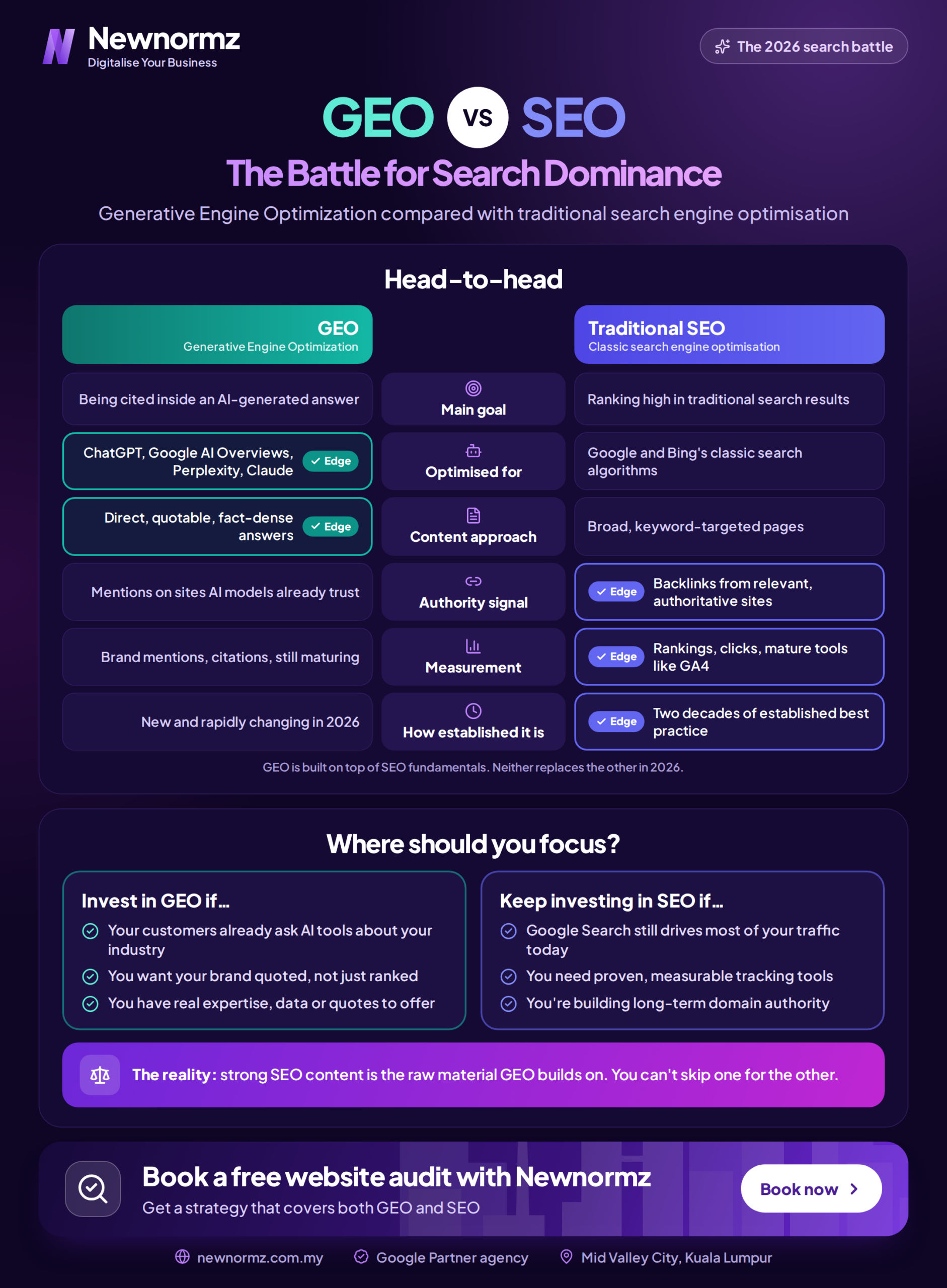
GEO vs Traditional SEO: The Practical Differences
| Factor | Traditional SEO | GEO |
|---|---|---|
| Goal | Rank a page in Google’s results | Be cited or recommended in AI answers |
| What the user sees | A list of links to choose from | One written answer, often with a few sources |
| Key signals | Keywords, backlinks, site speed, page experience | Clear answers, factual detail, authorship, mentions across the web |
| How you measure it | Rankings, impressions, clicks, conversions | Brand mentions, citations, referral visits, branded search |
| Time to see movement | Usually months | Varies, and is harder to predict |
Is AI Traffic Really Worth More?
One 2026 report from Opollo found AI-referred visitors converting at 14.2%, against 2.8% for Google organic. Treat that with care. It is a single source, the definitions of “conversion” differ between studies, and AI referrals are still a small share of most sites’ traffic. The likely reason for the gap is sensible, though: people who arrive after an AI tool has already recommended you are further along in their decision.
Gartner has also predicted that traditional search volume will fall 25% by the end of 2026 as people shift to AI assistants. Even if the real number lands differently, the direction is clear. Answers are increasingly given on the results page, and fewer people click through.
The sensible reading is not “abandon SEO”. Google is still where most of your traffic comes from today. The point is that being visible only as a blue link is becoming a narrower bet.
How the Two Work Together
AI tools do not invent their sources. Many of them draw on pages that already rank well and on sites the web already trusts. So a technically clean site, useful content and good backlinks help you in both places. Skip that foundation and GEO tactics have little to build on.
What GEO changes is the finish. Write pages that lead with a direct answer. Back claims with specifics. Keep your business name, address and details identical everywhere. Earn mentions on credible industry sites and review platforms. None of this hurts your Google rankings, which is why running both is cheaper than it sounds.
What This Means for Malaysian Businesses
Local and multilingual searches
Many Malaysians search in a mix of English, Bahasa Malaysia and Chinese, and often add a location such as Kuala Lumpur, Petaling Jaya or Penang. Accurate location details, a well-kept Google Business Profile and pages that reflect how your customers actually phrase things matter for both Google and AI tools. Our local SEO work covers this groundwork.
B2B and high-consideration services
If buyers research before they enquire, AI tools are likely already shaping your shortlist. Publish real case studies, clear pricing guidance and honest comparisons. Pages like these give an AI tool something specific to cite, and give a human buyer a reason to trust you.
A sensible order of work
- Fix the technical basics and make sure your key pages are indexed.
- Rewrite important pages so each opens with a direct answer.
- Tighten your business details and structured data.
- Build credible mentions beyond your own site.
- Test your brand in ChatGPT, Perplexity and Google’s AI summaries each month, and log what appears.
Frequently Asked Questions
Is GEO replacing SEO?
No. GEO builds on SEO. Google still sends the bulk of search traffic in Malaysia, and AI tools lean on the same signals of quality and trust. Think of GEO as an extension of good SEO, not a separate discipline.
Can traditional SEO alone get me cited by AI tools?
Sometimes, because ranking well helps. But it is not enough on its own. Pages that give a direct answer, state clear facts and come from a recognisable, well-mentioned brand are more likely to be quoted.
Can anyone guarantee AI citations?
No. AI tools change how they choose sources without notice, and answers can differ from one person to the next. Google has also said publicly that no one can guarantee a specific ranking position. Look for an agency that is honest about that and shows you how it will measure progress.
How do I check if my brand appears in AI answers?
Ask ChatGPT, Perplexity and Google’s AI summaries the questions your customers would ask, such as “best [your service] in Kuala Lumpur”. Note whether you are named, which competitors appear and which sources are cited. Repeat monthly to spot trends.
Is your brand showing up in Google and AI answers?
See where you stand in traditional search and AI search
Newnormz has run SEO campaigns across F&B, healthcare, ecommerce, and local services in Malaysia, backed by a performance guarantee of 70 percent of targeted keywords on Google’s first page.
30 minutes, no obligation, and we will check your AI visibility too.

Bryan Tan is an SEO Specialist and CEO at Newnormz, helping hundreds of businesses achieve first-page rankings on Google. With a passion for driving organic growth, Bryan blends innovative strategies with hands-on experience to optimize websites for maximum visibility. Always at the forefront of the latest SEO insights and trends, he consistently adapts to the evolving digital landscape.