Winning “near me” search in Kuala Lumpur doesn’t come from stuffing “near me” into your website. Google picks local results using three things it has publicly named: relevance, distance, and prominence. You can’t change how far a searcher is standing from your shop. You can control the other two: a complete and active Google Business Profile, consistent business details across the web, pages built for the KL districts you actually serve, a steady flow of genuine reviews, and a mobile site that loads fast enough for someone standing on the street. Get those right and you show up more often for the people nearest you. Nobody can promise you a fixed spot in the map pack, and anyone who does is guessing.
A Simple Way to Think About It
Two Stalls on the Same Lane
🚪 The stall with the shutter half down
The best nasi lemak on the lane, but the shutter is half down and there’s no signboard. People walking past assume it’s closed and keep going.
🏮 The stall the whole lane points to
Shutter up, sign lit, and every neighbour tells anyone who asks to go there. Nobody needs convincing.
Google acts a lot like those neighbours. The sections below cover what it looks at before it sends someone your way.
How Google Decides Who Shows Up for “Near Me” in KL
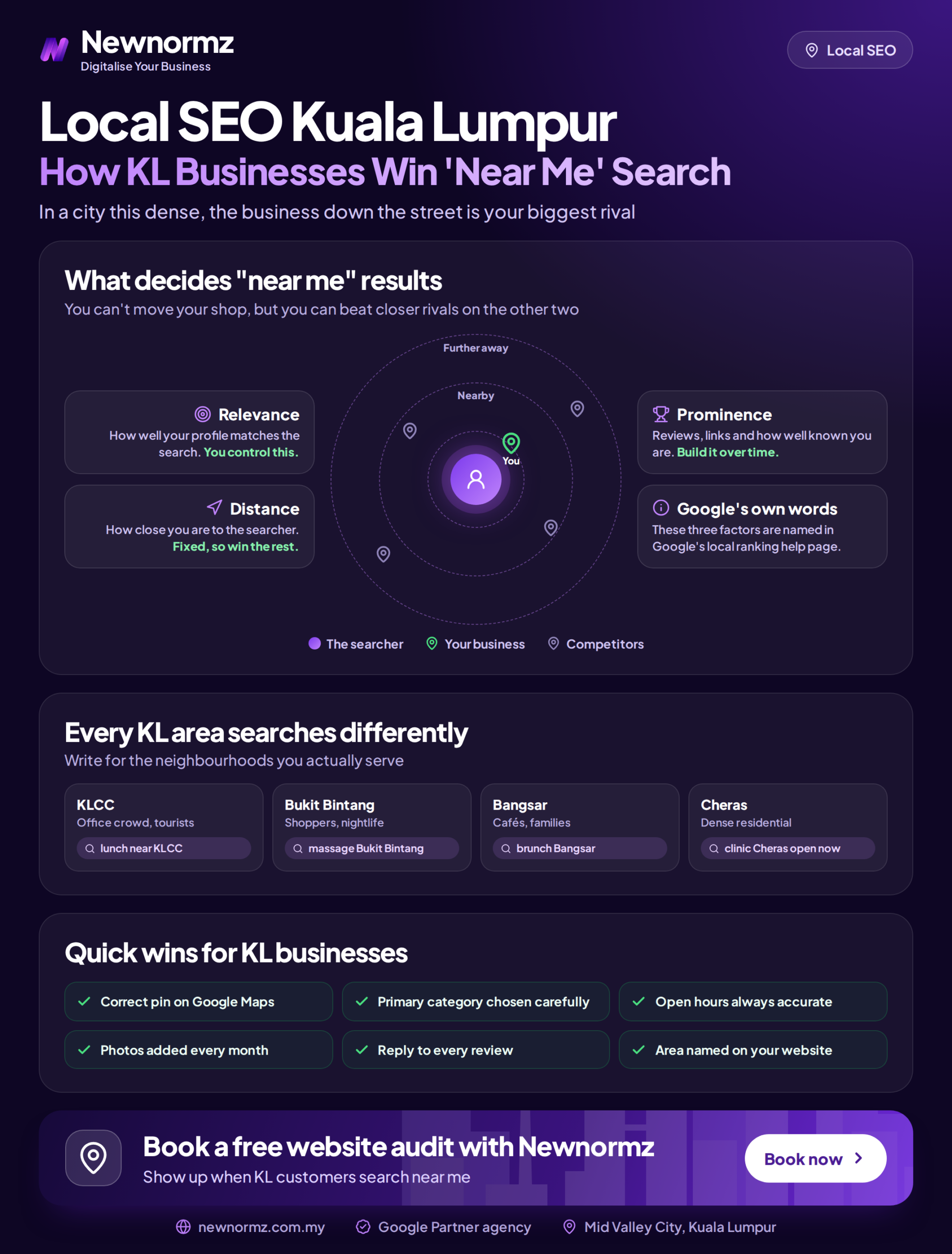
Google has said publicly that local results come down to three factors. Most KL businesses put their effort into the wrong one, so it’s worth knowing which parts you can actually change.
| Factor | What Google is asking | How much you control it |
|---|---|---|
| Relevance | Does this business actually offer what the person searched for? | High. Categories, services, page content, and how you describe your business. |
| Distance | How close is the business to the searcher, or to the location named in the search? | Almost none. Your address is your address. |
| Prominence | How well known and trusted is this business, online and off? | Medium to high. Reviews, citations, links, and overall website strength all build it over time. |
So when you hear “rank for near me,” what it really means is this: be the most relevant and most trusted option within the radius Google is already looking at. A dental clinic in Bangsar won’t outrank a clinic in Cheras for someone searching from Cheras, and it shouldn’t. It can win Bangsar, Bukit Bandaraya, and the people searching “dental clinic Bangsar” from anywhere in the Klang Valley.
What “Near Me” Search Looks Like in Kuala Lumpur
Malaysia had 35.4 million internet users at the end of 2025, about 98 percent of the population (DataReportal, Digital 2026 Malaysia). Google handles roughly 93 percent of Malaysian searches (Statcounter, May 2026). When someone in KL needs a plumber, a clinic, or somewhere to eat, they’re almost certainly asking Google, and usually on their phone.
A few things make KL different from a generic “local SEO” guide written for the US:
- Searches are multilingual. The same person might type “dentist near me” one day and “klinik gigi berdekatan” the next. Chinese-speaking customers often search in Chinese. If your profile and pages only speak one language, you’re missing part of the demand.
- Districts behave like separate markets. KLCC, Bangsar, Mont Kiara, Damansara Heights, Cheras, and Ampang each have different competitors, different customers, and different search volume. A strategy that treats “Kuala Lumpur” as one big area will lose to competitors who go district by district.
- Intent is high. Someone searching “aircon service near me” at 9pm isn’t researching. They want to call someone. The business that shows up with a phone number, good reviews, and opening hours that match gets the call.
The Four Things That Actually Move KL Map Rankings
Local SEO has plenty of small tweaks, but four areas do most of the work. If a KL business isn’t showing up in the map pack, the cause is almost always in one of these.
1. Your Google Business Profile
For most local searches, your Google Business Profile is the first thing a customer sees, before they ever reach your website. The most common problems we find in KL audits are basic ones: the wrong primary category, missing services, old photos, opening hours that don’t match reality, and a profile nobody has touched in a year.
Your primary category matters more than almost anything else on the profile. “Restaurant” and “Malaysian restaurant” are not the same signal. After that, fill in every field that applies, add real photos regularly, list your services in plain words that match how customers search, and post updates so the profile looks like a business that’s actually open.
2. Consistent Business Details Everywhere
Google cross-checks your business name, address, and phone number (often called NAP) across the web. If your Google profile says “Level 3” but an old directory still lists the office you moved out of in 2022, and Facebook shows a different phone number, Google gets less sure about which version is true.
KL businesses run into this a lot because they move offices, switch phone lines, or write their name differently on different platforms. The fix isn’t exciting: pick one exact version of your details, then find and correct every listing that doesn’t match, including duplicate listings you may not know exist.
3. Pages Built for the Districts You Actually Serve
One “Our Services” page can’t rank for “accounting firm KLCC,” “accounting firm Bangsar,” and “accounting firm Cheras” all at once. If you genuinely serve several districts, each one deserves a page that says something specific about it: who you serve there, how to reach you, relevant examples, and a clear way to get in touch.
The trap is making ten copies of the same page and swapping the district name. Google spots that, and so do customers. Only build pages for areas where you have something real to say.
4. Reviews, Asked For and Answered
Reviews affect both rankings and whether people choose you once they see you. A clinic with 40 recent reviews and thoughtful replies looks very different from one with 6 reviews from 2023.
Most businesses don’t lack happy customers. They lack a habit of asking. Build the request into your process at the moment the customer is most satisfied: after a successful treatment, a finished job, a good meal. Reply to every review, including the negative ones, calmly and specifically. Don’t buy reviews or offer rewards for them. Google’s policies prohibit both, and the risk isn’t worth it.
Mobile Speed: Where Local Traffic Quietly Leaks
Most “near me” searches happen on a phone, often on mobile data, often while the person is already on the move. Google also judges your site mainly by its mobile version. A slow mobile site hurts you twice: it weakens your rankings, and the visitors who do arrive give up before they call.
Usual causes are huge uncompressed images, cheap hosting, bloated themes, and layouts that jump around while loading so people tap the wrong button. Check your key pages on an actual phone, not just your office Wi-Fi. Make the phone number, WhatsApp button, and directions one tap away. For a local business, a fast page that gets someone to call beats a beautiful page that takes six seconds to load.
What Local SEO Can’t Do (and What to Do About It)
Being straight about the limits saves you money:
- It can’t beat distance. If your competitor is 200 metres from the searcher and you’re 5 kilometres away, they have an advantage no optimisation will fully remove.
- It can’t guarantee a position. Google has said many times that nobody can guarantee a specific ranking. Map pack results also change based on where the searcher is standing.
- It isn’t instant. Profile fixes can show movement within weeks. Prominence, meaning reviews, citations, and authority, builds over months.
If you need enquiries now while organic visibility builds, pairing local SEO with Google Ads is often the practical answer. One KL confinement centre we worked with ran on a RM2,550 monthly budget and got qualified leads within 30 days by combining the two. The ads brought in enquiries from day one, and the SEO work kept building in the background.
Where to Start If You Only Have a Week
If your local visibility is weak and you don’t know where to begin, work in this order. Each step makes the next one count for more.
- Fix your Google Business Profile: primary category, services, hours, photos, and a correct phone number.
- Write down your exact business name, address, and phone number, then correct the listings that don’t match, starting with the biggest platforms.
- Test your homepage and main service page on a phone using mobile data. Fix anything slow or hard to tap.
- Start asking every satisfied customer for a review, and reply to the ones you already have.
- Only then decide whether district pages make sense for your business.
Frequently Asked Questions About Local SEO in Kuala Lumpur
How long does local SEO in KL take to work?
Profile and citation fixes often show early movement in Google Maps within 4 to 8 weeks. Competitive categories in busy districts like KLCC or Bangsar take longer, because prominence (reviews, authority, links) builds over months, not weeks.
Do I need a physical address in Kuala Lumpur to rank locally?
A verified address in KL helps a lot for Maps visibility. If you’re a service-area business, such as a contractor or mobile service that visits customers, you can hide your address and set service areas instead, then lean more on your website and reviews.
Can I use a virtual office address to rank in a better district?
Google’s guidelines don’t allow listing an address you don’t actually operate from, such as a virtual office or mailbox. Listings like that can be suspended, which is far worse than ranking a little lower from your real location.
What’s the difference between local SEO and regular SEO?
Local SEO targets searches with location intent: the map pack, “near me” searches, and district-level keywords. Regular SEO targets broader organic rankings where location doesn’t matter much. Most KL businesses with a physical presence need both, with local taking priority.
Should my Google Business Profile be in English, Bahasa Malaysia, or Chinese?
Write it in the language most of your customers use, and mention your other languages naturally in your description and services. If many of your customers search in Bahasa Malaysia or Chinese, your website should have content in those languages too.
Does Newnormz work with businesses outside Kuala Lumpur?
Yes. We run local SEO campaigns across Malaysia, including Selangor, Penang, and Johor Bahru. The approach is the same: work out how customers in that specific area search, then fix whatever is stopping Google from showing you to them.
Not showing up when KL customers search nearby?
Find out exactly what’s keeping your business out of the map pack.
Newnormz has run SEO campaigns across F&B, healthcare, ecommerce, and local services in Malaysia, backed by a performance guarantee of 70 percent of targeted keywords on Google’s first page.
30 minutes, no obligation, with a clear look at your Google Business Profile, citations, and mobile speed.

Bryan Tan is an SEO Specialist and CEO at Newnormz, helping hundreds of businesses achieve first-page rankings on Google. With a passion for driving organic growth, Bryan blends innovative strategies with hands-on experience to optimize websites for maximum visibility. Always at the forefront of the latest SEO insights and trends, he consistently adapts to the evolving digital landscape.