Koray Tugberk Gübür’s topical authority methodology comes down to one idea. Google trusts a site that covers a subject completely, in a logical order, for a long time, more than a site that publishes scattered posts on whatever keyword looks easy this month. His shorthand is “Topical Authority = Topical Coverage + Historical Data.” In practice that means three things: you decide exactly what your site is about, you map every question a searcher could have on that subject, and you publish and interlink those answers consistently until Google has enough history to trust you. It works, and it can reduce how much you depend on backlinks. It is also slow, it takes planning, and a lot of its vocabulary is Koray’s own model of how search engines work, not official Google terms. Treat it as a very good framework, not a guarantee.
A Simple Way to Think About It
Two Bookshops on the Same Street
📚 One Book on Everything
The first shop stocks one book on every subject under the sun. Ask the owner for the next book in the series and they just shrug.
🏛️ Every Book on One Thing
The second shop only sells books about cooking, but it has all of them. Whatever you ask next, the owner is already walking you to the right shelf.
Koray’s methodology is basically a system for becoming the second shop. The sections below break it down piece by piece.
Who Koray Tugberk Is, and Why SEOs Keep Quoting Him
Koray Tugberk Gübür is a Turkish SEO and the founder of Holistic SEO & Digital. Over the last several years he has become the best-known voice for what the industry calls semantic SEO: the idea that search engines rank sites by how well they understand the topics and entities on them, not just by counting keywords and links.
He has published case studies of sites that grew organic traffic with very little link building, and he teaches his approach through a paid course and a very active presence on LinkedIn and X. That is why his name keeps coming up whenever SEOs argue about whether content or links matter more.
You don’t need to buy the course to understand the core of it. The principles are simple. The execution is what takes work.
The Core Formula: Coverage Plus History
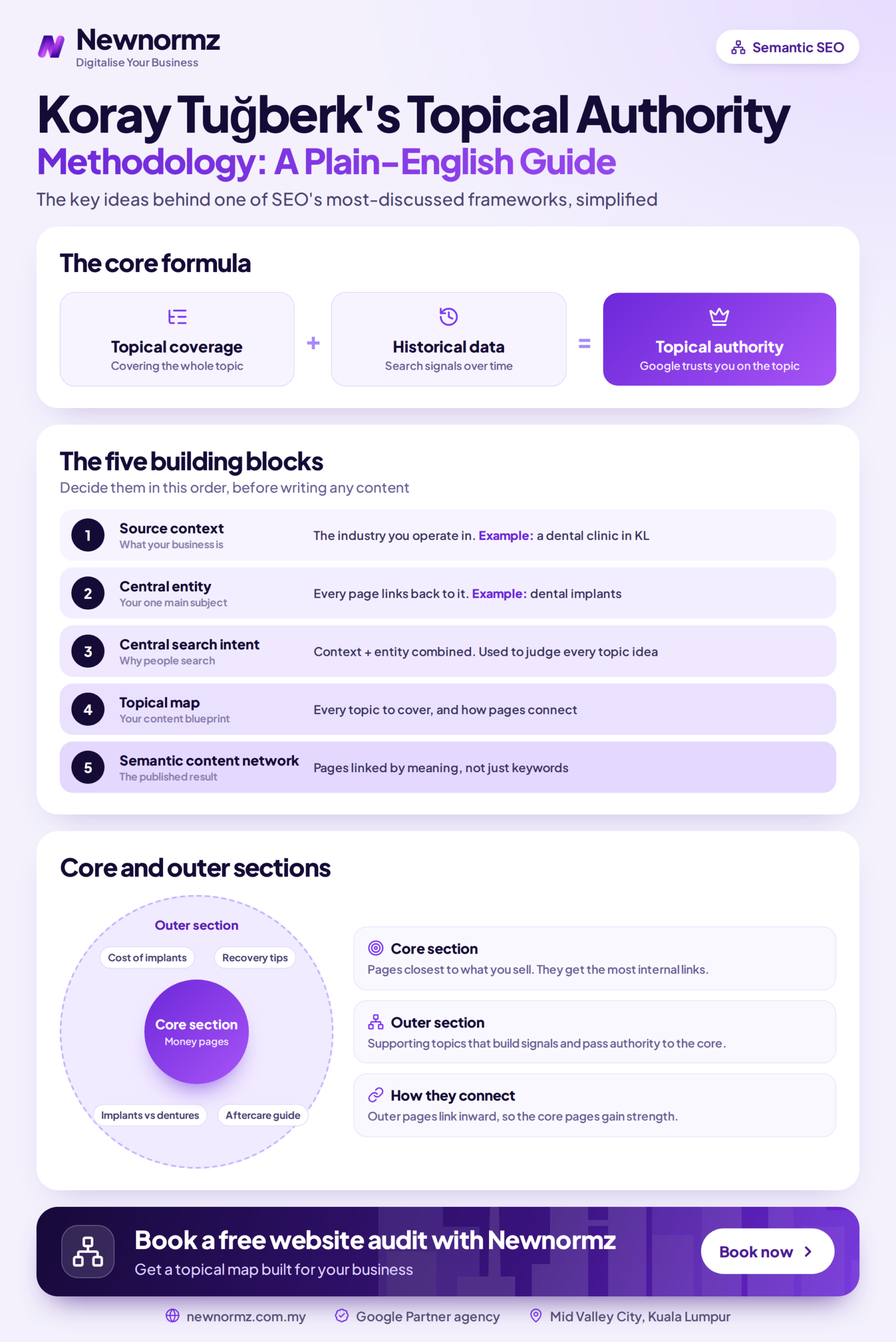
Koray sums up topical authority as Topical Coverage + Historical Data. Both halves matter, and most sites only ever work on one.
Topical coverage is how completely your site answers the questions people have about your subject. Not ten posts on your best keyword. Every meaningful sub-question, comparison, definition, cost question and “what happens if” question, each answered properly.
Historical data is the track record Google builds up about your site over time: which of your pages people click, whether they come back to Google unsatisfied, how often you publish, whether you keep content updated. You can’t fake this part. You can only earn it by showing up consistently.
The practical takeaway: a site that publishes 60 well-planned articles on one subject over a year will usually beat a site that dumps 60 random articles in a month and then goes quiet. Same volume, very different signal.
The Building Blocks, Translated
A lot of people bounce off Koray’s material because of the vocabulary. Here are the terms you’ll actually need, in plain English.
| Term | Plain-English Meaning | What It Means for Your Site |
|---|---|---|
| Source context | Who you are and why you are qualified to talk about this subject | A clinic, a retailer and a review blog should write about the same topic from different angles |
| Central entity | The main “thing” your whole site is about | Every page should connect back to it somehow |
| Central search intent | The main job a visitor wants done when they find you | Book, buy, compare or learn: pick the one that fits your business model |
| Topical map | A planned list of every page your site needs to cover the subject fully | You write from a plan instead of chasing whatever keyword tool shows this week |
| Core section vs outer section | Core pages are directly tied to what you sell. Outer pages cover related, broader questions | Build the core first, then widen outward to show depth |
| Semantic content network | Your pages linked together in a way that mirrors how the topics relate in real life | Internal links are planned with purpose, not sprinkled at random |
| Contextual flow | Each page answers its main question first, then moves logically to related ones | No 300-word intros before the actual answer |
| Cost of retrieval | How much effort it takes a search engine to crawl, understand and trust your content | Clear structure, fast pages and direct answers make you cheaper to rank |
How the Method Works, Step by Step
1. Define your source context before you write anything
Start with who you are, not with a keyword list. A Petaling Jaya physiotherapy clinic and a sports supplement shop could both write about knee pain. They should not write the same articles. The clinic’s angle is diagnosis and treatment. The shop’s angle is recovery and nutrition. Getting this wrong is how sites end up with content that ranks for nothing because it sounds like it could have come from anyone.
2. Build the topical map
List the central entity, then every attribute, sub-topic and question attached to it. For the physio clinic: conditions, causes, treatments, recovery timelines, costs, comparisons with alternatives, when to see a doctor instead. Use Google’s “People also ask” boxes, autocomplete and your own customer questions. Your front-desk staff usually know the real questions better than any keyword tool.
3. Write the core section first
Publish the pages closest to what you actually sell before you branch out. This tells Google early on what the site is fundamentally about. Outer content (broader, more informational topics) comes later and strengthens the core rather than diluting it.
4. Link pages the way the topics actually relate
A page about knee ligament injuries should link to the page about ligament surgery recovery, because that is the next question a reader has. Linking it to your page about office ergonomics just because both exist is noise. Anchor text should describe exactly what the linked page covers.
5. Publish consistently, then keep updating
Koray puts a lot of weight on publishing momentum. A steady rhythm gives Google a pattern to learn from. Going back to refresh older pages with better answers is part of the job too, not an afterthought.
6. Let historical data accumulate
This is the part nobody likes. Once the coverage is there, you still have to wait while Google gathers enough evidence that searchers are satisfied with your pages. Months, not weeks.
What Google Has Actually Confirmed (and What It Hasn’t)
Here is where a bit of honesty helps. Google has publicly described a “topic authority” system, announced in May 2023, that helps it surface expert sources in news results for specific subject areas. Its public guidance on helpful content also keeps stressing first-hand expertise and content written for people rather than for search engines. Both line up well with Koray’s thinking.
But terms like “source context,” “cost of retrieval” and “semantic content network” are Koray’s vocabulary. They come from his reading of Google patents, research papers and his own testing. They’re useful mental models. They are not settings inside Google that anyone can see or confirm.
That doesn’t make the method wrong. It means you should judge it by results on your own site, not by how scientific the terminology sounds.
Applying It to a Malaysian Website
With Google holding roughly 93% of Malaysian search share (Statcounter, May 2026), building authority there is where the traffic is. A few things change when you apply this framework locally.
Your topical map is multilingual. Malaysians search the same need in English, Bahasa Malaysia and Chinese, and often mix them in one query. “Physio near me,” “fisioterapi lutut” and Chinese-language searches for knee physiotherapy are the same topic with different searchers. A complete map decides deliberately which languages you’ll cover, rather than ignoring two-thirds of the market by default.
Local entities belong in the map. Neighbourhoods, landmarks, local regulations, local price ranges in RM, local holidays that affect demand. These are attributes of your topic that a generic overseas article will never cover, which is exactly why they’re your opening. If you serve customers in a specific area, pair this with proper local SEO so your Google Business Profile and your content point the same way.
Breadth compounds over time. Our Oriental Kopi campaign ran for two years and gained 24,500 more ranking keywords, 6.31M impressions and 468,000 clicks. That kind of keyword breadth doesn’t come from one viral post. It comes from covering a subject properly and staying consistent long enough for Google to build a history with the site, which is the coverage-plus-history pattern in action.
Where People Get It Wrong
| Mistake | What Happens | Better Approach |
|---|---|---|
| Mass-producing AI articles to “cover the map” fast | Lots of thin, near-identical pages that add nothing new | Use AI for drafting help if you like, but every page needs real expertise and a clear reason to exist |
| Skipping source context | Content sounds generic and competes with every other generic site | Write from your business’s actual position and experience |
| Expanding into unrelated topics too early | Google gets mixed signals about what the site is for | Finish the core section before widening out |
| Publishing in bursts, then going silent | No steady pattern for historical data to build on | Pick a rhythm you can sustain for a year, even if it’s modest |
| Treating it as a replacement for all technical SEO and links | Great content sitting on a slow, poorly crawled site in a competitive niche | Topical authority is one pillar. Site health and reputation still matter |
The Honest Limits
This methodology is among the most useful frameworks in SEO right now, but go in with realistic expectations.
It’s slow. The historical-data half of the formula only comes with time. If you need leads next month, content alone won’t get you there. That is a job for paid search running alongside it.
It’s a real investment. A proper topical map for even a narrow niche can mean dozens of well-researched pages. Someone has to plan them, write them with genuine expertise, and keep them updated. Cutting corners on quality undoes the whole point.
It doesn’t guarantee positions. Google has repeatedly and publicly stated that no one can guarantee a specific ranking. Anyone selling topical authority as a guaranteed path to number one is overselling it. What it does is make your site a more logical, trustworthy candidate for the rankings you’re competing for.
If you’d rather not build and run the map yourself, that planning and execution is the core of what a good SEO agency in Malaysia should be doing for you.
Frequently Asked Questions
Do I still need backlinks if I build topical authority?
In low-competition niches, strong topical coverage can carry a site a long way with few links. In competitive ones, links and brand mentions still help. Think of topical authority as reducing how many links you need, not removing the need entirely.
How many articles does a topical map need?
There’s no magic number. A narrow local service might be well covered with a few dozen pages. A broad subject could need hundreds. The map is finished when every meaningful question your audience asks has a clear, dedicated answer.
How long before I see results?
Expect early movement on less competitive long-tail queries within a few months and more meaningful growth over six to twelve months of consistent publishing. Our Sunway Medispa campaign saw a 700% traffic increase in six months, but results depend heavily on your niche, competition and starting point.
Is this only worth it for big websites?
No. Small businesses often benefit most, because a tightly focused site can cover a narrow topic more completely than a large, generalist competitor ever bothers to.
Do I need to take Koray’s course to use this?
Not to understand the principles. The course goes deeper into his specific frameworks, but the fundamentals (define what you are, map the topic fully, publish in a logical order, link with purpose, stay consistent) can be applied by any business willing to put in the work.
Does Google See Your Site as an Authority Yet?
Find Out Where Your Topical Coverage Has Gaps
Newnormz has run SEO campaigns across F&B, healthcare, ecommerce, and local services in Malaysia, backed by a performance guarantee of 70 percent of targeted keywords on Google’s first page.
30 minutes, no obligation, and you’ll leave knowing which topics your site still needs to cover.

Bryan Tan is an SEO Specialist and CEO at Newnormz, helping hundreds of businesses achieve first-page rankings on Google. With a passion for driving organic growth, Bryan blends innovative strategies with hands-on experience to optimize websites for maximum visibility. Always at the forefront of the latest SEO insights and trends, he consistently adapts to the evolving digital landscape.