If you ask for a LinkedIn ads cost Malaysia rate card, the honest answer is that there isn’t one. You bid in an auction. What you pay depends on how big your audience is, how many other advertisers want the same job titles, your objective, your bid strategy and how good your creative is. LinkedIn clicks usually cost more than Facebook clicks, but cost per click is the wrong number to judge. For B2B, the number that matters is cost per qualified lead: what you paid for each enquiry your sales team agrees is worth a call. By the end of this guide you will be able to build your own test budget and work out whether LinkedIn can pay back for your business.
How LinkedIn Ads Cost in Malaysia Is Actually Charged
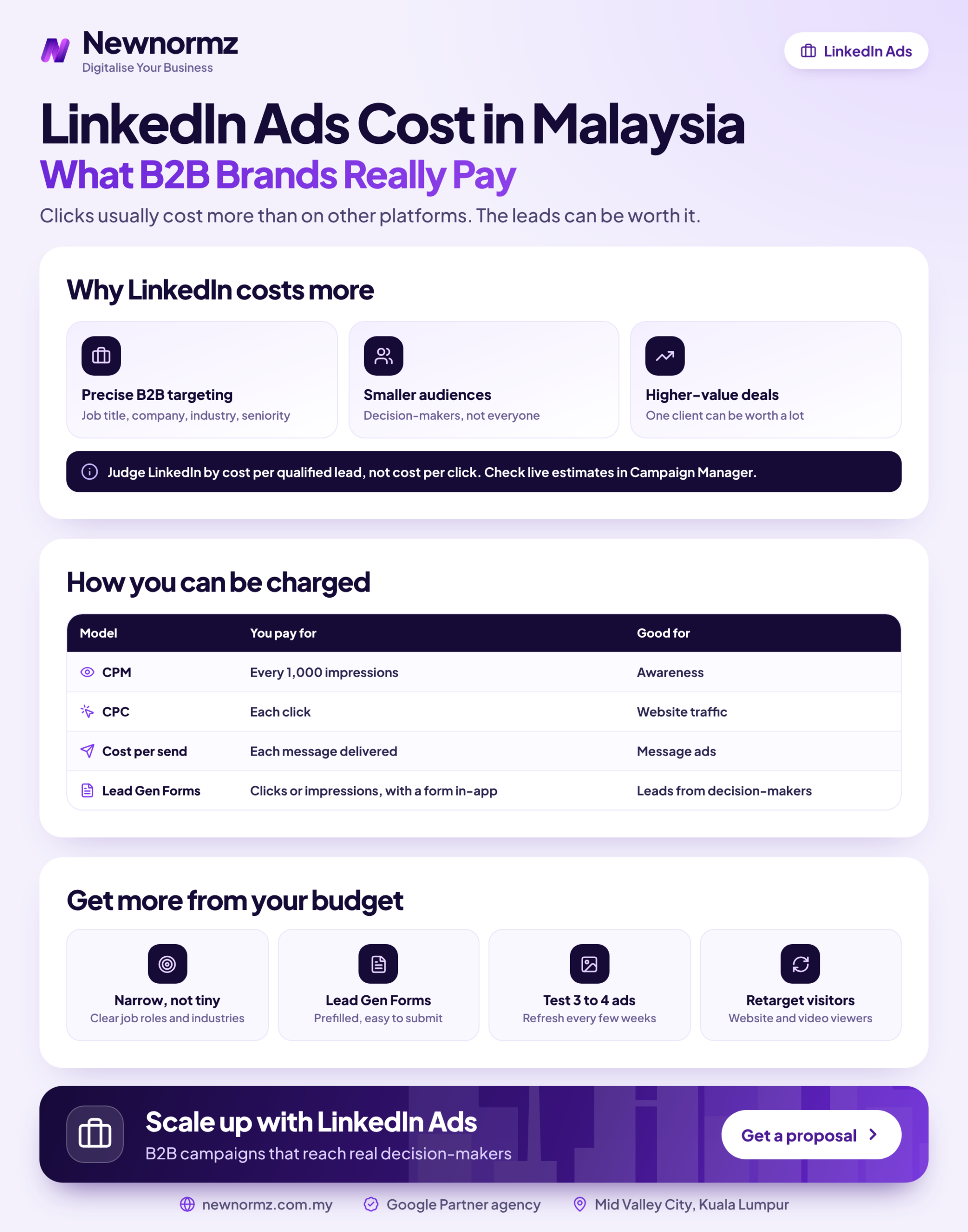
Everything runs through LinkedIn Campaign Manager. The billing model you can pick depends on your objective and ad format. Most B2B advertisers choose between two. CPM means you pay for every 1,000 times your ad is shown. CPC means you pay only when someone clicks. LinkedIn doesn’t set your advertising cost per click as a fixed fee. It comes out of your bid, your audience and how often people click.
| Billing model | What you pay for | Best used for | Watch-out |
|---|---|---|---|
| CPM (cost per 1,000 impressions) | Every time the ad is shown in the feed | Awareness among a defined account list, and creative you expect to earn a strong click rate | Weak creative still costs money even when nobody clicks |
| CPC (cost per click) | Clicks to your site or form opens | Website Visits and Lead Generation objectives while you are still learning | Looks expensive per click, so people cut budget before seeing lead quality |
| Cost per send | Each Conversation Ad delivered to a LinkedIn inbox | Event invitations, demos and offers to warm, retargeted audiences | Cold sends to strangers read as spam and burn goodwill |
| Cost per video view | Video plays past LinkedIn’s view threshold | Building a retargeting pool of people who watched your explainer | Views are not leads. Treat this as the top of a funnel, not the result |
On LinkedIn CPC vs CPM, start a first test on CPC through the Lead Generation or Website Visits objective. You pay for intent, not exposure. Move to CPM once your click rate is consistently healthy, because a strong ad on CPM can bring the effective cost per click down. LinkedIn Sponsored Content cost (single image, video and document ads in the feed) follows the same auction rules whichever model you choose.
LinkedIn does set a minimum daily and lifetime budget per campaign. That figure can change, so check the amount shown when you set up a campaign in Campaign Manager, or on LinkedIn’s official help page for campaign budgets, rather than relying on a number quoted in a blog.
Six Things That Decide What You Pay per Lead on LinkedIn
You can’t set the auction price, but you control these six levers. Between them, they decide most of the gap between a RM100 lead and a RM1,000 one.
Who You Target: Job Titles, Seniority and Company Size
LinkedIn targeting is the reason the platform exists for B2B: job title, function, seniority, company size, industry and named companies. The catch is that the most valuable people, such as finance directors, IT heads and procurement managers, are the ones every B2B advertiser in the region is bidding on. More bidders for the same people means a higher price per impression.
The decision rule is to keep your Malaysia audience large enough to deliver. Before launch, check the audience size estimate in Campaign Manager. If stacking job title, seniority and industry has left you with a tiny pool, target by function plus seniority instead of exact titles. For more on finding the right people, see our guide to reaching decision-makers on LinkedIn.
Malaysia-Only vs Regional Targeting
Most LinkedIn ads Malaysia campaigns start with a Malaysia-only audience of senior people in one industry, and that audience is often small. Small audiences see the same ads over and over, so performance drops within weeks and the cost per lead climbs. In our experience, this is the most common reason a LinkedIn test that started well looks bad by week four.
Malaysia note
Add Singapore only if you can actually serve and sell to Singapore buyers. It widens the pool, but Singapore audiences tend to be bid on more heavily, so the average price can rise. Run it as a separate campaign so you can see each market’s cost per qualified lead on its own, instead of letting a blended number hide which one is working.
Your Objective and Bid Strategy
Campaign Manager offers three main bid strategies. Maximum delivery lets LinkedIn spend your budget to get the most results, which is simple but gives you no control over price. Cost cap tells LinkedIn the average cost per result you are willing to pay. Manual bidding sets your maximum bid per click or impression. LinkedIn’s suggested bid is a starting point, not the price. Treat it as a range to test against, not a quote.
Two settings are switched on by default and deserve attention. Audience Expansion shows your ads to people LinkedIn thinks are similar to your target. The LinkedIn Audience Network places your ads on third-party apps and sites outside LinkedIn. Both make delivery cheaper, and both usually weaken lead quality. Switch both off for a first B2B test, so the result tells you how your real audience responds.
Ad Format: Sponsored Content, Document Ads, Thought Leader Ads and Conversation Ads
Single image ads are the easiest to produce and the easiest to scroll past. Document ads let people read a guide or checklist inside the feed, and you can ask for contact details before the full download, which makes them strong lead magnets. Video works well for products that need explaining. Conversation Ads land in the inbox, so save them for audiences who already know you.
Thought Leader Ads let you promote a post from your founder or an employee’s personal profile. They look like a normal post from a person, not a brand, and in B2B a respected founder’s opinion often earns more attention than a company logo. If you are deciding what to post in the first place, our comparison of which LinkedIn formats earn engagement is a useful starting point.
Creative Quality and Ad Fatigue
Frequency is the average number of times each person has seen your ad. CTR (click-through rate) is the share of people who clicked after seeing it. When frequency climbs and CTR falls week after week, your audience is tired of the ad, and you are paying more for each result. On small Malaysian B2B audiences this happens faster than most advertisers expect. Plan new creative every three to four weeks, or sooner if CTR drops sharply.
Lead Gen Forms vs Landing Pages
LinkedIn Lead Gen Forms fill in name, email, job title and company from the user’s profile. That makes completing the form very easy, which lowers your cost per lead and also lets in more people who are only half-interested. A landing page asks for more effort, so you get fewer leads, but they are usually more motivated.
To keep the low LinkedIn Lead Gen Forms cost per lead without the junk, add one or two qualifying questions, such as company size, timeline or budget range. You will get fewer leads but better ones. It’s the classic trap of chasing lead volume over lead quality. Because you are collecting personal data, make sure the form links to your privacy policy and uses clear consent wording in line with your PDPA obligations. Check the details with whoever handles compliance in your business.
Worked Example: A RM6,000 LinkedIn Ads Test for a Malaysian B2B Firm
The numbers below are a hypothetical example to show the maths. They are not market rates. Your CPM, CTR and conversion rates will differ by industry and audience. Picture an industrial equipment supplier spending RM6,000 over six weeks, targeting operations and procurement heads at Malaysian manufacturers. Next to it is an example “cheap” Meta lead campaign with the same budget.
| Funnel stage (example numbers) | LinkedIn example | Meta example |
|---|---|---|
| Budget | RM6,000 | RM6,000 |
| Example CPM, giving impressions | RM120, giving 50,000 | RM15, giving 400,000 |
| Example CTR, giving clicks (implied CPC) | 0.6%, giving 300 (RM20 each) | 1%, giving 4,000 (RM1.50 each) |
| Form completion, giving leads (cost per lead) | 10%, giving 30 (RM200) | 5%, giving 200 (RM30) |
| Qualified by sales (cost per qualified lead) | 50%, giving 15 (RM400) | 5%, giving 10 (RM600) |
| Opportunities (cost per opportunity) | 5 (RM1,200) | 2 (RM3,000) |
In this example, a LinkedIn click costs more than 13 times as much as a Meta click. Yet LinkedIn’s cost per qualified lead is a third lower, and its cost per opportunity is less than half. The difference comes from who saw the ad. Meta reached a huge, loosely matched audience. LinkedIn reached people whose job title matched the buyer. This is why high B2B CPCs are not the enemy.
To turn this into a LinkedIn ads budget for B2B that fits your own business, follow these steps:
Start from your deal value
Write down your average first-year deal value and your close rate from opportunity to signed customer. Use your CRM if you have one, or the sales team’s honest estimate if you don’t.
Work backwards to a target cost per opportunity
If you close 1 in 5 opportunities and a deal is worth RM30,000 (example), each opportunity is worth about RM6,000 in revenue. Decide how much of that you can afford to spend to win it.
Plug in your own funnel rates
Replace the example CPM, CTR and form rates with what Campaign Manager shows after the first two weeks. Recalculate weekly, not daily.
Apply the deal-value rule
If one closed deal is worth at least three times your test budget, the test is worth running, because a single win more than pays for the learning. If it would take ten deals just to break even, LinkedIn is probably not your first channel.
How Much Budget a First LinkedIn Campaign Needs to Learn Anything
The real LinkedIn ads minimum budget is not LinkedIn’s platform minimum. It’s the amount that produces enough leads for you to judge quality. Too little spend over too short a time just gives you noise. Use these rules:
So is LinkedIn advertising worth it? It is when your buyer can be described by job and company, your deal value is high, and you can afford a test long enough to learn from. If you are weighing the two channels, read our breakdown of LinkedIn ads against Google Ads for B2B.
Where Malaysian B2B Advertisers Waste LinkedIn Budget
✗ Audience Expansion and the Audience Network left on
Both are on by default. Your ads drift to people outside your target and to third-party sites, so cheap clicks pile up while qualified leads don’t.
✓ The fix
Switch both off for the first test. Turn Audience Expansion back on later as a separate, labelled campaign so you can compare lead quality side by side.
✗ No Insight Tag, no conversion tracking
Without the LinkedIn Insight Tag and conversion events, nobody can tell which website enquiries came from LinkedIn, and LinkedIn can’t optimise for them either.
✓ The fix
Install the Insight Tag, set up conversions for form submits and WhatsApp clicks, and add the Conversions API if your CRM or developer can support it. Then track every lead to pipeline. Our guide to measuring B2B ads by pipeline, not clicks covers the reporting side.
✗ Leads sit in a spreadsheet for days
A director who filled in a form on Tuesday has moved on by Friday. In Malaysia, B2B buyers often want to continue on WhatsApp or by phone, and a slow reply makes an expensive lead worthless.
✓ The fix
Sync Lead Gen Form leads to your CRM or email automatically, name one person to own the follow-up, and aim to call or WhatsApp within an hour. Sales Navigator helps your team research the person and company before that first call.
✗ One English ad for every segment
English is the default on LinkedIn, but some Malaysian decision-makers, such as Chinese-speaking business owners or GLC and public-sector buyers, may respond better to Chinese or Bahasa Malaysia messaging.
✓ The fix
Test a language variant written natively, not translated, for the segment where it fits, and compare cost per qualified lead against the English version.
From our audits
A pattern we see often in paid social audits: a LinkedIn campaign gets paused because the CPC “looked high”, while nobody checked what happened to the leads it produced. CPC tells you what attention costs. It says nothing about whether the right people paid attention. Judge LinkedIn on cost per qualified lead and pipeline, or you will switch off your best B2B channel for the wrong reason.
Getting More Pipeline From the Same LinkedIn Budget
Most of the results in LinkedIn marketing B2B campaigns come from setup and testing, not from bigger budgets. This checklist covers what we set up before scaling any account:
LinkedIn budget efficiency checklist
- ✓Insight Tag installed and conversions tracked, including WhatsApp clicks
- ✓Matched Audiences uploaded: a company list of target accounts, the base of any account based marketing LinkedIn campaign, plus website retargeting
- ✓Three to four creatives running per campaign, so you learn which message works
- ✓A Thought Leader Ad from the founder’s own post in the mix
- ✓Qualifying questions added to every Lead Gen Form
- ✓A named owner who follows up on every lead within an hour
- ✓Cost per qualified lead reviewed weekly with sales, not just CPC
None of this is difficult on its own. The work is in doing all of it at once and keeping it up week after week. At Newnormz we run LinkedIn alongside Google Ads and WhatsApp follow-up, so the same team can see which channel produced each enquiry, with strategists working in English, Bahasa Malaysia and Chinese. If you would rather hand that over, that is the work our social media marketing agency in Malaysia does, judged on enquiries, not views.
Comparing a LinkedIn ads agency Malaysia shortlist? See how we set up and test this checklist on your account.
LinkedIn Ads Cost: Frequently Asked Questions
How much does LinkedIn advertising cost in Malaysia per month?
There is no set monthly price. You decide the budget, and the auction decides what each click or impression costs. Work out your monthly figure from your target cost per qualified lead and how many qualified leads sales can handle, as in the worked example above.
What is the minimum budget for LinkedIn ads?
LinkedIn sets a minimum daily and lifetime budget per campaign, shown in Campaign Manager and on its official help page. The budget you actually need is higher: enough to produce enough leads over 4 to 6 weeks to judge their quality.
Why are LinkedIn ads more expensive than Facebook ads?
LinkedIn costs more per click because its audience is smaller and many B2B advertisers bid for the same senior professionals. You are paying for targeting by job title and company, which can make the cost per qualified lead lower even when the CPC is higher.
Should I pay per click or per impression on LinkedIn?
Start with pay per click for a first lead generation test, because you only pay when someone shows interest. Switch to CPM once your creative earns a consistently strong click rate, since that can lower your effective cost per click.
Are LinkedIn Lead Gen Forms worth the cost for B2B leads?
Yes, as long as you add qualifying questions and follow up fast. Pre-filled forms bring a lower cost per lead, but without qualifiers and a quick call, many of those leads go cold.
How long should a LinkedIn ads test run before I judge it?
Run it for at least 4 to 6 weeks. That gives delivery time to settle, lets you test more than one creative, and gives sales time to qualify leads. With long sales cycles, judge the first month on pipeline rather than closed deals.
Free LinkedIn ads review
Check your LinkedIn targeting and budget plan before you spend a ringgit
- ✓A review of your audience size, targeting and settings such as Audience Expansion
- ✓A test budget worked back from your deal value and target cost per qualified lead
- ✓A tracking and follow-up check, from the Insight Tag to WhatsApp (+60 17-588 2291)

Bryan Tan is an SEO Specialist and CEO at Newnormz, helping hundreds of businesses achieve first-page rankings on Google. With a passion for driving organic growth, Bryan blends innovative strategies with hands-on experience to optimize websites for maximum visibility. Always at the forefront of the latest SEO insights and trends, he consistently adapts to the evolving digital landscape.