A carousel post converts when the first slide stops the scroll with one bold promise, the next three or four slides deliver on that promise one idea at a time, a proof slide backs the claim with something real, and the final slide makes exactly one ask. Get that structure right, pair it with a caption and landing page that finish the job, and swipes and saves start turning into enquiries and sales instead of sitting there as vanity metrics.
A Simple Way to Think About It
A Poster on a Lamppost vs a Shop That Pulls You Through the Door
📌 The single poster
A nice photo pinned to a lamppost. People glance at it for half a second on their way somewhere else, no matter how good the photo is.
🚪 The guided walkthrough
A shop with one doorway leading to another, each one showing a little more, until the person is standing at the register wondering how they got there.
That is the difference between a single image post and a carousel built with intent, and the breakdown below shows exactly how to build the second one.
Why Carousels Beat Single Images and Reels on Conversion
Carousels convert because they buy attention in small pieces and the algorithm rewards that. Every swipe is a fresh interaction, so a multi-slide post keeps someone on screen longer than a single image ever could, and Instagram reads that extended viewing time as a signal to push the post to more feeds. A single image gets one glance. A carousel earns five to ten small decisions to keep going.
The numbers back this up. In a 10,000-post study, carousels averaged a 1.92 percent engagement rate against 1.74 percent for Reels and 1.22 percent for single images, and Socialinsider found that carousels generate 109 percent more engagement per person reached than Reels. That matters in Malaysia specifically, where Instagram reached roughly 15.5 million users in early 2025. Carousels are also the format people save and share, and saves are the closest thing to a buying signal a like can never give you: a save means someone intends to come back and act.
The Four-Part Anatomy of a Slide That Sells
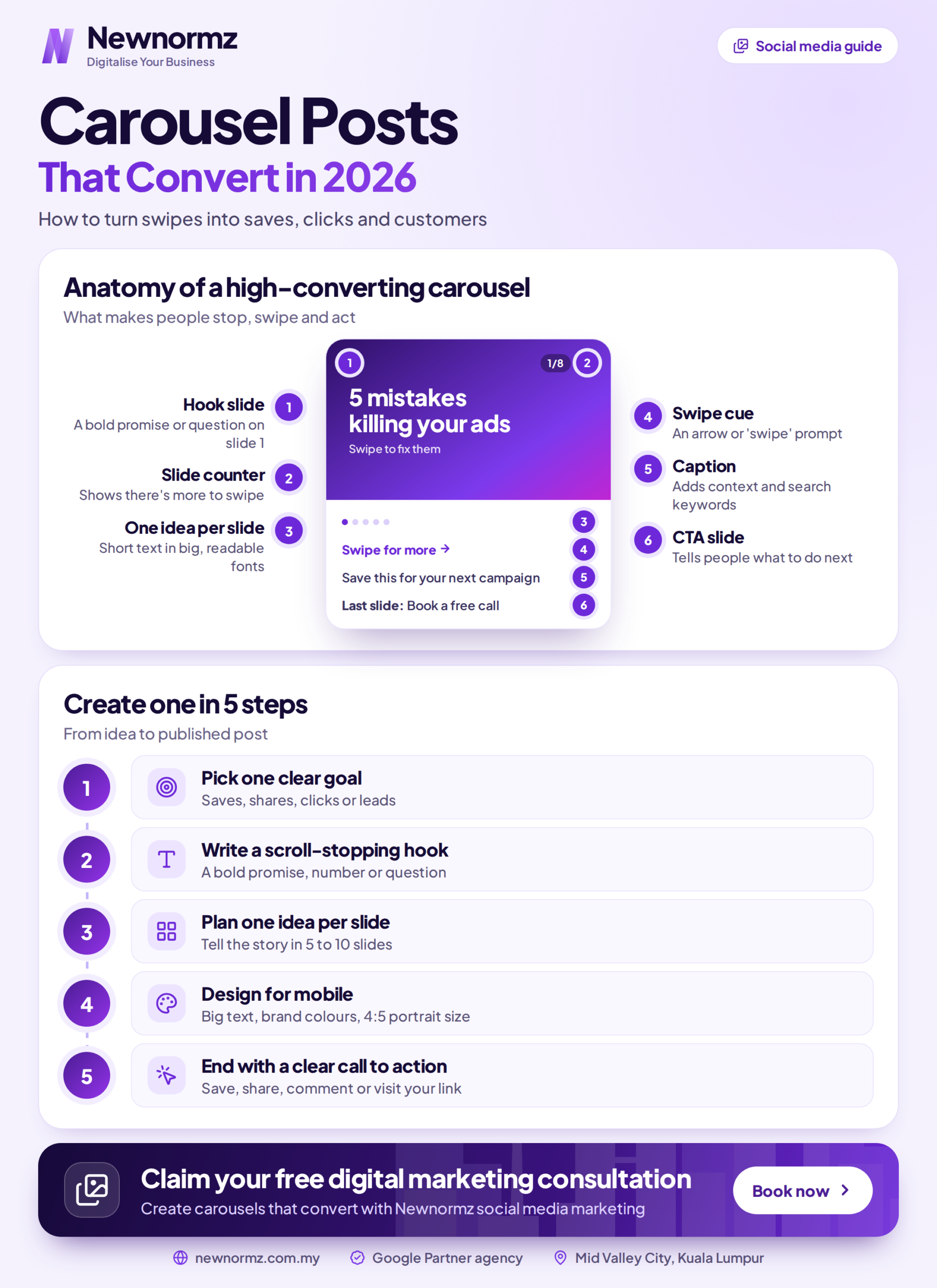
Every carousel that actually converts follows the same spine. Give each slide one job and do not let it drift.
Slide 1: the hook
Its only job is to stop the thumb. Lead with a bold claim, a number, a mistake, or a question your audience already feels. Big text, high contrast, one idea. If slide 1 does not land, nothing after it gets seen.
Slides 2 to 4: the value
Deliver on the promise, one point per slide, each one skimmable in under three seconds. End most slides with a visual cue that pulls the eye toward the next swipe.
The proof slide
This is where trust is won or lost. A real result, a testimonial, or a before and after does more work here than another claim. For a Malaysian audience, a real customer or an RM figure beats a vague promise every time.
The final slide: one ask
State it plainly: “Comment a keyword,” “Save this,” or “Link in bio.” A carousel with three competing calls to action converts worse than one with a single, obvious next step.
| Slide | Job | Rule of thumb |
|---|---|---|
| Slide 1 | Stop the scroll | One bold idea, huge text |
| Slides 2 to 4 | Deliver value | One point per slide |
| Slide 4 or 5 | Prove it | Real numbers or a name |
| Final slide | Call to action | One ask, stated plainly |
Design and Length Rules That Keep Thumbs Moving
Design for a thumb on a small screen. Use a 4:5 vertical ratio, 1080 by 1350 pixels, so the post claims more feed space. Stick to one font family and two brand colours across every slide, and make text readable without anyone needing to zoom in. Consistency is what keeps a swipe feeling smooth rather than jarring.
On length, eight to ten slides is the reliable sweet spot for educational and product carousels. A tighter five-slide post works well when you have one sharp idea and nothing to pad it with. Your caption is not decoration: open with a one-line hook that echoes slide 1, add a few short lines of value, and close with the exact same call to action as your final slide, so the message never splits into two different asks.
Timing helps too, though it is a starting point, not a rule. Mid-week mornings, roughly Tuesday to Wednesday between 8am and 11am, tend to suit save-heavy educational carousels, while late evenings tend to favour quick Reels. Check your own Instagram Insights before committing to a schedule.
Worked Example: A 5-Slide Carousel for a Malaysian Skincare Brand
Here is how the structure looks in practice, for a fictional Malaysian skincare brand, “Seri Glow,” selling an RM89 vitamin C serum.
Slide 1 (hook): “Why your RM200 skincare routine still is not working. Swipe.”
Slide 2 (value): “Mistake 1: you layer six products but skip the one that actually brightens, vitamin C.”
Slide 3 (value): “Mistake 2: you use it at night. Vitamin C works hardest in the morning, under sunscreen.”
Slide 4 (value plus proof): “Mistake 3: your serum is oxidised. Ours is fresh-batched, with 4,200 Malaysian customers and a 4.8-star rating.”
Slide 5 (CTA): “Fix all three in one step. Seri Glow Vitamin C Serum, RM89. Comment GLOW and we will send the link.”
Notice the discipline: slide 1 promises a payoff, slides 2 to 4 deliver three specific points, proof lands with a real number and a rating, and slide 5 makes exactly one ask. The caption repeats the hook and closes with the same “Comment GLOW” CTA, pointing to a landing page built to sell that single serum and nothing else.
Common Mistakes That Cost You Conversions
| Mistake | Fix |
|---|---|
| A vague or pretty slide 1 with no promise | Lead with a bold claim, number, mistake, or question |
| Cramming several points onto one slide | One idea per slide, skimmable in under three seconds |
| Ending with “hope this helps” or three different asks | One clear CTA on the last slide, matched in the caption |
| Mismatched fonts and colours across slides | One font family, two brand colours, every time |
| Sending saves and clicks to a slow or broken page | A fast, focused landing page with tracking in place |
Where Carousels Fit in Your Wider Funnel
A carousel is the top of the funnel, not the whole thing. It earns attention and intent; your website and tracking are what turn that into revenue. This matters more in Malaysia every year, with social commerce revenue forecast to approach one billion US dollars by 2028.
Map the path honestly: the carousel earns a save or a DM, the caption points to a link in bio, that link opens a fast landing page, and a form or WhatsApp button captures the lead. If that page is slow or cluttered, you leak everything the carousel just earned. Pairing consistent carousel content with stronger local SEO means the same Malaysian audience finds you in search as well as in their feed, and if the funnel is still leaking after a redesign, a proper SEO service audit will usually show you exactly where.
Frequently Asked Questions
How many slides should a carousel have?
Eight to ten slides is the reliable sweet spot for educational and product carousels, giving enough room to deliver value and earn saves. A tighter five-slide post works well for one focused idea. Instagram allows up to 20 slides, but only go that long if every slide earns its place.
Do carousels really outperform Reels for conversion?
For engagement and saves, yes. Carousels generate more engagement per person reached than Reels and hold the highest engagement rate of any format studied. Reels still win on raw reach and discovery, so the smart play is both: Reels to get found, carousels to convert and build authority.
What makes the first slide effective?
One bold idea, large high-contrast text, and a clear promise of payoff. Lead with a number, a common mistake, or a question your audience already feels, and avoid clutter or multiple messages. If slide 1 does not earn the first swipe, the rest of the carousel never gets seen.
What should the CTA slide actually say?
Make one ask, stated plainly, such as “Comment a keyword,” “Save this post,” “DM us,” or “Link in bio.” Repeat that same CTA in your caption. Competing calls to action split attention and lower conversions, so resist asking for three things at once.
How do carousels actually turn into sales?
The carousel earns attention and intent, then your funnel does the selling. The CTA drives a DM, save, or link click, the link opens a fast landing page, and a form or WhatsApp button captures the lead. Without a solid website and conversion tracking behind it, that engagement never becomes revenue.
Getting saves but not enquiries?
Let’s find out what’s stopping your carousel traffic from becoming customers
Newnormz has run SEO campaigns across F&B, healthcare, ecommerce, and local services in Malaysia, backed by a performance guarantee of 70 percent of targeted keywords on Google’s first page.
30 minutes, no obligation, just a clear look at where your funnel is leaking.

Bryan Tan is an SEO Specialist and CEO at Newnormz, helping hundreds of businesses achieve first-page rankings on Google. With a passion for driving organic growth, Bryan blends innovative strategies with hands-on experience to optimize websites for maximum visibility. Always at the forefront of the latest SEO insights and trends, he consistently adapts to the evolving digital landscape.