Malaysian advertisers operate inside intent-driven AI auctions rather than simple keyword matching. Google Ads Score Impacts Costs more directly than bid size alone, shaping cost per click, visibility, and long-term efficiency.
Two businesses competing for the same search query can face wildly different outcomes, even with similar budgets.
The reason usually comes down to quality score and how well campaigns align with user intent, page experience, and relevance signals.
As Google expands AI Overviews and Search Generative Experience (SGE) across Malaysia, ads with weak relevance now face a silent penalty that many SMEs only notice once budgets start draining faster.
Table of Contents
The Invisible Cost Pressure Facing Malaysian SMEs
Search auctions no longer reward aggressive bidding alone. Quality score now acts as a financial lever inside the ad auction.
Two advertisers bidding on “best insurance Malaysia” may sit side by side in the search network, yet one pays RM3 per click while the other pays RM12. The gap appears through differences in quality score, ad relevance, and historical performance.
Google’s newer models place heavier weight on ads quality signals. Campaigns that rely on generic copy or poorly matched landing pages face an AI premium that raises cost per click without improving ad placement.
This dynamic explains why strong Google Ads campaigns increasingly focus on relevance rather than scale.
The Anatomy of a High-Score Ad in the AI Era

Quality score still rests on three familiar pillars, though each has evolved.
1. Expected CTR
Click-through behaviour now reflects intent alignment rather than headline tricks. Ads matching user intent earn stronger engagement rate signals.
2. Ad Relevance
Relevance depends on how closely ads answer the search queries behind each impression. Dynamic keyword insertion helps when paired with disciplined keyword research, but careless use damages ads quality quickly.
3. Landing Page Experience
Page experience weighs mobile responsiveness, page load speed, and content relevance. High bounce rate often signals weak alignment between ad copy and landing page relevance.
These elements together define Google Ads quality score, shaping ad rank and impression share inside each ad auction.
Why Cost Per Click Keeps Rising

Cost inflation across Malaysian sectors such as banking, real estate, and technology often links back to quality score gaps.
The relationship between quality score and cost per click follows a simple logic:
Actual CPC = (Ad Rank of competitor below you ÷ Your Quality Score) + RM0.01
A low score forces higher bids just to remain visible. A strong score reduces CPC while protecting ad position.
| Quality Score | CPC Impact |
| 10 | Up to 50 percent CPC reduction |
| 6 | Market average |
| 3 | CPC increase of up to 400 percent |
Advertisers improving quality score often protect return on ad spend even as competition intensifies.
Mobile-First Behaviour Shapes Quality Score in Malaysia
Mobile usage dominates Malaysian traffic, influencing how Google judges landing page experience.
Page experience now depends largely on:
- Mobile optimisation
- Page load speed
- Clear navigation
- Content relevance on smaller screens
A delay beyond 1.5 seconds on 5G connections often hurts conversion rate and quality score simultaneously. Monitoring Core Web Vitals supports landing page optimisation, especially for service businesses and ecommerce brands.
For deeper insights into mobile-first optimisation in Malaysia, check out Mobile first Malaysia 2026 guide.
Many teams pair paid media with a strong corporate website or Ecommerce website foundation to stabilise page experience signals.
Generative AI and Ad Relevance Signals
Google’s AI Max and Performance Max models now use quality score to decide which assets appear across formats.
Campaigns with higher relevance gain:
- Better ad placement
- Wider reach across display network and YouTube ads
- More stable impression share
Ads with weak relevance rarely surface in AI Overviews, as trust signals matter more than bid size. This trend shifts optimisation focus toward solving user intent rather than matching phrases.
Improving Quality Score Through Structure and Intent
Campaign structure plays a direct role in quality score outcomes.
Key practices include:
- Grouping keywords by user intent
- Applying single keyword ad groups for high-value terms
- Aligning keyword match types carefully
- Using phrase match and exact match strategically
Strong ad group organisation improves ad relevance and historical performance while reducing wasted spend from irrelevant search terms.
Negative keywords protect customer acquisition cost by blocking low-intent traffic early.
Local Language Signals Matter
Malaysia’s multilingual intent environment influences quality score more than many advertisers realise.
Search intent varies across:
- English
- Bahasa Malaysia
- Mandarin
Local phrasing improves relevance and engagement. Simple adjustments using colloquial cues increase CTR improvement without altering bids.
Content and creative teams often support this process through content marketing and video making to reinforce relevance beyond text ads.
5-Step Quality Score Audit Checklist
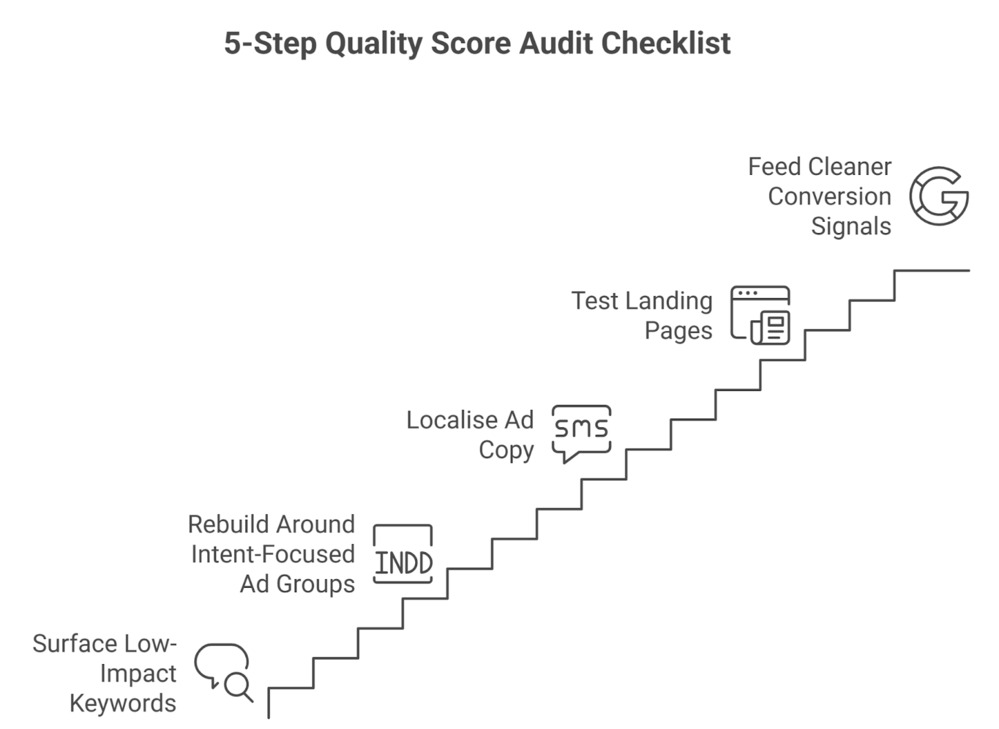
Quality Score improvements rarely come from one change. Consistent gains usually follow a structured audit that fixes relevance gaps, intent mismatch, and weak experience signals across the account.
1. Surface Low-Impact Keywords
Start by identifying keywords with a quality score between 1 and 3. These terms often drive higher cost per click while contributing little to ad performance. Flag them early to prevent budget leakage.
2. Rebuild Around Intent-Focused Ad Groups
Group keywords by clear user intent rather than broad themes. Intent-based ad groups improve relevance between search queries, ad copy, and landing pages, which supports stronger Quality Score signals.
3. Localise Ad Copy for Malaysian Search Behaviour
Refine messaging to reflect how Malaysians actually search. Local phrasing, tone, and language choice often improve engagement and relevance scores without any bid increase.
4. Test Landing Pages to Strengthen Experience Signals
Use split testing to assess layout, messaging, and load performance. Better user experience reduces bounce rate and supports stronger landing page experience scores.
5. Feed Cleaner Conversion Signals Back to Google
Upload enhanced conversion data and review search queries regularly. Cleaner signals help the system understand which actions represent meaningful outcomes, improving overall account performance.
Guidance on conversion efficiency appears in Google Ads conversions.
Quality Score and Long-Term Cost Control
Quality score supports sustainable growth when paired with disciplined bid management.
High scores lead to:
- CPC reduction
- Stronger ad performance
- Improved return on ad spend
- Competitive advantage over larger advertisers
Sectors that rely on scale often lose ground to smaller teams with higher relevance and cleaner page experience.
Privacy-first planning also matters. Signals from consent mode v2 and offline data strengthen optimisation. Forward-looking teams explore this shift through Google Ads cookieless insights.
Local execution consistently outperforms generic playbooks. Patterns across local brands Malaysia show how relevance protects cost efficiency.
A clear example appears in the home furnishing Google Ads case study, where quality score improvements stabilised ad placement despite rising competition.
Supporting Quality Score with Broader Channels
Paid search performance improves when supported by complementary channels.
Common pairings include:
- SEO Services and Local SEO for intent reinforcement
- Facebook Ads and Instagram Ads for demand generation
- LinkedIn Ads for B2B targeting
- Google Display Ads and Google Shopping Ads for mid-funnel visibility
Cross-channel consistency supports quality signals across the full journey.
Boost Quality Score, Cut Costs
Quality score now dictates who pays less and who gets priced out in Malaysian search auctions. Relevance, page experience, and intent alignment matter more than bid size alone.
Many businesses work with experienced partner Newnormz, digital marketing agency to maintain this balance as platforms evolve.
Real execution styles and outcomes can be reviewed through the Newnormz Portfolio.
Frequently Asked Questions