Good Google Ads management in Malaysia is not about getting more clicks. It is about knowing, from data you trust, which ringgit turned into a lead or a sale, and then moving budget toward those every week. That starts with accurate conversion tracking. You also need keywords that match buyers rather than browsers, landing pages that convert on a phone, and someone checking the account often enough to catch waste before it compounds. No honest agency can promise you a fixed cost per lead, because Google’s auction changes daily and your competitors change with it. What a good partner can promise is transparency: you own the account, you see the data, and every recommendation comes with a reason.
A Simple Way to Think About It
Two Stalls at the Same Pasar Malam
💸 Set and forget
A stall that pays for the best spot at the market and stocks exactly the same items every week, whether they sell or not.
🎯 Actively managed
The stall next to it, run by an owner who notices what sold out by 9pm and brings more of that next week.
Both pay the same rent. Only one gets better every week. The sections below cover what that weekly attention looks like inside a Google Ads account.
What Google Ads Management Actually Involves
Setting up a campaign takes an afternoon. Managing one is the ongoing work after that, and it’s where most of the money is won or lost. Google’s automation is powerful, but it only optimises toward whatever you tell it to, using whatever data you feed it. A human still has to decide what counts as success, cut the waste the algorithm doesn’t recognise as waste, and connect ad data to what your sales team sees.
In Malaysia this matters more than ever. There were 35.4 million internet users at the end of 2025, about 98% of the population (DataReportal Digital 2026 Malaysia), and Google handles roughly 93% of local search (Statcounter, May 2026). Nearly all your buyers are searching on Google. So are your competitors’ buyers, and your competitors are bidding for them too.
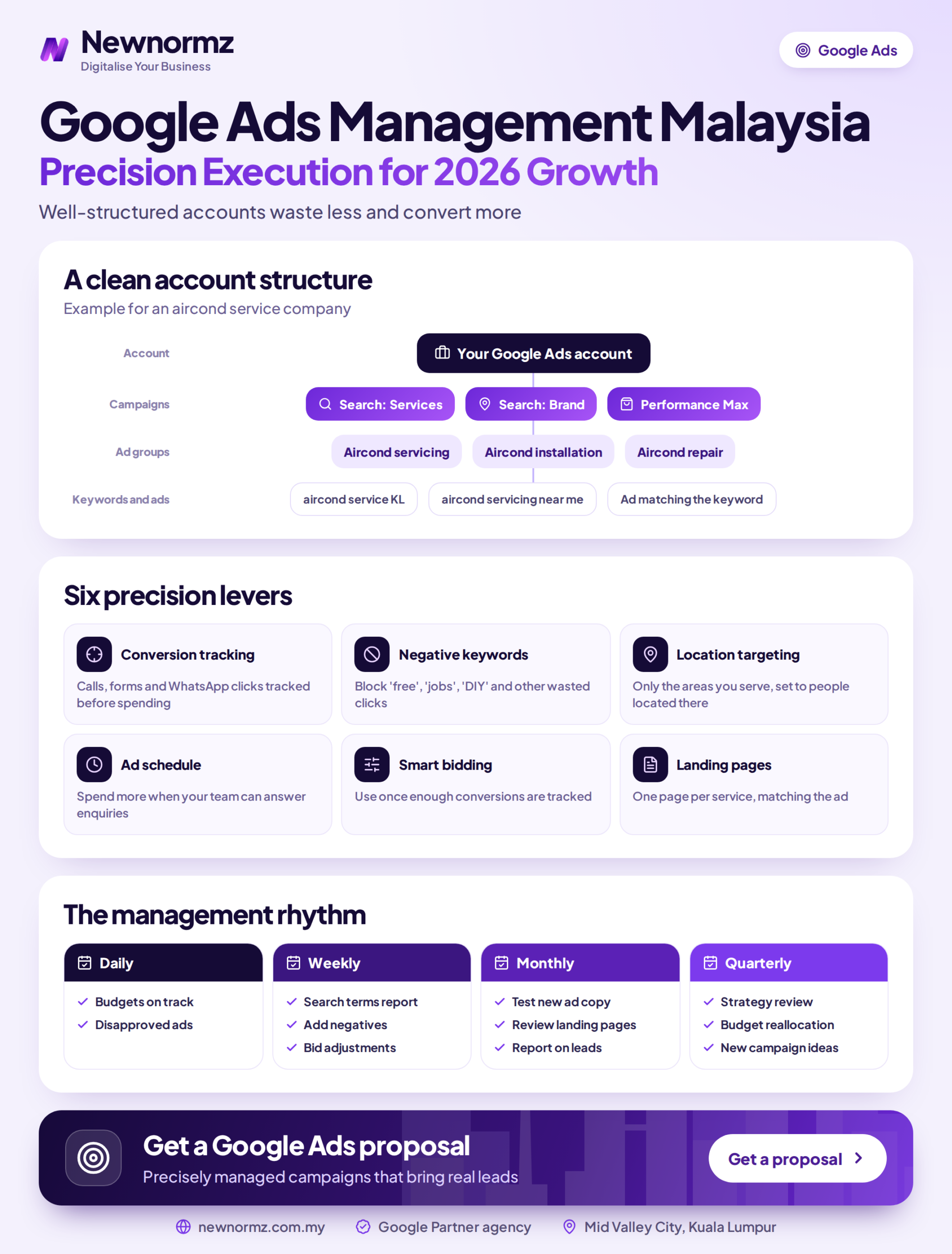
Here is what ongoing management should cover, and how often:
| Task | How often | What it protects you from |
|---|---|---|
| Search terms review and negative keywords | Weekly | Paying for searches that were never going to buy |
| Bid strategy and budget pacing check | Weekly | Burning the month’s budget early, or starving your best campaigns |
| Ad copy testing | Monthly | Stale ads that slowly lose click-through rate |
| Landing page and conversion rate review | Monthly | Paying for good clicks that land on a page that leaks |
| Lead quality check with your sales team | Monthly | Cheap leads that never close |
| Conversion tracking audit | Quarterly, and after any website change | Bidding on bad data, which quietly makes every other decision wrong |
Fix Tracking First, or Nothing Else Matters
Google’s Smart Bidding learns from the conversions you report. If your account counts a WhatsApp button tap the same as a paid booking, Google will happily find you more WhatsApp taps, because they are cheaper. Your dashboard will look great. Your sales won’t move.
Before touching bids or keywords, a competent manager checks three things:
- What is counted as a conversion. Only actions tied to real business value should be primary conversions. Micro-actions can be tracked, but they shouldn’t drive bidding.
- Whether the tracking is complete. Browser privacy restrictions and ad blockers mean standard tag-based tracking misses some conversions. How many varies by site. Enhanced conversions and server-side tagging close a lot of that gap.
- Whether offline sales feed back in. If your deals close over the phone, in a showroom, or after weeks of B2B follow-up, importing those outcomes from your CRM tells Google which clicks actually became revenue. Without it, you’re optimising for form fills, not customers.
If an agency’s first proposal jumps straight to “new campaigns” without asking about your tracking, that tells you how they’ll run the account.
What’s Different About Running Google Ads in Malaysia
Your buyers search in more than one language
A buyer in Penang might search in English, Bahasa Malaysia, or Chinese, sometimes mixing all three in one query. Campaigns built only on English keywords miss real demand, and often the less contested demand. The ad copy and landing page need to match the language of the search, not just the keyword.
The Klang Valley is the most expensive auction in the country
High-intent terms in Kuala Lumpur and Selangor attract the most bidders, so costs per click there are usually higher than the same terms elsewhere. Sometimes that’s worth paying. Often a tighter location radius, a more specific long-tail keyword, or a schedule that skips low-converting hours gets you the same buyers for less.
Most of your clicks will come from phones
Malaysians search on mobile first. A landing page that loads slowly or hides the call button below three screens of text is wasting budget you already paid for. Page experience also affects Quality Score, which in turn affects what you pay per click.
The 8% service tax belongs in your ROI maths
Malaysia’s 8% service tax on digital services applies to your ad spend. A RM5,000 monthly budget actually costs RM5,400. It’s a small number, but leaving it out of your cost per acquisition makes every campaign look slightly better than it is.
Financial services advertisers face extra checks
Since April 2026, Google requires financial services advertisers targeting Malaysia to complete additional verification before their ads run. If you’re in lending, investment, insurance, or similar, factor that approval time into your launch plan. Don’t assume a campaign can go live the day it’s built.
How Management Fees Are Structured (and What Each Model Rewards)
There is no standard price for Google Ads management in Malaysia, and anyone who quotes one without looking at your account is guessing. What matters more than the number is how the fee is structured, because each model nudges the agency toward different behaviour.
| Fee model | How it works | What to watch for |
|---|---|---|
| Flat monthly retainer | Fixed fee regardless of spend | Predictable, but check how many hours and which tasks the fee actually covers |
| Percentage of ad spend | Fee scales with your budget | The agency earns more when you spend more, whether or not results improve |
| Performance-based | Part of the fee tied to agreed outcomes | Aligns incentives, but only if “a lead” is defined tightly. Otherwise you pay for junk |
Whichever model you choose, insist on one thing: your management fee and your media spend are shown as separate numbers. A single bundled figure makes it impossible to know how much of your money actually reached Google.
A big budget isn’t a prerequisite either. One of our clients, a confinement centre in KL, worked with a RM2,550 monthly budget, combining Google Ads with SEO, and started getting qualified leads within 30 days. That came from narrow targeting and a clear offer, not from outspending anyone.
Questions to Ask Before You Hire a Google Ads Agency
Agency pitches all sound similar. The answers to these questions don’t.
| Question | Why it matters | Red flag answer |
|---|---|---|
| Who owns the Google Ads account? | Years of performance history should stay with you if you switch agencies | “It sits under our account and can’t be transferred.” |
| What counts as a conversion in your reports? | This is what Google will optimise toward | “Clicks, impressions, and engagement.” |
| Who manages my account day to day? | The person who pitched you is often not the person who runs your campaigns | They can’t name the person, or it changes every few months |
| What will you do in the first 30 days? | Shows whether they have a process or just a launch button | “Launch, then let the algorithm learn.” |
| Can you guarantee my results? | Tests honesty. Auction outcomes depend on competitors and Google, not just the agency | A fixed cost per lead or a guaranteed top position, with no conditions attached |
Size isn’t a reliable signal either way. Large agencies can bring process and resources. Smaller ones often give you more senior attention. What matters is who touches your account, how often, and whether they’ll show you everything they see.
Paid and Organic Work Better Together
Google Ads gives you speed: you can be in front of buyers this week. The trade-off is that traffic stops the day you stop paying. Organic search works the other way round. It’s slow to build, but it compounds. Oriental Kopi’s organic campaign with us ran for two years and reached 468,000 clicks and 6.31 million impressions, traffic that doesn’t carry a per-click cost.
The two channels also feed each other. Your search terms report shows which exact phrases turn into enquiries, which is far better keyword research than any tool’s volume estimate. Those proven phrases are where an SEO service should focus first. Over time, the keywords you rank for organically need less paid budget, and ads can move to new terms you haven’t won yet.
Frequently Asked Questions
How much does Google Ads management cost in Malaysia?
It depends on how many campaigns you run, how competitive your industry is, and which fee model the agency uses. Budget for two separate lines: the management fee and the media spend that goes to Google, plus 8% service tax on that spend. Ask any agency to quote these separately.
How long before a new campaign shows results?
Ads can start getting clicks within a day of approval. Smart Bidding usually needs around two weeks of data before it settles. Give a campaign about 90 days of steady optimisation before judging whether it’s working, as long as tracking was set up correctly from day one.
What is a good conversion rate?
There’s no universal number. It depends on your industry, your offer, and what you count as a conversion. A campaign counting phone calls will look very different from one counting completed purchases. The most useful benchmark is your own baseline: measure it accurately, then improve it month over month.
Should I bid on my own brand name?
Usually yes, especially if competitors are bidding on it. Brand clicks tend to be cheap because your ads are highly relevant. Without your own brand campaign, someone searching for you by name may see a competitor’s ad first.
Does a Google Premier Partner badge mean better management?
Google gives Premier Partner status to a small share of agencies each year based on spend, growth, and certification. It shows the agency has scale and Google’s recognition. It doesn’t tell you who will run your account or how closely. Use the questions above to find that out.
Is Google Ads better than Facebook Ads?
They do different jobs. Google Ads catches people already searching for what you sell. Facebook and Instagram reach people who aren’t searching yet. If buyers already know what they need, start with Google. If you have to create demand first, social usually comes earlier in the mix.
Not sure where your ad budget is leaking?
Get a second pair of eyes on your search strategy before you spend another ringgit.
Newnormz has run SEO campaigns across F&B, healthcare, ecommerce, and local services in Malaysia, backed by a performance guarantee of 70 percent of targeted keywords on Google’s first page.
30 minutes, no obligation, and bring your Google Ads questions along too.

Bryan Tan is an SEO Specialist and CEO at Newnormz, helping hundreds of businesses achieve first-page rankings on Google. With a passion for driving organic growth, Bryan blends innovative strategies with hands-on experience to optimize websites for maximum visibility. Always at the forefront of the latest SEO insights and trends, he consistently adapts to the evolving digital landscape.