Be wary of anyone who says they can make your rankings immune to the next Google update. Nobody can, and Google has said many times that no one can guarantee a specific ranking position. What you can do is build on the things every update so far has rewarded. That means content that answers real questions clearly, a brand that search engines and AI tools can identify without confusion, a website that loads fast and works well on mobile, and tracking that goes beyond “what position are we in today”. AI Overviews and chat-based search have changed where clicks go. They haven’t changed what makes a source worth showing or citing. A future proof SEO strategy is built on those things, not on whatever tactic is trending this quarter.
A Simple Way to Think About It
The Directory Board vs the Neighbourhood Name
🪧 Listed on one directory board
Picture a shop whose customers only find it through the mall’s directory board. When the mall renovates and redraws the board, the shop disappears overnight.
🏪 Known by name in the neighbourhood
Now picture a shop the whole neighbourhood knows by name. It doesn’t matter which map, board, or friend someone asks. That shop keeps coming up.
The sections below explain what it takes to be the second shop when the “board” is Google’s results page and that page keeps getting redrawn.
What Has Actually Changed in Search
Google started rolling out AI Overviews in 2024. For a lot of informational queries, a summary now appears above the usual organic results. Searchers also use ChatGPT, Perplexity, and Gemini to research purchases before they visit a website.
The practical effect is simple. Some searches that used to send a visitor to your site now end on the results page. This hits hardest on basic “what is” and “how does” questions. Commercial searches are less affected, such as “SEO agency Kuala Lumpur” or “confinement centre near me”, because people still need to compare, call, and book.
Plenty of articles quote dramatic percentages for how many searches now trigger AI answers or end without a click. Most of those figures come from limited samples and go out of date quickly, so I won’t pretend one number covers your industry. The honest approach is to check your own Search Console data. Look at which queries are losing clicks while their impressions hold steady. That pattern is the clearest sign an AI summary is answering the question before people reach you.
What hasn’t changed is that Google is still the main channel in Malaysia. Google holds roughly 93% of the Malaysian search market (Statcounter, May 2026), and Malaysia had 35.4 million internet users at the end of 2025, about 98% of the population (DataReportal Digital 2026 Malaysia). The channel is still there. The way people use it is shifting.
What Holds Up and What Doesn’t
Before you plan anything, sort your current tactics into two piles. Some were built for how Google worked ten years ago. Others are built on what Google and AI tools are actually trying to do, which is give the searcher a trustworthy answer.
| Tactics that age badly | Foundations that hold up |
|---|---|
| Repeating one keyword as often as possible | Fully answering the question behind the keyword, including the follow-up questions |
| Publishing large volumes of thin, unedited AI content | Fewer pages with real experience, real examples, and a named author behind them |
| Buying bulk backlinks from unrelated sites | Earning mentions from industry publications, directories, and local media people actually read |
| Inconsistent business details across listings | The same name, address, phone number, and description everywhere your business appears |
| Judging success only by ranking position | Tracking impressions, clicks, leads, and whether AI tools mention your brand |
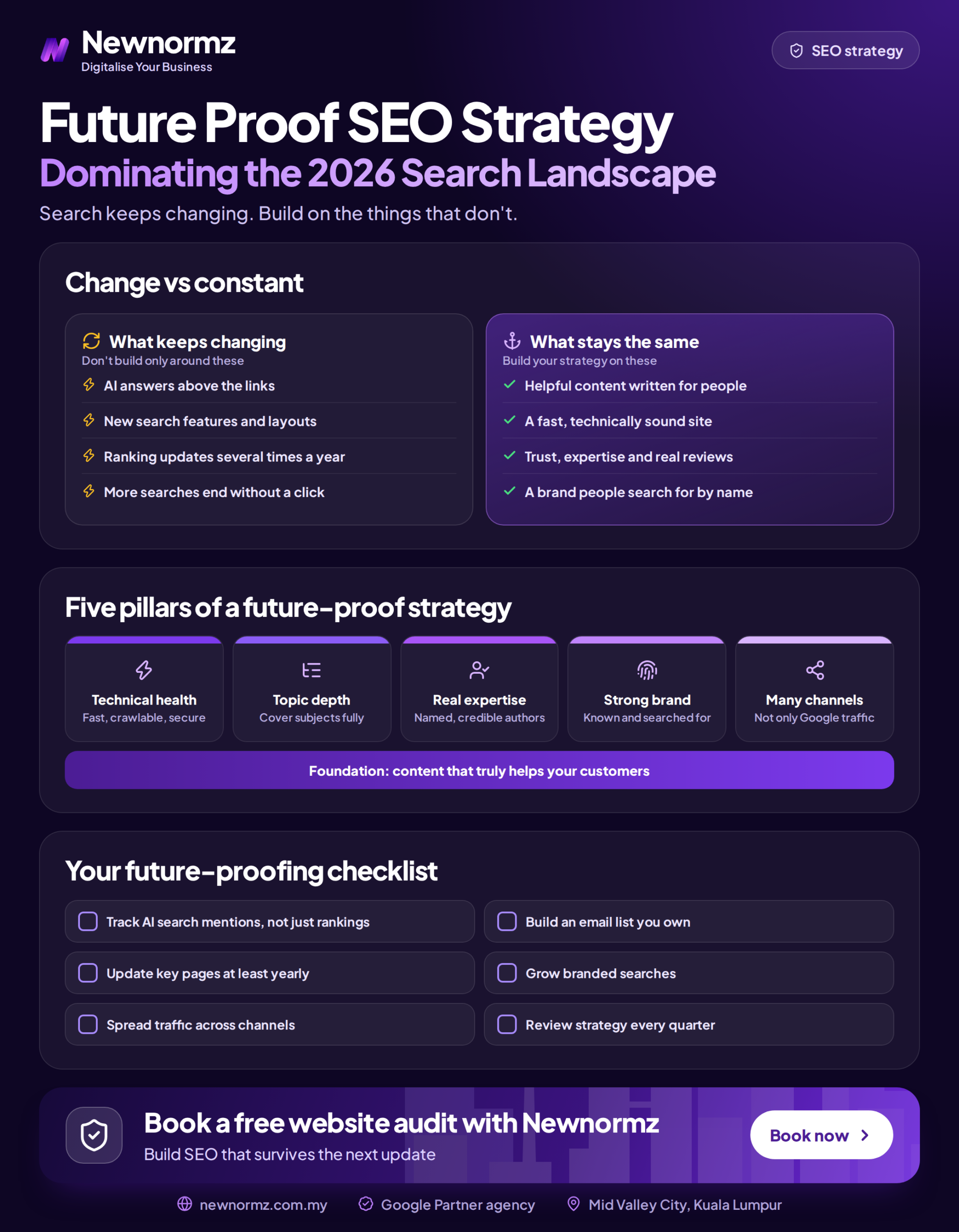
The Five Foundations of a Future Proof SEO Strategy
None of these are new inventions. What has changed is that skipping them now costs you more, because AI summaries pull from a small number of sources and leave the rest out.
1. Answer the question early and clearly
Google’s AI Overviews and tools like Perplexity pull out short passages that answer a question directly. If your page takes four paragraphs of warm-up to reach the point, it’s hard to extract a passage from it. Put the direct answer near the top. Use headings that match the questions people actually ask, then add depth underneath for readers who want it. This works for human readers as well. Nobody likes scrolling past filler.
2. Make your brand easy to identify
Search engines increasingly treat a business as an entity: a specific thing with a name, a location, a category, and people behind it. They confirm that picture by comparing what different sources say about you. So keep your business details identical on your website, Google Business Profile, and directory listings. Add structured data (schema markup) so your services, location, and reviews are machine-readable. Put real author names on your content, and link them to profiles that show their actual experience. If the information about you contradicts itself across sources, search engines and AI tools will trust it less.
3. Keep the technical foundation solid
Core Web Vitals are Google’s own measures of page experience, and the targets are public. A good score means Largest Contentful Paint under 2.5 seconds, Interaction to Next Paint under 200 milliseconds, and Cumulative Layout Shift of 0.1 or lower. Most Malaysian searches happen on phones, often on mobile data, so test on a real mid-range phone and not just your office desktop. A good technical setup won’t rank weak content. A bad one can stop strong content from ranking.
4. Go local, and go multilingual
This is where Malaysian businesses have an advantage that global SEO advice usually misses. Your customers search in English, Bahasa Malaysia, and Chinese, often mixing languages in the same query. A clinic in Petaling Jaya competes with the clinics nearby, not with every clinic in the world. Investing properly in local SEO (Google Business Profile, local reviews, location pages that say something useful) is one of the most durable moves available, because it’s tied to a real physical presence that’s hard to fake.
5. Measure more than rankings
If AI summaries take some of your clicks, a ranking report alone can mislead you in both directions. Track a wider set of signals so you can see what’s really happening.
| What to track | Why it matters now |
|---|---|
| Impressions (Search Console) | Shows whether Google is surfacing you at all, even on searches that don’t produce a click |
| Clicks by query type | Separates informational queries (more exposed to AI answers) from commercial ones (still click-heavy) |
| Leads and enquiries from organic | The number that pays the bills, and the one traffic charts can hide |
| Branded search volume | People who saw your name in an AI answer often search for you directly afterwards |
| AI mentions (manual spot checks) | Ask ChatGPT, Perplexity, and Gemini your customers’ key questions each month and note whether you’re cited |
What Durable SEO Looks Like in Real Campaigns
The best argument for building on foundations is how the results add up over time. Here are three Newnormz campaigns across very different industries.
Oriental Kopi (F&B), 2 years. Traffic grew by 43,300. The brand reached 6.31 million impressions and 468,000 clicks, and 24,500 more keywords ranked. Look at the gap between impressions and clicks. Millions of searchers saw the brand who never clicked, and that visibility still builds recognition. It’s the kind of exposure a ranking-only report misses.
Times Parking (parking management), 6 months. 528,000 impressions, 416 ranking keywords, 31.5K clicks, and 600 more visitors. It’s a niche B2B-leaning category, and steady technical and content work still produced measurable visibility in half a year.
Sunway Medispa (healthcare), 6 months. A 700% increase in traffic, 54,000 impressions, and 70% more keywords ranking. Healthcare is an area where Google holds content to a higher standard of expertise and trust. That makes authorship and accuracy part of the strategy, not optional extras.
None of these campaigns depended on a trick that a single update could remove. That’s the practical meaning of “future proof”. The work keeps paying off after Google changes how its results page looks.
Where to Start This Quarter
If your SEO hasn’t been touched in a while, don’t try to do everything at once. Use this order:
- Check your Google Business Profile and main directory listings so your details match exactly.
- Run your key pages through Google’s PageSpeed Insights on mobile and fix the worst problems first.
- Rewrite your top five service or product pages so the direct answer comes first and a real person’s expertise is visible.
- Set up a simple monthly report covering impressions, clicks, organic leads, and an AI mention spot check.
If you’d rather have specialists run this end to end, a structured SEO service should cover all four of these before it talks about anything fancier.
Frequently Asked Questions
Is Generative Engine Optimisation (GEO) separate from SEO?
Mostly no. The things that get you cited in AI answers overlap heavily with good SEO: clear answers, a well-defined brand, credible authors, and mentions on trusted sites. GEO is a useful name for paying closer attention to how AI tools pull from your content. It isn’t a replacement discipline, and you should be cautious about anyone selling it as one.
Will AI-written content hurt my rankings?
Google has said it judges content on quality, not on how it was produced. The real risk is volume without value: lots of generic pages that say nothing a competitor hasn’t already said. Using AI to help with drafting is fine. Your content still needs real experience, accurate details, and a human expert who checks and stands behind it.
Can anyone guarantee my brand appears in Google’s AI Overviews?
No. Just as nobody can guarantee a specific ranking position, nobody controls which sources an AI summary chooses for a given search. What you can do is improve your chances by being the clearest, most credible answer available, then track your mentions over time.
How long before a future proof SEO strategy shows results?
Expect early movement in impressions and keyword coverage within roughly six months, as with the Times Parking and Sunway Medispa campaigns above. The bigger compounding gains usually take longer, as the two-year Oriental Kopi campaign shows. If you need enquiries sooner, run Google Ads alongside SEO while the organic side builds.
How much should a Malaysian business budget for this?
It depends on how competitive your category is, how many locations you serve, and how much of the foundation already exists. As one real reference point, a KL confinement centre spent RM2,550 a month on SEO paired with Google Ads and saw qualified leads within 30 days. Be wary of very cheap packages that promise fast rankings. They often rely on exactly the tactics that age badly.
Is your SEO built to last through the next update?
Find out which parts of your strategy will hold up in 2026, and which won’t.
Newnormz has run SEO campaigns across F&B, healthcare, ecommerce, and local services in Malaysia, backed by a performance guarantee of 70 percent of targeted keywords on Google’s first page.
30 minutes, no obligation, including a check of how AI search tools currently see your brand.

Bryan Tan is an SEO Specialist and CEO at Newnormz, helping hundreds of businesses achieve first-page rankings on Google. With a passion for driving organic growth, Bryan blends innovative strategies with hands-on experience to optimize websites for maximum visibility. Always at the forefront of the latest SEO insights and trends, he consistently adapts to the evolving digital landscape.