Enterprise SEO is what happens when a website is too big for any one person to fix by hand. It is not “more of the same tactics” applied to a bigger site, it is a different discipline built around templates, approvals, and systems, because a single change at an enterprise level can touch thousands of pages at once, and a single mistake can break just as many. If your organisation has multiple brands, regional sites, or a content library in the thousands, your SEO problem is mostly structural and organisational before it is ever tactical.
A Simple Way to Think About It
The Speedboat and the Aircraft Carrier
🚢 The Slow Turn
An aircraft carrier needs miles of open water to change direction. A crew member cannot just yank the wheel. Every course correction has to go through the bridge, get checked against the rest of the fleet, and roll out gradually, or the whole ship overcorrects.
⚓ The Steady Heading
But once that carrier is pointed the right way, it does not need constant nudging. It holds its course through storms that would spin a speedboat off track, carrying far more weight, further, with fewer corrections.
That is the trade-off enterprise SEO teams live with every day, and it shapes almost every decision covered below.
What Actually Makes SEO “Enterprise” (It’s Not Just Size)
A site with 50,000 pages is not automatically “enterprise.” What makes SEO enterprise is complexity in decision-making: multiple business units competing for the same keywords, a CMS that requires an engineering ticket to change a title tag, legal and brand teams who need to sign off on public-facing copy, and regional offices in different countries who all have opinions about the same global template. A 50-page site run by one marketing manager who can edit anything directly is, in practice, simpler to optimise than a 5,000-page site split across six departments.
This is also why Google’s own repeated public position matters here more than at small business scale: no one, Google included, can guarantee a specific ranking position. At enterprise scale, that uncertainty compounds across thousands of URLs, which is exactly why process and governance carry as much weight as the SEO tactics themselves.
The Structural Challenges Unique to Large Organisations
Legacy CMS and Template-Locked Pages
Many large organisations run on a CMS chosen a decade ago for reasons that had nothing to do with SEO. Changing a meta description template might require a developer sprint, not a five-minute edit. This single constraint explains more enterprise SEO delays than any algorithm update.
Multiple Brands, Domains, and Subdomains
A conglomerate with separate brands for banking, insurance, and telco arms has to decide: one domain with subdirectories, or separate domains entirely. Subdirectories generally consolidate authority better; separate domains offer brand and legal separation but usually mean starting each domain’s authority from closer to zero.
Crawl Budget and Indexation at Scale
Google does not crawl every page on a massive site equally or immediately. Faceted navigation, duplicate parameter URLs, and orphaned pages can quietly eat crawl budget that should be going to pages that actually drive revenue. Log file analysis, not just Search Console, becomes necessary to see what Googlebot is actually doing on the site.
Governance: Who Actually Owns SEO in a Large Organisation
In a small business, one person often owns SEO end to end. In an enterprise, ownership is split across IT (who controls the CMS and site speed), brand and legal (who approve public copy), regional marketing teams (who run local campaigns), and sometimes an external SEO agency in Malaysia coordinating all of it. Without a clear governance model, a fix approved by marketing can sit in an IT backlog for months, or a legal review can block a page update long after the ranking opportunity has passed.
The organisations that do this well tend to build a lightweight but explicit approval path: a shared SEO requirements document that IT references directly in their sprint planning, rather than SEO recommendations living only in a slide deck nobody outside marketing ever opens.
Technical SEO at Scale: Fix the Template, Not the Page
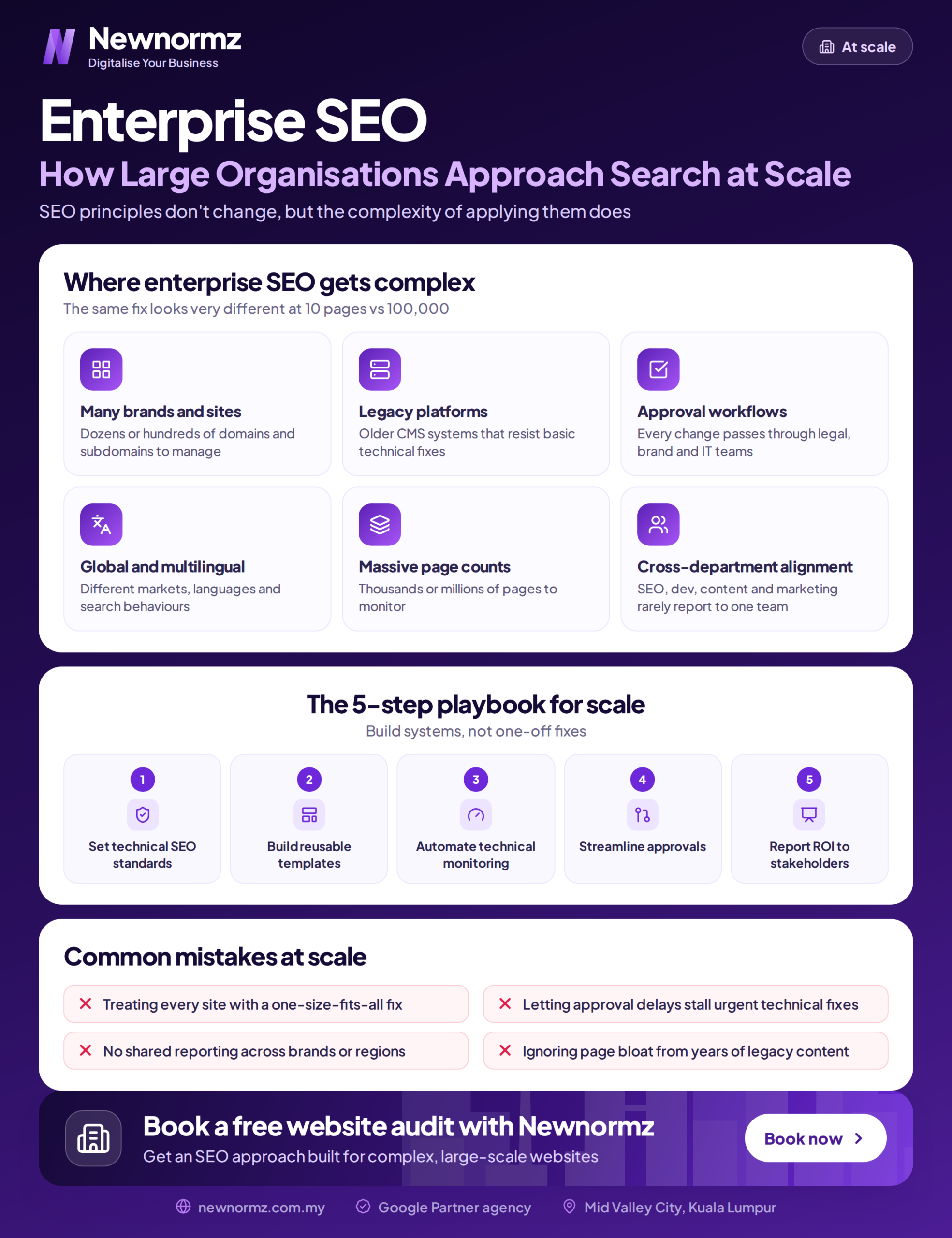
At small scale, you fix a slow page. At enterprise scale, you fix the template that generates ten thousand slow pages, because fixing one page at a time is not a strategy, it is a rounding error. This is where enterprise SEO becomes closer to engineering work than marketing work: identifying the shared component causing a Core Web Vitals issue, then pushing that fix through a release cycle that also has to serve every other page built on that same template.
International and multi-brand organisations add another layer: hreflang tags across language and country versions, canonical tags to prevent near-duplicate regional pages from competing with each other, and XML sitemaps segmented so Google can actually process a site with hundreds of thousands of URLs without wasting crawl budget on the wrong sections.
| Factor | SMB SEO | Enterprise SEO |
|---|---|---|
| Who approves a change | Usually one owner | Marketing, IT, legal, and sometimes regional leads |
| Time to ship a fix | Hours to days | Weeks to a full release cycle |
| Unit of change | Individual page | Shared template or component |
| Biggest risk | Missed opportunity on one page | One bad template change breaking thousands of pages |
| Reporting audience | Business owner | Multiple stakeholders and executive leadership |
Content and Keyword Strategy Across Business Units
Large organisations run a real risk of competing with themselves: two regional teams targeting the same keyword with two different pages, splitting the ranking signal that would have been stronger combined. A hub and spoke content model, where one authoritative page owns a broad topic and supporting pages link into it rather than duplicating it, prevents this kind of internal keyword cannibalisation. It also gives leadership a clearer picture of which team owns which slice of search visibility, instead of three departments quietly fighting for the same ten blue links.
Growth at this scale takes time to compound. Oriental Kopi’s two-year SEO campaign is a useful reference point: traffic grew by 43,300, impressions reached 6.31 million, and the site gained 24,500 additional ranking keywords, along with 468,000 clicks over that period. That is the kind of timeline enterprise SEO realistically runs on, not weeks, but sustained work across quarters.
Measuring and Reporting ROI to Leadership
Executives do not want to hear about keyword rankings in isolation, they want to know what search visibility is worth to the business. That means enterprise SEO reporting has to connect further down the funnel: organic sessions to qualified leads, qualified leads to pipeline, pipeline to revenue by business unit. Sunway Medispa’s six month campaign is a good illustration of what that connection can look like when it works, a 700% increase in traffic and 70% more keywords ranking, translated into a number a healthcare business’s leadership team could actually act on.
Many enterprises also run SEO and Google Ads in parallel rather than choosing one, using paid search to fill the gap while organic authority builds, particularly for new product lines or newly launched regional sites that have no ranking history yet.
What Malaysian Enterprises Tend to Get Wrong
With Malaysia at 35.4 million internet users and 98% penetration, and Google holding roughly 93% of the local search market, the audience size is not the problem for large Malaysian organisations. The recurring mistake is treating a regional or multilingual rollout as a translation task rather than a search intent task: a Bahasa Malaysia or Chinese-language page copied word for word from the English version rarely ranks the way a page built around how people actually search in that language does. The second recurring mistake is skipping governance entirely and hoping a single agency or in-house hire can push enterprise-wide change through the same channels that worked for a 20-page site. At this scale, the process has to be built before the tactics can stick.
Frequently Asked Questions
How long does enterprise SEO take to show results?
Meaningfully longer than SMB SEO, usually six months to see early movement and one to two years for compounding results, largely because approvals and template-level fixes take longer to ship than on a small site.
Should a large organisation use subdomains or subdirectories for different brands?
Subdirectories on one domain generally consolidate SEO authority better. Separate domains make sense when brands genuinely need legal or operational separation, but each one starts building authority almost from scratch.
Who should own SEO inside a large organisation?
No single department can own it alone. Marketing typically drives strategy, IT controls what can actually be shipped to the site, and legal or brand teams sign off on public copy. The organisations that succeed write this workflow down instead of leaving it informal.
Is enterprise SEO more about technical fixes or content?
Both, but technical structure tends to unlock or block everything else at this scale. A content strategy built on a site with crawl budget problems or broken templates will underperform no matter how good the writing is.
Running SEO across multiple brands or regions?
Get an SEO audit built for organisations, not single-page fixes
Newnormz has run SEO campaigns across F&B, healthcare, ecommerce, and local services in Malaysia, backed by a performance guarantee of 70 percent of targeted keywords on Google’s first page.
30 minutes, no obligation, structured around how your organisation actually approves changes.

Bryan Tan is an SEO Specialist and CEO at Newnormz, helping hundreds of businesses achieve first-page rankings on Google. With a passion for driving organic growth, Bryan blends innovative strategies with hands-on experience to optimize websites for maximum visibility. Always at the forefront of the latest SEO insights and trends, he consistently adapts to the evolving digital landscape.