Ecommerce SEO in Malaysia means getting your own online store, not just your Shopee or Lazada listing, to show up when someone searches for what you sell. It takes clean product and category page structure, product schema markup, keyword targeting that covers both English and Bahasa Malaysia searches, and content that answers buying questions Google actually gets asked. It usually takes three to six months before you see meaningful ranking movement, and longer in competitive categories where marketplaces dominate page one. There is no shortcut that skips that timeline, and no agency that can guarantee a specific ranking position, Google has said as much publicly.
A Simple Way to Think About It
Two Shops Selling the Exact Same Product
🚪 The Shop Down a Dead-End Lane
Same products, same prices, same photos, but it’s tucked behind a stall nobody walks past. The customers who would have bought never even see the door.
🏪 The Shop on the Main Road
Same store, moved to the busiest corner in town, with clear signage that answers exactly what shoppers are looking for before they even walk in.
The rest of this playbook is about moving your product pages from the lane to the main road, in a market where Shopee and Lazada already soak up most of the foot traffic.
Why Ecommerce SEO in Malaysia Needs Its Own Playbook
Malaysia had 35.4 million internet users at the end of 2025, close to 98 percent of the population, and Google still handles roughly 93 percent of all searches done in the country. That combination matters more than most store owners realise. Even shoppers who eventually buy on Shopee or Lazada often start on Google: comparing brands, checking prices in ringgit, reading reviews, or searching “[product] harga” before they commit. If your own store doesn’t show up in that research phase, you’re relying entirely on marketplace search and paid ads to be found, and both come with fees eating into every sale.
This is also why ecommerce SEO isn’t the same job as SEO for a services business or a company brochure site. A services site might have twenty pages to optimise. An online store can have hundreds or thousands, each one competing not just against other Malaysian retailers but against the marketplace listings that already dominate page one for most product keywords.
The Technical Foundations Most Online Stores Get Wrong
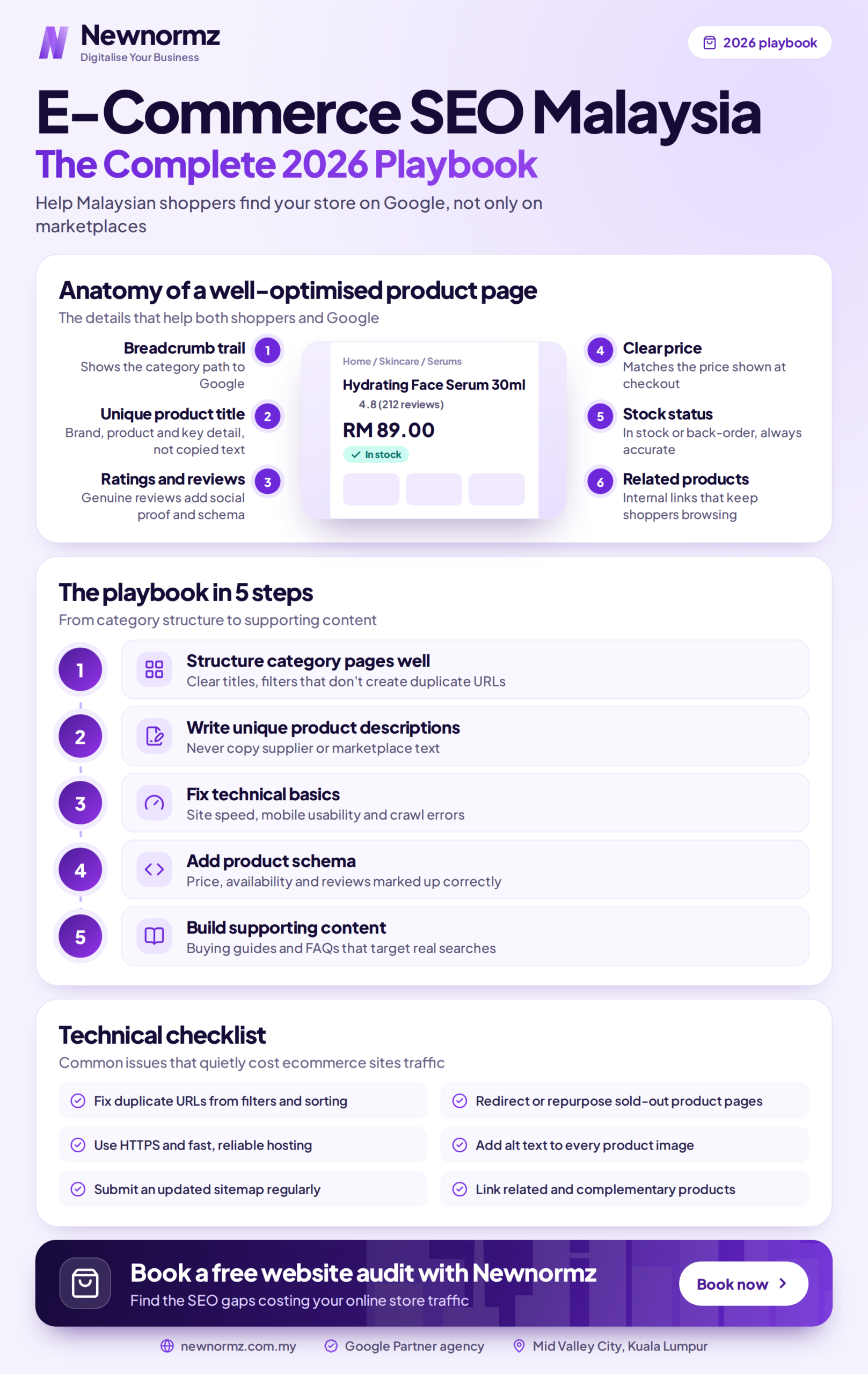
Before any content or keyword work pays off, the store itself has to be built in a way Google can actually crawl and understand. The most common problems we see on Malaysian ecommerce sites are structural, not creative:
Duplicate and thin product pages
Product variants (different colours, sizes, or bundles) often generate separate URLs with near-identical content. Without proper canonical tags, Google struggles to decide which version to rank, and sometimes ranks none of them well. Out-of-stock products left live with empty descriptions do similar damage.
Category page structure
Category pages need real, unique copy above the product grid, not just a filtered product list with a one-line heading. That copy is often the only thing separating your category page from a marketplace search results page in Google’s eyes.
Product schema markup
Structured data for price, availability, and review ratings is what earns the star ratings and price snippets you see in Google search results. On mobile, where most Malaysian shoppers browse, that extra visual real estate is often the difference between a click and a scroll past.
Page speed on mobile
Heavy product images and third-party scripts (chat widgets, marketing pixels, review plugins) are the usual culprits behind slow-loading store pages. Every extra second of load time is a chance for a shopper to bounce back to a marketplace tab instead.
Keyword Research for a Malaysian Online Store
Product keywords in Malaysia split across three intents, and most stores only target one of them. Transactional keywords (“buy [product] online Malaysia,” “[product] harga,” “[brand] Malaysia”) are what you’d expect to chase, and they should map directly to product and category pages. But a large share of search volume sits earlier: comparison searches (“[product A] vs [product B]”), and buying-guide searches (“best [product] for [use case]”) that happen before a shopper has picked a brand.
Language matters too. A meaningful share of product research in Malaysia happens in Bahasa Malaysia, and price-led queries in particular (“harga,” “murah,” “promosi”) are often searched in Bahasa even by shoppers who’d read English product descriptions without issue. Skipping that layer means skipping demand that’s already there, not demand you’d have to create.
Content Beyond the Product Page
Product pages convert, but they rarely rank for the early-stage searches that bring in new customers. That’s the job of supporting content: buying guides, comparison articles, and “how to choose” pieces that answer the questions a shopper types into Google before they know which product they want. Done well, this content links straight into the relevant category and product pages, so the ranking traffic it earns has somewhere useful to go.
This is also where an online store can build authority a marketplace listing never can. A Shopee listing can’t publish a buying guide, run a blog, or get cited as a source. A brand’s own site can, and every piece of that content is one more reason for Google, and for the shopper, to trust the site behind it.
Local Signals Still Matter, Even for a Purely Online Store
If your store has a warehouse, showroom, or pickup point anywhere in Malaysia, local SEO shouldn’t be skipped just because most sales happen online. A verified Google Business Profile, consistent address details, and location-relevant content all help with “near me” and city-specific searches, which convert at a noticeably higher rate than generic national searches. This works alongside, not instead of, the core SEO work described above.
Link Building and Authority for Product Pages
Ecommerce link building in Malaysia mostly comes down to earning coverage a marketplace listing never could: product reviews from local bloggers and publications, mentions in “best of” roundup articles, and partnerships with complementary local businesses. Generic directory submissions and paid link packages do little for a store competing against established marketplace domain authority, and Google’s own guidance is consistent on this: links need to be earned through something genuinely worth linking to, not manufactured.
Realistic Timelines for Ecommerce SEO Results
| Timeframe | What’s Happening | What You’ll Realistically See |
|---|---|---|
| Month 1 to 2 | Technical fixes, schema markup, category and product page restructuring | Crawl and indexing improvements, minimal ranking change yet |
| Month 3 to 4 | Supporting content published, product pages optimised for target keywords | Early movement on lower-competition keywords, rich snippets appearing |
| Month 5 to 6 | Link building and content compound, weaker pages get refreshed | Noticeable organic traffic growth, some page-one placements |
| Month 6+ | Ongoing optimisation, seasonal keyword targeting, content expansion | Compounding organic traffic that reduces reliance on paid ads over time |
What Results Actually Look Like
Newnormz has run SEO campaigns across F&B, healthcare, parking management, and local services in Malaysia. In one six-month campaign for a retail brand in the F&B space, we grew organic traffic by over 43,000 visitors and added roughly 24,500 newly ranking keywords over a two-year period, alongside 6.31 million impressions and 468,000 clicks. In a healthcare campaign over six months, organic traffic grew by 700 percent with 70 percent more keywords ranking. These results came from the same fundamentals covered in this playbook: clean technical structure, real content, and patience through the first few months before compounding growth kicks in. An online store following the same approach should expect a similar shape of results, not identical numbers, since category competitiveness and starting point vary a lot from store to store.
Frequently Asked Questions
Should I focus SEO on my own store or on my Shopee and Lazada listings?
Both, but they need different approaches. Marketplace SEO is about optimising titles and listings inside Shopee or Lazada’s own search algorithm. SEO for your own store is about ranking on Google, which captures shoppers earlier in their research and doesn’t come with a marketplace commission on every sale.
How long before ecommerce SEO shows results in Malaysia?
Most stores see early movement on lower-competition keywords within three to four months, with meaningful traffic growth by month six. Highly competitive categories where marketplaces dominate page one usually take longer.
Do I need Bahasa Malaysia content if most of my customers search in English?
Usually yes, at least for price-led and comparison queries, where Bahasa Malaysia search volume is often higher than English even among bilingual shoppers. Skipping it means skipping demand that already exists.
Is SEO still worth it if I’m already running Google Ads or Shopee ads?
Yes. Paid ads stop the moment you stop paying. Organic rankings keep bringing in traffic without a per-click cost, which is why most stores run both together rather than choosing one over the other.
How many product pages should I optimise first?
Start with your highest-margin or best-selling categories rather than trying to optimise the entire catalogue at once. Getting a handful of pages genuinely right teaches you what works before you scale the approach across hundreds of listings.
Not Sure Where Your Store’s SEO Actually Stands?
Get a Free Audit of Your Online Store’s SEO
Newnormz has run SEO campaigns across F&B, healthcare, ecommerce, and local services in Malaysia, backed by a performance guarantee of 70 percent of targeted keywords on Google’s first page.
30 minutes, no obligation, just a clear look at where your store stands today.

Bryan Tan is an SEO Specialist and CEO at Newnormz, helping hundreds of businesses achieve first-page rankings on Google. With a passion for driving organic growth, Bryan blends innovative strategies with hands-on experience to optimize websites for maximum visibility. Always at the forefront of the latest SEO insights and trends, he consistently adapts to the evolving digital landscape.