
There is no single social media advertising law Malaysia brands can point to. Your Facebook, Instagram and TikTok ads are covered by four separate layers: the platforms’ own ad policies, consumer and trade description law, communications and content law under MCMC, and industry regulators such as the Medicine Advertisements Board and the Securities Commission. For most brands, MCMC is the wrong place to start, because its new licensing rules apply to the platforms and not to you. The rules that actually get ads rejected, reported or investigated are the platform policies and the claims you make in the creative.
Key takeaways
- ✓A business running ads does not need an MCMC social media licence. That licence and the Online Safety Act 2025 mainly place duties on platform providers.
- ✓Meta and TikTok review every ad before it goes live, so their policies are the layer you will run into first and most often.
- ✓Price claims, “No.1” claims, health claims and returns promises are where the Consumer Protection Act 1999 and the Trade Descriptions Act 2011 come in.
- ✓Health, finance and property ads need sector clearance before you build the creative, not after the platform rejects it.
Social Media Advertising Law Malaysia: The Four Layers Behind Every Ad
Search for social media advertising rules Malaysia and most results start and end with MCMC. That misses where the real exposure sits. Here is who enforces what, and what each layer means for the ad you are about to publish.
| Layer | Who enforces it | What it covers | What it means for your ad |
|---|---|---|---|
| Platform ad policies | Meta (Advertising Standards), TikTok (Advertising Policies) | Prohibited and restricted products, health and weight-loss claims, personal attributes, financial products, Special Ad Categories | Checked before every ad runs. The layer that stops you most often. |
| Consumer and trade law | Ministry of Domestic Trade and Cost of Living (KPDN), Tribunal for Consumer Claims | Consumer Protection Act 1999 (misleading conduct, false representations), Trade Descriptions Act 2011 (false trade descriptions, price and halal claims) | Every claim needs proof, and every “was” price must be real. |
| Content and communications law | MCMC, Communications and Multimedia Content Forum | Communications and Multimedia Act 1998, the Content Code, the platform licensing framework and the Online Safety Act 2025 | No licence needed for brands, but offensive or false content can still be reported. |
| Self-regulation and industry regulators | Advertising Standards Authority Malaysia, Medicine Advertisements Board, Securities Commission, KPKT for housing | Malaysian Code of Advertising Practice, medicine and health product ads, investment promotion, developer ads | Sector clearance comes before the creative brief. |
The Advertising Standards Authority Malaysia runs a self-regulatory code rather than a statute, but its principles (legal, decent, honest and truthful) are the yardstick complaints get measured against. Treat it as the floor for every ad, whatever the platform.
Where MCMC Actually Fits (And Where It Doesn’t)
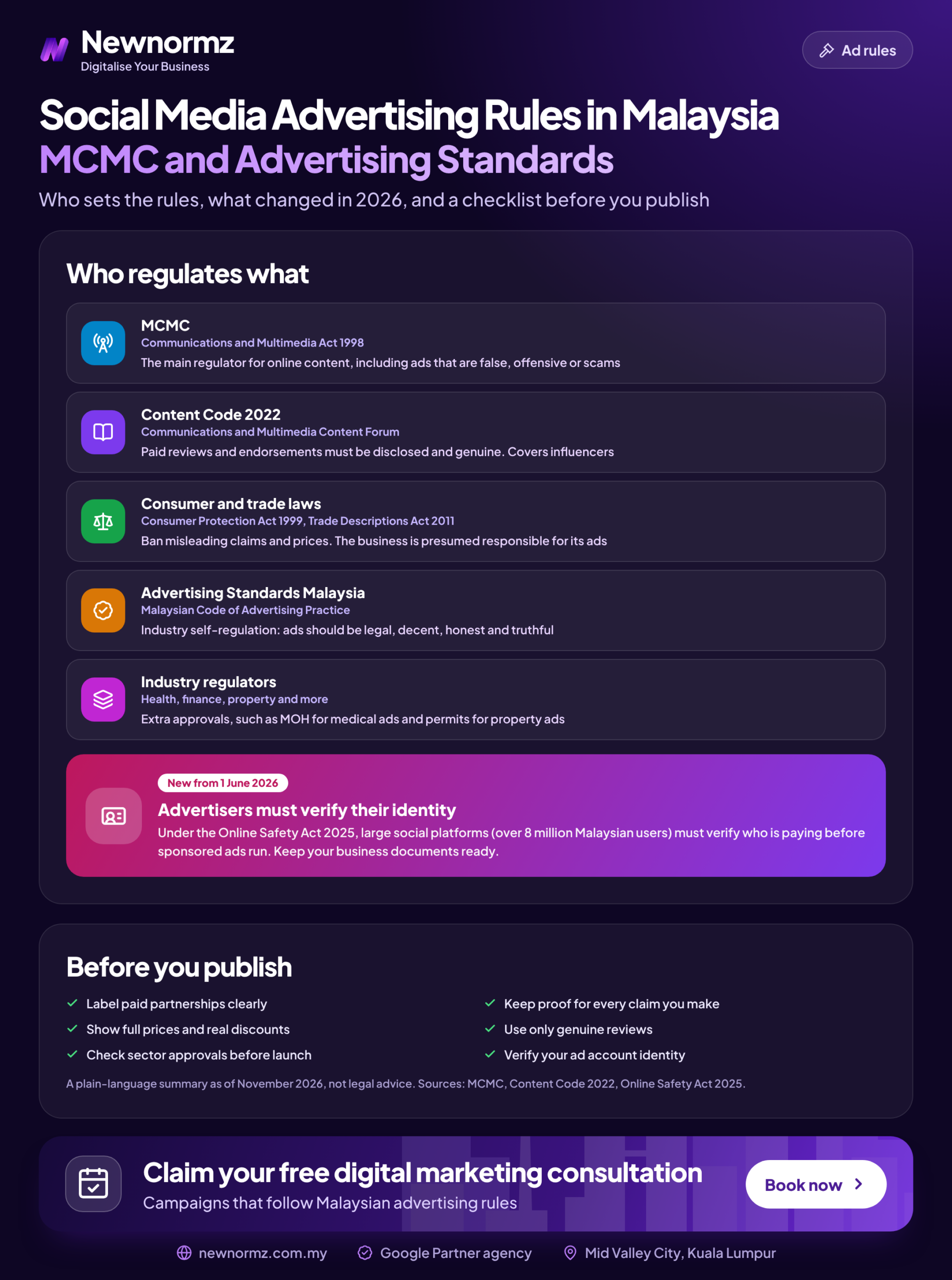
The social media licence Malaysia advertisers keep hearing about is MCMC’s licensing framework, which took effect in 2025 and applies to social media and messaging platforms above a user threshold. The Online Safety Act 2025 Malaysia introduced also puts its duties on licensed platform providers: systems for harmful content, user reporting and child safety. Neither one asks a bakery in Puchong or a clinic in PJ to hold a licence before boosting a post. Our guide to Malaysia’s social media licensing rules explains what the licence covers in more detail.
That doesn’t mean MCMC is irrelevant to MCMC social media advertising. Ads are still content. The Communications and Multimedia Act 1998 covers content that is offensive, false or harmful, and the industry Content Code includes advertising guidelines. In practice, a brand meets MCMC through a public complaint, usually after a mass-report, not through a licensing process.
The practical takeaway: you need no MCMC licence to run ads in Malaysia, but anything you publish can still be reported to MCMC.
Why Meta and TikTok Will Stop You Before Any Regulator Does
Every ad goes through automated (and sometimes human) review before it delivers. Meta’s Business Help Centre says most ads are reviewed within 24 hours. A regulator might act weeks after a complaint. The platform acts before your first impression, every single time. Nearly every Facebook ad rejected Malaysia advertisers show us was pulled for breaking Meta policy, not Malaysian law, and that happens weekly while a regulator’s letter is rare.
The usual triggers are before-and-after images, copy that implies something about the viewer (“Struggling with acne?”), weight-loss and health claims, and financial offers. The Meta Special Ad Categories add another layer. Ads about credit and financial products, employment, housing, or social issues, elections and politics must be declared, and targeting options are restricted for some of them. Check whether your Ads Manager asks you to declare one for your campaign, because the rollout differs by country. The TikTok ad policy Malaysia advertisers deal with works the same way: industry-specific restrictions and a review before delivery, with some categories not allowed at all.
From our audits
Repeated rejections do more damage than any single one. Platforms track an account’s policy history, and an account with a string of rejected ads can find itself restricted from advertising. The ad that was “only slightly over the line” costs you that one campaign and also puts the account you need for every future campaign at risk.
Claims That Get Malaysian Brands Into Trouble on Social
Most problems come from the claim, not the format. A Consumer Protection Act misleading advertisement complaint rarely starts with the video edit; it starts with one line of copy nobody could prove. Below are the claims we see most often, the law or code each one touches, and a safer way to say it. If your team produces a lot of creative, build these rewrites into your content creation process so they are applied at the brief stage.
| Risky claim | What it touches | Safer rewrite |
|---|---|---|
| “Was RM199, now RM99” when RM199 was never actually charged | Trade Descriptions Act 2011 (false price indications), Consumer Protection Act 1999 | Use a real previous price you can show records for, or say “Launch price RM99 until 30 Nov” |
| “No.1 in Malaysia” or “the best clinic in KL” | Consumer Protection Act misleading conduct, ASA code (substantiation) | State the proof: “Rated 4.9 from 600 Google reviews” (your real numbers), or drop the ranking |
| Before-and-after photos for skin, weight or hair | Meta and TikTok health policies, medical advertising rules | Show the process, the practitioner or the product, not a body transformation |
| “Cures eczema”, “lowers blood sugar”, “boosts immunity” | Medicine (Advertisement and Sale) Act 1956, platform health policies | Only claims your regulatory approval allows, worded exactly as approved |
| “Halal”, “Made in Malaysia” or “Japanese formula” without certification or origin proof | Trade Descriptions Act 2011 (halal and origin descriptions) | Show the certification you hold. Name origin only for what is actually made or sourced there |
| “Only 3 slots left!” on a countdown that resets daily | Consumer Protection Act false or misleading representation | Use a genuine deadline: “Promo ends 12.12, 11:59pm” |
| “Earn RM5,000 a month from home” or “8% guaranteed returns” | Securities Commission oversight, platform financial and scam policies | No income or return figures unless a licensed entity owns and approves the ad |
Regulated Industries: What to Clear Before the Ad Goes Live
In sensitive categories, the order of work matters. Clear the claim first, then brief the creative. Briefing the creative first and asking for approval afterwards usually means reshooting.
Health, Supplements, Aesthetics and Clinics
Under the Medicine (Advertisement and Sale) Act 1956, ads for medicines and certain health products need what marketers usually call medicine advertisement board approval (the body is formally the Medicine Advertisements Board) before they run, and some conditions cannot be advertised at all. Approved ads typically carry an approval reference (often shown as a KKLIU number). Private clinics, aesthetic centres and hospitals follow separate advertising rules under the Private Healthcare Facilities and Services Act 1998. The healthcare advertising rules Malaysia applies do get updated, so confirm the current requirements with the Ministry of Health rather than relying on any article, including this one.
Our team works with healthcare brands such as Sunway TCM Centre and Sunway Medispa on SEO, and the same discipline applies on social. Sensitive claims get cleared before anyone writes a hook.
Decision rule: if the ad mentions a condition, a treatment result or a product that treats something, get approval or written regulatory advice before you build the creative.
Finance, Investment and “Finfluencer” Content
The Securities Commission Malaysia oversees investment promotion and has publicly warned against unlicensed investment advice on social media. On Meta, financial products sit inside the Special Ad Categories, and investment ads face heavy scam-ad scrutiny, so expect slower reviews and more rejections. A creator talking up your fund or trading app is still promoting an investment.
Decision rule: if the ad mentions returns, earnings or investment, a licensed party has to own and approve it.
Property
Property ads land in Meta’s Housing category, which limits targeting by age, gender and postcode where the category applies. Developers’ ads have generally needed to show their advertising and sales permit details. Confirm the current display requirement with KPKT before you finalise the creative. Strategy for property campaigns is covered in our separate property article. For compliance, the rule is short.
Decision rule: no permit details confirmed, no ad.
Influencer and KOL Posts: Disclosure Is Your Job Too
Brands looking up influencer paid partnership disclosure Malaysia rules usually expect to find a statute. There isn’t one. That doesn’t make undisclosed paid posts safe. A paid recommendation dressed up as an honest opinion is a textbook misleading-advertising risk under consumer protection principles and the ASA code’s honesty standard. The platforms also require disclosure: Meta’s Branded Content tools add a “Paid partnership” label, and TikTok has a content disclosure toggle for branded content.
Newnormz take
Once you boost a creator’s post or run it as a Spark Ad or partnership ad, it is your ad. Any overclaim the creator made is now running on your budget and under your brand name. Put the disclosure requirement and an approved-claims list into the KOL contract, and review the final cut before you put money behind it.
3R, Festive Creative and Multilingual Ads: The Malaysia-Specific Risk
Race, religion and royalty (the 3Rs) are the quickest route to a mass-report, a screenshot going round WhatsApp groups and an MCMC complaint. Festive campaigns concentrate that risk. Raya, Chinese New Year and Deepavali creative needs a cultural check by someone from that community, not just a translator. Common problems include using religious symbols as props, food or attire shown in the wrong context, and humour that lands in one community and offends another.
Language adds a second risk: claim drift. “Helps you feel lighter” in English can become something closer to “makes you slimmer” in the BM or Chinese version, and that is now a weight-loss claim. Every language version is a separate ad, so review each one against the approved claim.
Here is what a rejection can cost in a festive window. Every number below is a labelled example, not a market rate.
| Example: RM6,000 over 10 days before Hari Raya | As planned | Rejected on day 2 |
|---|---|---|
| Days live | 10 days at RM600/day | Day 1, then off days 2 to 4 for the rework, relaunch days 5 to 10 |
| Example CPM (cost per 1,000 impressions) | RM15 throughout | RM15 on day 1, RM22 for days 5 to 10 as competition peaks |
| Spend | RM6,000 | RM600 + RM5,400 squeezed into 6 days |
| Impressions | About 400,000 | About 285,000 (roughly 29% fewer for the same money) |
That gap understates the damage. The relaunched ad starts the learning phase again, and pushing 50% more budget per day into it usually raises costs further. You also lose three of the highest-intent shopping days. To see how that hits revenue rather than reach, put your own numbers through the social media ROAS calculator.
A Pre-Launch Compliance Check Your Team Can Run in 15 Minutes
This is the routine we recommend for every ad set, done in this order. It fits alongside a broader step-by-step social media audit that covers the account as a whole.
Identify the industry layer
Health, finance, property or none? If one applies, stop and confirm the approval exists before you go any further.
List every claim and its proof
Write each claim in the copy, the visual and the voiceover in one column, with the evidence next to it. Any claim without evidence gets cut.
Check price and promo wording
Real prior prices, real end dates, terms visible or linked. This is where most Trade Descriptions Act advertising problems start.
Run the platform policy check
Read the relevant Meta or TikTok policy page for your category and decide whether a Special Ad Category applies before you build targeting.
Confirm creator disclosure
The paid partnership label or branded content toggle is on, and the creator’s script matches your approved claims.
Review culture and language per version
A native speaker checks the EN, BM and Chinese versions separately for 3R sensitivity and claim drift.
Save approvals and evidence
Keep approvals, certificates, price records and creator contracts in one shared folder, named by campaign. If a complaint arrives, you answer it in minutes.
Check the Meta Ad Library
See what competitors in your category are running. Ads that have stayed live for months show you which claim styles are getting through review.
Lead forms and WhatsApp chats collect personal data, which brings in the PDPA. That needs its own process and is outside this checklist.
What to Do When an Ad Is Rejected or Reported
- Open Account Quality in Business Support Home and read the exact policy reason. “Health and wellness” and “personal attributes” call for very different fixes.
- Edit the ad to remove the problem. Resubmitting it unchanged only adds to your account’s rejection history.
- Request a review once if you believe the ad complies, and say clearly which policy it meets.
- Don’t open new ad accounts or pages to get around the decision. Platforms treat that as circumvention, and it can get the whole business restricted.
If the problem is a public complaint rather than a rejection, reply calmly in the comments and move the details to private messages. Our guide to handling complaints on social covers the tone and the reply times to aim for.
Keeping Compliance From Slowing Your Campaigns
Teams often respond to a rejection by testing less: one safe ad, approved by three people, left running until it fatigues. That trades a compliance risk for a performance problem. On Meta and TikTok, creative volume does most of the targeting work, so the aim is to stay compliant at full testing speed.
Build a pre-approved claim library: every claim you are allowed to make, worded exactly, with its proof attached. Then write hook variations that only draw from that library. Writers can produce 20 versions without each one going back for legal review, because the risky part was cleared once. Our guide to planning a social campaign properly shows where this fits in the campaign timeline.
A rejected or reported ad brings in zero enquiries, however good the hook was.
That is why we judge social on enquiries, not views, and why compliance belongs inside the creative process rather than at the end of it. If you would rather hand paid social to a social media marketing agency in Malaysia that already works this way, our team handles campaign management, active social listening and community management, so reports and comments are watched after launch, not only before it. We also run social alongside SEO and Google Ads, which keeps your claims consistent across every channel.
FAQ
Is there a specific social media advertising law in Malaysia?
No. Social ads are covered by general laws such as the Consumer Protection Act 1999, the Trade Descriptions Act 2011 and the Communications and Multimedia Act 1998, by sector regulators, and by the ASA Malaysia code. Platform policies sit on top of all of these and are usually the strictest layer.
Does my business need an MCMC licence to advertise on social media?
No. The social media licence applies to platform providers above MCMC’s user threshold, not to brands buying ads. Your content can still be reported to MCMC if it is offensive, false or harmful.
Does the Online Safety Act 2025 apply to businesses running ads?
Not directly. Its duties mainly fall on licensed platforms, which must manage harmful content and user reports. In practice, that means platforms may become faster at acting on reported ads, so careless creative carries more risk.
Do influencers in Malaysia have to disclose paid posts?
Yes, in practice. There is no standalone influencer disclosure statute, but Meta and TikTok require paid content to be labelled, and hiding a paid relationship risks breaching consumer protection and ASA honesty principles. The brand shares that risk, especially if it boosts the post.
Do health and beauty ads on Facebook need approval in Malaysia?
Many do. Ads for medicines and certain health products need Medicine Advertisements Board approval, and healthcare facilities follow their own advertising rules. Check your product’s status with the Ministry of Health before you build the creative.
What happens if a social media ad breaks Malaysian advertising rules?
The most likely result is that the platform rejects the ad or restricts the account. Beyond that, a complaint can lead to action by KPDN, MCMC, ASA Malaysia or the relevant sector regulator, depending on which rule the ad broke.
Why was my Facebook ad rejected when it follows Malaysian law?
Because Meta’s Advertising Standards are stricter than Malaysian law in many areas. Before-and-after images, personal-attribute wording and some health or financial claims can be legal in Malaysia and still break Meta policy. Read the reason in Account Quality and edit the ad before you request a review.
This article is general guidance for marketers, not legal advice. For a specific campaign, check the current rules with the relevant regulator or a qualified lawyer.
Free social media audit
Get your ads, claims and account health reviewed before your next campaign
Newnormz plans, creates and runs social media and paid social for Malaysian brands, and judges every campaign on enquiries, not just views. 5.0 rating from 214+ Google reviews.
Get Your Free Social Media Audit →
No obligation. A strategist will reply within business hours.

Bryan Tan is an SEO Specialist and CEO at Newnormz, helping hundreds of businesses achieve first-page rankings on Google. With a passion for driving organic growth, Bryan blends innovative strategies with hands-on experience to optimize websites for maximum visibility. Always at the forefront of the latest SEO insights and trends, he consistently adapts to the evolving digital landscape.



