Short verdict
Social listening means tracking what people say about your brand, your competitors and your category, then acting on it. For a Malaysian business, the unprompted comment is the most honest market research you will ever get, and you can read it for free. Replying to comments and DMs is not listening. That’s customer service. Listening is when what you read changes an ad, a price page, a product or a sales script. Free tools and a weekly routine are enough for most SMEs. The work that matters is setting up the right keywords in English, BM and Chinese.
Social Listening vs Social Monitoring: Monitoring Answers Comments, Listening Changes Decisions
Most businesses already do monitoring and call it listening. Someone checks the Meta Business Suite inbox, answers the “how much ah?” comments and hides the spam. That’s useful community management, but it only reacts to people who tagged you or wrote on your page.
| Social monitoring (brand monitoring) | Social listening | |
|---|---|---|
| Question it answers | Who mentioned us, and have we replied? | What does the market keep saying, and what should we change? |
| Time horizon | Minutes to hours | Weeks to months (patterns) |
| Who owns it | Community or customer service team | Marketing lead, with sales, product and service |
| Typical output | Replies, hidden comments, escalations | New ad hooks, FAQ changes, product fixes, positioning |
| Example | Answering “got halal cert or not?” under a post | Noticing that question appears weekly and putting the halal logo in the first second of every ad |
If you’re not sure which one you’re doing now, start with a full social media audit. It shows you which conversations your team sees and which it misses.
How Social Listening Works, From Keyword List to Decision
The social listening process has four parts: decide what to search for, decide where to look, tag what you find, and give every recurring theme an owner. Social media listening tools only help with the first three. The fourth is a management habit.
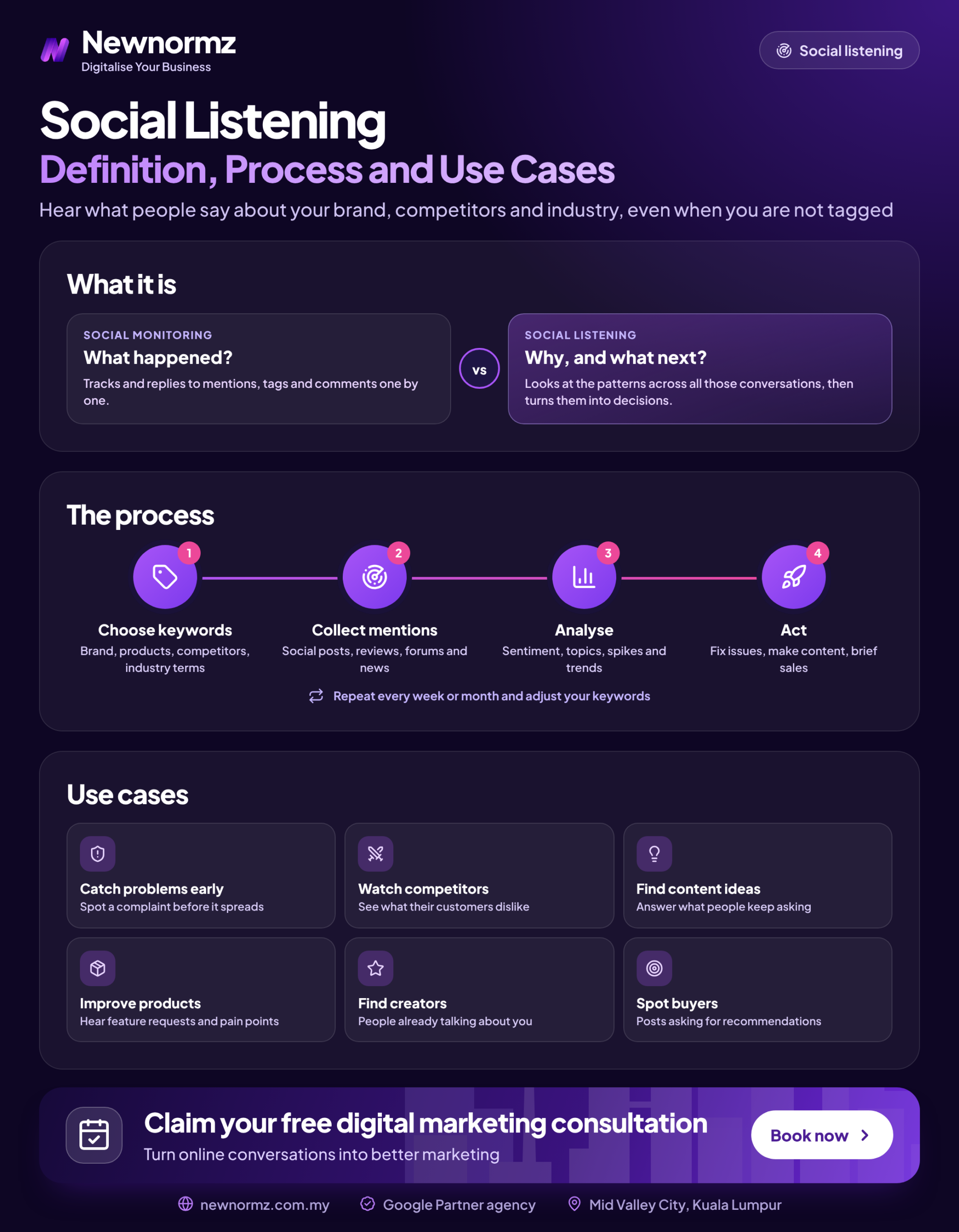
Step 1: Build a keyword list in every language your customers actually type
This step decides what you can see. Malaysians don’t type the way your brand guidelines are written. They switch between English, BM and Chinese mid-sentence, misspell your name and use shorthand. Here is an example list for a confinement centre, split into four groups:
| Group | English / BM / Chinese | Manglish, misspellings, shorthand |
|---|---|---|
| Brand | [Your brand name], [brand name in Chinese characters], your @handles | Name without spaces, common typos, initials people use |
| Competitor | [Competitor A], [Competitor B], plus their Chinese names | Their nicknames and misspellings |
| Category | confinement centre, pusat berpantang, 月子中心, 坐月子 | confinement center, confinment, pantang, “CL” (confinement lady) |
| Pain point | price, harga, halal, 价钱, review | “worth it ah”, “got halal or not”, “berapa ya”, “pricey sia” |
Boolean search queries combine these terms with AND (both must appear), OR (either can appear) and NOT (exclude). A starter category query might look like this:
(“confinement centre” OR “confinement center” OR confinment OR “pusat berpantang” OR pantang OR 月子中心 OR 坐月子) AND (price OR harga OR berapa OR “worth it” OR halal OR 价钱) NOT (jawatan OR hiring)
Paid platforms take that query directly. In TikTok search and Xiaohongshu search you run each phrase by hand, so save your top ten as a checklist.
Step 2: Decide where to listen, including places tools can’t reach
Public sources are the easy part: TikTok comments and search, Instagram, Facebook pages, Xiaohongshu (RedNote), YouTube comments, forums such as Lowyat.NET, and Google reviews. Google Alerts picks up news, blogs and some forum pages, but not most social posts, so don’t treat it as social coverage.
The harder part is dark social. A lot of Malaysian buying conversation happens in WhatsApp groups and private Facebook Groups: the mothers’ group, the condo residents’ group, the alumni chat. No tool can legitimately read private WhatsApp chats, and you shouldn’t want one that claims to. You capture this conversation through the people who hear it. Give your sales and customer-service staff a shared “what customers asked this week” log, with columns for the question, the channel, the language and whether the customer mentioned a competitor. On WhatsApp Business, labels for recurring question types make this quicker.
Step 3: Tag what you find by theme, sentiment and intent
Sentiment analysis sorts each mention into positive, negative or neutral. Automated sentiment often misreads Manglish and sarcasm. “This one damn power lah” is praise. “Wah, very fast service hor, three days no reply” is a complaint. Let the tool do a first pass, then have a person check a sample every week.
Sentiment alone rarely tells you what to do. Intent tags do. Use a small, fixed set: objection, feature request, complaint, buying signal and competitor praise. Over a month the counts per tag become a priority list. For deeper analysis of this data, see our guide to mining social data for audience insight.
Step 4: Turn each theme into an owner and an action
Rank the themes
Pick the three tags that came up most often or carry the most risk this week. Drop everything else.
Assign a department
Objections go to marketing, buying signals to sales, feature requests to product, and complaints to service.
Write one concrete action
“Add halal certificate to ad frame one”, not “address halal concerns”.
Set a due date and check it
Review last week’s actions at the start of each session. If the same theme keeps returning, the fix didn’t work.
Social Listening Use Cases That Actually Move Revenue
Mining comments for ad hooks and objections
Recurring questions are ready-made hooks. If people keep asking “halal or not?” or “berapa for 28 days?”, answer that in the first three seconds of the ad and in the caption, not in a reply buried under the post.
Worked example (illustrative numbers, not a benchmark): say your Meta lead ads cost RM40 per lead and 1 in 5 leads qualifies. That’s RM200 per qualified lead. Listening shows half your comments ask about price or halal status, so the new creative answers both up front. If qualification rises to 1 in 3 at the same cost per lead, your cost per qualified lead falls to about RM120. The ad didn’t get cheaper. It got more honest about who it’s for.
The same questions should feed your blog, FAQ page and video scripts. That’s where content marketing services earn their keep: one recurring objection can become a Reel, a carousel and a landing page section.
Reading competitors’ comment sections and the Meta Ad Library
Competitor analysis on social media starts in their comments. Whatever their customers complain about (slow delivery, hidden fees, rude staff) is a gap you can fill in your own messaging. Then open the Meta Ad Library, search their page and look at which ads have been running longest. An ad that has been live for months is usually one that pays for itself, which tells you which angle is working for them.
Catching a complaint before it becomes a thread
Reply speed and tone decide whether a complaint stays one comment or turns into a pile-on. In Malaysia a screenshot can jump from TikTok to a dozen WhatsApp groups within hours, and at that point you can’t reply to it any more. Listening for your brand name plus words like “scam”, “tipu”, “worst” or “jangan beli” gives you early warning. Our guide on handling complaints on social media covers the response playbook.
Spotting B2B buying signals
For B2B brands, listening picks up people asking for supplier recommendations on LinkedIn or in industry groups. We’ve covered this in depth in finding B2B leads in comment sections.
Planning festive campaigns from last year’s conversation
Go back to what people said around Hari Raya, Chinese New Year, Deepavali and 11.11 last year. Look at which gifts they hunted for, which delivery cut-offs they worried about and which competitor promos they shared. Ad costs and competition rise around these dates, so a creative brief written in advance from real comments beats a rushed one written in the festive week.
From our audits
The mistake we see most often is a brand that tracks only its own name, and only in English. That misses most of the category conversation, every misspelt mention and everything said in BM or Chinese. The fix is four keyword groups (brand, competitor, category, pain point) in three languages, plus the slang and typos your customers really use.
Do You Need a Paid Social Listening Tool?
Usually not at first. For social listening in Malaysia, the keyword list and the internal question log matter more than the software. Use these rules:
Brandwatch, Meltwater, Talkwalker, Sprout Social and Brand24 are examples of paid social listening tools. Coverage and pricing differ, so in any demo, test real BM, Manglish and Chinese queries from your own category before you sign. For a wider comparison, see our roundup of free and paid social media analytics tools.
Setting Up Social Listening in One Week: A Starter Routine
A social listening strategy doesn’t need a big launch. It needs a routine your team can keep up. Here’s a five-day start:
Day 1: Keyword list in three languages
Fill in the four groups from Step 1. Ask your sales team for the slang and typos they see.
Day 2: Sources and saved searches
Set up Google Alerts, bookmark TikTok and Xiaohongshu searches, and list the competitor pages and forums you’ll check.
Day 3: Shared tagging sheet
Use columns for date, source, language, quote, sentiment and intent tag. Keep the tag list fixed.
Day 4: Sales and customer-service question log
This is your window into WhatsApp and private groups. Five minutes a day per person is enough.
Day 5: First 30-minute review and three actions
Rank the themes, then give each of the top three an owner and a due date.
On privacy: listen to public conversation, and don’t scrape or store personal data beyond what you need to act. Under the PDPA, a theme and an anonymised quote are usually all a marketing decision requires.
Keeping this going every week, across three languages and several platforms, is real work. It’s the first thing to slip when the team gets busy, which is why many brands hand it to a social media marketing agency in Malaysia that already runs listening alongside its campaigns.
FAQ
What is the difference between social listening and social monitoring?
Monitoring tracks and replies to individual mentions, while listening looks for patterns across many conversations and changes decisions because of them. Monitoring works in hours. Listening works over weeks and feeds marketing, sales and product.
Are there free social listening tools?
Yes. The Meta Business Suite inbox, Google Alerts, the Meta Ad Library and native TikTok and Xiaohongshu search are all free. They take more manual effort, but for a business with modest mention volume they cover most of what you need.
Can social listening track WhatsApp groups or private Facebook groups?
No, and no tool should claim it can. Those conversations are private. The practical substitute is a shared log where sales and customer-service staff record the questions customers bring from those groups.
Is social listening legal in Malaysia under the PDPA?
Listening to public conversation for marketing insight is generally fine. The risk starts when you collect and store personal data. Keep themes and anonymised quotes, avoid scraping profiles, and check with a legal adviser if you plan to contact individuals or build databases.
How often should a small business do social listening?
Once a week for 30 minutes is enough for most small businesses. Check daily for complaint keywords, and increase the frequency during launches and festive campaigns, when conversation moves faster.
Free social media audit
Find out what your customers are already telling you, and turn it into enquiries
Newnormz plans, creates and runs social media and paid social for Malaysian brands, and judges every campaign on enquiries, not just views. 5.0 rating from 214+ Google reviews.
Get Your Free Social Media Audit →
No obligation. Prefer WhatsApp? Message us at +60 17-588 2291.

Bryan Tan is an SEO Specialist and CEO at Newnormz, helping hundreds of businesses achieve first-page rankings on Google. With a passion for driving organic growth, Bryan blends innovative strategies with hands-on experience to optimize websites for maximum visibility. Always at the forefront of the latest SEO insights and trends, he consistently adapts to the evolving digital landscape.