
Key takeaways
- ✓Here is how to respond to negative comments: reply in public within hours, name the specific problem, move personal details to DM or WhatsApp, then come back and close the loop in public.
- ✓Reply to genuine complaints. Hide abuse and repeat trolls, and delete spam, scam links and posted personal data. Anything touching 3R (race, religion, royalty), legal threats or health claims goes to a senior person before anyone replies.
- ✓Deleting a real complaint, or answering it with a copy-paste “please PM us”, usually does more damage than the comment did.
- ✓Comments on your ads are the blind spot most teams miss. Until someone replies, you are paying to show an unanswered complaint to everyone who sees the ad.
- ✓Reply in the language and tone the customer used, whether that’s English, Bahasa Malaysia, Chinese or Manglish.
Picture this. A customer posts on your Facebook Page on 11 November: their 11.11 order still hasn’t shipped, and nobody has replied. Two days later the comment is still sitting there, and the page has published three more promo posts since. Each new post now has someone asking “Admin, why ignore the complaint?” underneath. The late parcel was a small problem. The silence turned it into a public one.
This guide is for Malaysian business owners and the admins who run their pages. It covers what to write, when to hide or delete a comment, and how to set up a reply policy so nobody has to make it up on a Saturday night.
How to Respond to Negative Comments: The 4-Part Reply That Works on Every Platform
When you’re responding to negative feedback on social media, you are writing for two audiences. One is the unhappy customer. The other is the hundreds of people who will read the thread later and decide from your reply whether to buy. The same four-part structure works for both of them on Facebook, Instagram, TikTok and Google.
Acknowledge the specific issue
Repeat the actual problem back to them (“five days without a tracking number”), not a generic “your experience”. This shows you read the comment, and readers can tell straight away whether you did.
Take responsibility, or clarify without arguing
If you got it wrong, say so in one sentence. If the customer has a fact wrong, state the correct fact once, calmly, and don’t add “as stated in our T&Cs”.
Move personal details to DM or WhatsApp
Order numbers, phone numbers and addresses never belong in a public thread. Name the exact channel and, if you can, the person who will follow up and by when.
Close the loop in public
Once it’s fixed, come back to the original comment and say so. This is the step almost everyone skips, and it’s the one that turns a complaint into proof that you deal with problems.
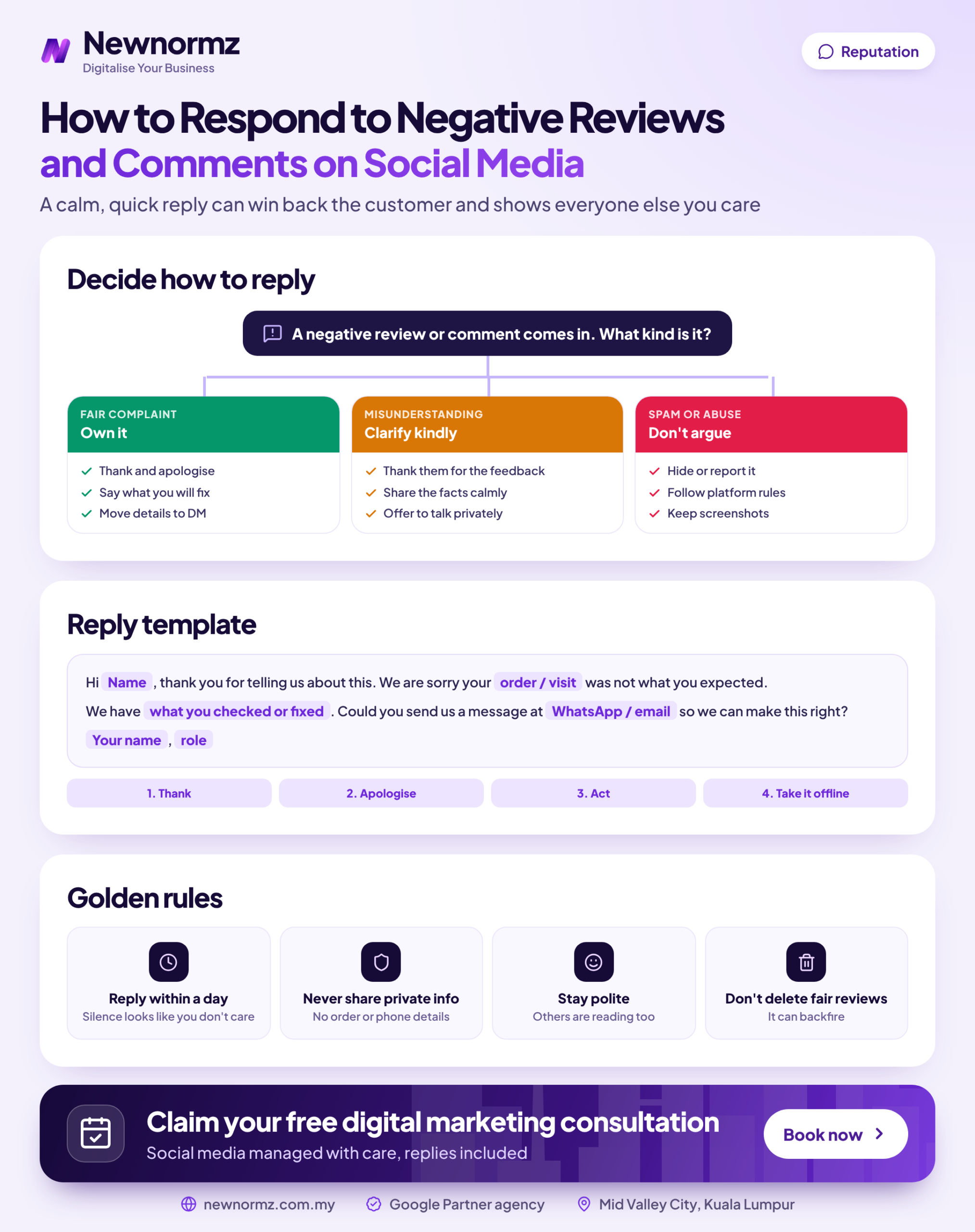
Here’s how that looks in practice. The comment: “Ordered on 11.11, still no tracking number. Useless.” The reply: “Hi Mei Ling, sorry, five days without tracking isn’t good enough. Our courier missed two pickups this week and we’re clearing the backlog today. Could you WhatsApp your order number to [your number]? Farah from our team will send your tracking link before 6pm.” It’s short and specific, admits the problem, and gives a named next step.
First, Triage the Comment: Reply, Hide, Delete or Escalate
Not every negative comment deserves the same treatment. Should you delete negative comments? Almost never if they’re genuine complaints, but sometimes yes. Decide the comment type first, then act.
Whether to hide or delete Facebook comments comes down to one question: is the comment abusive, or does it just make you look bad? Abuse can be hidden or deleted. Criticism stays up and gets a reply. For the wider question of running support through your social channels, see our guide to handling customer service on social.
9 Mistakes That Turn One Bad Comment Into a Pile-On (and the Fix for Each)
When we audit Malaysian brand pages, the comments that caused real damage usually weren’t the angriest ones. They were the ones that got a bad reply, or none at all.
A negative comment rarely damages a brand on its own. The reply is what does the damage.
Mistake 1: Deleting Legitimate Complaints
✗ Deleting a real complaint to keep the page “clean”
The customer notices within minutes and comes back angrier, often with a screenshot of the original comment. The second post usually says “they deleted my comment”, which hurts more than the first one did.
✓ The fix
Reply, and keep Hide for abuse. Know the difference. On Facebook, a hidden comment is still visible to the person who wrote it and their friends, so they usually don’t realise it’s hidden. Deleting removes it for everyone, and the commenter can tell. On Instagram, Restrict works in a similar way: the restricted person’s new comments are visible only to them unless you approve them.
Mistake 2: The Copy-Paste “Sorry for the Inconvenience, Please PM Us”
✗ Pasting the same line under every complaint
When the same sentence appears under 15 complaints, readers can see nobody actually read them. It also tells the customer to start over in a private channel, with no sign that anyone will be waiting there.
✓ The fix
Mention the specific issue in your first sentence. Then name the channel and the person: “WhatsApp us at [number] and Aisyah will check your refund today.” Use WhatsApp Business labels to tag complaint chats so they don’t get lost among sales enquiries.
For most Malaysian customers, WhatsApp is where the problem actually gets solved, so it pays to set it up properly for moving complaints to WhatsApp, with quick replies and a named owner.
Mistake 3: Arguing the Facts in Public
✗ Proving the customer wrong, point by point
Even when you’re right, a long rebuttal reads as a business picking a fight with a customer. You can win the argument and still lose everyone watching it.
✓ The fix
State the fact once, without blame: “Our Bangsar outlet closes at 10pm on weekdays, so we’re sorry the timing didn’t work out.” Then offer to check their case privately. Don’t reply a second time in public.
Mistake 4: Asking for IC Numbers, Phone Numbers or Order Details in the Comments
✗ “Please comment your IC and phone number so we can check”
This puts the customer’s personal data on a public page, where scammers can scrape it. It also raises questions under Malaysia’s Personal Data Protection Act (PDPA) about how your business collects personal data.
✓ The fix
Always send them to DM or WhatsApp for anything personal. If a customer posts their own details publicly, hide or delete that comment and explain why in your reply: “We’ve hidden your comment to protect your details. We’ve messaged you instead.”
Mistake 5: Replying Only in English to a BM or Chinese Comment
✗ A stiff English reply to “Bos, barang tak sampai lagi ni”
Replying in a different language or tone feels distant, and in a complaint thread distance comes across as not caring. A formal corporate reply to a casual Manglish comment has the same problem.
✓ The fix
Reply in the language the customer used, and match how formal or casual they were (polite, but not robotic). Give each language a named owner, or keep a reviewed template set in English, BM and Chinese (see the table below) so whoever is on shift isn’t relying on machine translation.
Mistake 6: Ignoring Comments on Ads and Dark Posts
✗ Only checking comments on the Page feed
Comments on ads sit on the ad post itself, and dark posts (ads that never appear on your Page) don’t show up in the feed at all. Admins scrolling the Page miss them, sometimes for the whole time the campaign runs.
✓ The fix
While ads are live, check comments every day in the Meta Business Suite inbox (make sure ad comments are included in your filter), and open each live ad’s post from Ads Manager to check its comments. When you refresh creative because of creative fatigue, check the comments on the old ads you keep running as well.
Here’s the cost, with example numbers. Say you put RM3,000 behind a promo post, and at an example CPM (cost per 1,000 impressions) of RM15, that buys about 200,000 impressions. If the top comment is an unanswered “Ordered 2 weeks ago, no reply from admin”, everyone who opens the comments reads that before your offer. You’re paying to advertise the complaint. Meta’s Business Help Centre also says the quality ranking in its ad relevance diagnostics is based partly on how people respond to the ad, including negative feedback. That’s one more reason not to leave an angry thread running under paid reach.
Mistake 7: Answering Hours or Days Late
✗ Nobody owns the comments after 6pm, at weekends or during festive breaks
Complaints peak exactly when teams are thinnest: courier delays after 11.11 and 12.12, and closed outlets and slow replies over Hari Raya and Chinese New Year. A complaint that sits all weekend picks up replies from other customers before you’ve said anything.
✓ The fix
Set a first response time target your team can actually keep. In our experience, within a few working hours on weekdays and the same day at weekends is achievable for most SMEs. Write a festive-season rota before the campaign calendar starts. Good community management depends on having enough people on shift.
Automation can buy you time with an instant acknowledgement, but only if it doesn’t read like a bot pretending to care. Our guide on automated replies that still sound human covers where to draw that line.
Mistake 8: Letting the Intern Reply to a Healthcare, Finance or Legal Complaint
✗ Discussing treatment, results or account details in a public reply
Clinics, aesthetic centres, insurers, financial services and property developers all work under extra advertising and confidentiality rules. A well-meant reply like “your results should show in 2 weeks” can create a problem that’s far bigger than the original comment.
✓ The fix
Write an escalation list that names who approves replies on treatment, outcomes, money and legal matters. Until that person approves, the public reply is only an acknowledgement and an invitation to talk privately, with no details about the case.
Mistake 9: Never Closing the Loop
✗ Fixing it privately and leaving the public thread hanging
The customer got their refund, but anyone reading the thread later still sees an angry comment and “please PM us”. They’ll assume nothing happened.
✓ The fix
Go back to the original comment: “Glad we sorted the refund, Jason. Thanks for your patience.” Often the customer replies or reacts, and now the thread shows a problem being solved. That builds more trust than a page with no complaints at all.
Negative Review Response Templates in English, Bahasa Malaysia and Chinese
If you’re working out how to respond to negative reviews and comments without starting from a blank page, start here. These templates cover how to reply to bad reviews in the five situations Malaysian brands deal with most. Replace everything in brackets. Each template moves personal details to WhatsApp, in line with Mistake 4.
| Situation | English | Bahasa Malaysia | 中文 |
|---|---|---|---|
| Late delivery | Hi [Name], sorry your [11.11] order hasn’t arrived yet. We know you were counting on it. Could you WhatsApp your order number to [number]? [Staff name] will check with the courier and update you today. | Hai [Nama], maaf pesanan [11.11] anda masih belum sampai. Boleh WhatsApp nombor pesanan anda ke [nombor]? [Nama staf] akan semak dengan kurier dan maklumkan kepada anda hari ini. | [名字]您好,很抱歉您的[11.11]订单还没送到。麻烦您把订单号WhatsApp到[号码],[员工名字]今天会跟快递公司确认并回复您。 |
| Product fault | Hi [Name], a [product] that [specific fault] isn’t acceptable, and we want to make it right. Please WhatsApp a photo and your order number to [number] and we’ll arrange a replacement or refund. | Hai [Nama], [produk] yang [masalah] memang tidak sepatutnya berlaku, dan kami mahu betulkan. Sila WhatsApp gambar dan nombor pesanan ke [nombor], kami akan uruskan penggantian atau bayaran balik. | [名字]您好,[产品]出现[问题]确实不应该,我们会负责处理。请把照片和订单号WhatsApp到[号码],我们会为您安排更换或退款。 |
| Rude staff | Hi [Name], thank you for telling us. That’s not how anyone should be treated at our [outlet]. Our manager [Name] would like to hear what happened. Could you WhatsApp [number] with the date and time of your visit? | Hai [Nama], terima kasih kerana memberitahu kami. Layanan begitu bukan cara kami di cawangan [lokasi]. Pengurus kami, [Nama], ingin tahu apa yang berlaku. Boleh WhatsApp [nombor] dengan tarikh dan masa lawatan anda? | [名字]您好,谢谢您告诉我们。这不是我们希望顾客在[分店]受到的对待。经理[名字]想了解详细情况,方便您把到店日期和时间WhatsApp到[号码]吗? |
| Fake or unfounded review | Hi [Name], we take every review seriously, but we can’t find an order or booking under this name. If we’ve missed something, please WhatsApp [number] and we’ll look into it straight away. | Hai [Nama], kami ambil serius setiap ulasan, tetapi kami tidak menemui sebarang pesanan atau tempahan atas nama ini. Jika kami terlepas pandang, sila WhatsApp [nombor] dan kami akan semak segera. | [名字]您好,我们重视每一则评价,但查不到这个名字的订单或预约记录。如果是我们遗漏了,请WhatsApp到[号码],我们会马上跟进。 |
| Google Business Profile review | Thank you for the feedback, [Name]. You’re right that the wait on [day] was too long. We’ve since added [a second counter] at peak hours. We’d like your next visit to be better, so please call or WhatsApp us at [number]. | Terima kasih atas maklum balas anda, [Nama]. Memang benar masa menunggu pada [hari] terlalu lama. Kami kini menambah [kaunter] pada waktu puncak. Sila hubungi atau WhatsApp kami di [nombor] supaya lawatan seterusnya lebih baik. | [名字],谢谢您的反馈。[日期]的等待时间确实太长了,我们已在高峰时段增加了[柜台]。希望您下次有更好的体验,欢迎致电或WhatsApp [号码]联系我们。 |
Treat every negative review response template as a starting point. Before you post, rewrite the first sentence so it names the customer’s actual problem. The same rules cover how to reply to Google reviews, with one difference: the reply stays on your Business Profile for future customers to read, so write it for them as much as for the reviewer. On Google, a reply that mentions what you changed (the extra counter, the new courier) works harder than one that only apologises.
How to Handle Negative Comments on Instagram, TikTok and Facebook: Platform Tools to Set Up Today
Most comment problems can be filtered out before anyone on your team has to see them. Set these up once, then review them every quarter. If you’re wondering how to respond to negative comments on TikTok, the same 4-part reply applies, but the tools below decide how much abuse reaches you first. The same goes for negative comments on Facebook Page posts, which are still where many Malaysian customers complain first.
| Platform tool | What it does | How to use it |
|---|---|---|
| Instagram Hidden Words and Restrict | Filters offensive comments and any custom words or emojis you add. Restrict limits one account’s comments so only they can see them. | Add slurs, scam phrases and competitor spam in English, BM and Chinese. Use Restrict for repeat trolls. |
| Facebook moderation and keyword blocking | Hides comments that contain blocked keywords and filters profanity on your Page. | Block scam terms and links you’ve already seen. Don’t block words like “refund” or “late”, because those are real complaints. |
| Facebook Page recommendations | Facebook’s version of reviews: people say whether they recommend your Page. | Reply to negative ones like any complaint. Report only those that break Meta’s rules. |
| TikTok comment filters | Filters spam, offensive comments and chosen keywords, or holds all comments for your approval. | Use keyword filters on everyday posts. On TikTok, a video reply to a fair complaint can work better than a text reply. |
| Google Business Profile reviews | Lets the owner reply publicly and report reviews that break Google’s policies. You can’t delete reviews yourself. | Reply to every negative review. Report only fake or off-topic ones, and reply to them anyway while Google reviews the report. |
| Meta Business Suite unified inbox | Puts Facebook and Instagram comments and messages in one place. | Make it the one place your team works from, with ad comments included. Assign conversations to named people. |
Platforms rename and move these settings often, so check your own settings before you rely on any of them. A filter you set two years ago may not cover the scam wording going around this month.
When a Negative Comment Becomes a Social Media Crisis
Most complaints stay small if you handle them well. Social media crisis management starts when the conversation moves somewhere you don’t control. Treat any of these as a crisis signal:
Crisis signals
- ✓The same complaint arrives from many unrelated accounts within hours.
- ✓The post is being shared, stitched or screenshotted outside your own pages.
- ✓A journalist, news portal or KOL picks it up or asks you for comment.
- ✓The issue involves 3R, food safety, health or a person getting hurt.
Once any of these signals appears, do three things in this order. First, pause scheduled posts and live ads, because a cheerful promo going out in the middle of a crisis reads as tone-deaf. Second, publish one short holding statement saying what you know, what you’re checking and when you’ll update people, then point every channel to it. Third, set up a single approval chain so that nobody posts anything that hasn’t gone through the same one or two people.
Most crises are visible before they hit your page, on forums, in other people’s TikToks and in group chats. Social listening, meaning tracking mentions of your brand beyond your own posts, gives you that warning. These sentiment analysis tools can flag a sudden rise in negative mentions so you see it within hours instead of days.
Handling this well means monitoring in three languages, getting approvals quickly and replying around the clock for days, and most in-house teams aren’t staffed for that. If that sounds like your situation, a social media agency in Malaysia that already runs community management and active social listening can cover it, so your team can focus on fixing the actual problem.
Write a One-Page Reply Policy Before You Need It
Before you shop around for online reputation management Malaysia services, do the free part first. A Malaysian SME doesn’t need a 40-page manual. It needs one page that anyone on shift can follow. Use this checklist to write it, or to check the policy you already have.
Your one-page reply policy
- ✓Who replies: named people for Page comments, ad comments, DMs and Google reviews.
- ✓Response-time target: for weekdays, weekends and festive periods, with a cover rota.
- ✓Language owners: who checks English, BM and Chinese replies.
- ✓Hide, delete and escalate rules: the five-row triage from this article.
- ✓Approved templates: for your five most common complaints, in each language.
- ✓Escalation contacts: phone numbers for the owner, legal adviser and, if relevant, medical or compliance lead.
- ✓Team wellbeing: rotation limits and a rule that nobody handles abusive threads alone.
From our audits
The most common gap isn’t tone or templates. It’s that nobody is named as owner for ad comments and weekend comments. Page comments on weekdays usually get answered. The complaints that sit for days are almost always under a live ad or posted on a Saturday. Social media should turn attention into enquiries, not just views, and an ignored complaint under a paid post works against that.
Reading hostile comments every day wears people down, and a tired admin writes worse replies. Build in rotation and support, and share our guide on protecting your team from comment burnout with whoever runs the inbox.
If you’re not sure where the gaps are, start with a full social media audit. Include response times, unanswered ad comments and review replies as line items, not just follower growth.
FAQ
Should you delete negative comments on Facebook or Instagram?
No, not if they’re genuine complaints. Reply to them in public instead. Delete only spam, scam links, slurs and posts that expose personal data, and hide or restrict repeat trolls. Deleting a fair complaint usually brings the customer back angrier, often with a screenshot.
How fast should a business reply to a negative comment?
In our experience, aim for within a few working hours on weekdays and the same day at weekends. The exact target matters less than keeping it, including over 11.11, 12.12, Hari Raya and Chinese New Year, when complaints rise and teams are on leave.
Should you reply in public or move it to private messages?
Do both. Reply in public first, then move the details to DM or WhatsApp. The public reply shows other readers that you took it seriously, and the private channel keeps the customer’s personal data off the page. Once it’s resolved, come back to the public thread and say so.
What should you do when a troll keeps commenting on your posts?
Reply once, calmly, then stop engaging and hide or restrict their comments. That one reply is for everyone else reading the thread. If the account posts abuse, threats or other people’s personal data, delete the comments and ban the account.
Do negative comments on Facebook ads hurt ad performance?
They can. Meta’s Business Help Centre says ad quality ranking is based partly on how people respond to an ad, including negative feedback. More directly, an unanswered complaint is the first thing many viewers read, so you’re paying to show it. Check ad comments every day while campaigns are live.
Should you reply in English, Bahasa Malaysia or Chinese if the customer uses another language?
Reply in the language the customer used, and in a similar tone. A BM comment gets a BM reply, and a casual Manglish complaint gets a friendly, plain reply rather than formal corporate English. Keep reviewed templates in each language so replies stay accurate when the usual person is off.
Getting more comments than your team can answer well?
Newnormz runs community management and active social listening as part of its social media service, and judges every campaign on enquiries, not just views. Send us a WhatsApp message and a strategist will reply within business hours.

Bryan Tan is an SEO Specialist and CEO at Newnormz, helping hundreds of businesses achieve first-page rankings on Google. With a passion for driving organic growth, Bryan blends innovative strategies with hands-on experience to optimize websites for maximum visibility. Always at the forefront of the latest SEO insights and trends, he consistently adapts to the evolving digital landscape.



