
Key takeaways
- ✓LinkedIn personal branding for a founder works best as a 90-day operating system, not a posting habit. You fix the profile, set up a weekly content routine and build a reliable way to turn comments into real conversations.
- ✓It takes about 45 to 60 minutes of the founder’s time a week. A team turns a 30-minute weekly voice interview into posts, watches the comments and sorts the DMs.
- ✓Judge it on profile views from target job titles, inbound DMs, conversations moved to a call or WhatsApp, and meetings booked. Follower count is a vanity number.
- ✓Ads are optional. Only put Thought Leader Ads behind a post once it has already earned relevant comments organically.
Picture the night before a big pitch. The prospect’s procurement head opens your LinkedIn and finds a job title, a photo from 2021 and a reshared company announcement from three years ago. Nothing there is wrong, but nothing helps you either. This guide sets out the system we use to fix that. It takes about a week to set up and 90 days to prove, and after that the founder’s profile starts producing conversations.
Before You Start: What LinkedIn Personal Branding Needs From a Founder (and What It Doesn’t)
Most LinkedIn for founders advice assumes the founder has hours a week to write, comment and network. They don’t, and that’s fine. The founder supplies the opinions, the stories and the final approval. Everything else can be run by a team. Thought leadership on LinkedIn means having a clear point of view your buyers recognise. It doesn’t mean sounding clever to other marketers.
What to have in place before the first post
- ✓One clear commercial goal: deals, senior hires, investors or partners. Pick one to lead with.
- ✓A named target reader, written down as job titles and industries (for example, “plant managers and COOs at Malaysian manufacturers”).
- ✓Three content pillars taken from the founder’s real expertise, not from trending topics.
- ✓A fixed 30-minute “voice interview” slot in the founder’s calendar every week.
- ✓One named person who owns drafting, scheduling and comment monitoring.
- ✓A decision on languages: English only, or English plus occasional Bahasa Malaysia or Chinese posts.
- ✓Sign-off rules for regulated topics (finance, healthcare, property, listed-company matters) and for anything that names a client.
Leave follower count off this list on purpose. A founder with 1,500 followers who are all buyers in the right industry will get more meetings than one with 30,000 followers who are mostly other founders and job seekers.
Phase 1 (Week 1): Turn the CEO Profile Into a Sales Asset
Prospects, candidates and investors all check the profile before they reply to anything. Get these LinkedIn profile tips for CEOs done before you publish a single post. If you skip this, every post sends readers to a page that doesn’t convert.
Rewrite the headline, photo, banner and URL
Done when a stranger can tell who you help and with what in five seconds.
Rewrite the About section as a short pitch
Done when it ends with a clear way to start a conversation.
Set up the Featured section
Done when it holds three items that prove the headline.
Step 1: Rewrite the headline for the buyer, not the title
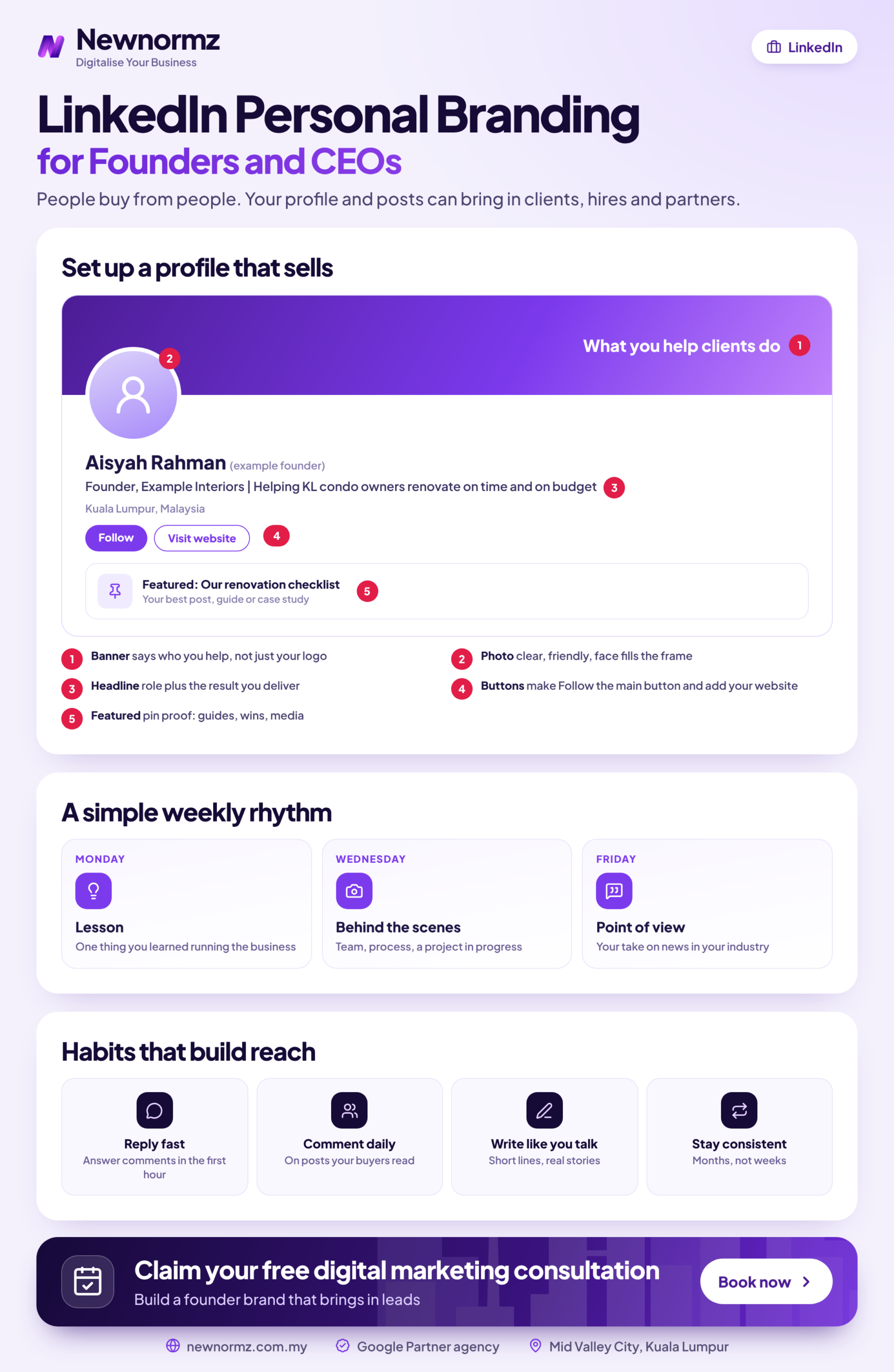
The headline shows up next to every comment you leave, so it does more selling than anything else on the profile. A title on its own wastes it. Use this structure instead: who you help, with what, and one piece of proof.
- Weak (example): “CEO at ABC Engineering Sdn Bhd”
- Strong (example): “Helping Malaysian factories cut unplanned downtime | CEO, ABC Engineering | 20 years in industrial maintenance”
Then fix the rest of the first screen. Claim a custom URL (linkedin.com/in/yourname) for business cards and email signatures. Use a recent, well-lit photo where the face fills most of the frame. Make the banner state the offer in one line, not show a stock skyline.
Step 2: Write an About section that reads like a short pitch
Use four short paragraphs. Start with the problem you solve, in the buyer’s words. Then explain how you think about that problem differently from your competitors. Next, say who you work with (industries, company size, roles). Finish by telling people exactly how to start a conversation.
Malaysian buyers often prefer to talk on WhatsApp, so put your WhatsApp Business number or a booking link in the last line and in the contact info. Use a business line, not the founder’s personal phone, so the team can help answer.
Step 3: Use the Featured section as a mini landing page
Pin three things: your best-performing post, a case page or service page, and a newsletter, talk or podcast appearance. Also link the company page from the Experience section so curious readers can find it.
The personal profile and the company page do different jobs. People trust people, so the founder’s posts start conversations. The company page holds the proof, the jobs and the ads. Both matter, and if the company page is thin, start with this guide to growing your LinkedIn company page.
Phase 2 (Weeks 2 to 6): Build a Founder-Led Content System You Can Actually Sustain
Founder-led content usually fails for one reason. The founder writes three good posts in a burst of energy, then gets busy and stops. A LinkedIn content strategy that lasts takes the writing off the founder completely and keeps only the thinking with them.
Choose three content pillars
Done when each pillar has at least five post ideas only your founder could write.
Run the weekly voice interview and ghostwriting workflow
Done when two weeks of approved posts are scheduled ahead.
Write B2B hooks and choose formats
Done when every draft’s first two lines would make a buyer stop scrolling.
Step 4: Pick three content pillars from what only the founder knows
Good pillars come from experience nobody else can copy. Three that work for most B2B founders:
- Hard-won lessons: a tender you lost, a hire that didn’t work out, a pricing change that backfired, and what you do differently now.
- Your point of view on the market: where you disagree with your industry, and what you think changes for clients next year.
- Behind-the-deal stories: how a project actually unfolded, anonymised or shared with the client’s permission.
Skip motivational quotes, “grateful to announce” posts and generic leadership advice. Those posts get reactions from other founders, not from your buyers.
Step 5: Run the 30-minute voice interview and ghostwriting workflow
LinkedIn ghostwriting only works when the writer hears the founder talk every week. Record a 30-minute call (video or voice note), get it transcribed, and ask these six questions. A good session gives you three posts.
The weekly voice interview brief (copy this)
- ✓What did a client or prospect ask you this week, and how did you answer?
- ✓What does your industry commonly believe that you disagree with?
- ✓What mistake did you see a client, supplier or competitor make recently?
- ✓Which decision this month would you make differently with hindsight?
- ✓What number in your business surprised you lately, and why?
- ✓If a new client’s CEO asked for one piece of advice, what would you say?
The ethical line is simple. The ideas, stories and opinions must come from the founder, and the founder approves every post before it goes out. The writer handles structure and editing. The writer never invents an experience. Keep the founder’s own phrases in the draft, including the slightly Malaysian ones, because they make a post sound like a person.
| Weekly task | Who | Example time per week |
|---|---|---|
| Voice interview | Founder plus writer | 30 min of founder time |
| Review and approve 3 drafts | Founder | 10 min |
| Key comments and warm DMs | Founder (from phone, in short bursts) | 15 to 20 min |
| Drafting, editing, visuals, scheduling | Team | 2 to 3 hours |
| Comment monitoring, target-account shortlist, DM triage | Team | 15 min a day |
| Weekly results note | Team | 20 min |
These times are an example from a typical set-up, not a fixed rule. The point is the split. The founder spends under an hour, and the team does the hours.
Step 6: Write hooks and formats that suit B2B readers on LinkedIn
LinkedIn cuts a post off after the first two or three lines, so those lines are your hook. Five formulas that work for Malaysian B2B readers (templates; fill in your own facts):
- The lost deal: “We lost a RM[X] tender last year. Here’s what the procurement team told us.”
- The contrarian view: “Most [industry] companies in Malaysia still [common practice]. We stopped in [year].”
- The client question: “A [job title] asked me this week: ‘[question]’. My honest answer:”
- The number: “[Number] of the [proposals / hires / audits] we did this quarter had the same problem.”
- The before and after: “Three years ago I would have told you [old belief]. I was wrong, and it cost us [consequence].”
For formats, plain text posts are the fastest to produce and work well for opinions and stories. Document (carousel) posts suit frameworks and step-by-step explanations. A LinkedIn Newsletter suits founders with deeper ideas; check the Resources or creator tools on your profile to see whether you have access. For more on choosing between the two longer formats, see this comparison of carousels versus long-form articles.
Start with 2 to 3 posts a week. In our experience that’s the most a founder can keep up while running a business, and consistency over 12 weeks matters more than volume in week one.
Phase 3 (Weeks 4 to 12): Comments, DMs and the Handoff to a Real Conversation
This is the part most CEO LinkedIn strategy guides skip, and it’s where the pipeline actually comes from. Posts get you seen. Comments and DMs turn that attention into enquiries.
Work the comments every day
Done when target buyers start recognising the founder’s name before they see a post.
Move warm signals to a call or WhatsApp
Done when every warm signal has an owner and a reply within one business day.
Step 7: Spend 15 minutes a day in other people’s comments
Save 20 to 50 target accounts and their decision-makers in a Sales Navigator list. Each morning, the team member shortlists three or four fresh posts from that list. The founder then leaves a thoughtful comment on each, one that adds a point or an experience rather than just “Great insight”. Do this before and after your own post goes live, because people often click through from a good comment to the profile.
On the founder’s own posts, reply to every relevant comment in the first few hours. The team can flag and suggest replies, but the founder should send the ones that matter. For a fuller playbook on account targeting, see our guide to reaching decision-makers on LinkedIn.
Step 8: Move warm signals to a call, and in Malaysia often to WhatsApp
Three signals count as warm: a target-title profile view, someone who has commented on two or more posts, and any inbound DM. Each one gets a short, non-salesy message. For example:
“Hi [Name], thanks for your comment on the downtime post. Curious how your team handles [specific issue] at [Company]. Happy to share what we’ve seen work at similar plants if useful.”
When they reply with a real problem, offer a 20-minute call. Many Malaysian decision-makers would rather continue on WhatsApp, so offer that too. What matters then is who answers and how fast. A warm lead left on read for two days in WhatsApp Business is as cold as one ignored on LinkedIn. Under the PDPA, only store contact details in your CRM in line with your privacy notice, and don’t add anyone to a broadcast list without their consent.
Once this works for the founder, you can extend the same system to your sales team so warm conversations don’t depend on one person’s inbox.
Malaysia note
In our experience, English carries most B2B conversation on LinkedIn in Malaysia. Even so, an occasional Bahasa Malaysia or Chinese post aimed at a specific segment, such as SME owners or Chinese-Malaysian family businesses, can earn far more replies than its reach suggests. Write it natively in that language instead of translating an English post. Plan around the festive calendar too. Inboxes go quiet over Chinese New Year and Hari Raya, so schedule lighter posts for those weeks and save your strongest post for the week buyers return.
Phase 4 (Optional): Put Ad Budget Behind the Founder With Thought Leader Ads
Sponsor proven founder posts to a target account list
In LinkedIn Campaign Manager, Thought Leader Ads let the company page sponsor a post from a member’s profile once that member approves it. Choose a post that has already earned relevant comments. Upload your target company list as a matched audience and narrow it by job function or seniority. Check in your Campaign Manager account that the format is available to you before you plan around it.
Worked example (illustrative numbers, not LinkedIn rates): Say you spend RM1,500 over a month sponsoring two founder posts. At an example CPM (cost per 1,000 impressions) of RM100, that buys 15,000 impressions within your target accounts. If 1% of viewers visit the profile, you get 150 profile visits. Say 10 of those turn into DM conversations and 3 become qualified meetings. Your cost per qualified meeting is then RM500. If your average deal is worth RM50,000 and you close one in ten meetings, the maths can work. Judge the campaign on that number, not on the impressions.
Your own CPM will depend on audience size, seniority and competition, so treat the first month as a test. If you’d rather have specialists set up the targeting and reporting, that’s what our LinkedIn advertising management covers.
Want founder content and Thought Leader Ads planned and run as one system, judged on meetings booked?
How to Check Your LinkedIn Personal Branding Is Working
Newnormz judges social on one principle: turn attention into enquiries, not just views. Use LinkedIn post analytics and profile views, plus a simple log of conversations, to track these:
| Metric | What it tells you | What to look for at 30 / 60 / 90 days |
|---|---|---|
| Profile views from target titles | Whether the right people are curious | Rising by day 30 |
| Comments from target buyers | Whether the content speaks to their problems | Repeat commenters by day 60 |
| Inbound DMs | Whether the profile invites a conversation | A steady trickle by day 60 |
| Conversations moved to a call or WhatsApp | Whether the handoff works | Logged weekly from day 60 |
| Meetings and pipeline sourced | The commercial result | Tagged in the CRM by day 90 |
| Followers and impressions | Reach only, says nothing about buyers | Glance at it; never report it as the result |
Add up the weekly drafting, comment monitoring, DM triage and reporting, and it’s clear why many founders hand the running of it to a social media marketing agency in Malaysia and keep only the interview and approvals for themselves.
Common Problems and Fixes When Founders Post on LinkedIn
✗ Posting company announcements in the founder’s name
New office, new award, new product: readers can tell these are press releases, and they scroll past.
✓ The fix
Post announcements on the company page. If the founder shares one, add the personal story behind it: why you made the decision and what it cost.
✗ Ghostwritten posts that sound like nobody
The writer works from a topic list instead of the founder’s words, so every post reads like a generic blog intro.
✓ The fix
Draft only from the voice interview transcript. Keep at least one direct quote or specific detail from the founder in every post.
✗ Disappearing after week 3
A busy month hits, the interview gets cancelled and posting stops, just as people were starting to recognise the name.
✓ The fix
Keep two weeks of approved posts in the queue at all times. If an interview is missed, the schedule keeps running while you rebook.
✗ Chasing reach with broad motivational content
Life-lesson posts can pull big numbers, but the audience they attract is job seekers and other founders, not buyers.
✓ The fix
Stay inside the three pillars. A post that 800 of the right people read beats one that 80,000 of the wrong people read.
LinkedIn Personal Branding Questions Founders Ask
Is it okay to use a ghostwriter for a founder’s LinkedIn posts?
Yes, as long as the ideas and stories are the founder’s and the founder approves every post. The ghostwriter’s job is structure and editing, not inventing experiences. A weekly voice interview keeps the posts sounding like the founder.
How often should a CEO post on LinkedIn?
Two to three posts a week is a sustainable starting point for most CEOs. That’s our practical judgement, not a LinkedIn rule. Posting consistently for 12 weeks does more than a burst of daily posts followed by silence.
Should a founder post in English, Bahasa Malaysia or Chinese on LinkedIn?
Post mainly in English, and add occasional Bahasa Malaysia or Chinese posts for specific segments. In our experience English carries most B2B conversation on LinkedIn in Malaysia. A native BM or Chinese post aimed at SME owners or family businesses can still earn strong replies.
Is a founder’s personal profile better than the company page for B2B leads?
For starting conversations, usually yes, because people reply to people more readily than to logos. The company page is still where proof, hiring and ads live, so run both as part of a wider B2B content strategy on LinkedIn.
Can you run ads on a CEO’s LinkedIn posts?
Yes, through Thought Leader Ads in LinkedIn Campaign Manager, once the CEO approves their post being sponsored. They work best on posts that have already done well organically, targeted at a defined list of accounts.
Turn your founder’s LinkedIn into a source of pipeline, not just likes
Newnormz plans, creates and runs social media and paid social for Malaysian brands, and judges every campaign on enquiries, not just views. We work alongside SEO and Google Ads, so LinkedIn conversations can be connected to search and WhatsApp enquiries. 5.0 rating from 214+ Google reviews.
No obligation. Prefer WhatsApp? +60 17-588 2291

Bryan Tan is an SEO Specialist and CEO at Newnormz, helping hundreds of businesses achieve first-page rankings on Google. With a passion for driving organic growth, Bryan blends innovative strategies with hands-on experience to optimize websites for maximum visibility. Always at the forefront of the latest SEO insights and trends, he consistently adapts to the evolving digital landscape.



